










From AI Pilot to Production, Scaling AI Across the Enterprise

Shaun Kollannur
Senior AI Engineer, Unico Connect
In this article
- Quick Answer
- Key Takeaways
- The Post Pilot Scaling Gap Is Real and It Is Not Algorithmic
- Where This Roadmap Starts
- Gate 1, Turn Pilot Results Into Production Acceptance Criteria
- Gate 2, Re Engineer the Pilot for Production Reliability
- Gate 3, Build Runtime Evals, Observability and Rollback
- Gate 4, Prove the Unit Economics Before Multiplying Usage
- Gate 5, Scale One Dimension at a Time
- Gate 6, Establish Production Ownership and Change Control
- How to Decide Whether to Expand, Hold or Roll Back
- What Post Pilot Scaling Looks Like in Practice
- Frequently Asked Questions
Quick Answer
To move a working AI pilot into enterprise production you have to show the system holds quality, reliability, security, latency and acceptable economics as real usage grows. Scaling an AI initiative increases how much the business depends on the system, and that goes beyond a rise in request volume. Six gates sit between a validated prototype and a production grade system. Working through them, you turn pilot results into production acceptance criteria, harden the architecture around the model, build runtime evaluation and rollback, prove the unit economics, scale one dimension at a time, and name the people who own the thing in production.
Key Takeaways
- A pilot proves value. Production then has to show that the value holds up under concurrency, edge cases and a service level agreement.
- Write acceptance criteria before the rollout starts. Failure rate, escalation rate and cost per task are invisible at pilot volume, so set them as thresholds in advance.
- Design the failure path with the same care as the successful path, because non deterministic output makes failure a routine event.
- Do not trust an LLM judge you have not validated against human annotation on your own borderline cases.
- Measure unit economics per successful business task instead of per token, and count retries and human review time in the cost.
- Autonomy is a scaling dimension in its own right, and a rise in volume is no reason to grant more of it.
- Every AI asset needs a version and a rollback route, including prompts.
The Post Pilot Scaling Gap Is Real and It Is Not Algorithmic
The move from prototype to deployed production remains the hard part of enterprise AI. In its State of AI Global Survey, McKinsey reports that 88 percent of respondents say their organizations regularly use AI in at least one business function, yet nearly two thirds say they have not begun scaling AI across the enterprise. Only about 6 percent qualify as high performers, which McKinsey defines as attributing at least 5 percent of EBIT to their use of AI.
Two other numbers frame the risk. MIT research on enterprise AI found that about 95 percent of generative AI pilots delivered no measurable profit impact, and the authors trace that gap to weak integration and organizational learning rather than model quality (MIT Project NANDA, 2025). Gartner expects more than 40 percent of agentic AI projects to be cancelled by the end of 2027, citing escalating costs, unclear business value and inadequate risk controls (Gartner).
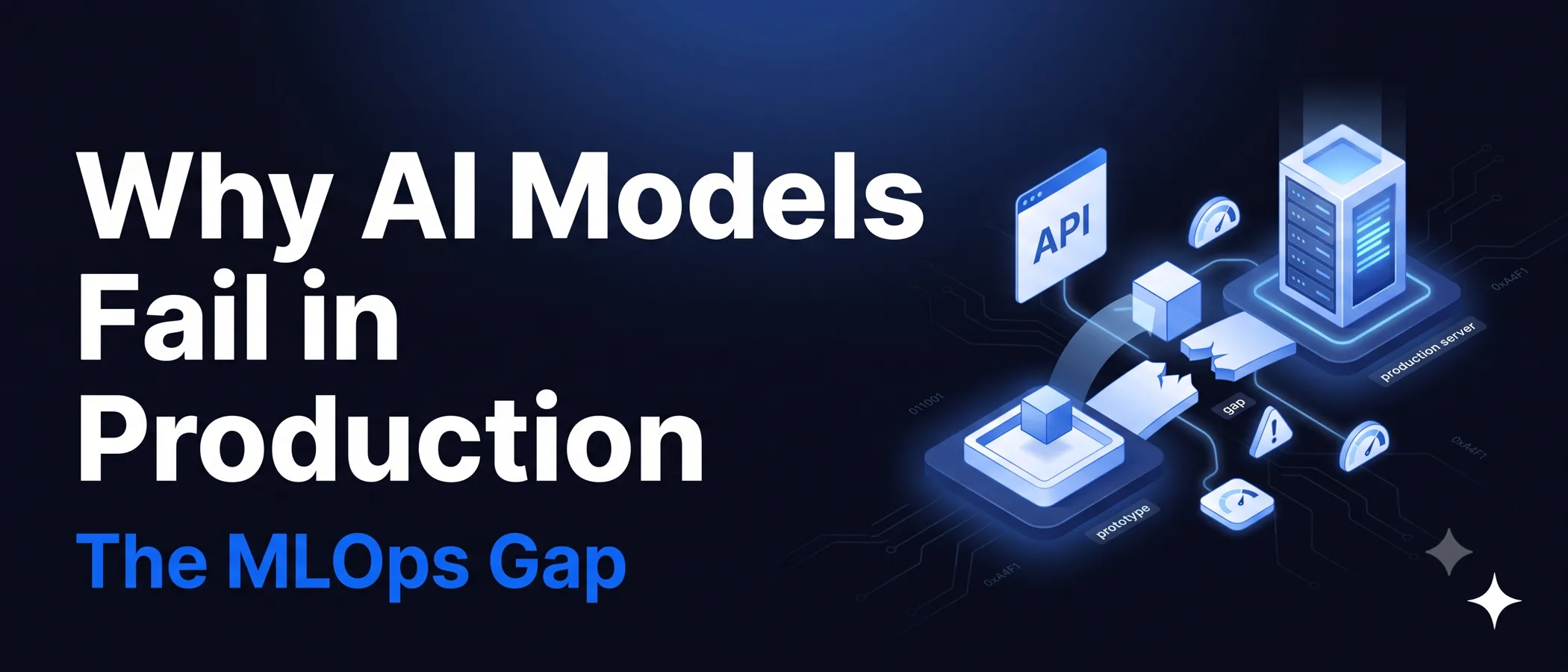
Read together, those numbers say the barrier is rarely the model. At scale, teams meet integration problems that never showed up in the pilot, plus brittle fallbacks and latency spikes that arrive without warning. Governance and unit economics that looked manageable at pilot volume degrade quickly without production gating, continuous runtime analysis and real observability.
Where This Roadmap Starts
We assume the pilot already did its job. You have identified a valuable workflow, established clear business ownership, secured usable data and validated a prototype against agreed success criteria, and you have enough evidence to justify further engineering investment.
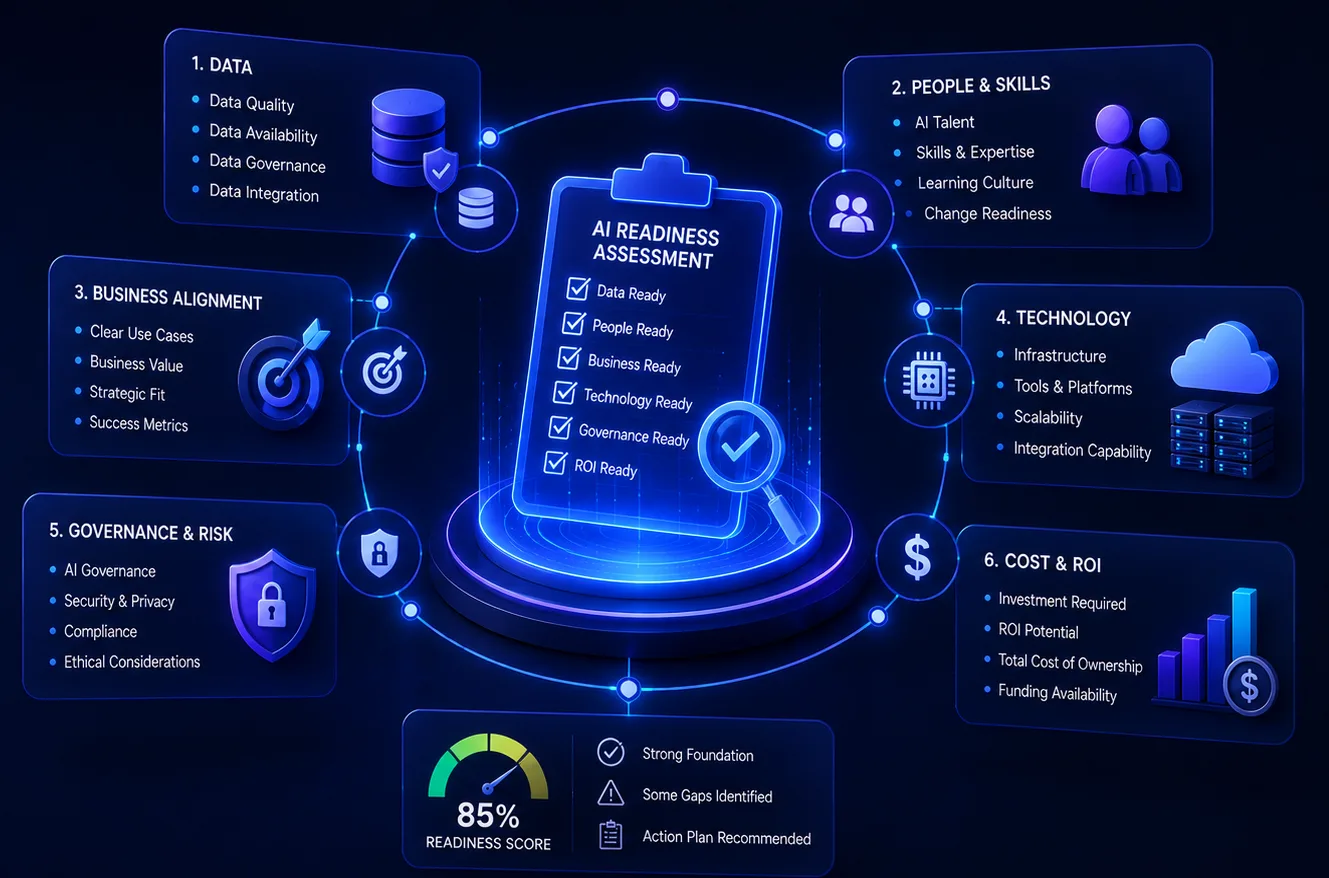
Whether AI is the right answer, how to rank use cases and how to judge initial data readiness are earlier decisions, and they belong in the AI readiness assessment you run before you build. If your pilot did not produce value in the first place, the honest next step is diagnosis rather than scaling, and our post on why AI projects miss ROI walks through it.
The roadmap picks up where the prototype stops. Its one question is how to re engineer a system that produces useful results in a controlled setting so that it survives the concurrency, edge cases and operational commitments of a live enterprise environment.
Gate 1, Turn Pilot Results Into Production Acceptance Criteria
The pilot produced baseline evidence, and that evidence is specific to pilot conditions. The job now is to turn it into measurable standards for deployment, moving from a subjective read (the output looks useful) to thresholds set against a representative sample of production data.
Average response times recorded during the pilot become latency targets and tail latency commitments. Aggregate accuracy gets decomposed so you can watch components and edge cases separately, because an average hides the failure mode that will page someone at two in the morning.
These criteria set go or no go thresholds at every stage of the rollout, across quality, latency, failure rate, escalation rate, availability, cost and workflow completion. A system can clear every pilot evaluation and still fail a production gate. Large documents push tail latency far beyond the median, so a design that looks quick on average can breach its latency budget on the slowest decile and need an asynchronous queue instead of a synchronous call.
A recent document parsing integration shows how this plays out. The pilot reached around 85 percent accuracy, which everyone was happy with, and then tail latency on very large PDFs ran past our 4 second production SLA. The accuracy number was never the problem. The fix was an asynchronous queue design in place of the synchronous call, and no amount of further model tuning would have surfaced it.
Aggregate accuracy also hides its own distribution. In our document intelligence work extraction accuracy runs around 85 percent tuned per corpus, which is strong enough to build a product on and not strong enough to remove the confidence scoring and audit trail that sit around it. A pilot number that looks healthy in aggregate still needs a field level view before you adopt it as a production threshold.
Production acceptance scorecard, sanitized from a live engagement. Where the pilot produced a baseline, the production threshold is stricter than it, because a pilot that only just clears its own bar has no headroom for real traffic.
| Gate | Production threshold | Pilot baseline |
|---|---|---|
| Quality metric | RAG retrieval relevance above 0.85 | 0.80 |
| Latency SLA | P95 response under 1200ms | around 1500ms |
| Failure threshold | Fewer than 1 unhandled exception per 10,000 requests | not measured at pilot volume |
| Escalation rate | Under 5 percent requiring human in the loop | not measured at pilot volume |
| Target economics | 0.02 dollars per successful task completion | not modelled at pilot volume |
The three rows with no pilot baseline are the ones that catch teams out. They are invisible at pilot volume by definition, which is why they have to be written down as thresholds before the rollout begins.
Gate 2, Re Engineer the Pilot for Production Reliability
Harden the Architecture Around the Model
Pilot architecture exists to prove something quickly, while production architecture has to behave predictably. Taking a build into production means tightening service boundaries and enforcing authentication and authorization properly. Direct database queries get replaced with secure API contracts, and production data access controls go in. Where the workload allows it, add queues for asynchronous processing, set rate limits tight enough to stop an expensive runaway, and put a provider abstraction layer between the application and the model vendor.
State management and transactional consistency become critical the moment an AI system starts taking actions inside your wider application estate. These components exist specifically to absorb the non deterministic nature of large language model output.
Design the Failure Path, Not Just the Successful Path
A production AI architecture is defined by what happens when the model does not behave. You need deterministic fallbacks, short timeouts, retries with exponential backoff and jitter, and graceful handling of a model or provider outage. Plain exponential backoff falls short on its own, because synchronized clients retry in waves and hammer a recovering service. AWS documents jitter as the fix, and the same reasoning applies to a rate limited model endpoint.
If the model returns invalid JSON or hallucinates a tool result, the system has to degrade to a safe state or take a recovery step instead of failing the request. Structured output modes from the major providers reduce malformed responses but do not eliminate them, so schema validation belongs on your side of the boundary regardless.
Engineering decision record, redacted context. When we integrated Claude into a core microservice, we expected two failure modes in production, rate limit errors and the occasional malformed tool call schema. If either occurs, the fallback route sends the user request to a smaller locally hosted model that returns a lower fidelity but immediate answer, and flags the payload for asynchronous human review. The user still gets an answer, and the quality difference goes on record.
Confidence thresholds are the other half of this pattern. In the WhatsApp voice to order system described below, an interpretation whose confidence falls under the threshold triggers a clarification request and never goes downstream as a malformed payload. Asking for clarification is a far cheaper failure than a wrong order landing in the ERP.
Architecture flow
User request
  >> application layer
  >> orchestration and rate limiting
  >> AI provider and tools
  >> runtime evals
  >> on failure, deterministic fallback or human escalation
  >> enterprise systems
Gate 3, Build Runtime Evals, Observability and Rollback
Move From Pilot Evaluation to Continuous Production Evals
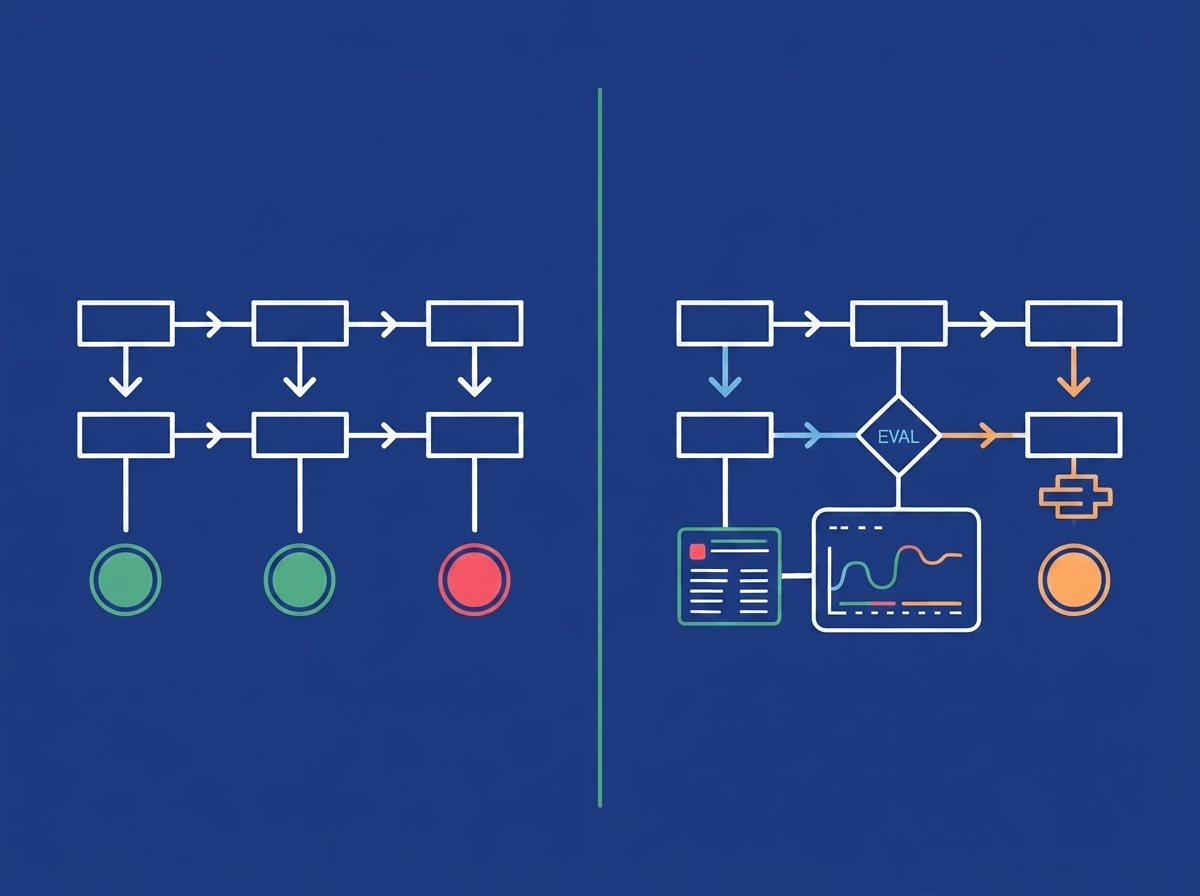
A pilot can be validated against fixed datasets, but a production system needs continuous evaluation at runtime. That calls for offline regression suites plus production sampling, with live output scored by a mix of model graded judgement for semantic quality and deterministic assertions for structure and format.
Evaluation sets have to be segmented, and production exceptions should feed straight back into the golden datasets so edge case coverage grows over time. With that feedback loop in place, you notice a quality regression in hours rather than quarters, and you can compare model versions and prompt iterations against a growing library of real failures.
Validate the Judge Before You Trust the Judge
Most teams reach for an LLM as a judge and then treat its score as ground truth, and that step is where production evaluation quietly breaks. The largest systematic study to date covered 21 judge models from nine providers across roughly 541,000 individual judgments and found reliability and validity are not the same thing. A judge can be highly consistent and still consistently wrong (Reliability without Validity, arXiv 2026).
That makes aggregate judge accuracy the wrong number to watch. Judge failures cluster on the borderline outputs your system produces, and those are the cases where you need the judge to be right. Before a judge gates anything, sample a few hundred representative cases, collect expert annotation, measure agreement between judge and human, and iterate the judge prompt until correlation is strong enough to rely on. Then re test on a schedule, because both models and data drift underneath you.
Where a deterministic check exists, use it instead. Schema validity, numeric tolerance, required field presence and citation grounding are all cheaper and more trustworthy than asking a model for an opinion.
Make AI Behavior Observable
Observability for AI systems goes well past CPU and memory. Teams need request traces tied to a specific model version and prompt version, retrieval and tool call records, latency and failure causes, and token and inference usage per transaction. Evaluation scores, escalation rates and end user feedback belong in the same view. We go through the instrumentation behind that view in AI observability for production LLM applications.
Make Changes Reversible
A prompt edit can regress behavior as badly as a model upgrade. Put every AI asset under version control so releases stay controlled and canary deployments become possible. Google SRE practice is to roll out slowly and monitor a canary before full exposure, and an AI release deserves the same discipline with an extra signal, the eval score, sitting beside latency and error rate.
Deployment trace, redacted
deploying prompt_v4.2  (canary at 10 percent of traffic)
monitoring P95 latency and eval score
alert: eval score degraded by 12 percent against the golden dataset
executing automatic rollback to prompt_v4.1
Latency in that trace was fine and no errors were raised. Without an eval score wired into the release gate, that regression ships and nobody notices until a user complains.
Gate 4, Prove the Unit Economics Before Multiplying Usage
A pilot is cheap partly because it is small, and an enterprise rollout changes the arithmetic. The number to track is cost per successfully completed business task. Model or token cost is only one input to it. True unit economics include inference, retrieval and vector infrastructure, tool API calls, retries, orchestration overhead, observability storage, human review time and ongoing operational support.
Retries and escalations push this number up. A workflow with a 5 percent retry rate and a 3 percent escalation rate runs above 108 percent of nominal cost, because retries carry full inference cost and escalations carry human cost, which is usually the most expensive line in the table. Put the failure paths into the cost model alongside the happy path.
The levers that work are model routing (sending simpler requests to smaller and cheaper models), prompt caching where the workload repeats, trimming context windows that carry passengers, and moving to asynchronous processing wherever latency tolerance allows. Before you increase usage, model those levers across three scenarios, which are current pilot volume, ten times that volume and projected enterprise volume.
| Cost component | Pilot assumption | Production variable | Optimization lever |
|---|---|---|---|
| Model inference | Low volume, flat rate | Token volume and concurrency | Model routing and semantic caching |
| Vector and retrieval | Often negligible | Index size and query frequency | Hybrid search tuning |
| Tool and API calls | Rarely measured | Retry rate and fan out | Idempotency and call budgets |
| Human review | Often 100 percent manual | Escalation rate | Confidence based routing |
| Observability | Not in scope | Trace volume and retention | Sampling and tiered retention |
Choosing which model handles which request is its own decision with its own tradeoffs, which we work through in how to choose an AI model for production.
Gate 5, Scale One Dimension at a Time
Enterprise scaling is controlled growth along several dimensions, namely number of users, transaction volume, data sources, workflow types, geographic coverage, external integrations, decision authority and agent autonomy. Move several at once and root cause analysis becomes guesswork when something breaks. At every step, compare quality, latency, error rates, unit economics, escalation rates and incident frequency against your baseline.
Treat Autonomy as a Scaling Variable
For agentic systems, autonomy is the dimension that matters most. A high volume of successful runs is no evidence of judgement, so do not hand an AI more authority on that basis. Separate autonomy into five degrees.
- The AI generates information
- The AI recommends an action
- The AI prepares an action for human approval
- The AI executes reversible actions
- The AI executes consequential actions
Each step up needs stronger evidence than the one before, along with tighter auditability and more precise runtime controls. Every move up a level should trigger a scheduled governance review, so autonomy never grows quietly inside a sprint. The same logic holds at organizational scale, which we cover in governing AI agents at enterprise scale, and the approval mechanics sit in enterprise AI guardrails and human approval flows.
| Rollout stage | Scope | Evidence required | Main risk | Expansion decision |
|---|---|---|---|---|
| Pilot | Internal test group | Output accuracy | Unrepresentative data | Move to limited production |
| Limited production | Small share of user traffic | Tail latency and error rate | Edge case failures | Expand or hold |
| Expanded production | Around half of traffic | Unit economics stability | Rate limits and cost | Full deployment |
| Full production | All users and regions | Incident frequency | System degradation | Authorize more autonomy |
Gate 6, Establish Production Ownership and Change Control
Once an AI workflow becomes operationally critical, the biggest risk is that nobody owns it. Assign explicit ownership for changes to models, prompts, application logic and evaluation sets. Be clear about who handles incidents, who reviews user feedback, who tracks cost and who approves an increase in agent autonomy.
Ownership is what turns a fragile AI feature into a dependable enterprise service, and in practice it means production runbooks, a named incident response owner, formal approval for releases and changes, and a review after every incident. If your provider deprecates the underlying model, the migration plan should exist before the deprecation window opens.
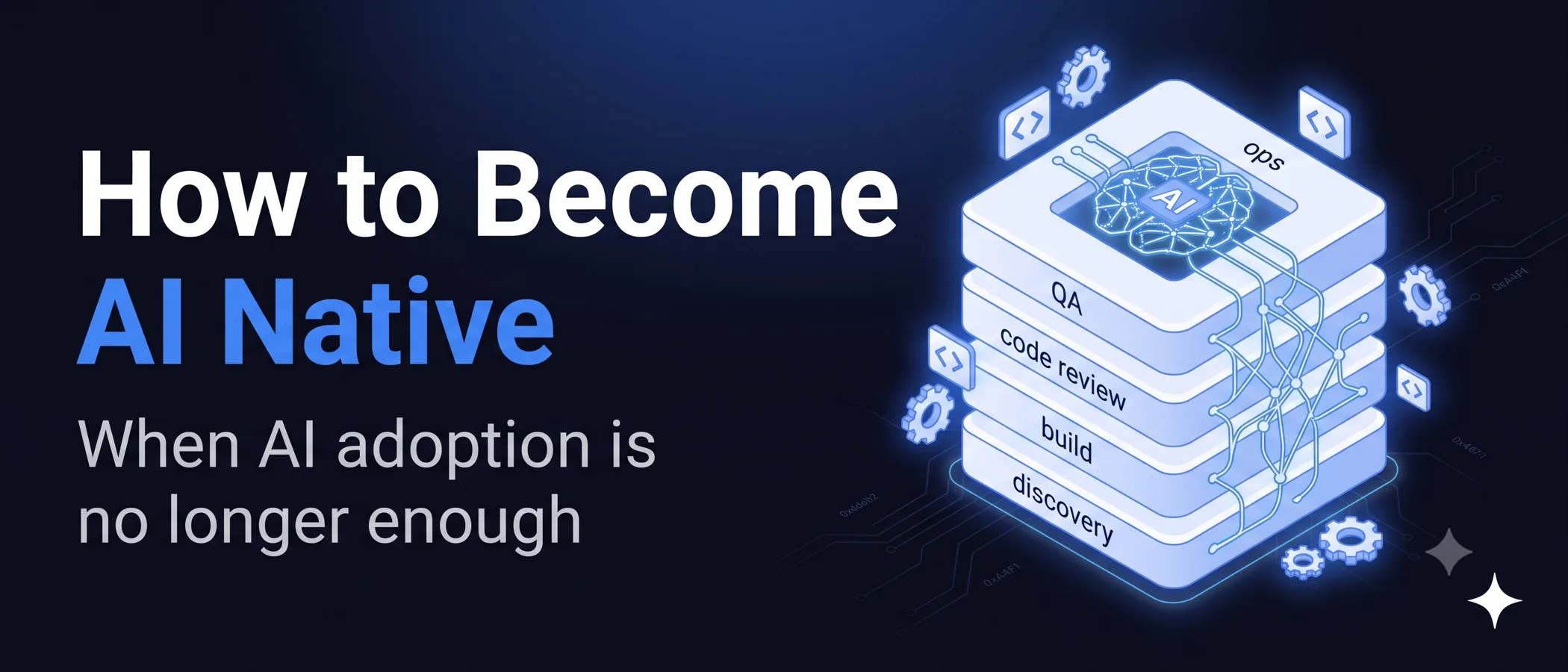
Scaling one production system needs clear operational ownership. Redesigning how an entire organization works around AI is a different and larger problem, and it gets its own treatment in how to become AI native.
How to Decide Whether to Expand, Hold or Roll Back
The six gates feed a decision matrix, which keeps expansion from coming down to a gut call. Engineering leaders should be reading five pillars continuously. For quality, check that production evals sit inside threshold. For reliability, check that failures are recoverable and understood. Economics asks whether cost per successful task still works, operations asks whether monitoring and incident ownership are functioning, and risk asks whether the current level of autonomy is safe to support.
| Decision | Evidence |
|---|---|
| Expand | Quality, reliability, economics and operational control all sit inside agreed boundaries |
| Hold | The value is real but one production constraint needs correcting first |
| Roll back | Quality, cost, reliability or risk has moved materially outside what was accepted |
Once the system is running, the question changes from whether to expand to whether it is working. That is a measurement problem, and the subject of our companion guide on AI KPIs and how to build an AI performance dashboard.
What Post Pilot Scaling Looks Like in Practice
We built a WhatsApp voice to order system for B2B logistics that handles both text and voice orders in English and Hindi, using a multimodal and natural language pipeline wired into the customer backend. Through the pilot the core sequence ran cleanly, from voice order to multimodal processing, through interpretation to structured output and backend integration.
Scaling exposed input variability immediately. Multilingual edge cases, background noise in voice notes that obscured critical logistics terms, and backend API rate limits all showed up in the first weeks of wider use. None of them appeared in the pilot, which sampled a friendlier slice of reality. The same holds well beyond that project, because pilot traffic is self selected and production traffic is not.
Most of the hardening went into exception paths. When interpretation confidence falls below a threshold, the system triggers a clarification request, so no malformed payload reaches the backend. We added continuous evaluation coverage for audio transcription, and unmatched inventory items got an operational handling route so they no longer fail silently. Before expanding the system we had to show that our monitoring could detect these specific failure modes, and that proof is the real gate on any rollout. The architecture that sits under this kind of workload is covered in voice AI agents in production.
Frequently Asked Questions
How do you move an AI pilot to production without rebuilding it from scratch?
Separate what is reusable from what needs hardening. The core prompt, model selection and initial context design usually survive. What gets rebuilt is architecture, security boundaries, continuous evals, observability, fallback handling, deployment pipelines and integration resilience.
What usually breaks when scaling AI in the enterprise?
The usual culprits are shifts in real user input distribution, database concurrency issues, downstream API failures, unexpected tail latency, non linear cost growth, brittle retrieval or tool use, thin monitoring, and untested edge cases that fail silently without raising an error. These production specific failure modes appear fast once wider use begins.
What should be monitored after production AI deployment?
Track eval scores, latency percentiles, error classes, model and prompt version history, retrieval and tool behavior, token and inference cost, human escalation rates, user feedback, and completion of the underlying business task. Uptime is part of the picture, but on its own it is not enough.
Can you use an LLM to evaluate another LLM in production?
Yes, but only after you validate it. Large scale evaluation of judge models shows consistency and correctness are different properties, and judges fail most often on borderline cases. Validate against human annotation on a few hundred representative samples, measure agreement, and prefer deterministic checks wherever one exists.
When should a team increase the autonomy of an AI system?
Increase autonomy only when production evidence supports it, and treat neither the calendar nor user count as a trigger. Tie the decision to demonstrated production reliability, an honest assessment of what an error costs, the reversibility of the action, strict auditability and a working human escalation path.
When should an enterprise pause or roll back a scaling AI initiative?
Pause or roll back the moment quality, economics, reliability, security or operational control moves outside the defined acceptance thresholds. Fix the specific constraint before exposing more traffic. A well designed production system treats recalibration as a normal event.