










Built an AI relationship health platform that turns 200+ peer-reviewed studies into a personalised diagnostic, action plan and matched professional support
A consumer platform built around a 7-minute assessment that maps a relationship across seven dimensions, identifies the bottleneck constraining everything else, prescribes the highest-impact next action and matches couples with vetted professional support when they want it. It is grounded in relationship science and engineered with AI to scale personalisation.
Key Takeaways
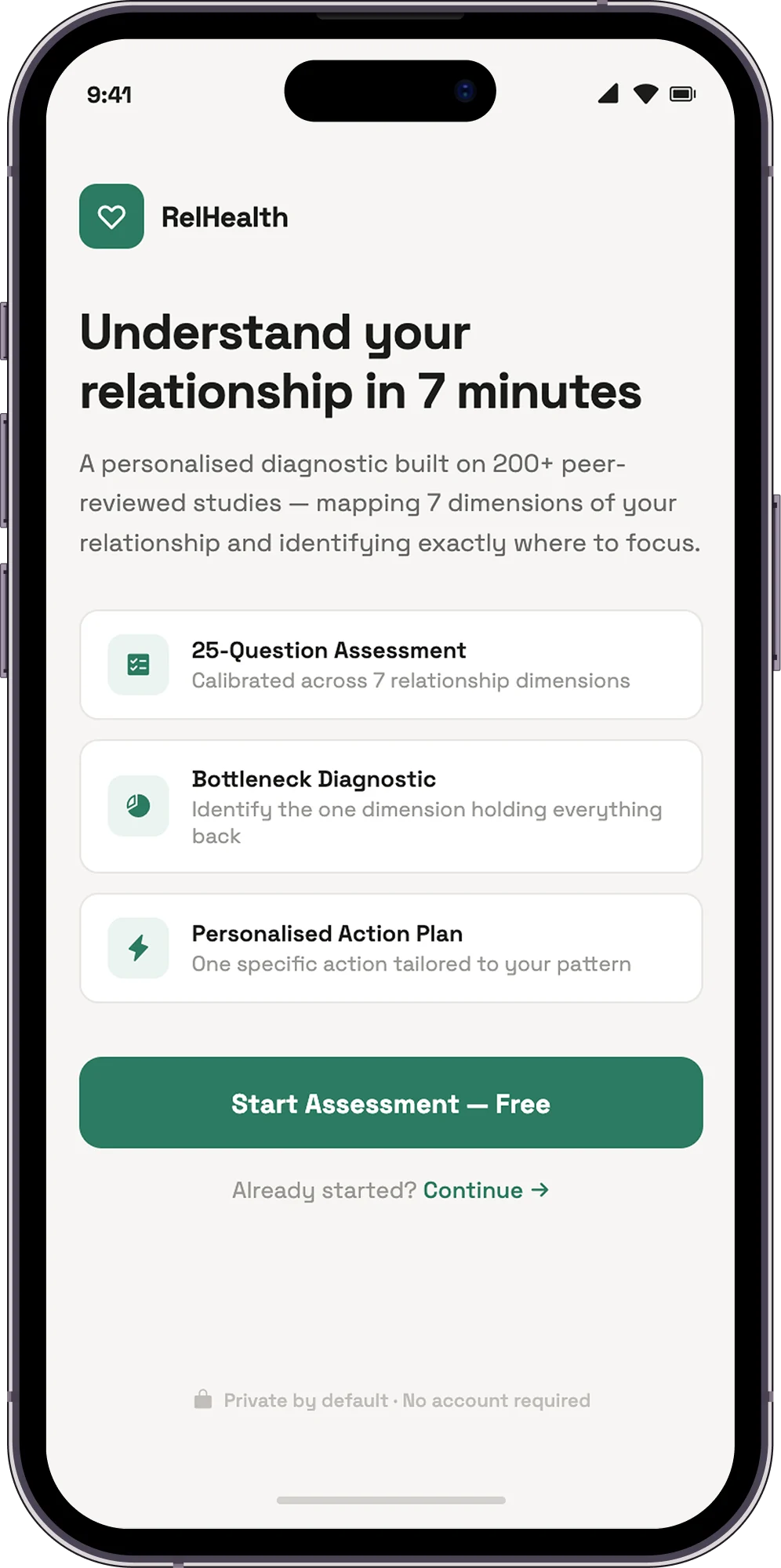
A US-based relationship technology product came to Unico Connect to build the platform that turns clinical relationship science into a personalised consumer experience. We delivered an AI-powered platform centred on a 7-minute assessment that maps relationships across seven dimensions, identifies the structural bottleneck that constrains the relationship, prescribes the highest-impact action and matches couples with vetted professional support through a curated network.
The platform is grounded in 200+ peer-reviewed studies and engineered to operate at scale while staying research-grounded and credible to the relationship science community it serves.

The Challenge
Relationships are the largest source of life satisfaction, or distress, for most adults, and yet the tooling people have to actually improve them has not kept pace with what is available for other dimensions of life. Physical health has wearables, biomarkers and regular check-ins. Mental health has digital therapy, mood tracking and structured assessments. Relationships have books, podcasts, weekend workshops and the occasional couples therapy session that begins from scratch each time. The gap between what relationship science actually knows (substantial evidence from Gottman, attachment theory, the Vulnerability-Stress-Adaptation model and the 200+ peer-reviewed studies the field rests on) and what consumers can access is structural.
The client came to Unico Connect with a clear thesis. The science exists. The frameworks exist. What is missing is the platform that turns this body of knowledge into a personalised, action-oriented diagnostic that consumers can actually use. Not another quiz that returns a personality type. Not another book of generic advice. A research-grounded diagnostic that identifies what is actually happening in a specific relationship, names the one thing that would unlock progress and prescribes the action that would actually move the needle.
The challenge with this kind of product is that it has to do several things together for the proposition to land. The assessment has to be short enough that people actually complete it (the 7-minute target was deliberate), but it has to capture enough signal across enough dimensions to produce a credible diagnostic. The framework has to be grounded in actual relationship science rather than pop psychology. The diagnostic has to identify a bottleneck rather than a generic profile, because relationships are systems and the unlock comes from addressing the constraining dimension. The action has to be specific to the user situation rather than canned advice. And the platform has to know when to recommend professional support and match the user with someone credible rather than leaving them on their own when they need more than a self-guided action.
The user base the client serves spans the relationship spectrum, from couples in genuine distress to couples who are fine but could be better. Different stages need different tooling. Couples in crisis need different guidance than couples in a maintenance pattern who could be deeper. The platform had to identify where each couple sits and adapt the experience accordingly, rather than offering the same prescription to everyone.
The trust requirements were significant. Relationships are intimate and the data the platform captures is sensitive. The platform had to handle this with the privacy posture consumers expect on personal data, with explicit controls around who sees what and explicit boundaries on how the data is used.
The opportunity was equally clear. The science exists and the frameworks exist; the platform that operationalises them at consumer scale did not. The gap between what the field knows and what couples can access is the gap this product was built to close, turning an accumulated body of relationship science into an experience that actually produces change rather than another generic advice channel.
Our Approach

We engaged with the client as a product partner on the platform build, with the work structured around the clinical framework, the AI personalisation that scales it and the operational mechanics that make the platform credible to the consumers it serves. The clinical framework came from the client relationship science work and the body of peer-reviewed research it draws on; our job was to translate it into the product architecture that could deliver the diagnostic at scale, implementing each piece faithfully to the framework rather than approximating it.
Key decisions:
Framework implemented faithfully, not approximated
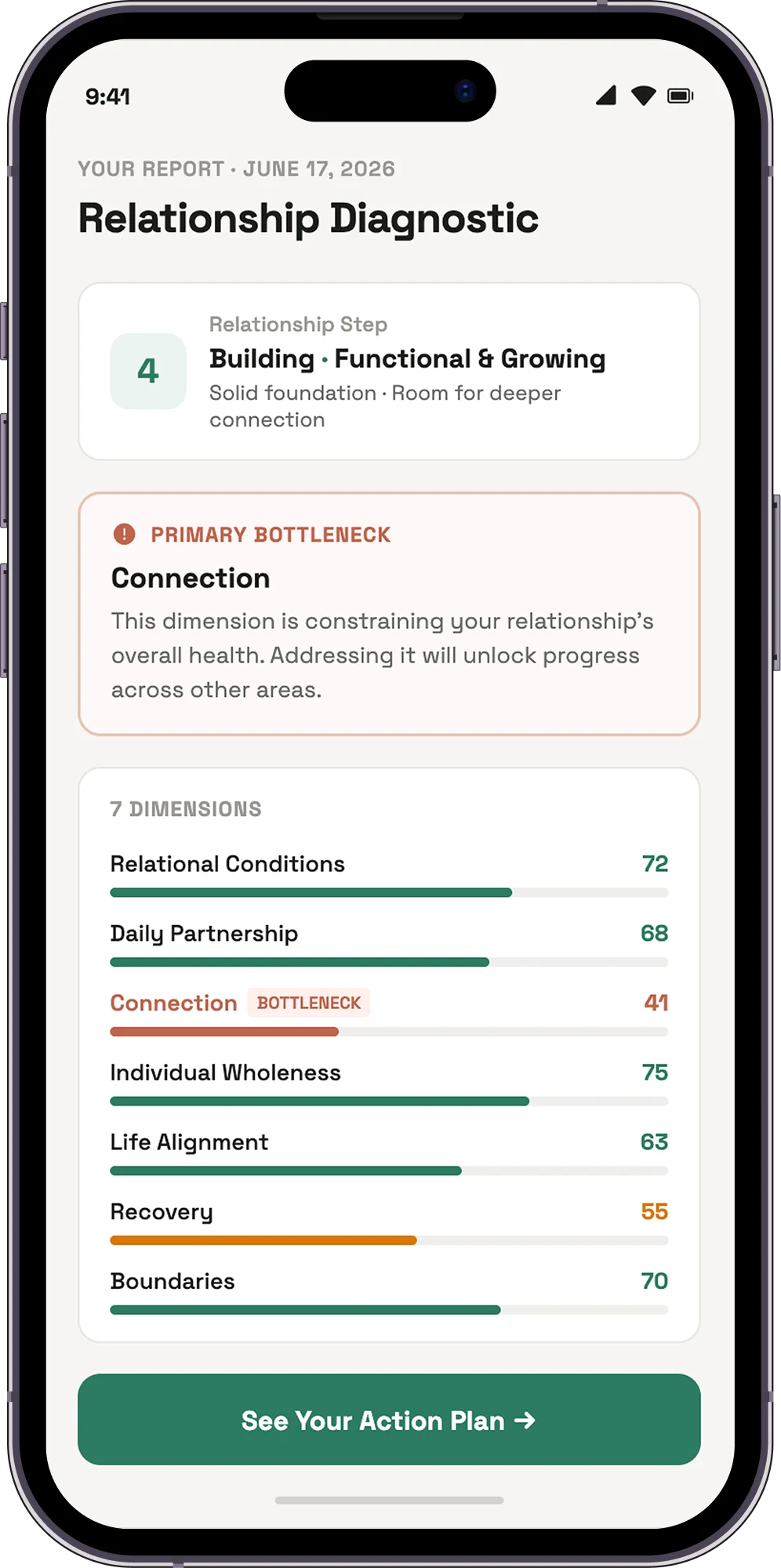
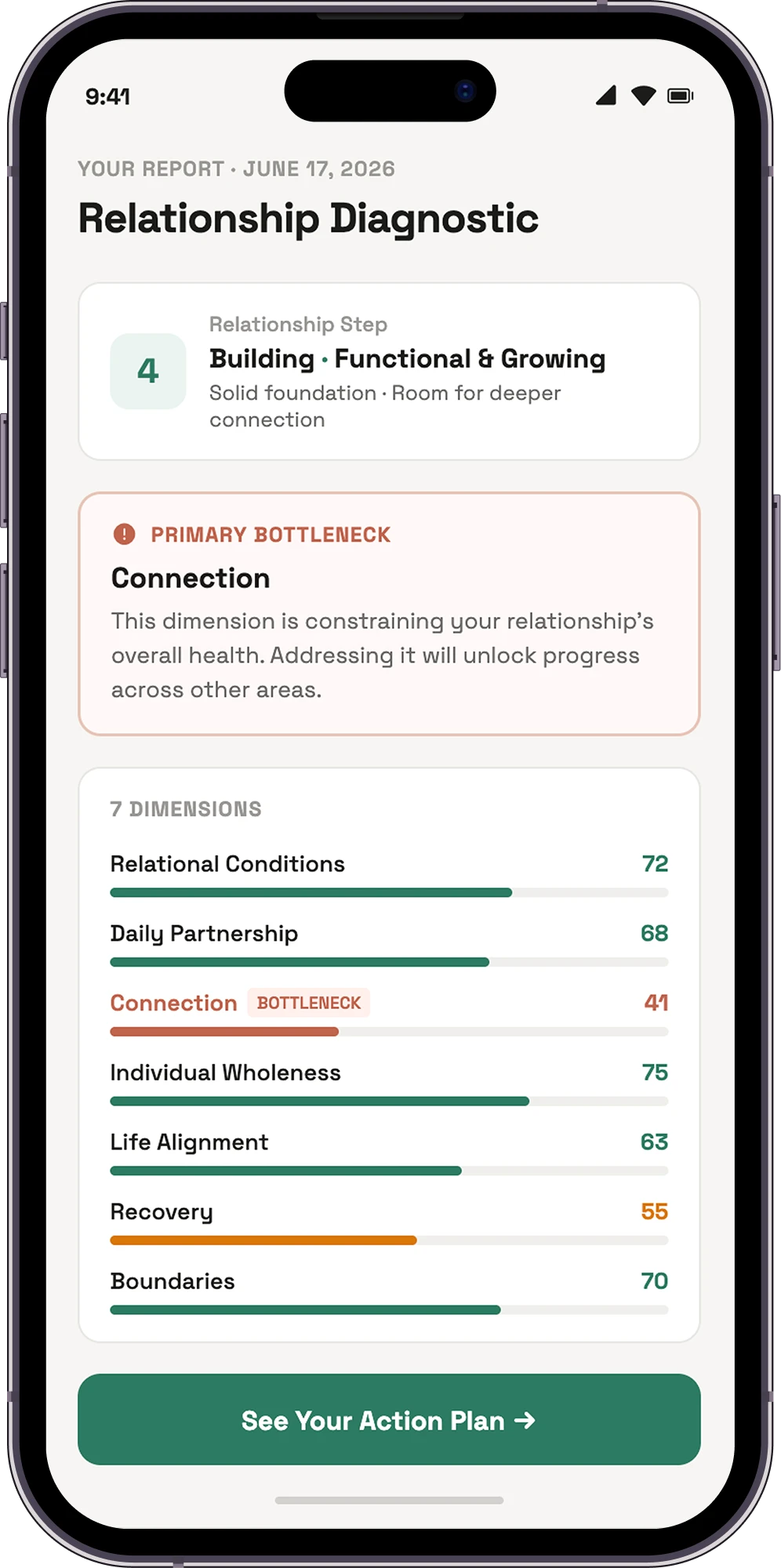
The 7-dimension model (relational conditions, daily partnership, connection, individual wholeness, life alignment, recovery and boundaries) became the data structure. The 7 Relationship Steps, from crisis to thriving, became the staging logic. The 5 action types (gain insight, build skills, reduce debt, create structures, manage resources) became the categories of intervention. Each piece was implemented to the framework rather than approximated.
Calibrated questions, not a generic quiz
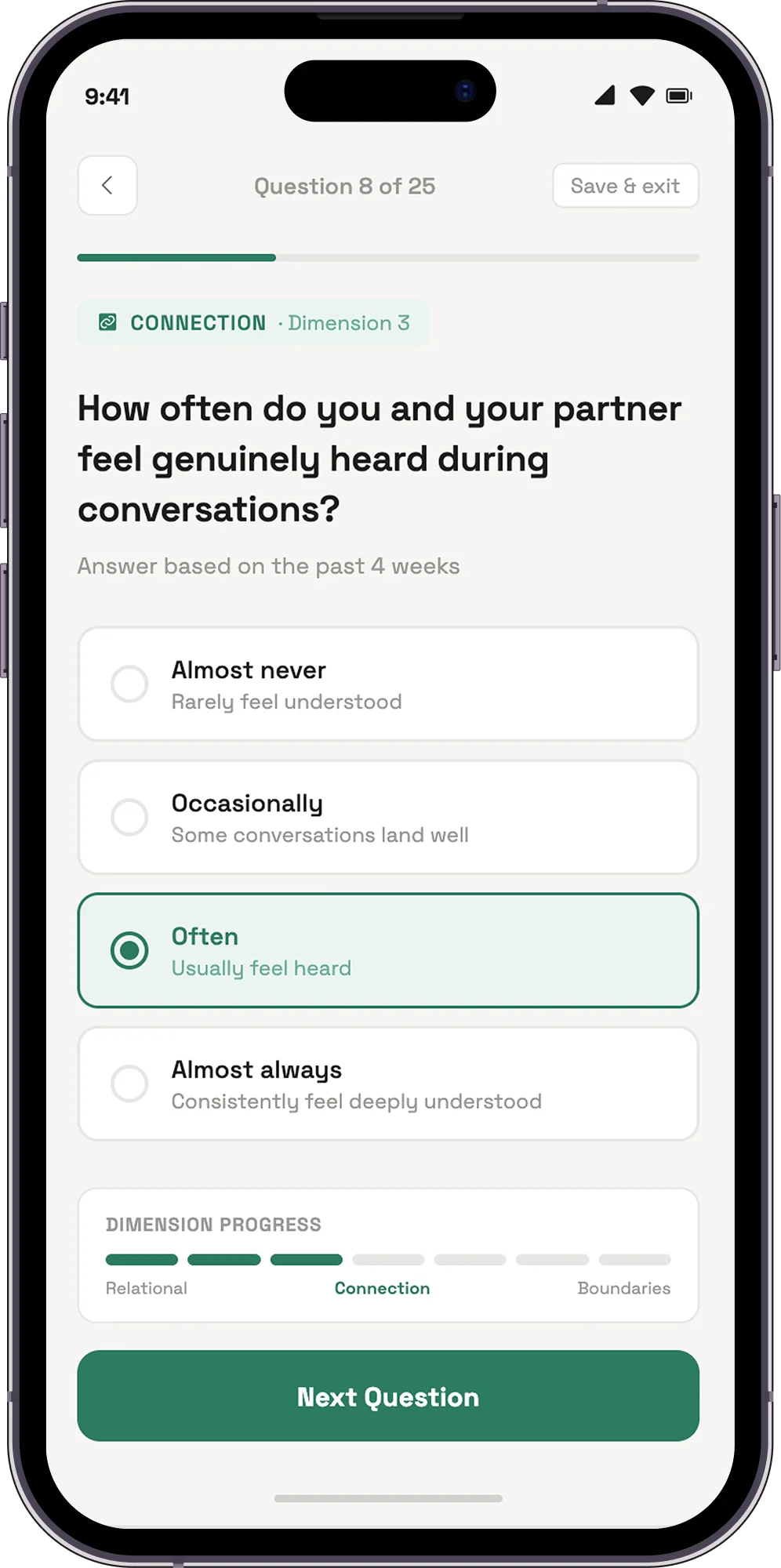
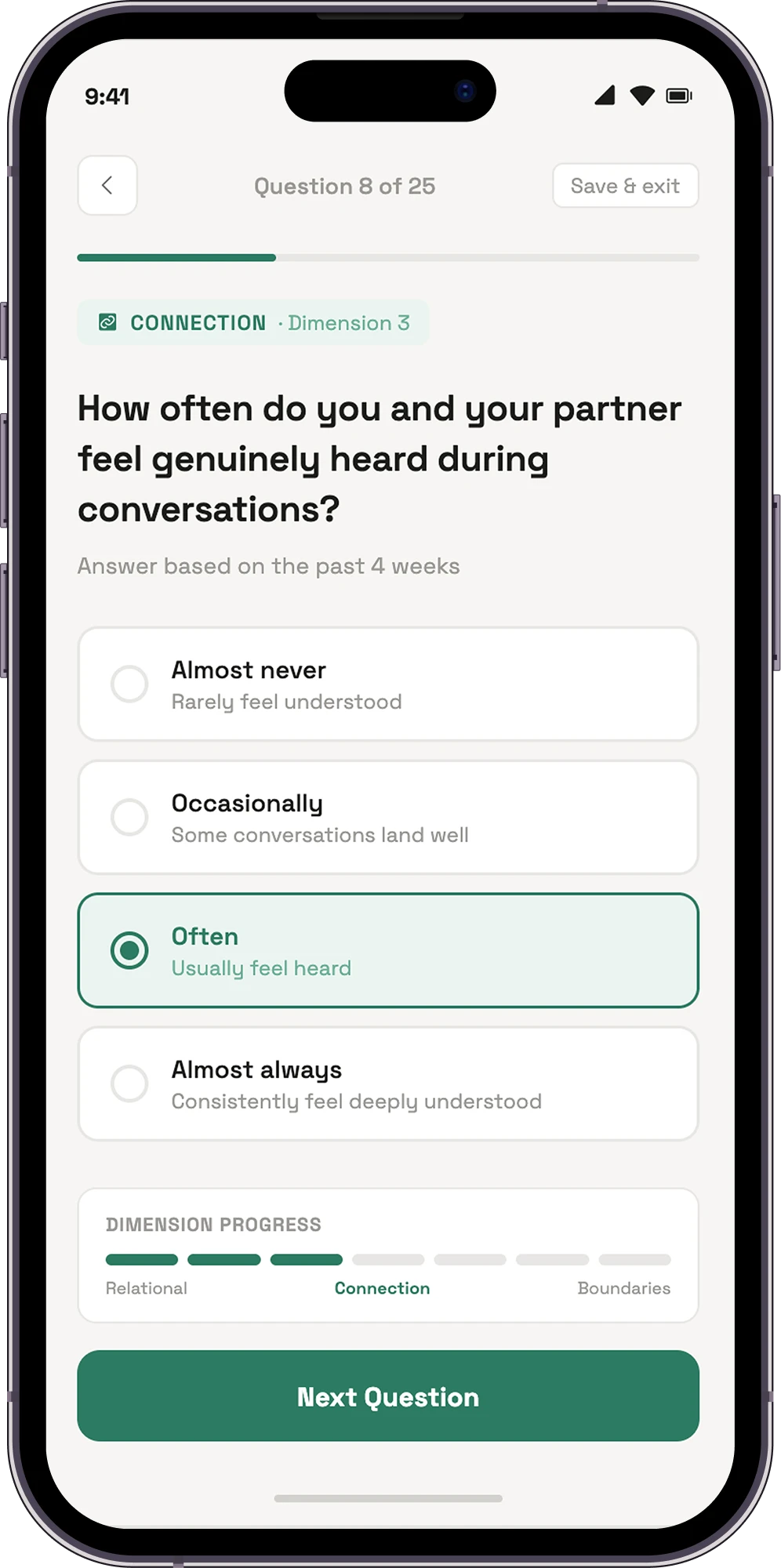
Twenty-five calibrated questions across the seven dimensions, delivered in a flow that takes seven minutes, produce enough signal for the diagnostic to be credible. The questions are not surveying preferences; they probe the specific signal patterns the framework cares about. We worked with the client science team on the calibration so the assessment captures what the framework needs.
AI on the full pattern, validated against the framework
Two couples with the same overall score but different patterns across the seven dimensions get different bottleneck identifications and different prescribed actions, because the AI operates on the full pattern rather than the headline score. The action prescription is grounded in the user bottleneck, relationship step, pattern and the action type the AI determines will have the highest impact. This is what distinguishes a clinical diagnostic from a personality quiz.
The solution we built
The platform consists of the assessment experience, the diagnostic engine, the action prescription system, the follow-through and adaptation layer, and the matched professional support network, all running on an architecture designed for the research-grounded credibility and the consumer trust the product requires.
The 7-minute assessment
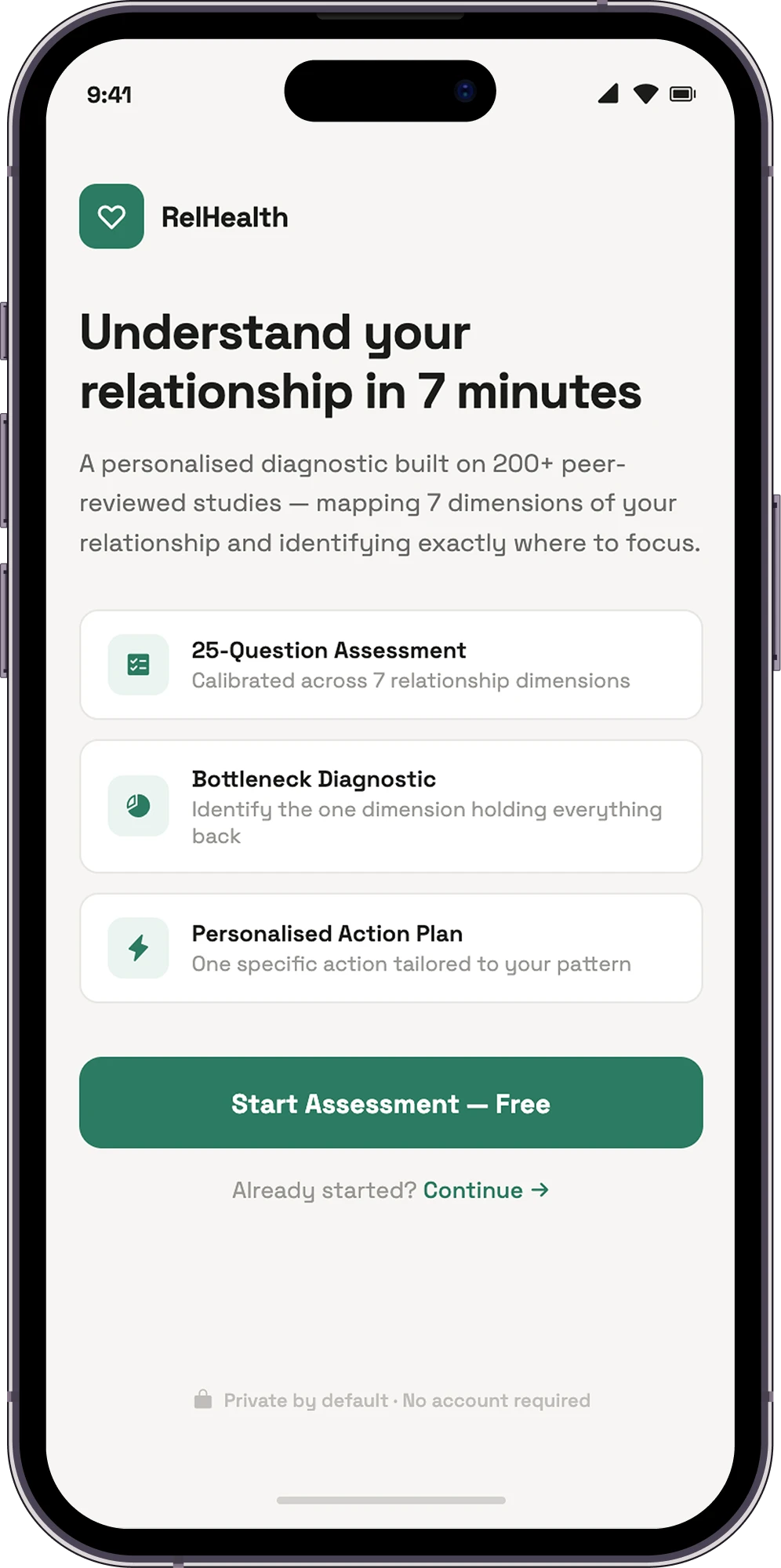
Users complete a 7-minute, 25-question assessment that maps their relationship across seven dimensions. The questions feel approachable rather than clinical, with the signal capture happening through calibration rather than clinical language. The assessment supports a solo path (one partner) and a bilateral path (both partners, combined into a paired report).
The diagnostic engine
Processes the responses and produces the structured output: a score across each of the seven dimensions, the bottleneck identification (the one dimension constraining everything else), the relationship step (1 through 7, from crisis to thriving) and the pattern analysis that informs the recommended action type. The output is presented in a report accessible to a consumer reader but grounded in the framework underneath.
The action prescription system
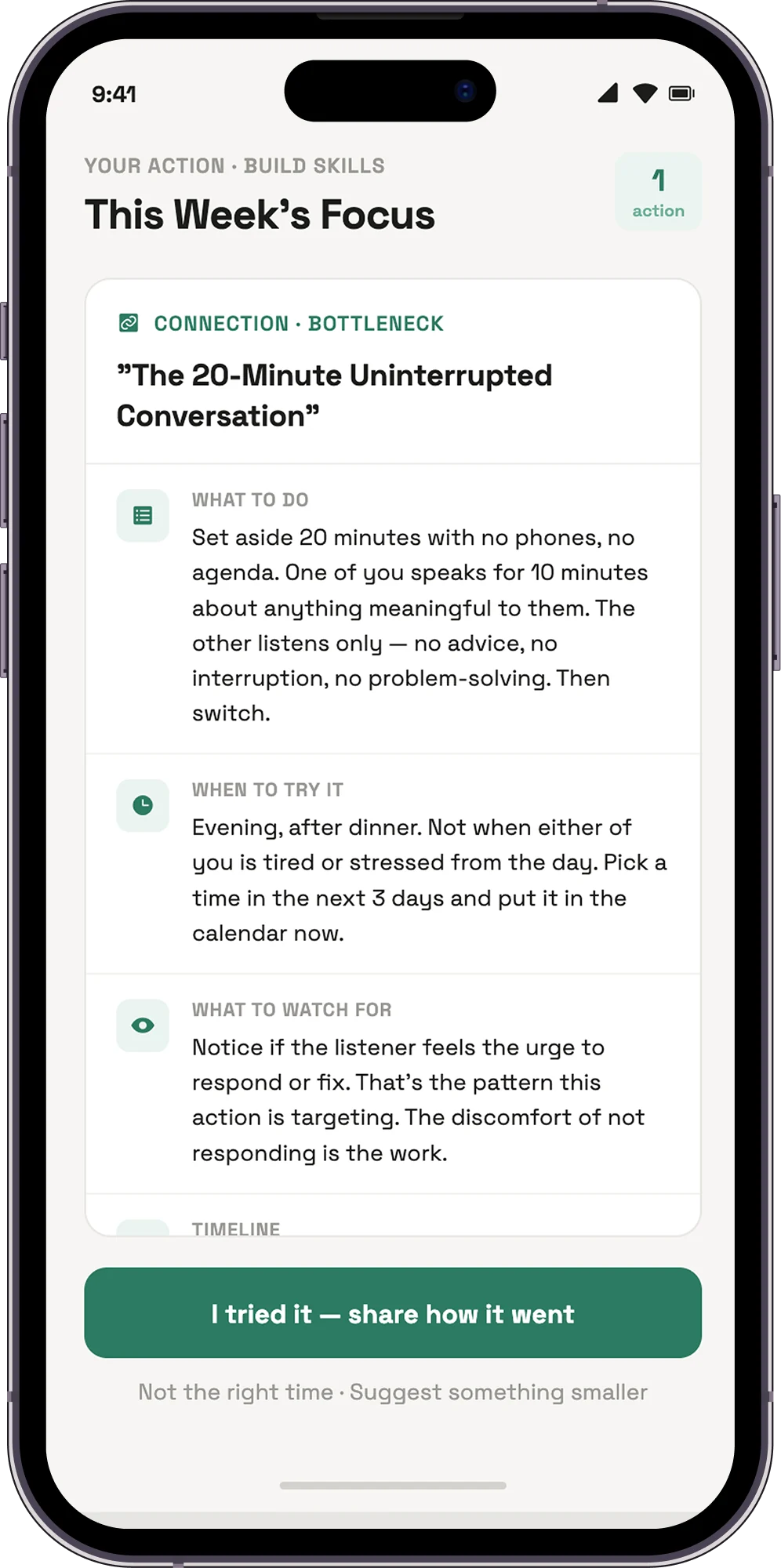
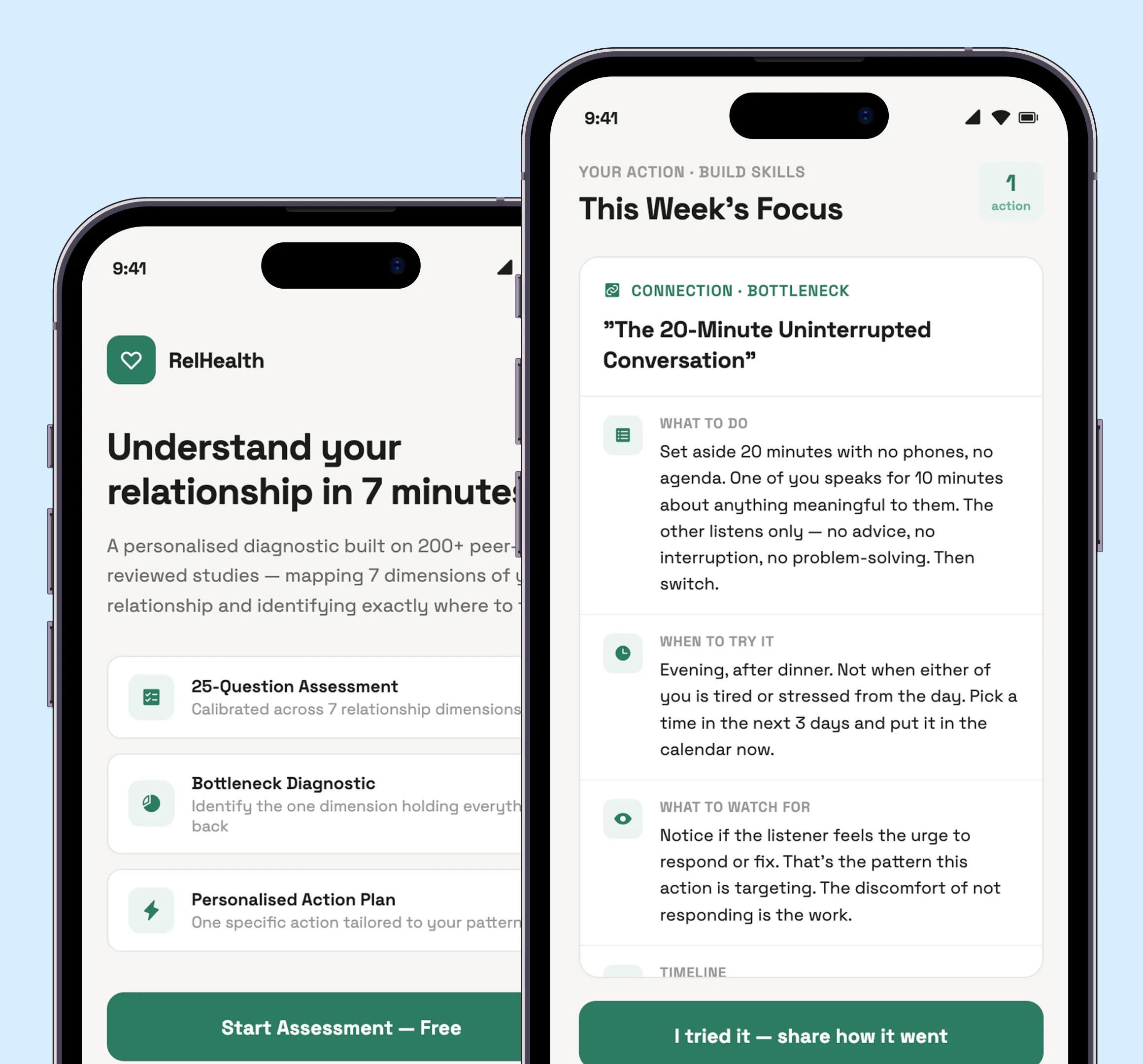
Surfaces one concrete action based on the user specific patterns, determined by their bottleneck, step and pattern rather than picked from a generic list. The prescription includes what to do, when to try it, what to watch for and how long it takes, so the user gets one specific action rather than a list of suggestions.
Follow-through and adaptation
After the user tries the action, the platform follows up with a structured reflection that captures what happened, and adapts the next action based on what the user reported. It surfaces support when they get stuck and understands when an action is not working, suggesting a different approach, a smaller step, or the exact words to use, depending on the failure mode.
Matched professional support
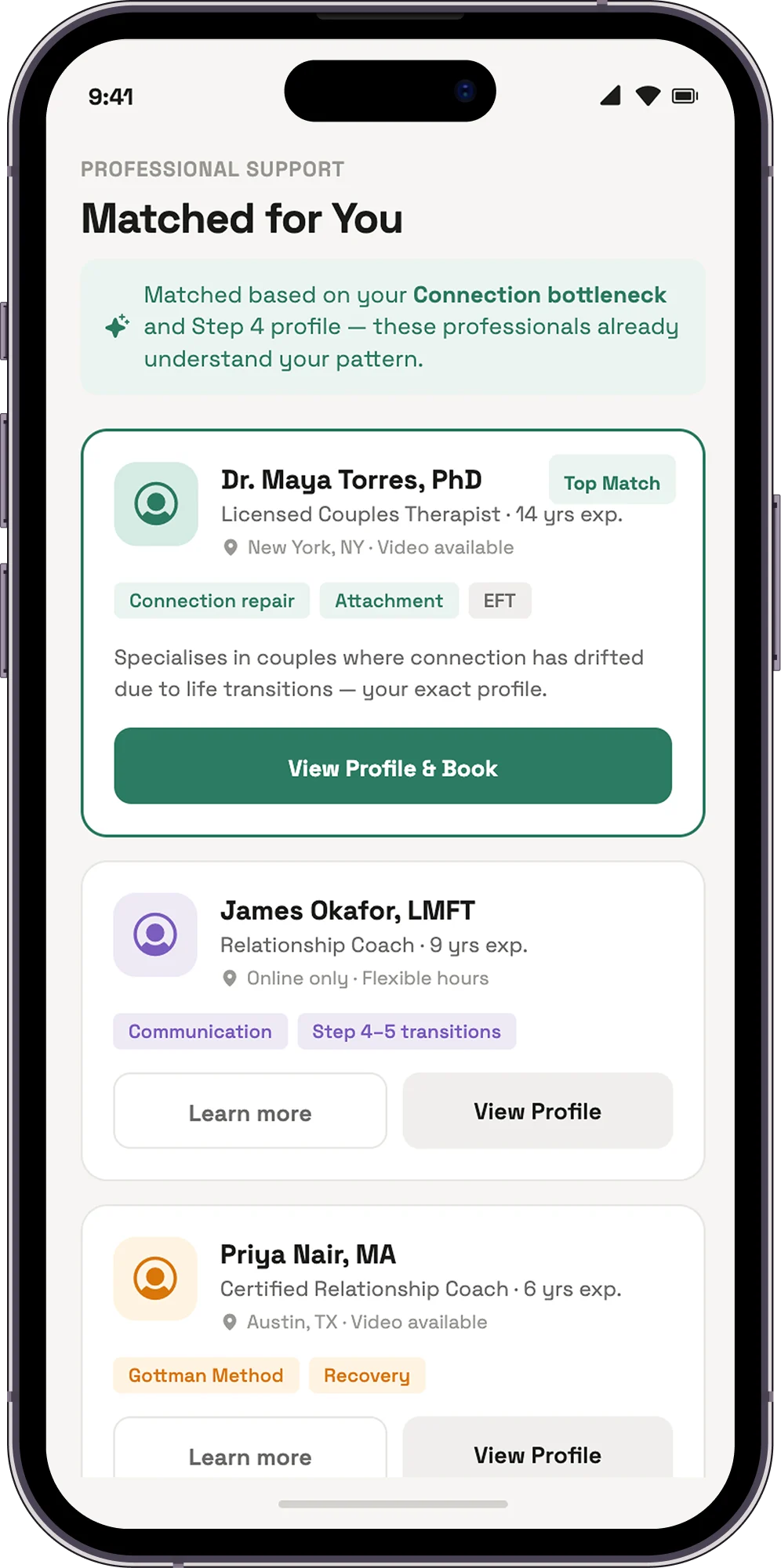
Connects users to vetted coaches, therapists and programs when they need more than self-guided action. The matching is informed by the user diagnostic, so the professional understands the user bottleneck, step and pattern before the first conversation. Users are not required to work with a recommended professional; the choice is theirs.
Privacy and trust posture
Built in from the start. Users do not need an account to take the free assessment. Partner data is private (one partner cannot see the other individual responses without consent). Data is encrypted in transit and at rest, not sold and not used to train models without explicit consent. The positioning is clear: the platform is guidance and technology, not therapy or healthcare, and users in genuine crisis are directed to professional support.
Outcomes & Impact
Live in market
In production use in the US market
Consumers are taking the assessment, receiving their diagnostics and acting on the prescribed actions, validating that the accumulated body of relationship science can be turned into an experience that produces change rather than another generic advice channel.
Insight to action
A structured improvement loop, not a profile to file and forget
The diagnostic is the entry point to one specific action with built-in follow-through, the mechanism that makes the recommendation land. This is the kind of structural design that distinguishes a product people actually use from one people sign up for and abandon.
Professional support
Makes matched professionals more effective
The platform is not replacing professional support; it makes it more effective by ensuring users arrive with their profile understood and their bottleneck identified, so coaches and therapists in the matched network start the first conversation from a position of knowing rather than from scratch.
Built to grow
The operating layer of a maturing category
Additional dimensions and action types can be added as the science evolves, and the matched network can extend across geographies and modalities. The architecture is built to grow with the category as it matures.
Trusted and verified by our clients


 ISO/IEC 27001:2022
 ISO 9001:2015
 GDPR compliant
Frequently Asked Questions



Tell us about your project
Tell us about your product, the framework you want to operationalise and where you want the platform to be in twelve months. A 30-minute call with our team is the fastest way to find out whether Unico Connect is the right partner.
Prefer to book directly?
🗓️ Schedule on Calendly →Or email us:
✉️sales@unicoconnect.com