









Why AI Projects Miss ROI and How to Fix It

Malay Parekh
CEO & Director, Unico Connect
In this article
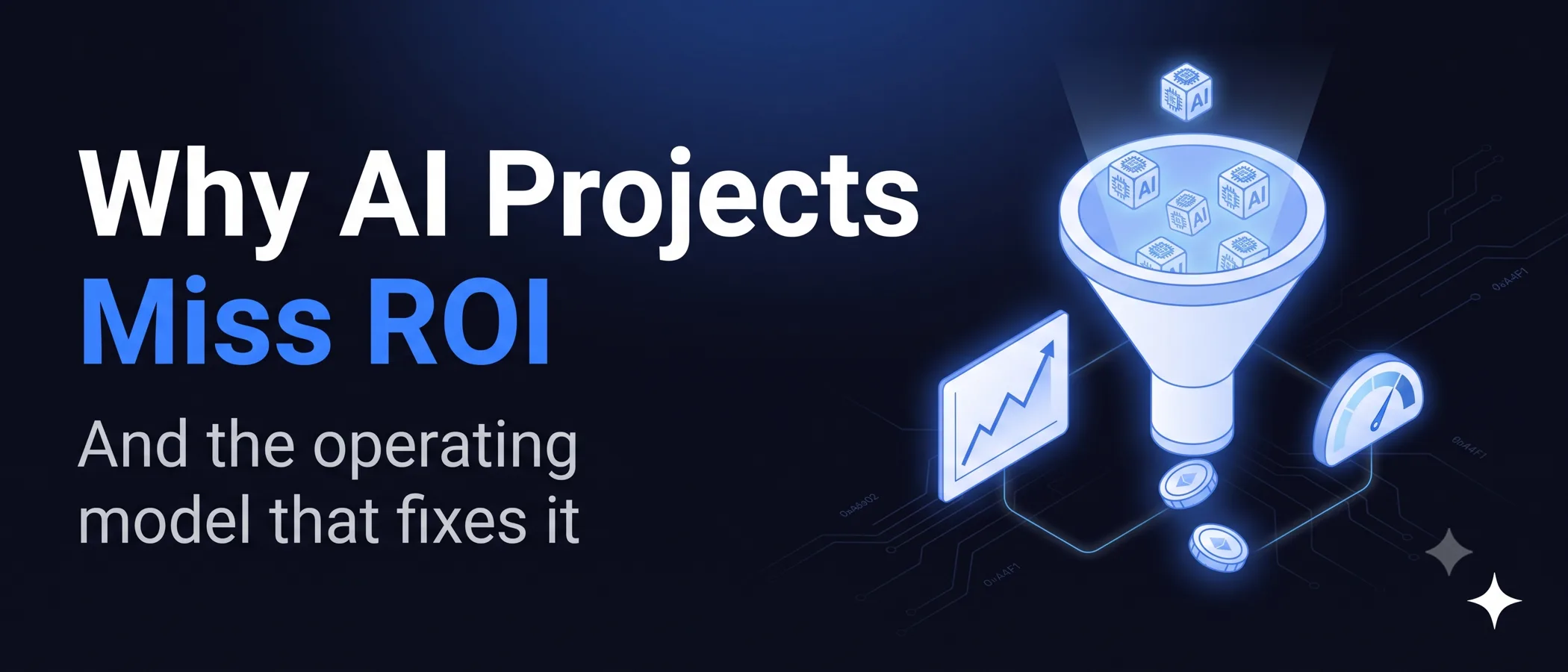
When an AI project misses its return, the model is seldom to blame. The usual cause is that the team treated AI as a one time build instead of a production system with owners, metrics and a maintenance plan. What fixes it is a better operating model, rarely a better model.
Quick Answer
AI projects miss ROI when the work stops at a demo. The common failures are vague success metrics, evaluation added too late, deployment treated as a handoff, no ownership of the model in production, and technical debt from rushed MVPs. Teams that do get a return set a measurable target before they build and wire evaluation in from day one. They also treat deployment and monitoring as owned engineering work, and they pay down debt early.
The ROI Gap Is Real, and Mostly Self Inflicted
MIT research on enterprise AI found that about 95% of generative AI pilots delivered no measurable profit impact, a gap the authors trace to weak integration and organisational learning rather than model quality (MIT NANDA, 2025). IBM, surveying CEOs across 33 countries, found only 25% of AI initiatives delivered the expected return and just 16% had scaled across the enterprise (IBM, 2025).
McKinsey reports that nearly nine in ten organisations now use AI in at least one business function, yet only about 6% qualify as high performers with a meaningful bottom line impact, only 37% attribute any EBIT impact to AI, and just 44% report AI scaling across the enterprise (McKinsey, 2026). The pattern across these studies is consistent. Execution is the bottleneck, not model capability. We keep the full set of 2026 adoption and ROI figures in our AI statistics for 2026.
Below are the five failure modes we see most often, and the fix for each.
Why AI projects miss ROI, and the fix for each failure mode
| Failure mode | What it looks like | The fix |
|---|---|---|
| No success metric | The model ships with no number tied to the business, so nobody can say whether it worked | Define one ROI metric and a threshold before any code is written |
| Evals added late | Quality is judged by demo impressions, and regressions slip through after launch | Wire evaluation into the pipeline from day one, with a golden dataset and pass thresholds |
| Deployment as a handoff | The model is tossed to an operations team with no release discipline | Treat deployment as an engineering phase, with versioning, canary rollout, and rollback |
| No production owner | Output quality drifts silently as live data changes, with no alert firing | Assign clear ownership for monitoring, drift checks, and retraining triggers |
| Tech debt from rushed MVPs | Shortcuts taken to ship fast quietly erode the return later | Budget to pay down debt early, before it compounds across the system |
How to Fix It, a Production First Operating Model
Closing the ROI gap means changing the operating model. Teams that get a return run AI the way they run any production system, with metrics, evaluation, an owner and a plan for what happens after launch.
Define the return before you build
Write down a single success metric tied to the business, such as cost per resolved ticket or hours saved per week, along with the threshold that makes the project worth running. Without it, teams keep tuning model accuracy and never get to the question of whether the workflow creates value. A model that scores 95% on a benchmark is worthless if the number the business cares about does not move.
Build evaluation in from day one
Development tests tell you what a model can do in general, while production evaluations check safety, consistency and latency for your specific workflow. Put automated evaluation into the pipeline during the earliest phases, with a golden dataset and clear pass thresholds, so a new prompt or model version cannot quietly break an existing edge case.
Treat deployment as an engineering phase
Tossing a model over the wall to an operations team guarantees friction. Production AI needs release discipline, meaning consistent environments, strict versioning of model weights and prompts, canary rollout and deterministic rollback. Deployment work continues for as long as the model is live, so plan it as a continuous lifecycle.
Own the model after launch
Silent failure is the most common way AI systems go wrong. Without a named owner for post launch monitoring, teams miss quality drift, latency spikes and context specific errors. We break down what post launch AI monitoring costs to run in a separate post. Assign ownership for drift checks, set retraining triggers, and treat a degraded model as a production incident.
Pay down technical debt early
IBM found that technical debt can cut the return on an AI business case by up to 29% and stretch delivery timelines by up to 22% (IBM, 2025). A rushed MVP that skips structure to ship fast creates exactly this kind of debt, so budget to fix it early, before it compounds across the system.
How to Compute the Return Before You Commit
Most AI business cases fail on the arithmetic rather than on the technology. A workable model needs four numbers and a time horizon.
- Baseline cost of the current workflow. Volume multiplied by handling time multiplied by loaded hourly cost. If you cannot state this number today, you cannot claim a return against it later.
- Expected deflection or speed up, stated as a range. Give a low, mid and high case, because a single point estimate hides the risk and is the first thing a finance team will challenge.
- Cost to serve. Inference plus retrieval plus the human review that stays in the loop. Review cost is the line teams forget, and it often decides whether the case works at all.
- Cost to build and keep running. Evaluation sets, monitoring, retraining and the engineering time to maintain all three. Carry this as a recurring cost for as long as the system runs.
As a worked example, take a support queue of 20,000 tickets a month at nine minutes average handling time and a loaded cost of 12 US dollars an hour. That is 3,000 hours, or roughly 36,000 US dollars a month. A conservative 25% deflection at 90% accuracy automates about 5,000 tickets, of which some 500 still need human correction. The saving is real, but it is not 25% of 36,000, because the corrections and the cost to serve come off the top before any of it counts toward the return. Modelling it this way usually moves the honest answer from a large number to a moderate one, and the moderate one is what survives a second quarter of scrutiny.
Discipline matters more than precision here. A business case with a stated range, an explicit cost to serve and a named baseline can be checked after ninety days, while one built on a single percentage cannot be checked at all, which is how projects arrive at their first review with no verdict available.
What Separates the Teams That Get a Return
The model is rarely what sets these teams apart. McKinsey found that the small group of high performers are far more likely to have redesigned their workflows around AI rather than bolting it onto unchanged processes. At Unico Connect we build AI as a product engineering problem, with custom evaluation frameworks, drift aware monitoring, and clear ownership from discovery through maintenance. Take the two WhatsApp agents we built for a B2B logistics client, one for voice enquiries and a separate one for ordering. We tied their monitoring to the metrics the business depends on, such as transcription accuracy and order intent mapping, and treated API uptime as one signal among several.
If your models stall after the demo, our post on why AI models fail in production goes into the causes, and the MLOps versus DevOps guide covers the operating model behind reliable AI. Our view on this was also featured in DesignRush News, in articles on why only a quarter of AI initiatives deliver ROI and how to fix that.
Frequently Asked Questions
Why do most AI projects fail to deliver ROI?
Most AI projects miss ROI because of weak integration and a learning gap, the causes MIT research on generative AI pilots points to, and rarely because of model quality. Tools are bought or built but never wired into real workflows, measured against the business or owned in production, so the failure sits in how the project is run.
What share of AI initiatives actually deliver the expected return?
Only 25% of AI initiatives delivered the return their leaders expected, according to IBM, and just 16% had scaled across the enterprise. Most stall somewhere between pilot and production.
How does technical debt affect AI ROI?
IBM found that technical debt can reduce the return on an AI business case by up to 29% and extend delivery timelines by up to 22%. Shortcuts that speed up an early demo often become the reason the project never pays off.
What do the teams that succeed do differently?
They redesign the workflow around AI instead of layering it on top, set a measurable target before building, evaluate continuously and keep an owner on the model in production. McKinsey found in 2025 that workflow redesign had the biggest effect on EBIT impact from generative AI.
How do we set an AI project up to deliver ROI?
Define one success metric and threshold before building, add evaluation from day one, treat deployment and monitoring as owned engineering work, and budget to pay down technical debt early. Run it on the same operating model you would use for any real production system.
Conclusion
The ROI gap is a discipline problem, and a better model will not close it. Decide what a return looks like before you build, measure results against the baseline you set, own the system after launch and keep debt from eroding the gains. To scope an AI build that holds up in front of real users, start with our AI development services or hire AI engineers from our team.