








How to Design Enterprise AI Guardrails and Human Approval Flows

Malay Parekh
CEO & Director, Unico Connect
In this article
Enterprise AI works best when engineering teams spell out what can be automated, what needs conditional review, and what must stay with a person. Designing enterprise AI guardrails is a policy issue, but at its core it is a workflow and system design problem. An autonomous system that has to scale needs approval logic you can rely on, strict escalation controls and hard operational boundaries. With risk tiers, distinct approval triggers and a careful rollout plan, organizations can bring human-in-the-loop AI into production safely.
Quick Answer
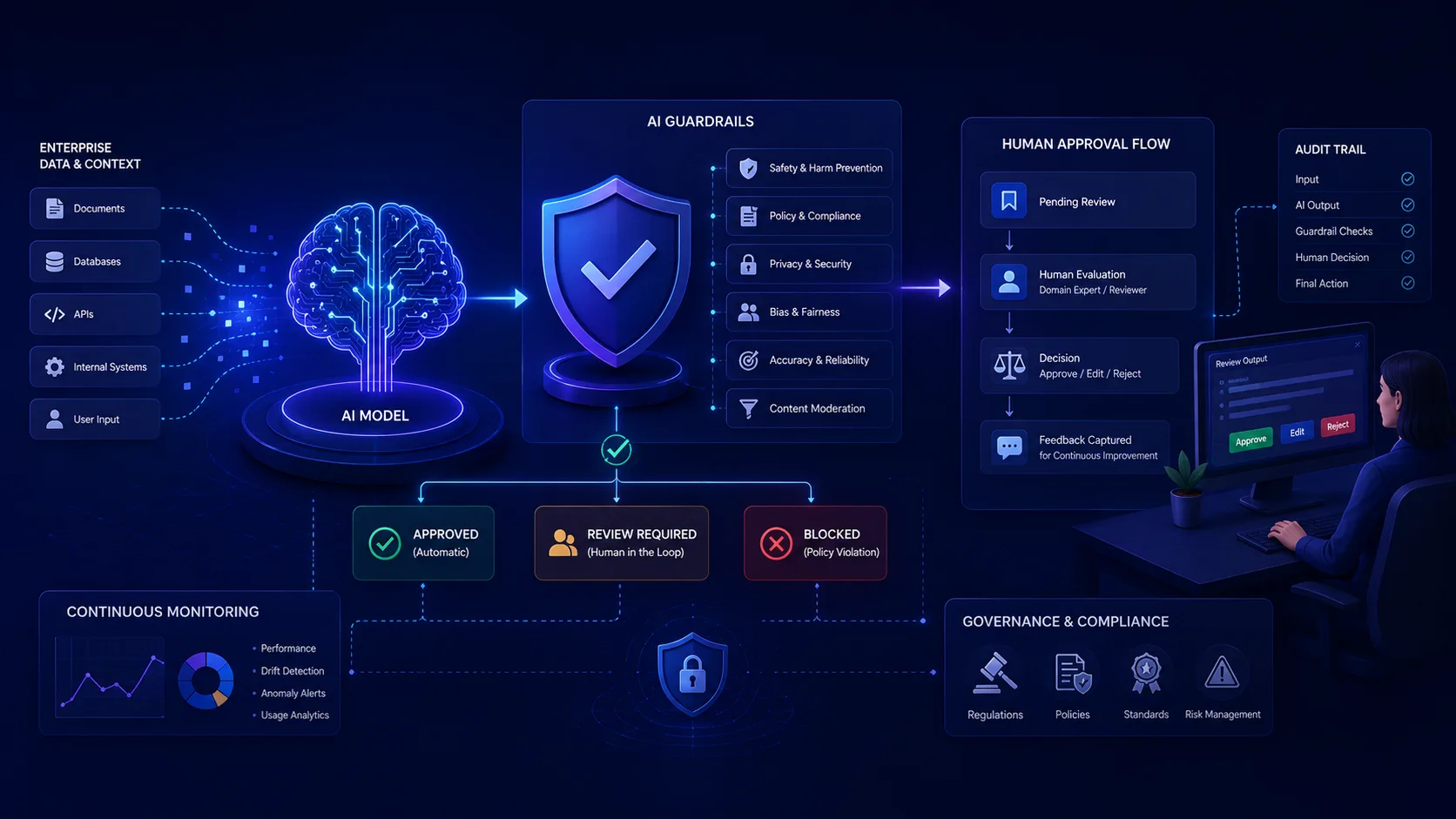
Enterprise AI guardrails are the controls that decide what AI does on its own, what needs conditional review, and what requires explicit human approval. The design pattern Unico Connect uses in enterprise AI builds combines a risk-based approval matrix (low/medium/high), rule-based escalation triggers rather than model confidence alone, structured reviewer feedback, and controls across the full stack (inputs, retrieval, prompts, tools, outputs and actions). Aim for calibrated oversight, not maximum review.
Key Takeaways
- When an AI workflow misbehaves, look for unclear boundaries and weak escalation first, since most enterprise AI failures are architectural and start there rather than in bad model outputs.
- Derive approval logic from workflow risk (business impact, reversibility, compliance, customer impact), and assess that risk before anyone picks a model or writes a prompt.
- Keep assistive actions, which can run autonomously, in a different autonomy tier from execution actions, which must be gated.
- Add rule-based escalation triggers on top of LLM confidence scores, and record structured reviewer feedback so routing improves over time.
- Place guardrails at every layer (inputs, retrieval, prompts, tools, outputs and downstream actions), and give agentic systems stricter ones than chatbots because agents call tools and take actions directly.
Why Enterprise AI Needs Guardrails Before It Scales
Most enterprise AI failures trace back to unclear operational boundaries, weak escalation logic and uncontrolled downstream actions. Poor model output is seldom the root cause. Engineering teams need to draw a sharp line between harmless content generation, such as drafting text, and business execution actions, such as modifying database records. Those boundaries and controls belong in the design from the start, since secure, reliable and scalable AI development across enterprise environments depends on them.
Enterprise leaders prioritize reliability, strict accountability, confidence in adoption and lower operational risk. If an AI agent mistakenly processes a refund without authorization, that is an architectural failure rather than an algorithmic one. Good enterprise AI governance treats AI risk controls as a mandatory requirement for scaling, which means they cannot wait for a compliance pass at the end. The voluntary NIST AI Risk Management Framework, with its Generative AI Profile published in July 2024, is a useful shared reference for risk controls. Its Govern function sets the policies, accountability structures and risk culture that decide who is responsible for each AI risk decision.
Start with a Risk-Based Approval Matrix
Approval logic should always begin with an assessment of workflow risk, before anyone chooses a model or designs a prompt. Evaluate each task on business impact, reversibility, compliance sensitivity and customer impact.
Sorting workflows into distinct tiers gives you operational decision layers in place of abstract technical settings. The AI approval matrix below is the blueprint for safe AI oversight design.
| Risk tier | Automation level | Example actions |
|---|---|---|
| Low | Fully automated | Drafting summaries, classifying inputs, suggesting knowledge-base responses |
| Medium | Conditional review on triggers | Invoice matches within thresholds, routine updates with checks |
| High | Mandatory human approval | Financial decisions, state-changing database writes, binding customer commitments |
Build the Human Approval Flow
Define What the AI Can Do Without Approval
Effective human-in-the-loop AI starts with a clear split between assistive actions and execution actions. Drafting meeting summaries, classifying user inputs or suggesting knowledge-base responses can often run autonomously. Financial decisions, state-changing database actions and binding customer commitments must sit in a separate, gated tier. Hard execution boundaries make sure your AI risk controls isolate generative assistance from operational changes.
Set Approval Triggers and Escalation Rules
The internal confidence score of an LLM is too weak a signal to run a production system on by itself, so add rule-based escalation triggers. Take an AI that processes vendor invoices. It might approve matches under $500 on its own, while an explicit rule sends any invoice with missing data, policy deviations, amount thresholds or conflicting evidence straight to an AP specialist. Uncertain cases must escalate to the correct AI escalation workflow instead of being forced through automation, because operational clarity in AI approval workflows is worth more than an aggressive completion metric.
Capture Reviewer Decisions and Feed Them Back into the System
Every approval must leave behind structured operational feedback, and a bare "approve/deny" click does not give you that. During human review, capture specific reason codes, missing context, policy concerns or low-confidence evidence. Those reviewer decisions improve upstream prompts, refine routing rules and, over time, raise escalation accuracy. Mature enterprise AI governance depends on that feedback loop.
Put Guardrails Across the Full System Stack
A single prompt constraint is not enough. Guardrails need to sit across inputs, retrieval systems, prompts, tools, outputs and downstream actions. In practice that includes hard retrieval restrictions (RAG boundaries), strict role-based permissions, output validation layers, action allowlists and full audit logging.
Layering matters even more for agentic AI guardrails. Autonomous agents bring serious risks from unrestricted tool access, chained actions nobody monitors and execution with no human step. If an agent can call an API, your AI risk controls must strictly limit both the payload and the methods it is authorized to use.
Test the Approval Logic Before Production
Test failure cases, escalation paths and reviewer workflows thoroughly, and do not stop at validating the successful "happy path" scenarios. Enterprise AI governance requires you to evaluate the approval layer through shadow mode, historical replay and sample-based review before a broader rollout.
The operational metrics engineering leaders should track are the baseline escalation rate, false approvals, reviewer turnaround time and override frequency. Human approval logic is a production control layer, so stress test and evaluate it exactly as you would any other critical one.
Common Mistakes Teams Make
Organizations designing AI escalation workflows tend to make three operational mistakes. The first is treating approval as a static compliance add-on instead of building it into the workflow as an operational checkpoint. The second is relying on a single confidence threshold for every workflow, whatever the context. The third is building enterprise AI guardrails and review queues so heavy and cumbersome that people start working around the process.
Too much review, badly routed, slows adoption and destroys operational trust in human-in-the-loop AI. What you want is calibrated oversight that lets teams scale automation safely. In the enterprise deployments Unico Connect has shipped, the guardrail layers that survive are the ones designed with the workflow owners rather than bolted on after the build.
Frequently Asked Questions
When do enterprise AI guardrails need human approval?
Human approval is mandatory for irreversible actions, financial decisions, regulated compliance workflows, and binding customer-facing commitments. If the business cannot easily undo the action or absorb the liability of an error, a human must explicitly authorize it.
How are AI approval workflows different from enterprise AI governance?
Enterprise AI governance sets the organizational policy, risk tolerance and compliance standards, while AI approval workflows are the technical runtime mechanisms that enforce those operational decisions inside the software stack.
What makes AI escalation workflows too slow or too risky?
Escalation workflows turn slow or risky because of poor rule routing, reviewers who lack operational context, excessive review on low-risk tasks, or unclear escalation ownership. Unclear ownership leaves flagged items sitting unreviewed in generalized queues.
Do agentic AI guardrails need to be stricter than chatbot controls?
Yes. A chatbot mostly generates text, which carries reputational risk. An agent has direct tool access, runs chained workflows and takes actions on its own, so it adds direct operational execution risk. Agentic AI guardrails therefore need stricter action allowlists and harder system boundaries. Our enterprise application development team builds these guardrails in from day one.