









Built an AI-led engineering enablement system that Unico uses internally to deliver client work faster, with higher quality and on consistent standards
A working AI-led engineering platform built by Unico Connect for Unico Connect, encoding the company’s technical standards, code review practices, security baseline and project setup workflows into an everyday engineering layer, with measurable acceleration across the delivery lifecycle.
Key Takeaways
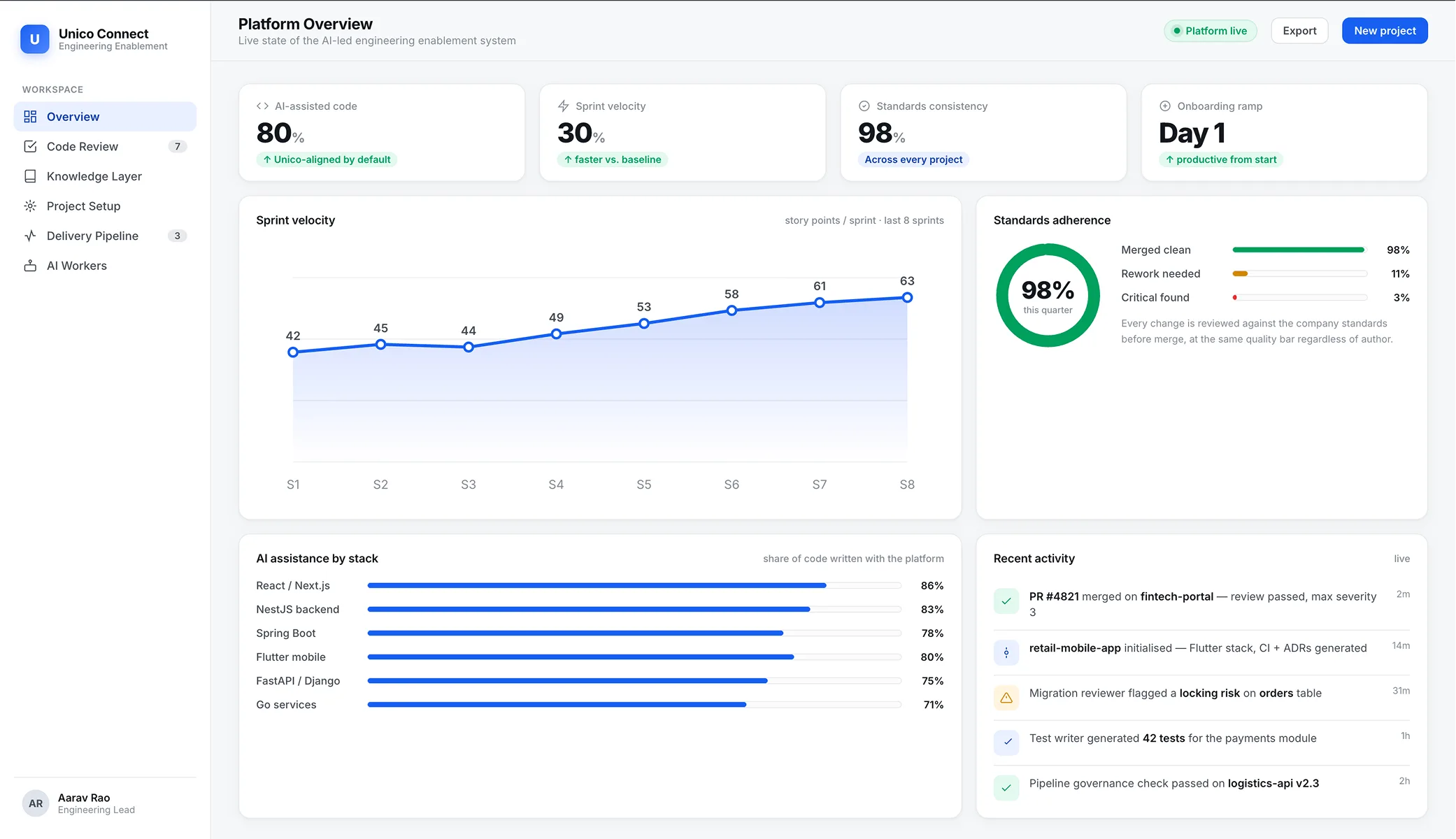
Unico Connect runs an AI-led engineering enablement system that the company built for itself and now operates as the everyday platform underneath every client project. The system encodes the company’s technical standards, code review practices, security baseline and project setup workflows into a working layer that every engineer interacts with.
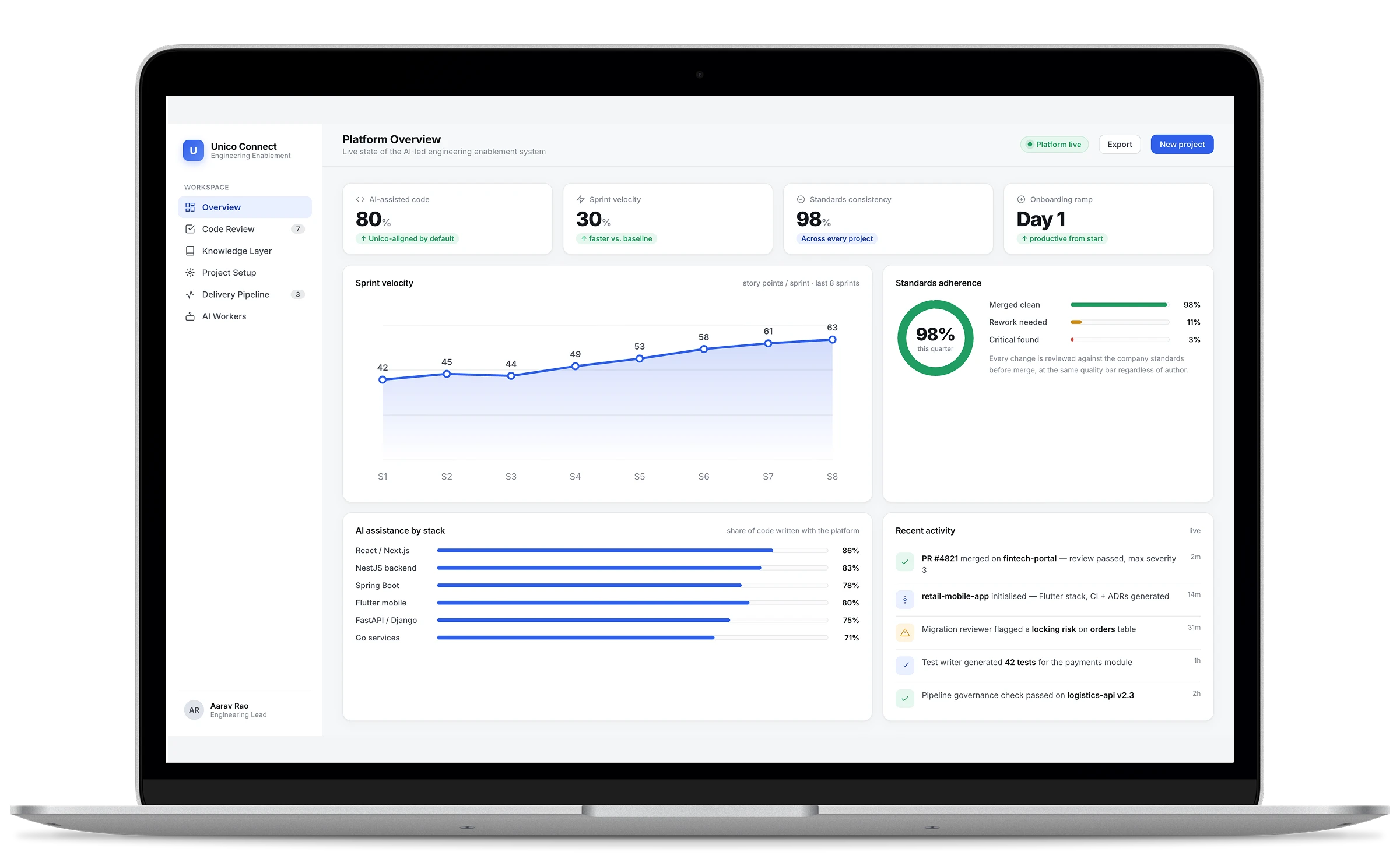
It produces 80 percent of code with AI assistance, accelerates sprints by 30 percent, and delivers consistent standards across projects regardless of which engineer is working on which.

The Challenge
Unico Connect built the company on the principle that AI-led development is not a feature to add to projects but the operating model the company runs on. The challenge with operating on that principle is that AI assistance is only as useful as the surrounding discipline. A team with access to AI coding tools but no shared standards produces inconsistent code; a team with standards in wikis but no way to enforce them at the point of writing code produces standards that exist in documents but not in delivery. The gap between “we use AI” and “AI consistently accelerates our work” is real, and most teams never close it.
The company had spent years accumulating technical standards, code review practices, security baselines, deployment checklists and architectural patterns. Some lived in internal documents, some in the heads of senior engineers, some in code review feedback newer engineers learned by repetition. The knowledge was substantial but distributed in a way that made it hard to apply consistently — new projects re-invented decisions already made, new engineers spent months absorbing standards, and the AI tools in use produced generic rather than Unico-aligned output.
The team set itself a practical, ambitious brief: build an internal engineering enablement system that encoded the standards, embedded into the day-to-day engineering workflow, and produced measurable acceleration without compromising quality — working across the full stack the company delivers in (web, mobile, backend, cloud), and maintainable so that as the standards evolved, the platform evolved with them.
Our Approach

Unico engineered the platform with the same discipline the company applies to client engagements. The first phase was inventorying the accumulated knowledge that should sit inside the system — technical standards across the primary stacks, API design conventions, testing standards, security baselines, deployment and incident-response procedures, code review practices and the architectural decision frameworks used on every project.
Key decisions:
A working layer, not a reference library
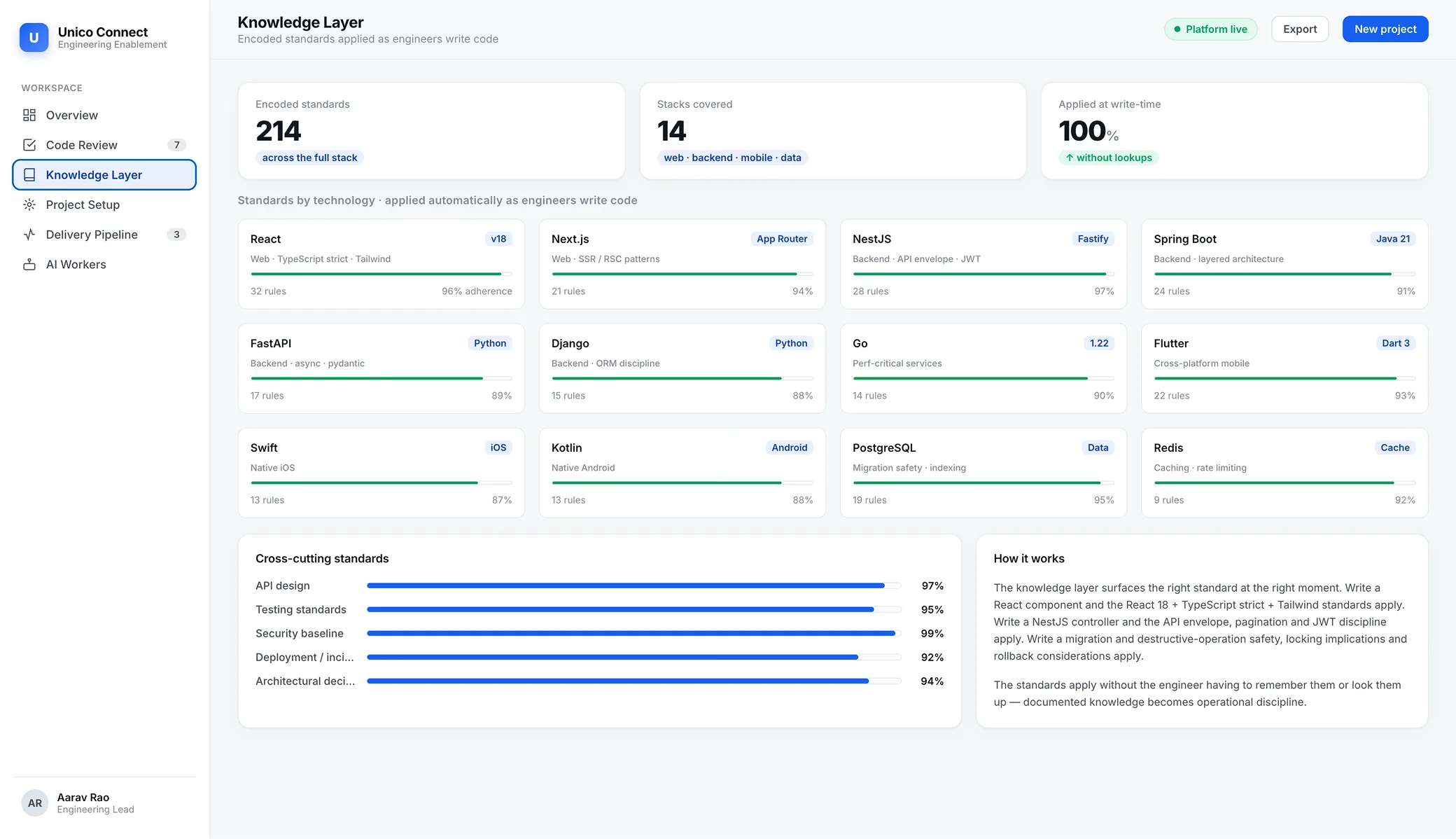
Documented standards in a wiki are background knowledge; working standards in an everyday platform are operational discipline — each piece structured to be accessible at the moment an engineer needs it.
Knowledge-driven and action-driven capability
Surface the right standard at the right moment (API conventions before an endpoint, migration safety before a migration, security baseline before auth), plus workers that perform tasks (review, test generation, dependency scanning, documentation).
Standards-aware review as the default
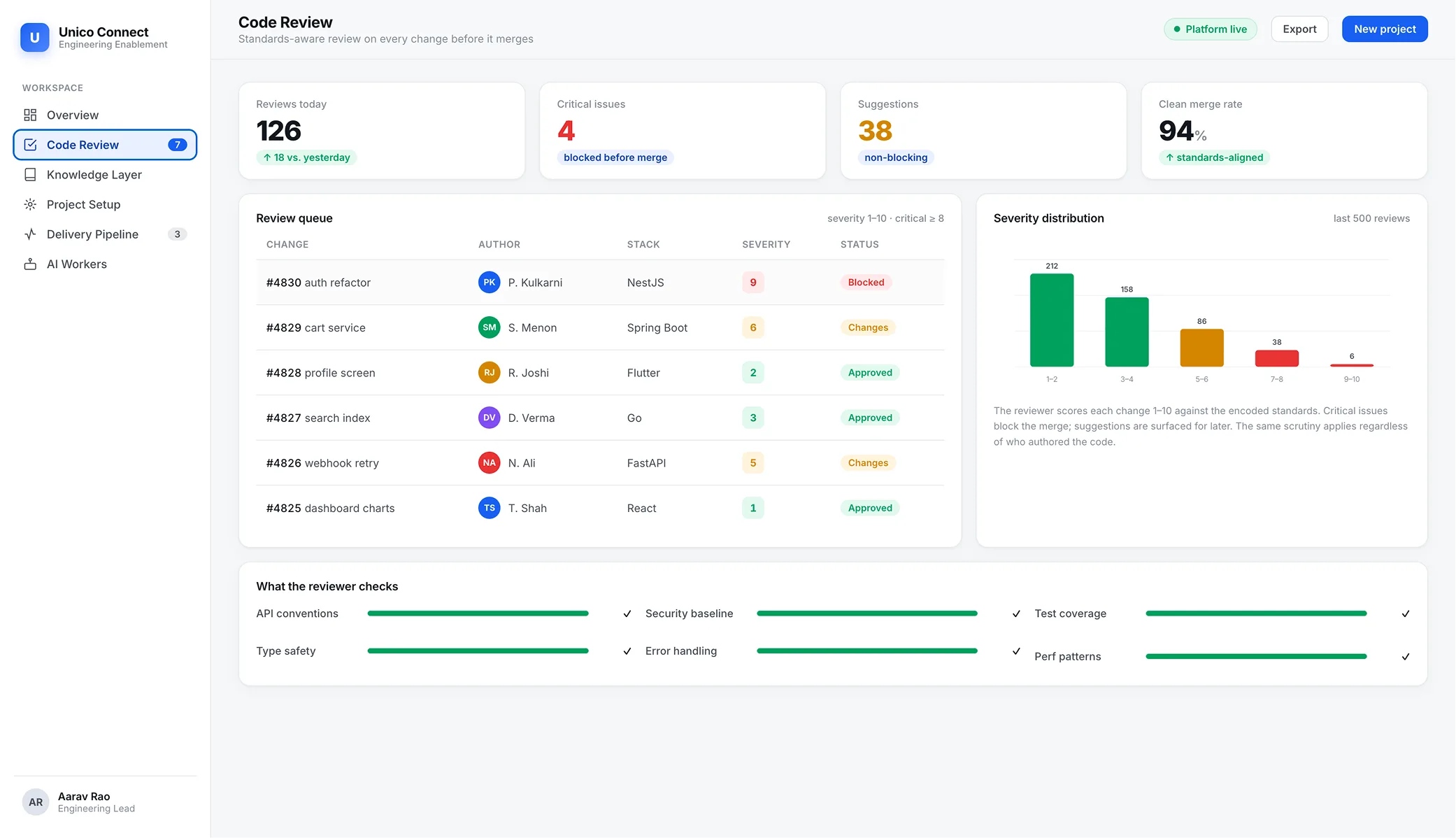
Every change passes through review against the standards before it merges, with severity scoring — the layer that turns standards from documentation into delivery discipline at a consistent quality bar.
The solution we built
A set of integrated capabilities engineers interact with through their day-to-day workflow — project setup, an encoded standards knowledge layer, standards-aware code review, specialised task workers and a pipeline that orchestrates them from concept to production.
Discovery-led project setup
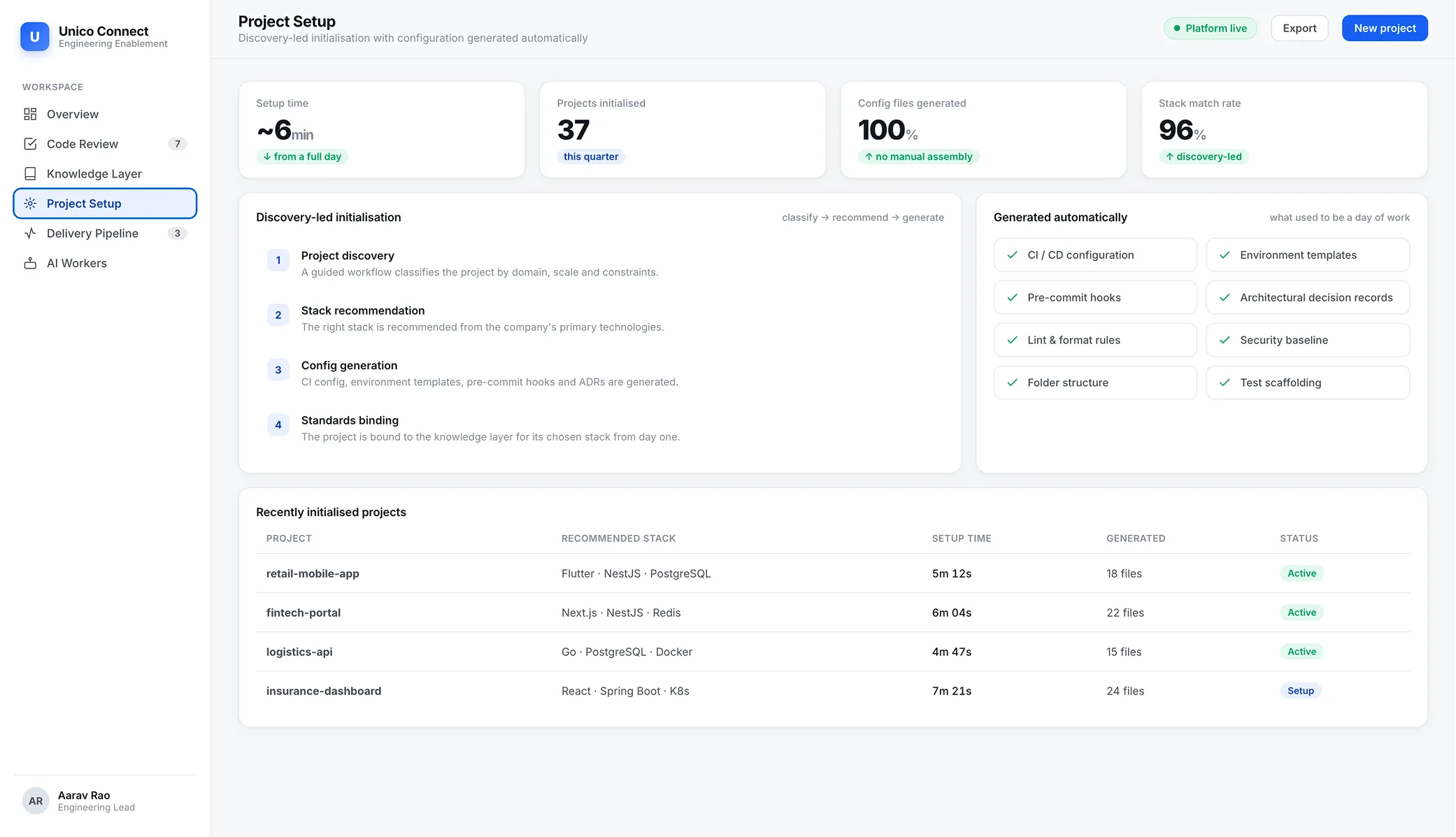
Classifies the project, recommends the stack and generates the configuration — CI, environment templates, pre-commit hooks, architectural decision records — turning a day of setup into minutes.
Encoded standards knowledge layer
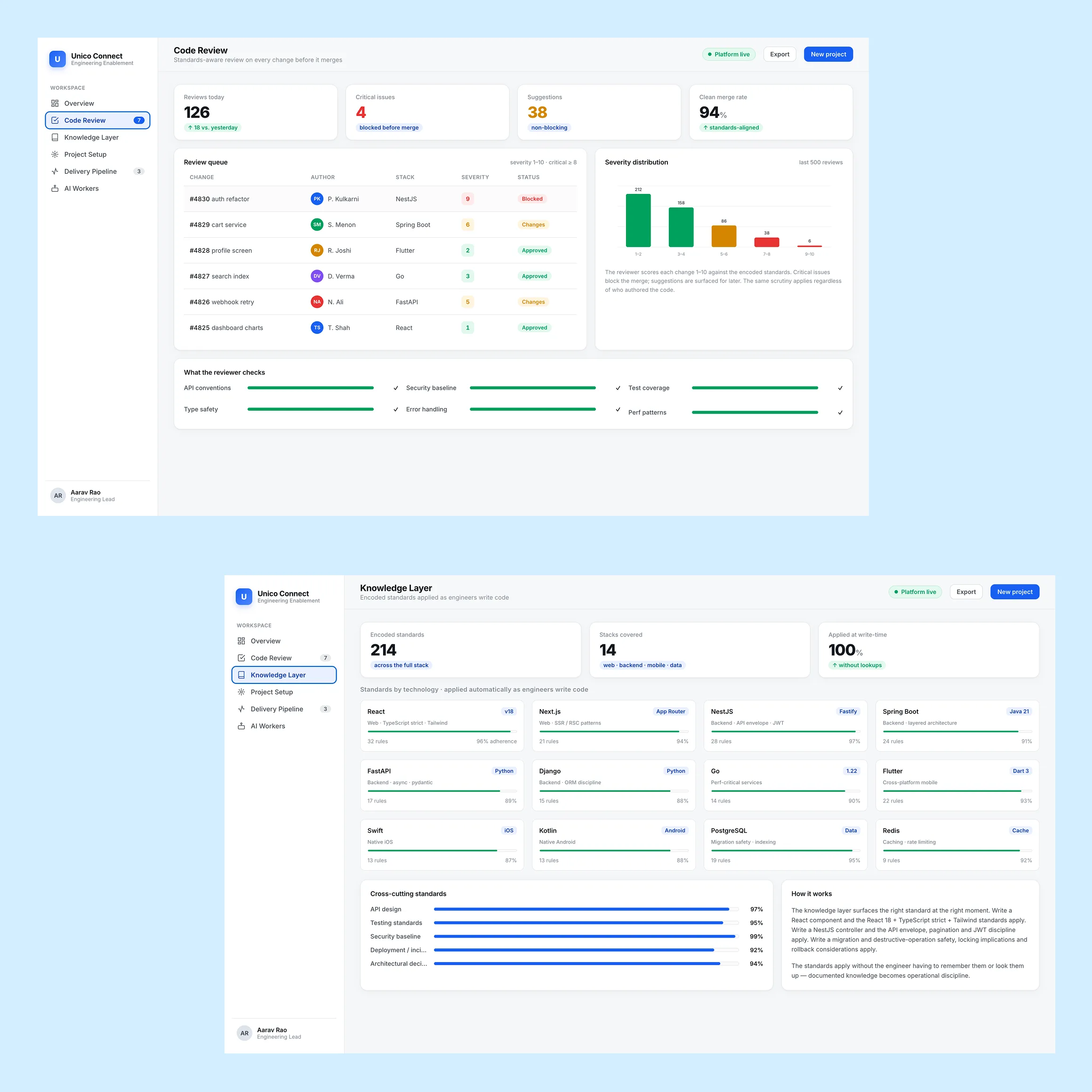
Standards apply as code is written — React/TypeScript conventions, API design and JWT discipline for backends, destructive-operation safety for migrations — without the engineer having to remember or look them up.
Standards-aware code review
Every change reviewed against the company’s standards with severity scoring from 1 to 10 — the same scrutiny regardless of who authored it, which is what makes consistency possible across a team.
Specialised workers and pipeline
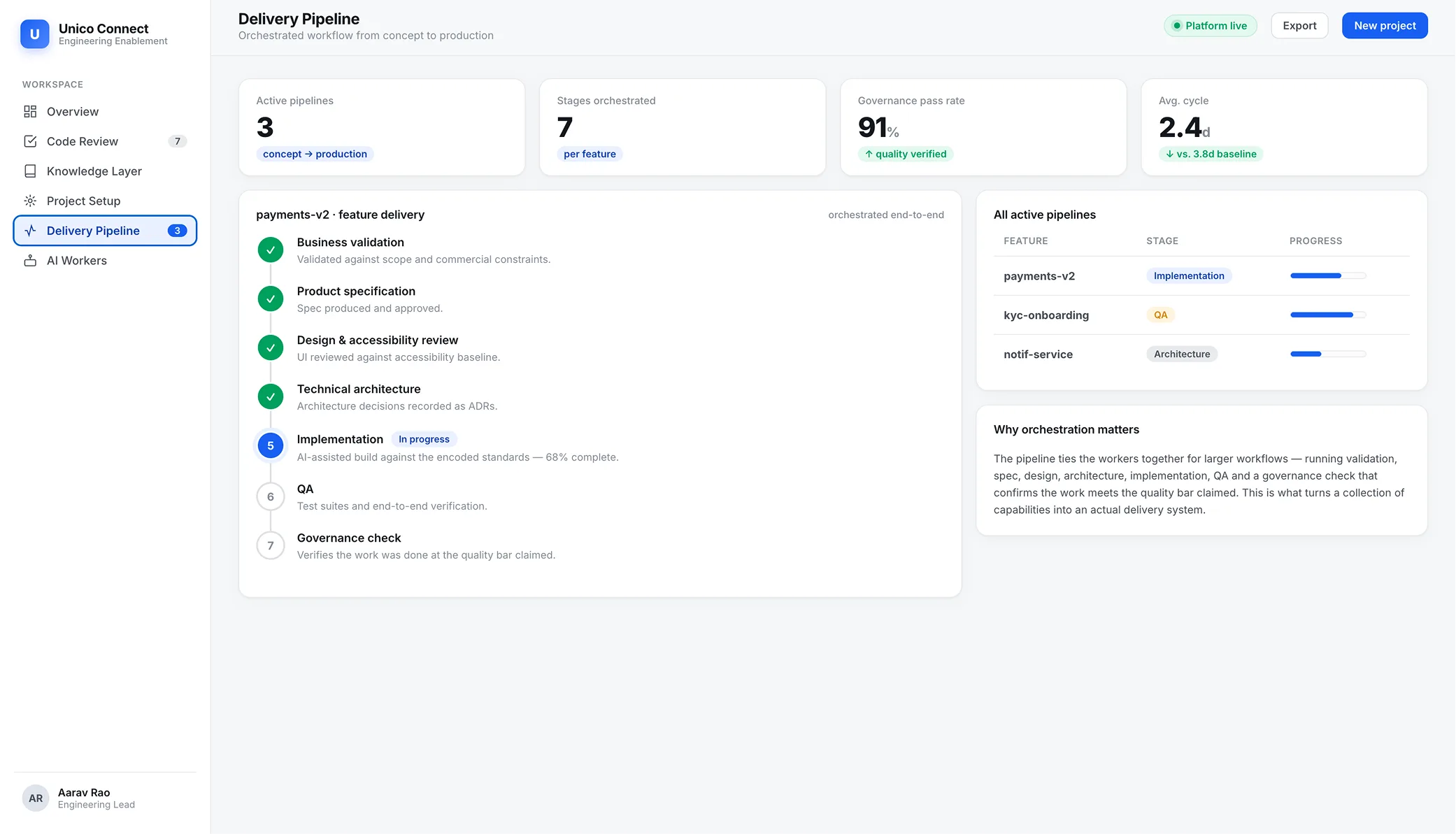
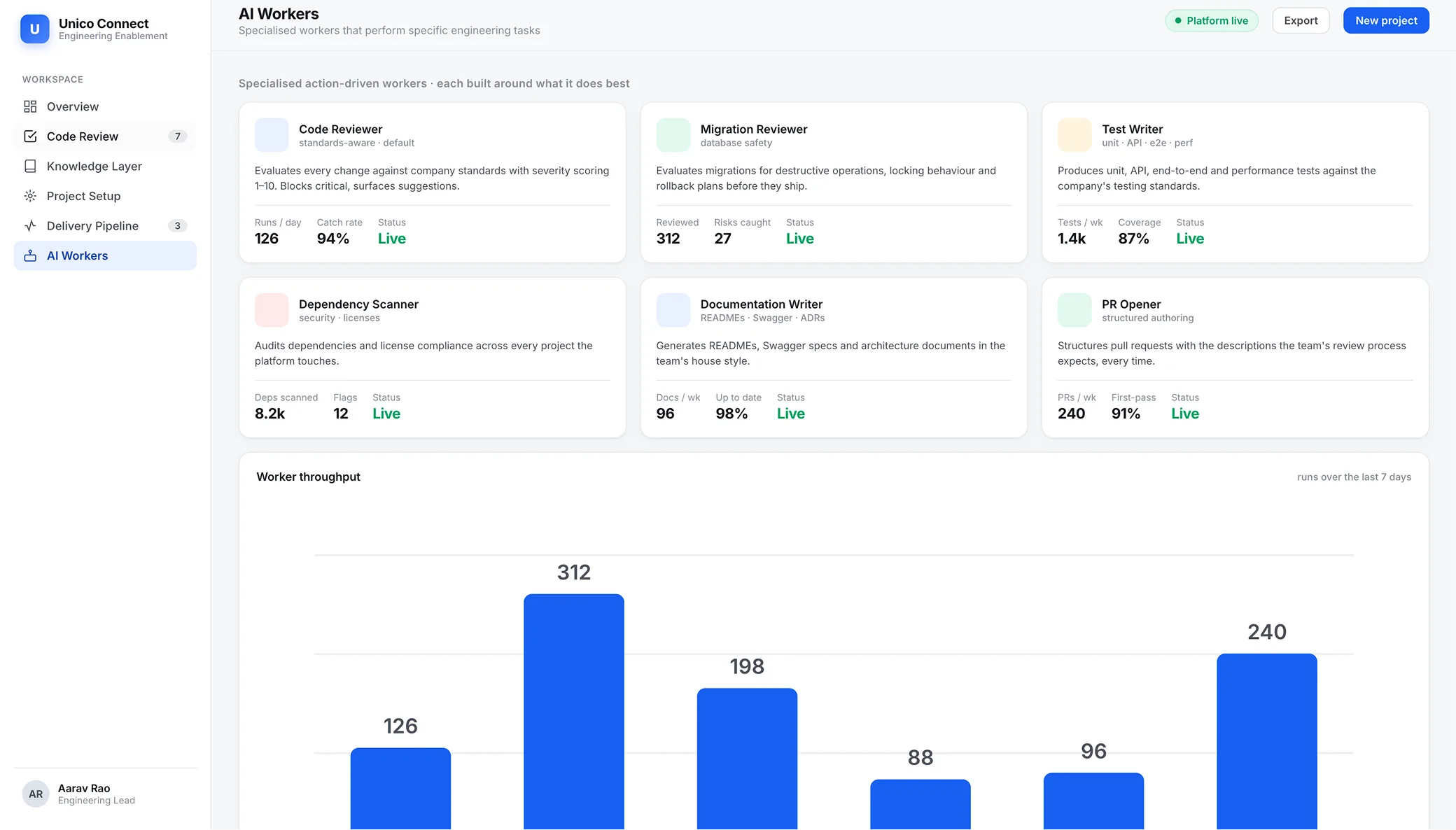
Test generation, migration safety review, dependency and licence scanning, documentation and structured PRs — tied together by a pipeline that runs validation, spec, design, implementation, QA and a governance check.
Tech stack





Outcomes & impact
80%
Of code written with AI assistance
30%
Faster sprint delivery
Consistent
Standards across every project
Trusted and verified by our clients


 ISO/IEC 27001:2022
 ISO 9001:2015
 GDPR compliant
Frequently Asked Questions
Let's Build Your Team
Tell us about your project and the outcomes you want, and we'll show you what AI-led delivery actually looks like at the working level. We reply within one business day.
Prefer to book directly?
🗓️ Schedule on Calendly →Or email us:
✉️sales@unicoconnect.com