










Built an AI-powered virtual try-on capability for fashion manufacturers, letting customers visualise apparel, footwear and accessories before they commit
An AI and computer vision tool for a fashion manufacturing platform's customer base, enabling virtual try-on across the fashion product mix so brands and retailers can give their customers a confident purchase experience without physical sampling at every step.
Key Takeaways
A fashion manufacturing platform serving brands and retailers came to Unico Connect to build an AI-powered virtual try-on capability covering the breadth of their product mix. We delivered the tool in Python with computer vision and image generation models tuned for fashion.
The capability lets customers visualise apparel, footwear and accessories before they commit, reducing the friction in the path from product discovery to purchase and giving the platform's brand and retailer customers a new way to differentiate their experiences from the generic e-commerce template.
The Challenge
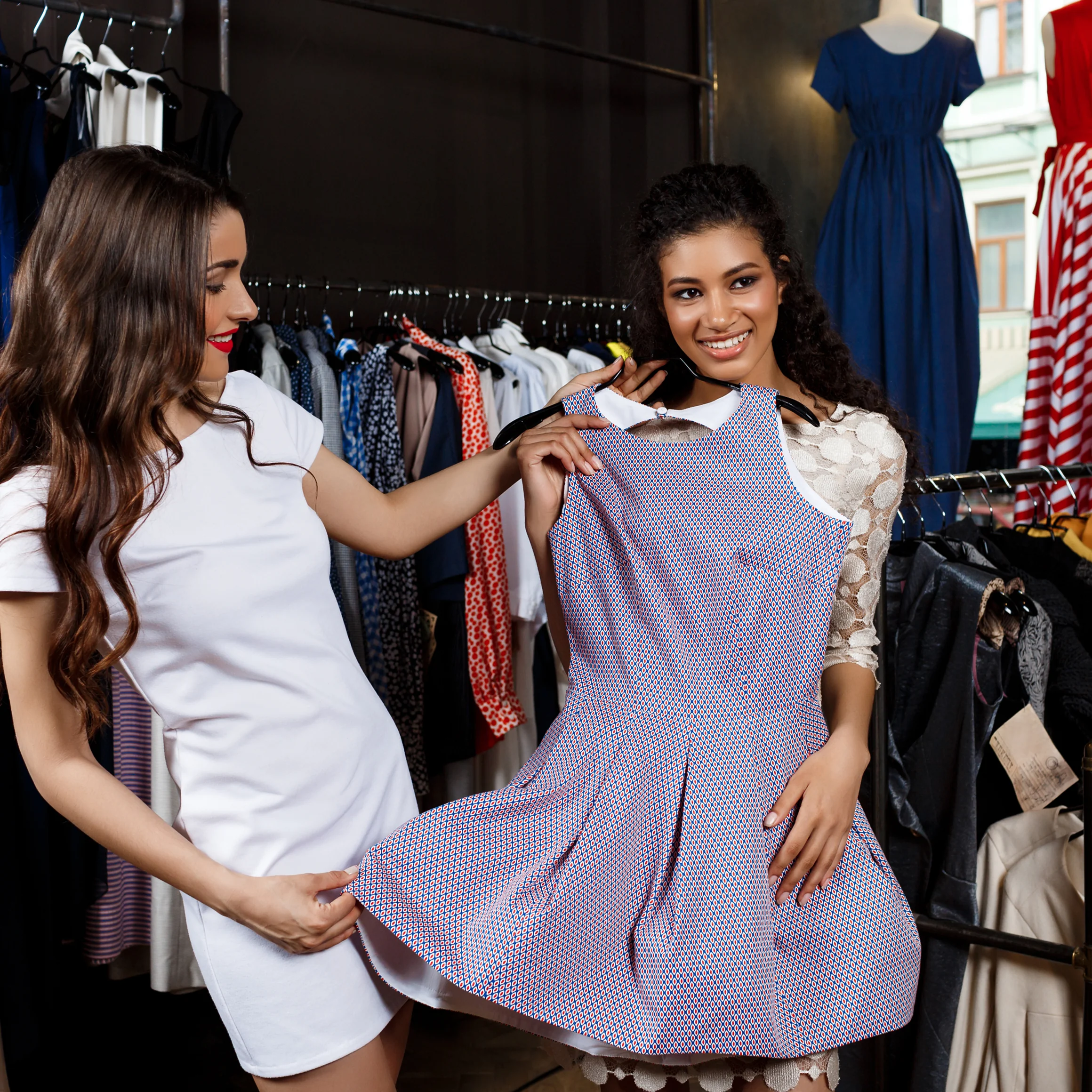
Fashion is structurally hard to sell online. A customer looking at a jacket, a pair of shoes or an accessory on a product page does not actually see what the item will look like on them; they see a model in the brand's photography or, more often, a flat product shot. The cognitive gap between what is shown and what the customer would experience wearing it is the largest single driver of friction in the fashion purchase journey. It drives the return rates that plague e-commerce. It limits the conversion rates that brands and retailers achieve. It is the reason fashion remains stubbornly tied to physical retail even as adjacent categories have shifted to online.
The client came to Unico Connect with this problem framed clearly. They operate a fashion manufacturing platform serving brand and retailer customers across apparel, footwear and accessories. Their customer base wanted to give end-shoppers a virtual try-on experience that closed the cognitive gap, letting customers see how items would look in context rather than asking them to imagine it. The existing virtual try-on solutions in the market were either limited to specific product categories (footwear-only, sunglasses-only) or required customer-facing technology that the brand and retailer customers could not realistically deploy at scale.
The strategic opportunity was to build a virtual try-on capability that worked across the product mix the platform actually serves. Apparel sits differently on a person than footwear, which sits differently than accessories. A try-on tool tuned to one category fails on the others. Building a unified tool that worked across the categories was the engineering challenge that the platform's customers had not seen solved elsewhere.
The constraints were technical. The tool had to produce visualisations that customers would actually trust, because an unconvincing result gets ignored and erodes brand trust faster than no tool at all. The visualisation had to handle the variation in customer body types, footwear styling on different shapes of feet, and the way accessories interact with the rest of a person's outfit, while staying within an e-commerce compute envelope. There was also a product distribution consideration: the capability was being built to serve the platform's brand and retailer customers, which meant it had to be packaged so those customers could deploy it through their own customer-facing surfaces, a different model from a consumer-facing try-on app.
Our Approach
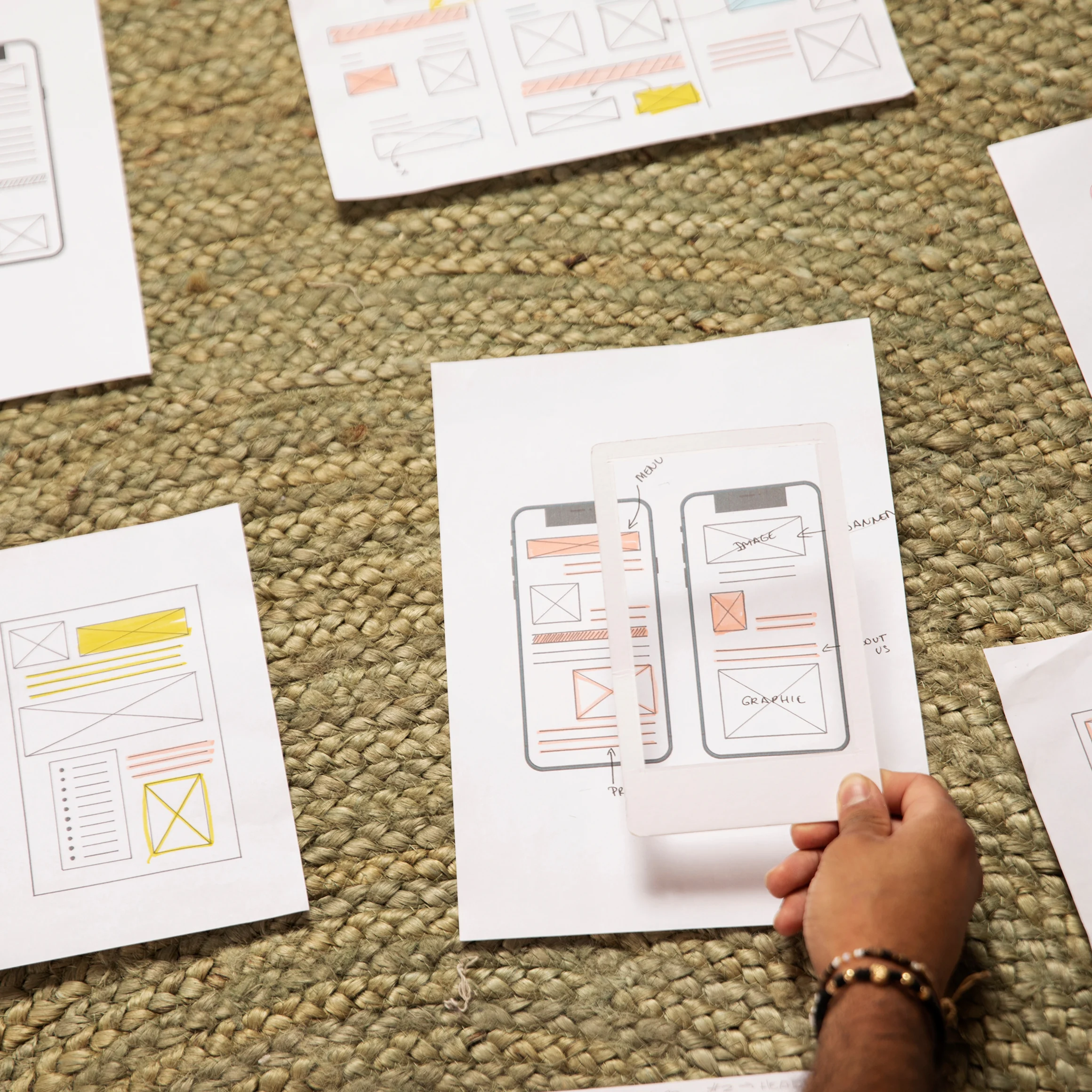
We engaged with the client as a partner on the AI capability build, with the work structured around two parallel concerns: the model work that produces convincing visualisations and the platform packaging that makes the capability deployable across the customer base.
Key decisions:
One pipeline, specialised by category
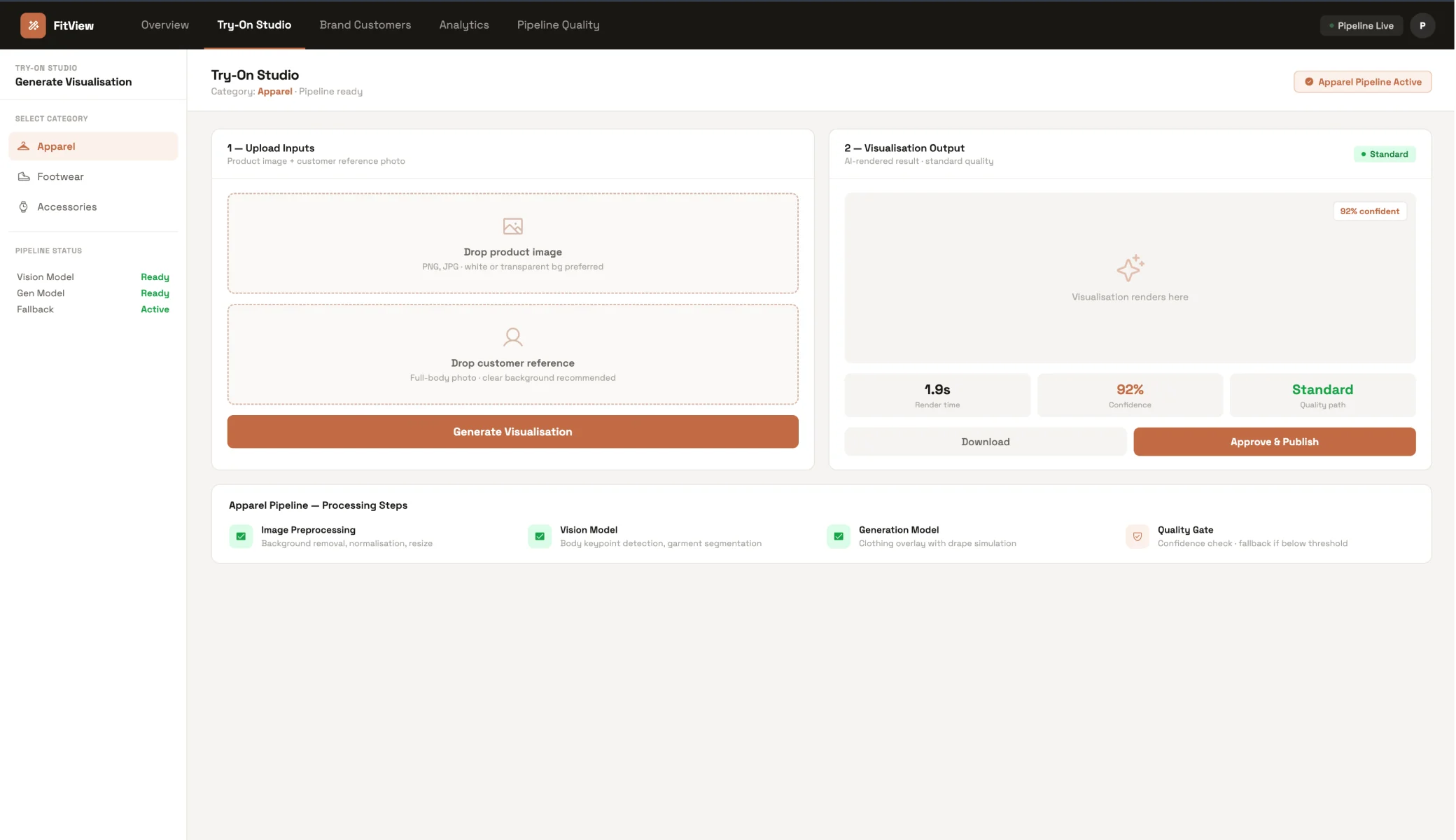
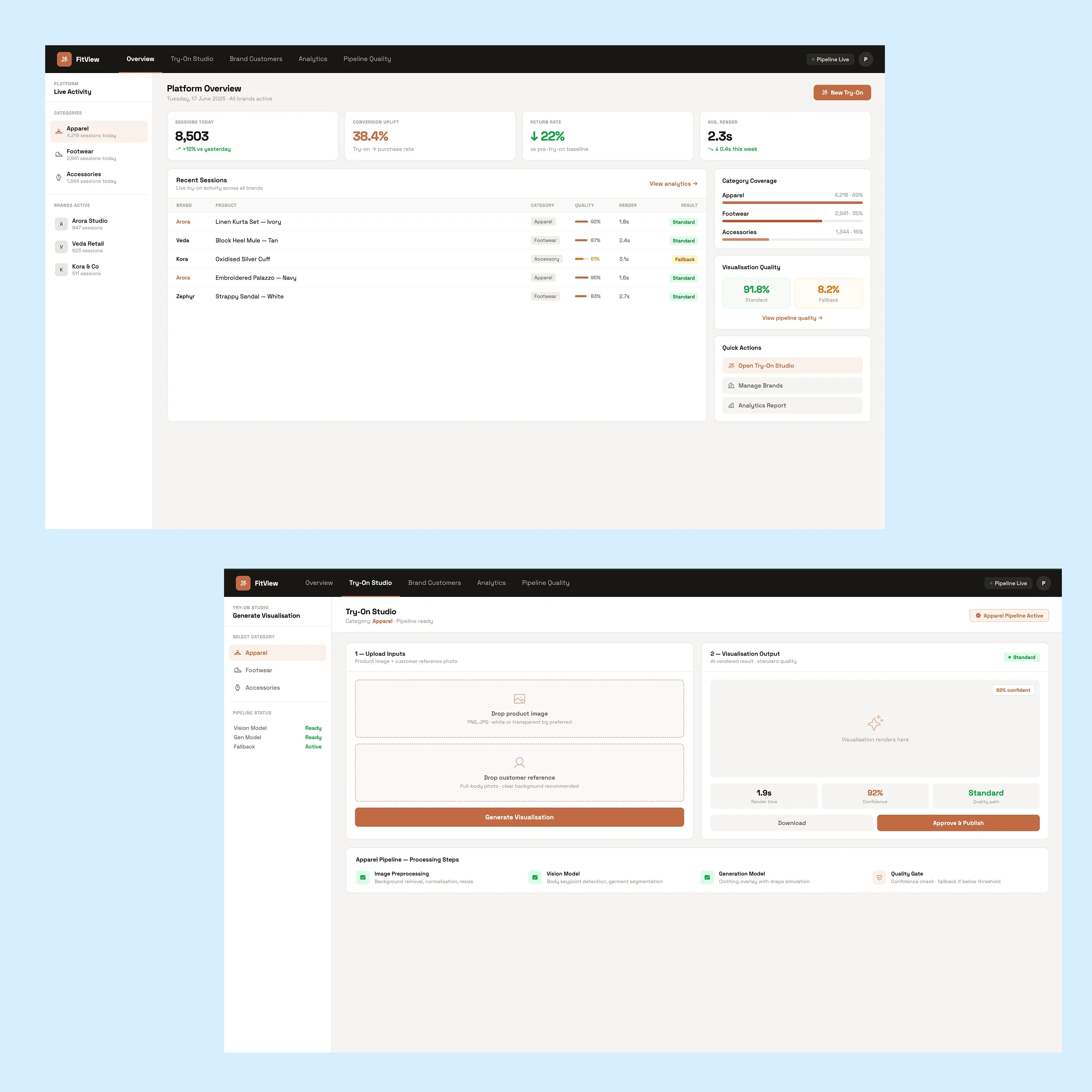
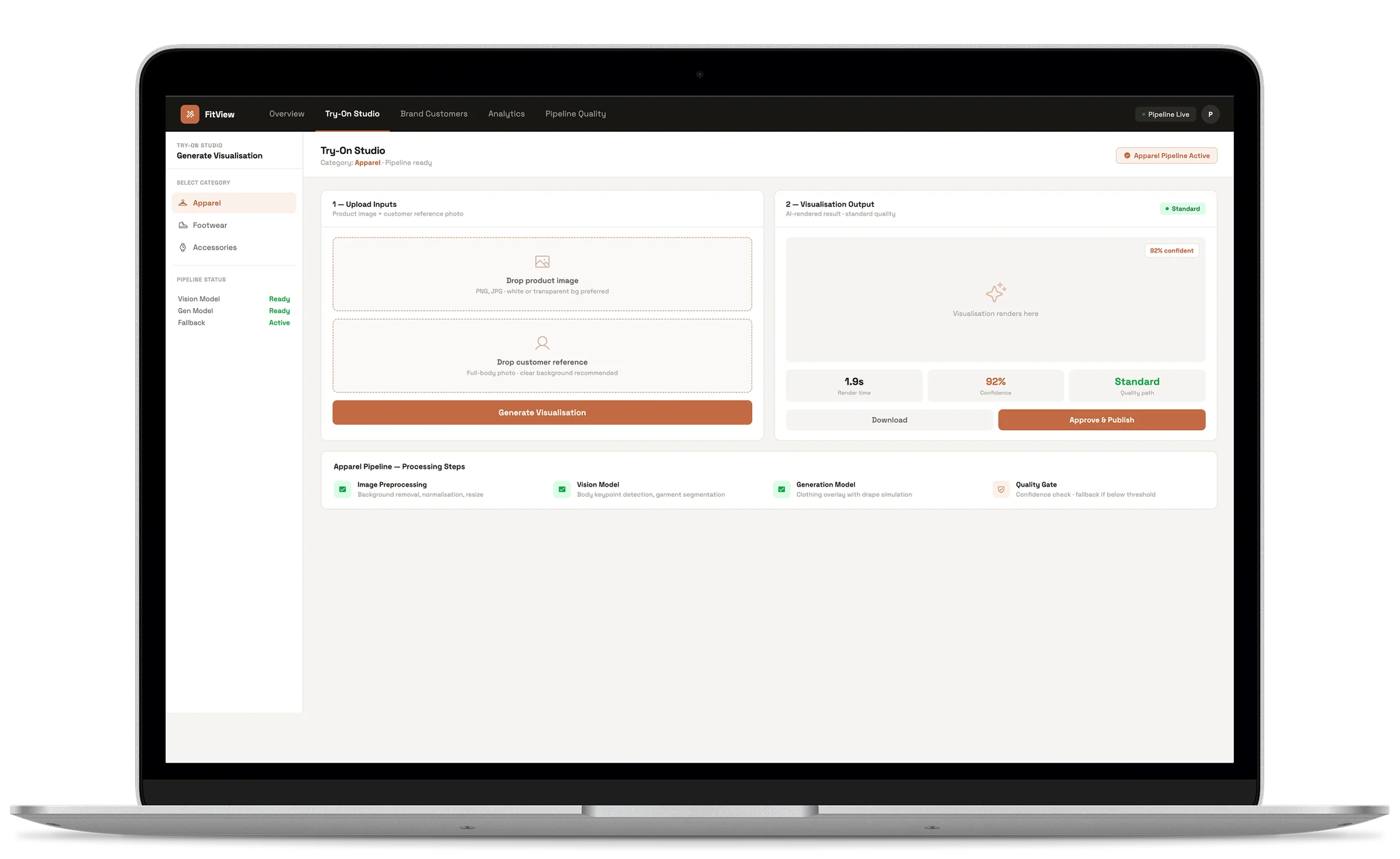
We built the visual generation pipeline in Python, with computer vision and image generation models that handle the variation across product categories. The apparel pipeline needs different processing than footwear, which needs different processing than accessories, so the pipeline can be specialised by category while the underlying engineering stays common. This is the structural decision that makes the tool work across the platform's full product mix rather than only on one category.
Tuned conservatively for trust
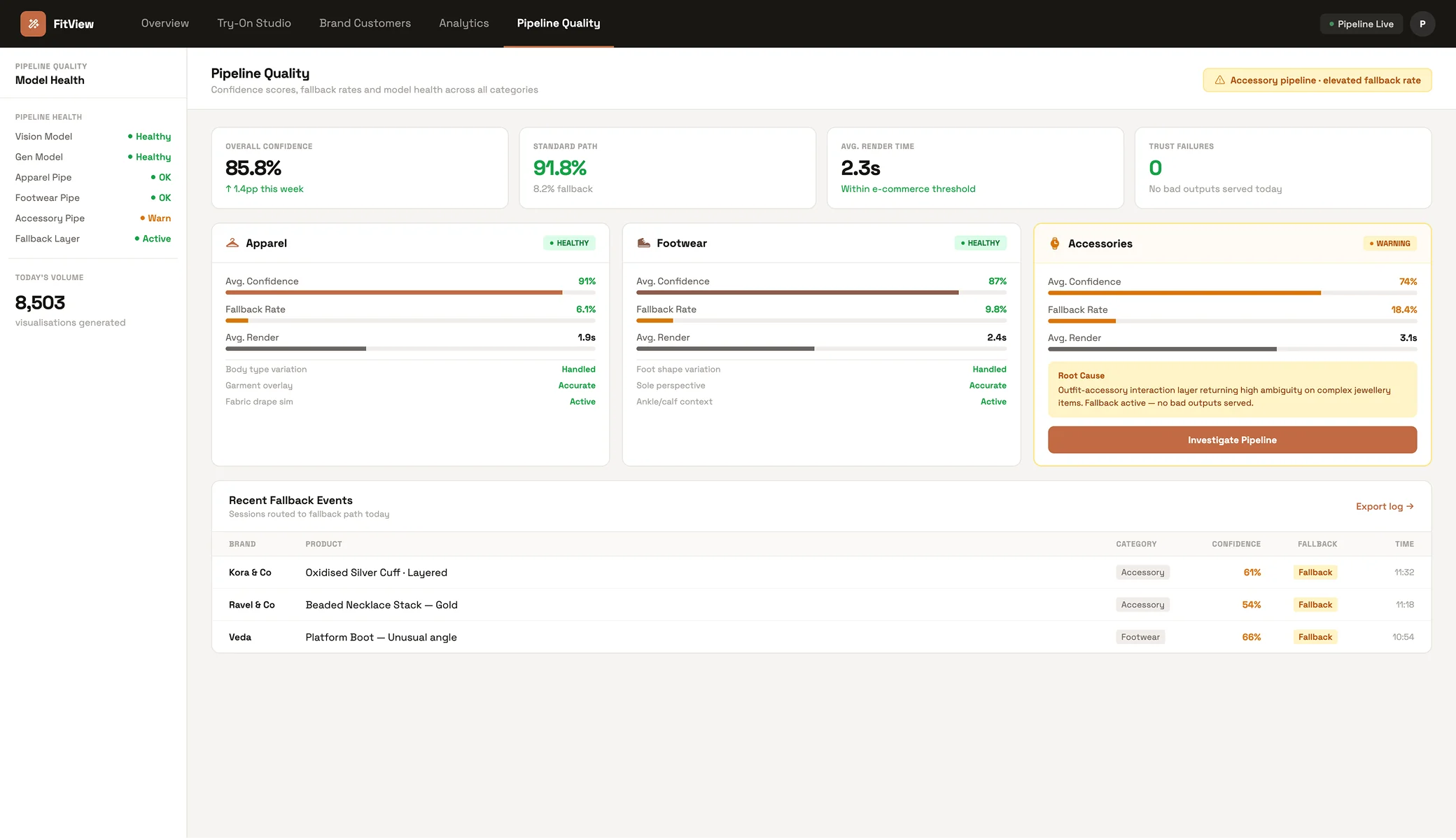
Customers can tell when an AI-generated image is wrong, even if they cannot articulate what is off, and a try-on tool customers do not trust is worse than no tool. We tuned the pipeline conservatively, biased toward visualisations that look right rather than ones that demonstrate maximum AI capability. We also worked through the failure modes: when the model is uncertain, the pipeline signals that uncertainty and routes to a fallback rather than producing a confident bad result.
Packaged for multi-customer distribution
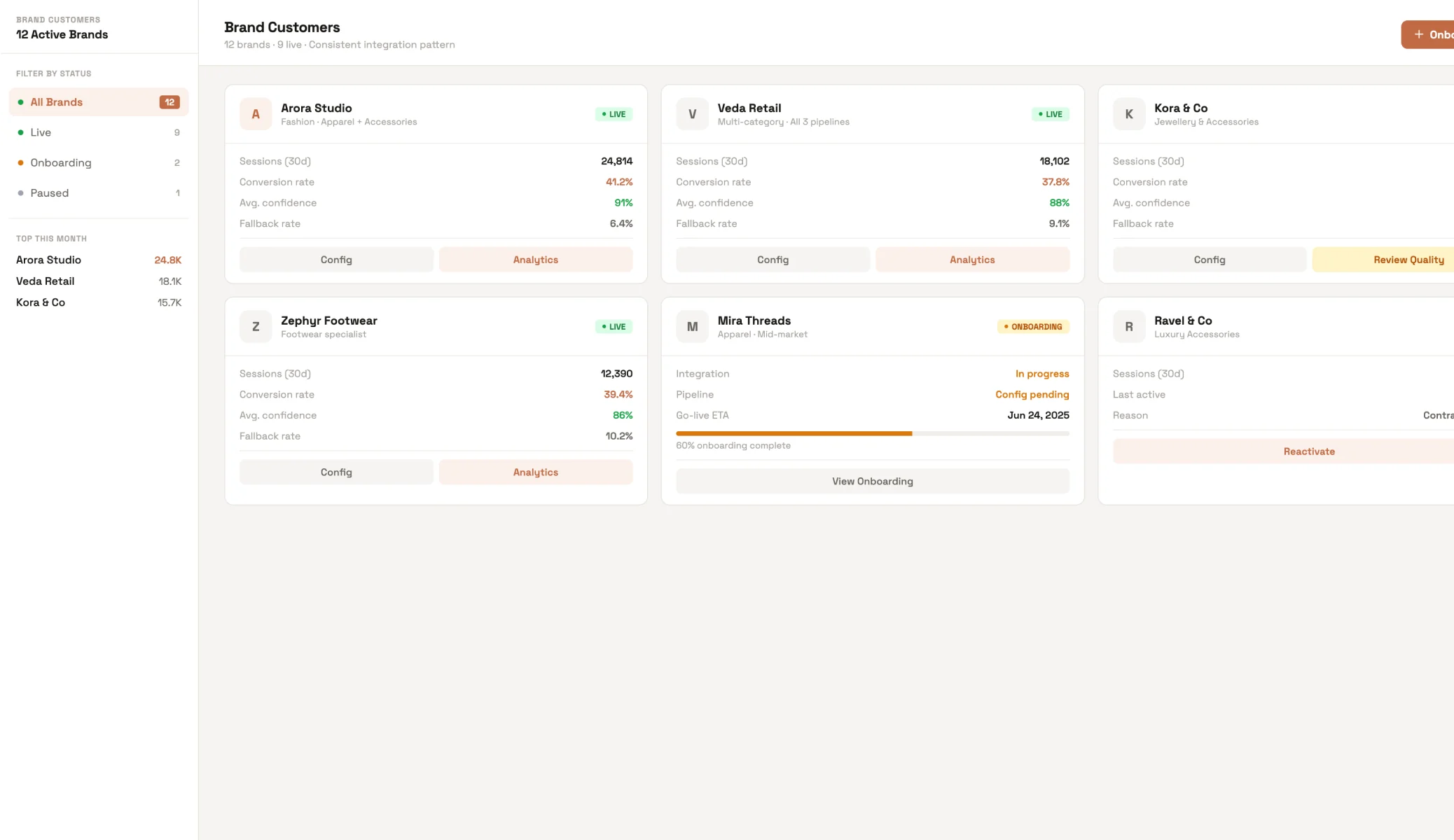
The integration approach was designed for the platform's distribution model. The capability is packaged so brand and retailer customers can integrate it into their customer-facing surfaces with minimal engineering effort. The platform team configures the integration parameters, and the underlying capability does the visualisation work consistently regardless of which customer is using it. This is the layer that makes the build commercially viable, because the same capability serves many customers rather than requiring custom integration per deployment.
The solution we built
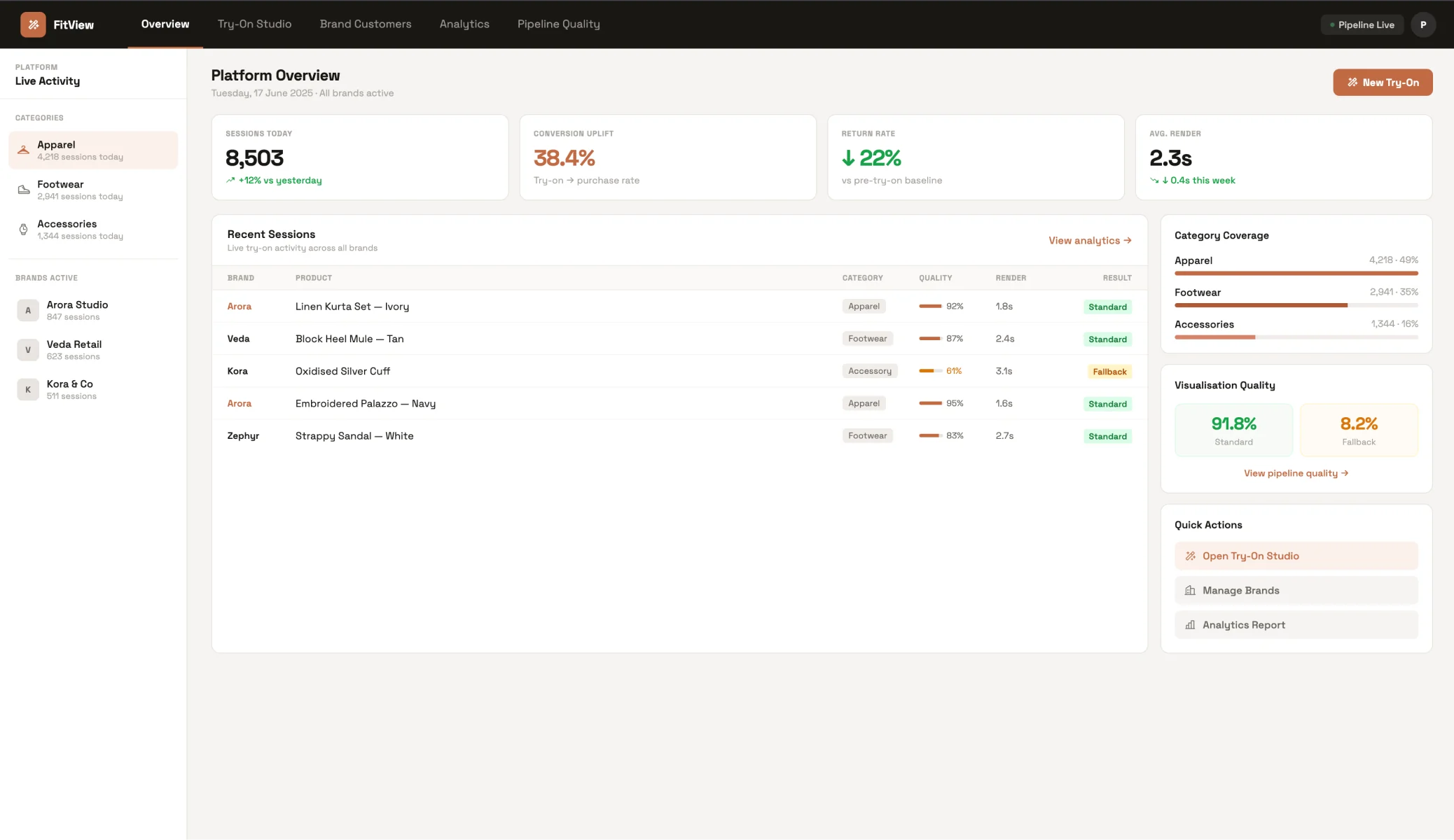
A virtual try-on tool built for the breadth of the fashion product mix the platform serves. From the end-shopper's view the experience is direct: a customer browsing a product on a brand or retailer surface can visualise it on themselves, with the apparel, footwear or accessory placed in context rather than as a flat overlay.
Computer vision and image generation pipeline
Built in Python, the pipeline runs computer vision and image generation models that place the product on the customer in context. Visualisations return fast enough to keep the shopper moving, within the response budget an e-commerce context expects, with compute provisioned for the volume the platform serves.
Apparel visualisation
Handles the variation in body types and garment styling that apparel needs to handle, so the same garment reads correctly across the range of customers shopping it.
Footwear visualisation
Accounts for the way footwear sits on different shapes of feet and the styling cues that matter in this category, which a generic apparel-tuned model gets wrong.
Accessory visualisation
Handles the interaction between the accessory and the rest of the person's outfit, which is where most generic try-on tools fail.
Multi-customer integration layer
The structural feature that makes the capability commercially deployable. Brand and retailer customers integrate the try-on through a consistent integration pattern, and new customers are onboarded without custom engineering per deployment. The platform team configures the parameters that determine how the capability behaves for each customer, with the underlying pipeline doing the visualisation work consistently.
Fallback handling that protects trust
When the model is uncertain about a specific visualisation, the pipeline routes to a fallback that produces a less ambitious but more reliable result. The customer does not see an obviously bad visualisation; they see something the platform can stand behind, which keeps customer trust intact even when the model's edge cases are encountered.
Built to extend as the capability matures
Additional product categories can be added by extending the category-specific pipelines. New visualisation modes (different angles, contexts, multi-product combinations) can be layered in without re-architecting the foundation, and the image generation models can be updated as they improve, with the platform infrastructure absorbing the upgrade.
Tech stack

Outcomes & Impact
Try-on coverage
Virtual try-on across apparel, footwear and accessories
The breadth of category coverage is what makes the capability commercially viable across the platform's customer base rather than only useful in one category. End-shoppers can now see how products would look on them rather than imagining it from a flat product shot, which is the structural change that converts hesitating customers into committed ones.
Customer differentiation
A differentiator for the platform's brand and retailer customers
Customers shopping their products now have an experience the generic e-commerce template does not offer, which points toward higher conversion on the products where try-on is available and lower returns because customers commit to products they have actually seen on themselves.
Distribution model
Deployable across the customer base without custom engineering
The integration patterns are consistent, the visualisation behaviour is predictable and the fallback handling protects customer trust even at the model's edge cases. This is the operational model that makes the capability commercially scalable across many customers.
Long-arc value
Positioned to extend as image generation matures
Each generation of model improvement can be absorbed into the platform without disrupting the customer integrations, which is the value of building the integration layer separately from the model work.
Trusted and verified by our clients


 ISO/IEC 27001:2022
 ISO 9001:2015
 GDPR compliant
Frequently Asked Questions


Tell us about your project
Tell us about your platform, the AI capability you want to deliver and where you want it to be in twelve months. A 30-minute call is the fastest way to find out whether Unico Connect is the right partner.
Prefer to book directly?
🗓️ Schedule on Calendly →Or email us:
✉️sales@unicoconnect.com