









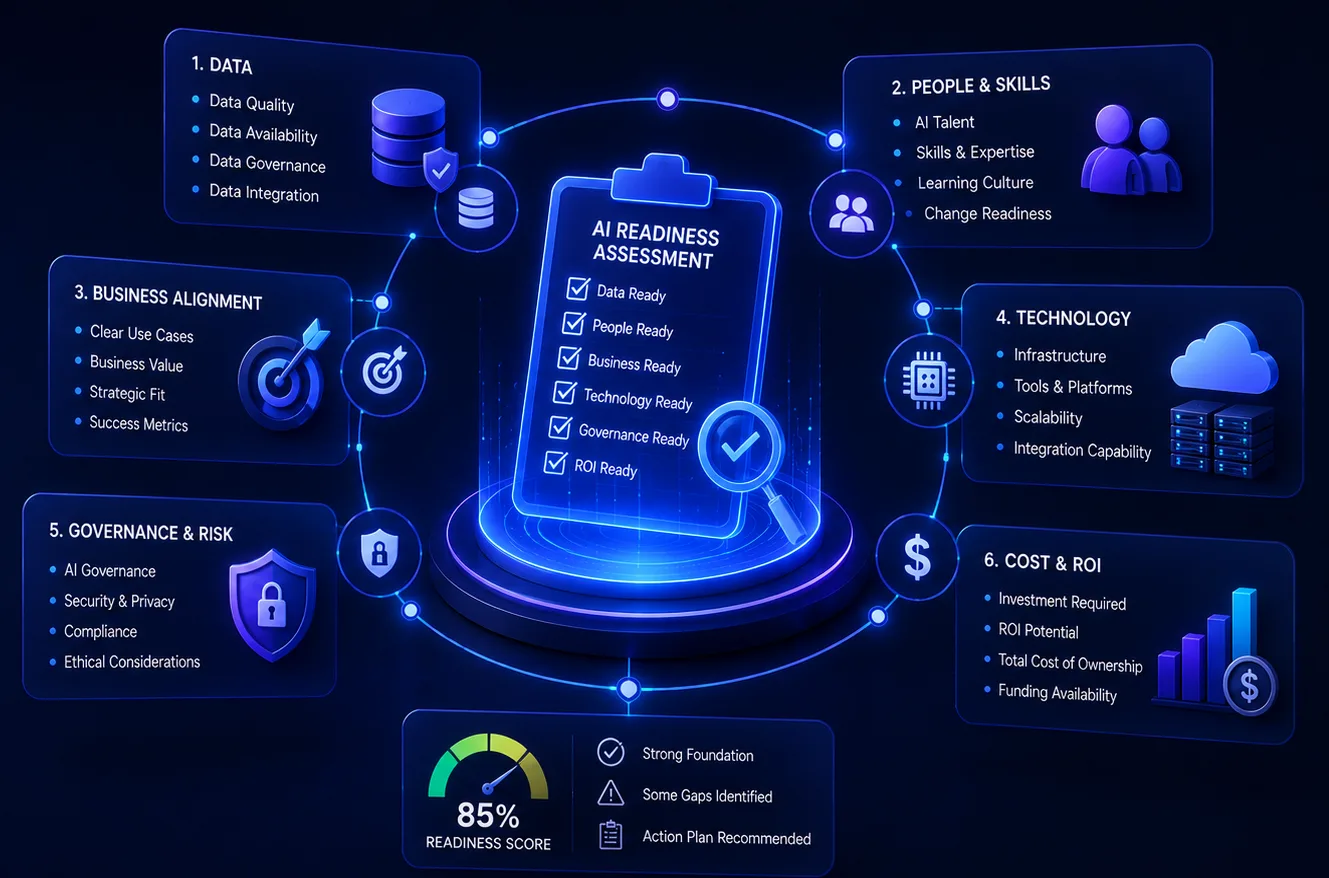
AI Readiness Assessment, What to Evaluate Before You Build

Malay Parekh
CEO & Director, Unico Connect
In this article
An AI readiness assessment is a decision process you run before the build to find out whether your organization has the right conditions to deploy an AI solution successfully. Unlike a general innovation exercise, it looks at one specific workflow and checks whether that workflow has the validated business case, accessible data, system architecture, strict governance and measurable success metrics that a production build needs.
Quick Answer
An AI readiness assessment checks whether a specific workflow can support a production AI system, and you run it before you pick a model. The five pillars it covers are business clarity, data readiness, system integration, governance and risk, and measurable success criteria. The output is a hard decision to build now, to delay until the blockers clear, or to build differently with a narrower scope or a solution that does not use AI.
Key Takeaways
- Run the assessment on one workflow before any model or vendor is chosen, because the question is whether that workflow can support AI at all.
- By some estimates more AI projects fail than succeed, often because of an unclear problem, poor data or weak infrastructure. Review those gaps before you compare model quality.
- Check all five pillars (business fit, data readiness, system integration, governance and evaluation criteria), since a decision to build now needs all five to be green.
- Audit data quality, access, freshness, structure and permissions before you blame the model. Most "AI" failures turn out to be information design problems.
- Close the assessment with a decision (build now, delay or build differently) and a tightly scoped, measurable prototype.
Why Does AI Readiness Matter Before Development Starts?
Engineering teams often rush to pick a foundation model or a vendor platform before they have checked whether their own delivery conditions are in place. The skipped checks always resurface later in the development cycle as unclear business ownership, poor workflow fit, unreliable probabilistic outputs, or serious security and compliance concerns, and by then a project that was technically feasible has stalled in operations.
For CTOs, product leaders and DevOps engineers, an AI implementation readiness phase deserves priority because it tests the problem statement itself. Over 80% of AI projects fail by some estimates that RAND cites. The practitioners RAND interviewed most often blamed leaders who misunderstood the problem, then missing or poor data, and cited the limits of AI itself less often. At that failure rate, treating a readiness assessment as optional adds an unacceptable level of delivery risk and technical debt. Our 2026 AI statistics put those failure rates next to the adoption and ROI figures.
What Should an AI Readiness Assessment Evaluate?
A practical AI readiness assessment puts the evaluation into one compact framework you can act on. It leaves out the broad organizational audit and looks hard at five pillars. They are business problem clarity, data and knowledge readiness, system and workflow integration, governance and risk controls, and strict evaluation criteria for prototype feasibility.
This enterprise AI readiness review produces a concrete build decision. It has to tell you clearly whether to go ahead with development, narrow the project scope sharply, or pause entirely until the foundational blockers are resolved.
Enterprise AI readiness checklist
- Business fit. Are the operational bottleneck and the desired outcome strictly defined?
- Data state. Is the context the AI needs accessible, structured and securely permissioned?
- System integration. Can the AI interact securely with upstream inputs and downstream APIs?
- Governance. Have you mapped the risk boundaries and the human-in-the-loop workflows explicitly?
- Evaluation. Do you have quantifiable success metrics in place before coding begins?
The 5 Checks to Complete Before You Build
1. Business problem and use-case fit
An AI readiness checklist starts with the workflow problem, and the underlying model comes later. Engineering leaders need to ask which operational bottleneck is being improved, who owns that process, and what measurable business outcome changes if the build succeeds. A focused workflow assistant built for one task will outperform a vague, unstructured "AI transformation" initiative every time.
2. Data and knowledge readiness
Most failures found in a generative AI readiness assessment are information design issues rather than model failures. Check the source data for quality, API access, freshness, structure, permissions and fragmentation. This is also the stage where architects decide what the use case depends on, whether that is static documents, real time database transactions, multimodal inputs, or internal enterprise knowledge spread across highly fragmented sources.
3. Systems and workflow integration
Technical feasibility depends heavily on integration logic, and how the model performs in isolation is only part of the picture. To judge AI implementation readiness, map exactly where the system sits in the live workflow. Architects must define the upstream data inputs, the downstream actions the system executes, the API access it needs, latency expectations, the human review checkpoints and deterministic fallback paths for when the AI fails, which it eventually will.
4. Governance, risk, and human oversight
Governance has to be a core architectural requirement from early in the process instead of a compliance layer added just before launch. An effective AI governance checklist covers data privacy, role-based security, compliance boundaries, full audit logging and how much error the organization can tolerate. It must also spell out the conditions under which human-in-the-loop review is required before an action runs.
5. Evaluation criteria and prototype scope
Defining success before the build starts is not optional. The readiness assessment must set quantifiable technical and business measures, such as retrieval accuracy, target latency, automated completion rates, engineering time saved, exception routing rates and adoption targets for end users. A good AI readiness assessment ends by recommending a tightly focused, measurable prototype scope, and it steers you away from a broad first release across the whole organization.
Build Now, Later, or Differently?
The assessment must end in a hard decision matrix that turns the diagnostic findings into immediate instructions for the engineering team.
| Decision | When to choose it | Signal |
|---|---|---|
| Build now | Workflow integration, data access, governance, and success metrics are explicitly clear | Green across all five checks |
| Delay the build | Foundational blockers remain unresolved | Fragmented data permissions, undefined human-in-the-loop workflows |
| Build differently | The use case is too vague to measure | Choose a narrower scope or a non-AI deterministic solution |
Final Takeaway
Before any build, the question that matters most is whether the organization has the structural conditions to make the system useful and secure, and to keep supporting it once it is live. Which language model to deploy is a decision for later. Running a structured AI readiness assessment before prototyping means you do not waste expensive engineering cycles on workflows that are not ready.
Frequently Asked Questions
What is included in an AI readiness assessment?
An AI readiness assessment covers five areas, namely business problem clarity, data and knowledge accessibility, system integration feasibility, governance and risk controls, and strict evaluation metrics set up to judge whether the prototype succeeded.
How is an AI readiness assessment different from an AI maturity assessment?
An AI maturity assessment looks at the whole organization, while an AI readiness assessment looks at one project. The maturity review covers organizational culture, infrastructure across the enterprise and overall data literacy. The readiness assessment asks whether one specific, isolated workflow is technically and operationally prepared for software development to start now.
When should a team use an AI readiness checklist?
Use an AI readiness checklist during the initial budgeting phase, before you evaluate vendors, and in any case before anyone writes prototype code. Doing it that early gets the technical and business stakeholders aligned before the build starts.
What does enterprise AI readiness look like before a prototype?
An enterprise that is ready for AI has clear business ownership, data that is highly accessible and structured, a defined workflow and approved governance boundaries before the prototype starts. It also has success criteria that were set in advance and can be measured.
When is a generative AI readiness assessment more useful than a broader review?
A generative AI readiness assessment is more useful than a broader review when the proposed use case depends heavily on complex language generation, dynamic retrieval-augmented generation (RAG) pipelines, or multimodal interactions, since those bring high prompt drift and probabilistic risk. Our AI development team can run this readiness assessment before your build.