










Governing AI Agents at Enterprise Scale, Identity, Access, and Audit

Malay Parekh
CEO & Director, Unico Connect
In this article
Quick Answer
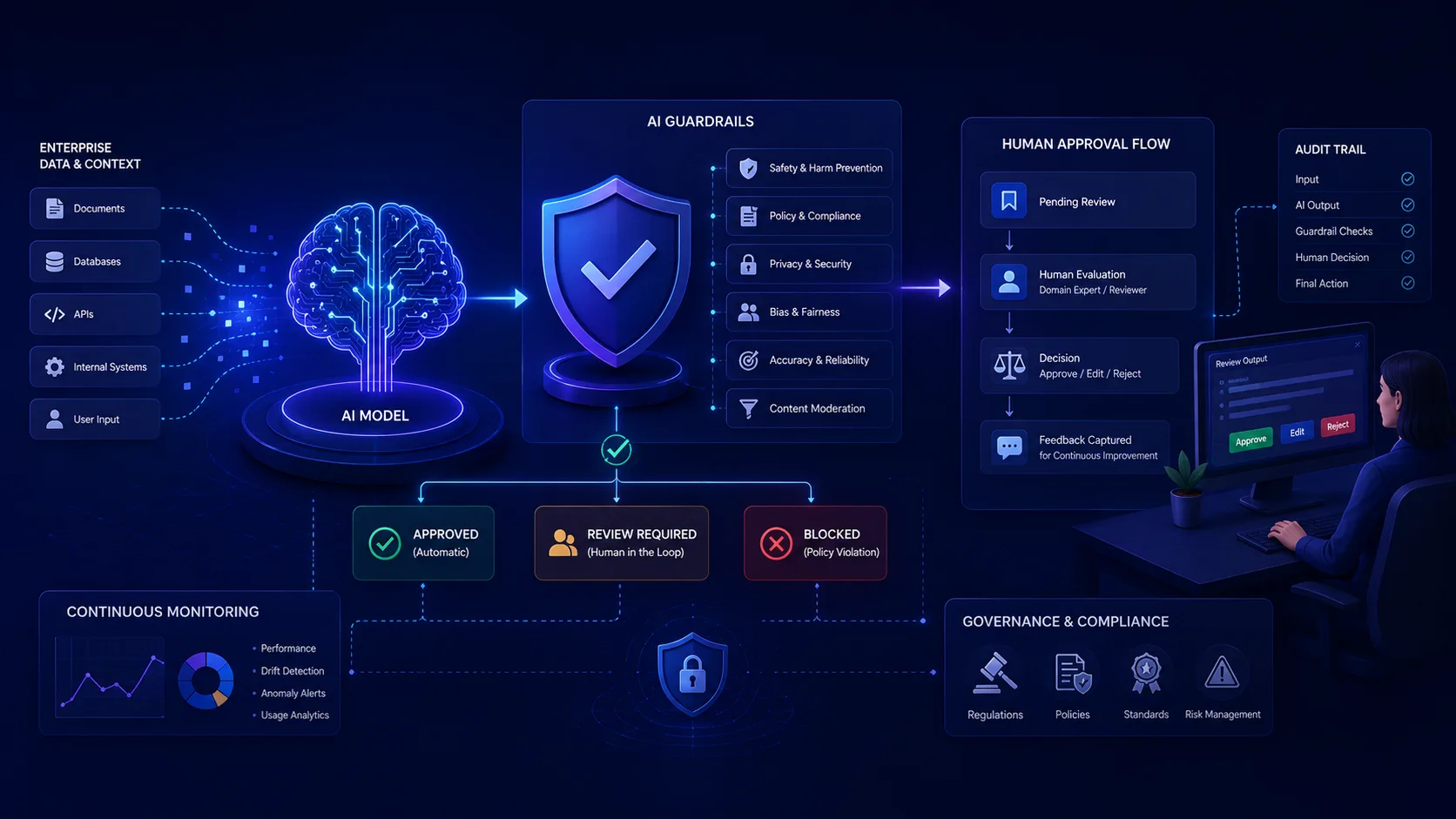
A working governance model for AI agents rests on four pillars, namely agent identity, scoped access, audit trails and continuous monitoring. Agents are entering enterprise operations faster than organisations can govern them, so the question has moved from "what can the agent do?" to "what is it allowed to do, and how do we prove it after the fact?" Each pillar maps directly to the access-management and audit controls that procurement teams already evaluate vendors against.
The Governance Gap
The pace of AI agent deployment has outrun most enterprise governance frameworks. I put it this way to DesignRush News in April 2026.
"Businesses have moved past fragmented, one-off implementations and now need structured ways to govern their AI workforce. That includes identity controls, defined access, and clear accountability."
The early agent deployments were tactical (a chatbot here, an automation script there), and each was small enough that informal oversight worked. The current wave is structural. Agents now sit inside core workflows and act across multiple systems, sometimes starting other agents, and at that scale informal oversight stops being credible.
Pillar 1, Agent Identity
Every agent gets its own identity, distinct from the user it acts on behalf of. This is the single most important governance primitive and the one most teams skip.
Three rules make that concrete.
- Each agent has a unique credential (OIDC subject, service-account token or signed key), and its permissions attach to that credential instead of being borrowed from a human.
- Delegated authority is explicit. When the agent acts for a user, the audit log records both identities (the agent and the user it represented).
- Agent identities are created, rotated and revoked through the same lifecycle process as service accounts, and a decommissioned agent has its credentials retired immediately.
Without per-agent identity, every governance decision downstream becomes ambiguous, because the audit log can only say "the system did X", which is useless. With it, the log says "the order-intake agent acting for user 4521 did X", and that action becomes auditable, accountable and controllable.
In control terms, this pillar covers identity management, authentication and access-rights review, the same controls auditors check for any non-human service principal.
Pillar 2, Scoped Access
An agent registered to handle "order intake" should not be able to issue refunds, change pricing, or read unrelated customer data. Scope every agent to the minimum permissions its job requires, which is least privilege applied to non-human principals.
In practice, scoping works like this.
- Per-agent permission scopes are declared statically, and the orchestration layer enforces them.
- Tool-call scoping. An agent can invoke only the tools its scope allows, even if other tools exist in the registry.
- Data classification awareness. Agents handling restricted data run on infrastructure cleared for that classification (for example, HIPAA workloads go to isolated endpoints instead of shared multi-tenant inference).
- Time-bounded elevations. When an agent needs temporarily elevated access (for example, to clear a stuck queue), the elevation is logged and time-limited, and someone reviews it.
The matching controls are access control, access-rights enforcement and information-access restriction.
Pillar 3, Audit Trails
Everything else in this model is built on the audit log. If you cannot reconstruct what an agent did, with what inputs, on whose behalf and with what outputs, you cannot govern it.
For every agent action, log the following.
- Agent identity and (if applicable) user identity it acted for
- Input (exact prompt, retrieved context, tool inputs)
- Output (model response, tool outputs, and side effects such as DB writes and API calls)
- Model + prompt version, retrieval pipeline version
- Timestamp, latency, cost
- Outcome (success, partial, failed or escalated)
Retain logs for the period your applicable regulations require, typically 1 to 7 years depending on industry, and make them queryable. The first time something goes wrong, you will need to answer "what did the agent know when it decided that?", and that answer has to come back in minutes rather than days.
The audit trail satisfies the controls for event logging, monitoring activities and the collection of audit evidence.
Pillar 4, Continuous Monitoring
Agents drift as models change, source data changes and retrieval pipelines decay, so an agent that worked in production last quarter may quietly degrade over the next quarter.
Operational monitoring for agents covers four areas.
- Behavioural metrics (task completion rate, escalation rate, average steps per task). Tracking their trend shows drift early.
- Eval set runs, meaning continuous evaluation on a curated test set with alerts on regressions. Our piece on continuous AI evaluation goes into the underlying discipline.
- Cost and latency on per-agent dashboards. Cost overruns are often the first signal that a change in the system has unintended consequences.
- Anomaly detection on the audit log, to catch unusual sequences of tool calls, sudden volume spikes and off-hours activity.
Monitor agents as seriously as you monitor production applications. If the on-call rotation cares about the order-intake API, it should care equally about the order-intake agent.
On the control side, this maps to monitoring activities and to change management for prompt and model rollouts.
A Starter Checklist
If your organisation is deploying agents and has nothing formal in place, start with this list.
- Every agent in production has a unique identity, separate from any user
- Permissions for each agent are declared statically and enforced at runtime
- An audit log captures every agent action with inputs, outputs, and identities
- At least one behavioural metric per agent has a dashboard the team checks weekly
- A documented process exists for retiring an agent (credential revocation, scope removal, data disposition)
- Compliance and risk teams have signed off on the scope of agent-accessible data
You do not need a perfect governance framework on day one, but you do need each of these six items present at some level of maturity, with a roadmap to improve them.
What This Means for Procurement
Buyers evaluating AI vendors in 2026 are starting to ask these agent-governance questions explicitly.
- Show us your agent identity model.
- How are agent permissions scoped, and how do we audit them?
- What is in the audit log? How long is it retained? Can we export it?
- Which security and audit controls apply to the agent layer specifically?
Vendors with credible answers to these questions move forward in evaluations, and the ones who hand-wave do not. We have seen procurement cycles stall by months over exactly these questions, and close quickly when the vendor walks in with the answers already prepared.
Closing Thought
The infrastructure pieces for agent governance (identity providers, audit log systems, monitoring dashboards) are familiar, and none of this requires new tools. It takes the discipline to apply tools you already have to a new class of actor inside the system. Most teams have the building blocks, so the work is in the assembly.
Frequently Asked Questions
What does "agent identity" mean in practice?
It means each AI agent gets its own credential (an OIDC subject, service-account token or signed key), distinct from the user it acts on behalf of. Permissions are tied to that agent credential, and audit logs capture both the agent identity and the delegated user identity. Without per-agent identity, audit trails become ambiguous and least-privilege scoping is impossible.
Which security and audit controls apply to AI agents?
The most directly relevant areas are access control, identity management, authentication, access-rights review, information-access restriction, event logging and monitoring, and evidence collection. Change-management controls also apply to prompt and model version rollouts.
How long should I retain AI agent audit logs?
Match the retention to your most stringent applicable regulation, which typically means 1 year minimum for general compliance and 6 to 7 years for healthcare (HIPAA) or financial services. Logs must be queryable and tamper-evident. Store them in a system designed for audit data instead of relying on application logging alone.
What is the difference between governing AI agents and governing human users?
Agents act faster, in higher volume and across more systems than humans, and they cannot exercise judgement about whether an action is appropriate beyond their training. The frameworks are similar, but those traits mean agent governance depends more on static scoping, structured audit and monitoring than on culture and training.
What is the most common AI agent governance mistake?
The most common mistake is sharing a single credential across multiple agents, or worse, having agents use the credentials of a human. This collapses identity, makes the audit log useless for accountability and creates blast-radius issues when the credential is compromised. Per-agent identity is the fix that everything else depends on.
This article expands on remarks by Malay Parekh in DesignRush News, April 2026. Unico Connect builds AI agent platforms with governance controls in place from day one. See our Agentic AI service and Cloud & DevOps.