








Built an AI-led operations enablement system that Unico uses internally to document projects, report status and run governance with the discipline that scaling delivery requires
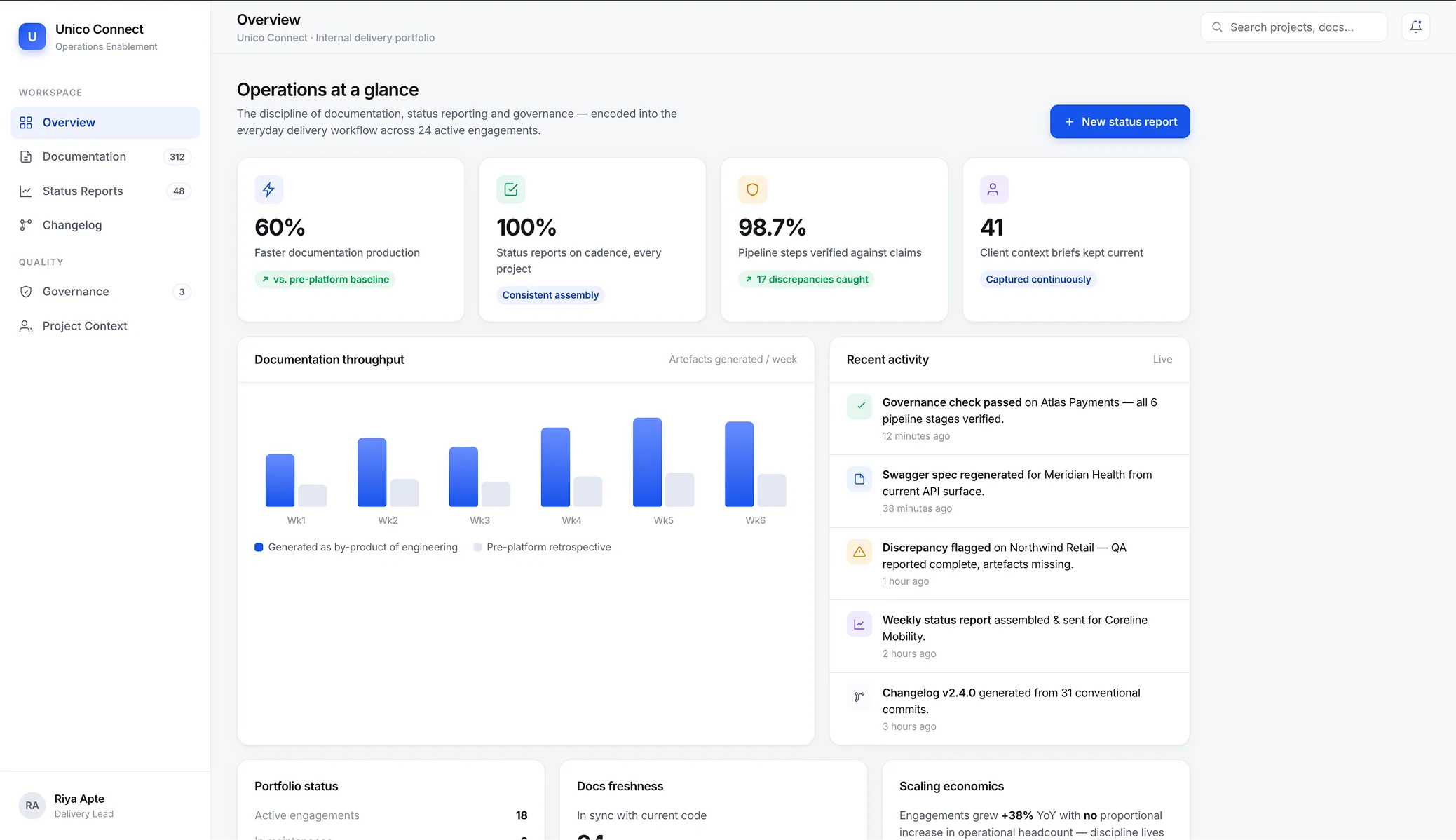
A working AI-led operations platform built by Unico Connect for Unico Connect, encoding the company’s documentation standards, status reporting cadence, governance workflows and project context discipline into an everyday operations layer.
Key Takeaways
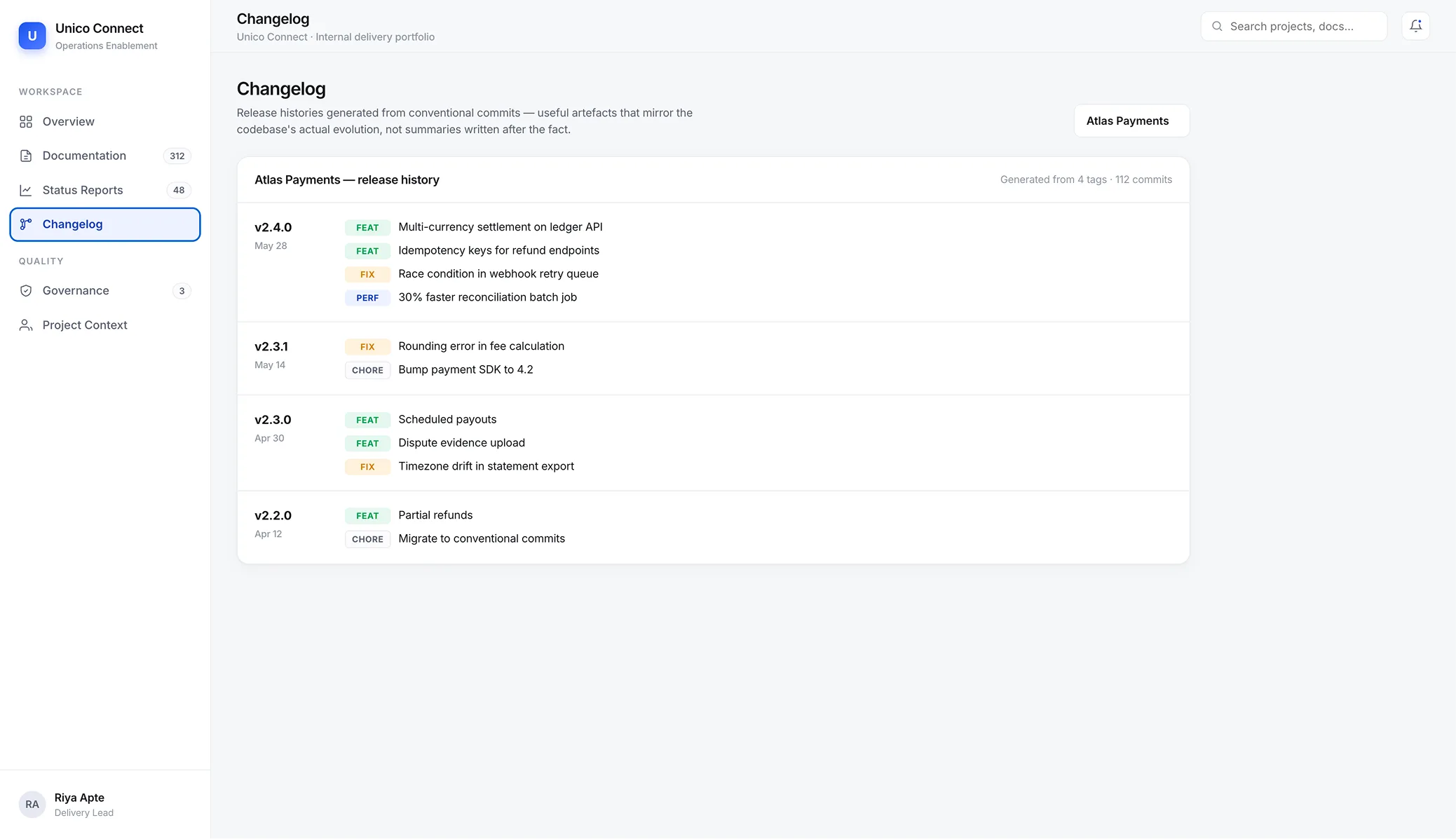
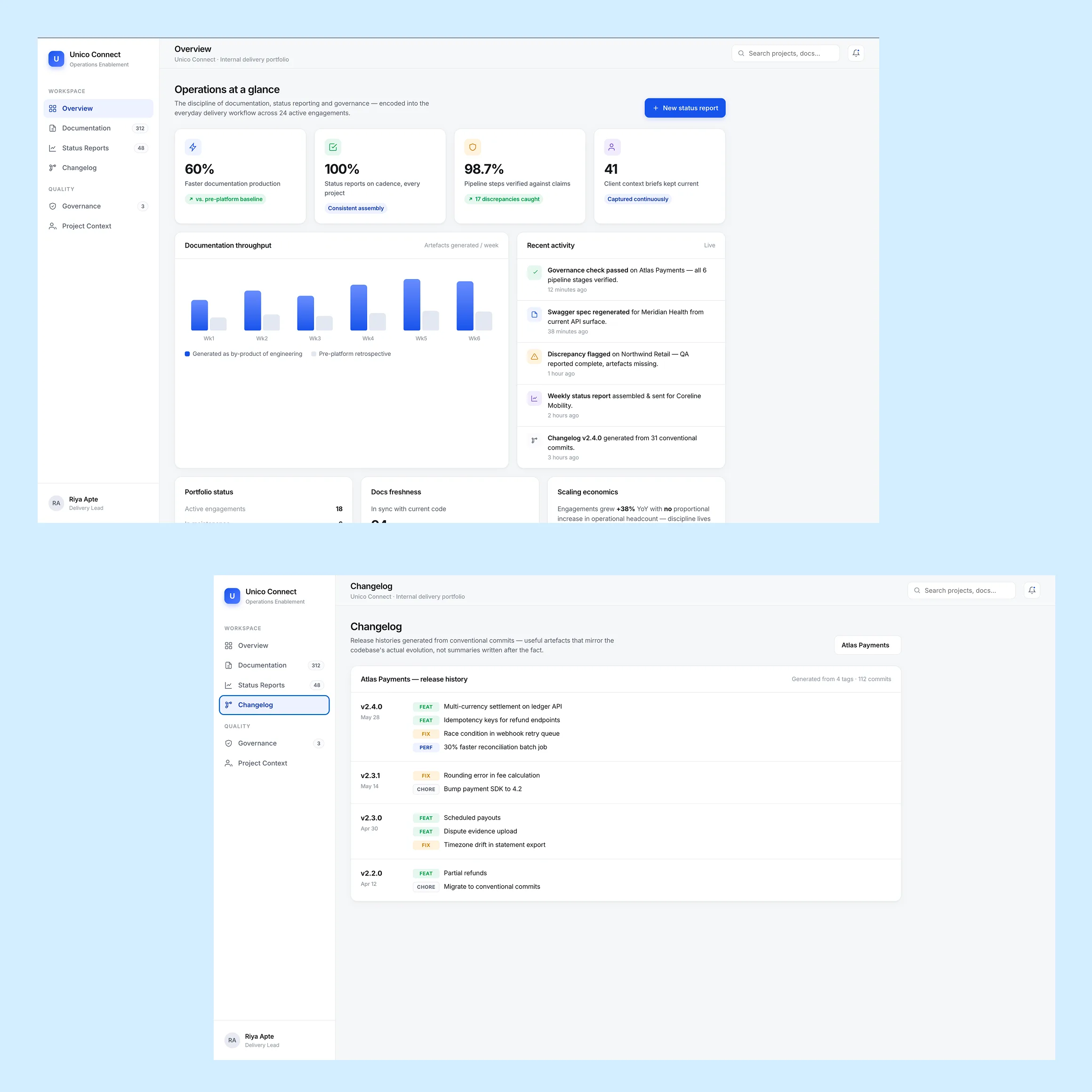
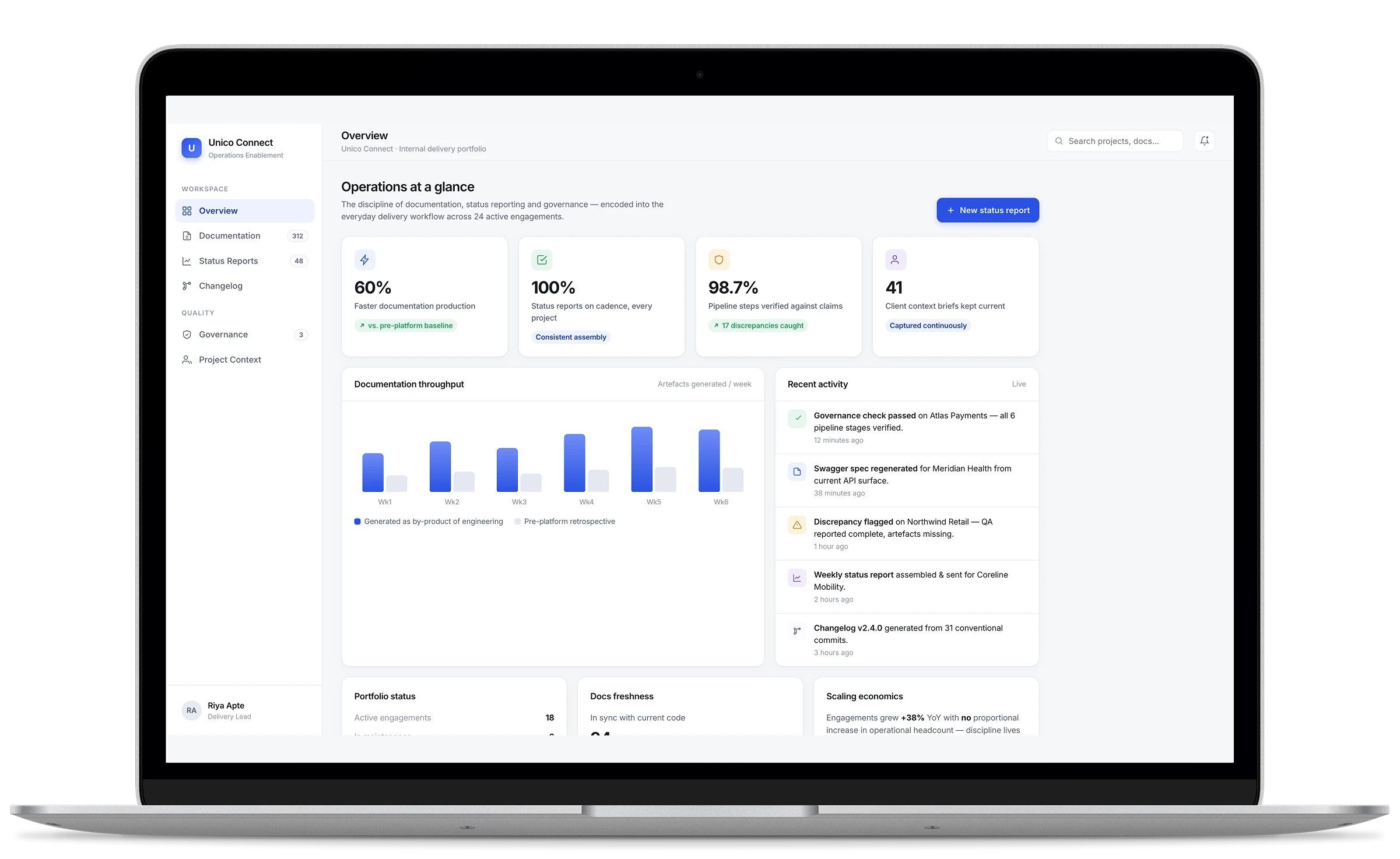
Unico Connect built an AI-led operations enablement system for its own team, encoding the company’s documentation standards, status reporting patterns, governance discipline and project context capture into an everyday operations layer.
The team uses it to produce documentation 60 percent faster, deliver status reports with consistency across projects, and run governance that verifies work was actually done at the quality bar claimed rather than just promised.

The Challenge
Software services companies live or die on operational discipline. Running projects, documenting decisions, reporting status to clients, managing changelogs across releases, capturing project context for handoffs, verifying that delivery commitments were actually met — none of this shows up on a marketing site, but all of it determines whether a company can scale delivery without losing the quality that distinguishes it. Operational discipline is hard to maintain consistently as a team grows, and most companies hit quality drift once delivery volume exceeds what a single experienced operator can personally oversee.
Unico Connect had spent years building operational practices that worked — documentation patterns, status reporting cadences, governance workflows, changelog discipline. Each worked when senior operators were directly involved, but applying them consistently across a growing team and project portfolio was getting harder. The cost of inconsistency is real even without a visible incident: variable documentation slows future engineers, variable reports erode client confidence, and governance that depends on senior involvement makes the senior team a bottleneck rather than a quality multiplier.
The company saw the same opportunity engineering and sales had: encode the operational discipline into an everyday platform the team interacts with as they work. Every status report would land at the same quality bar regardless of who produced it, every piece of documentation would meet the standards from the start, and every project would carry the context capture and governance discipline the company’s quality reputation depends on.
Our Approach

Unico engineered the operations platform alongside the engineering and sales platforms, each tuned to its specific reality. The first phase was inventorying the operational knowledge that should sit inside it — documentation standards (READMEs, architecture docs, API specs, integration guides), status reporting patterns, governance frameworks, changelog generation, project onboarding patterns and the client context briefs that capture the working knowledge of an engagement.
Key decisions:
Operations as a by-product of delivery
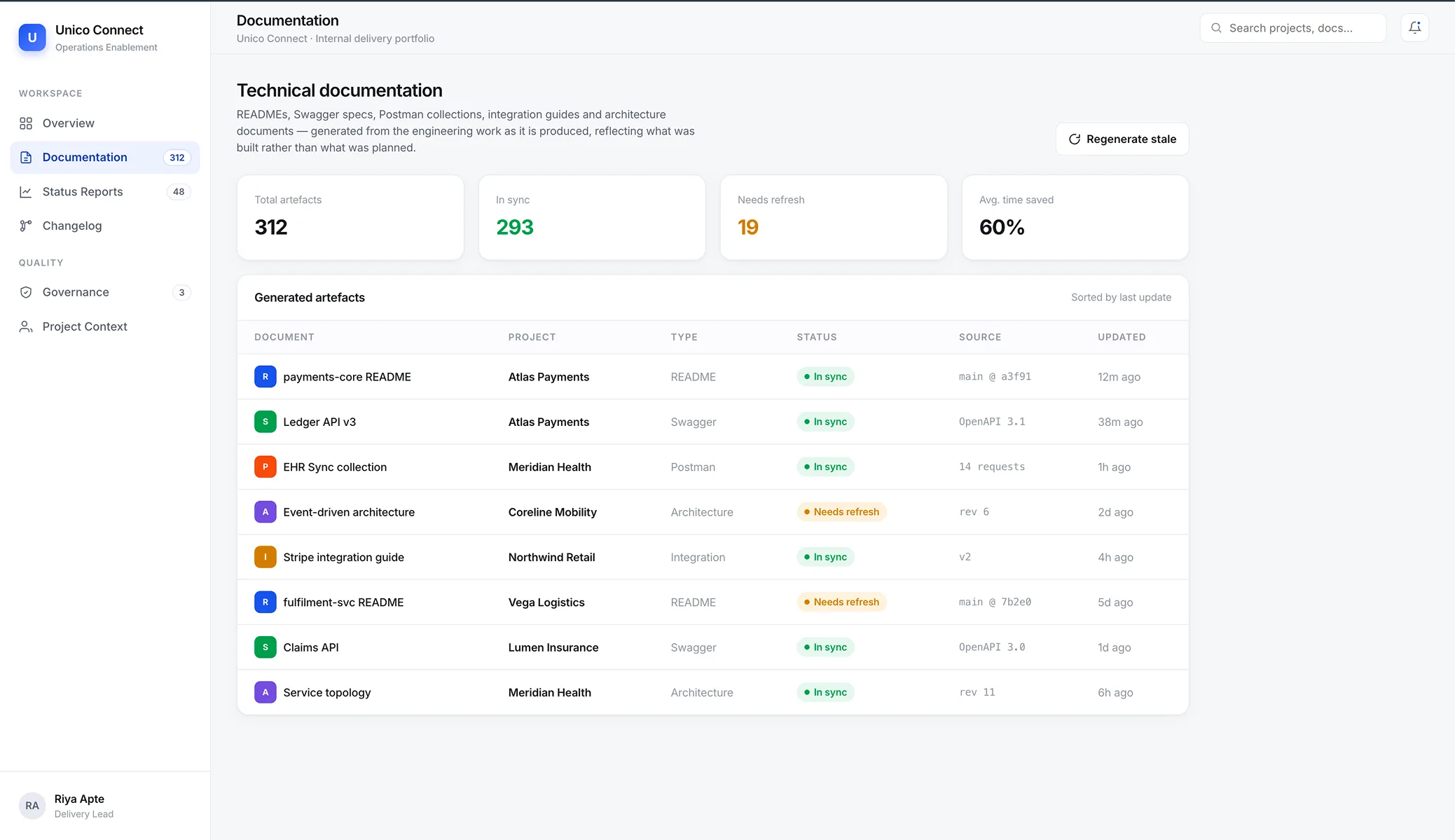
Documentation emerges from the engineering work rather than being written in retrospect; status reports are assembled from actual project state rather than a separate process — integrated operations, not parallel operations.
Each capability at the moment it matters
API specs reflect the API that was built, changelogs run from conventional commits, status reports pull from the project’s real state — the platform surfaces the right output where it is actually needed.
Governance that verifies, not just reports
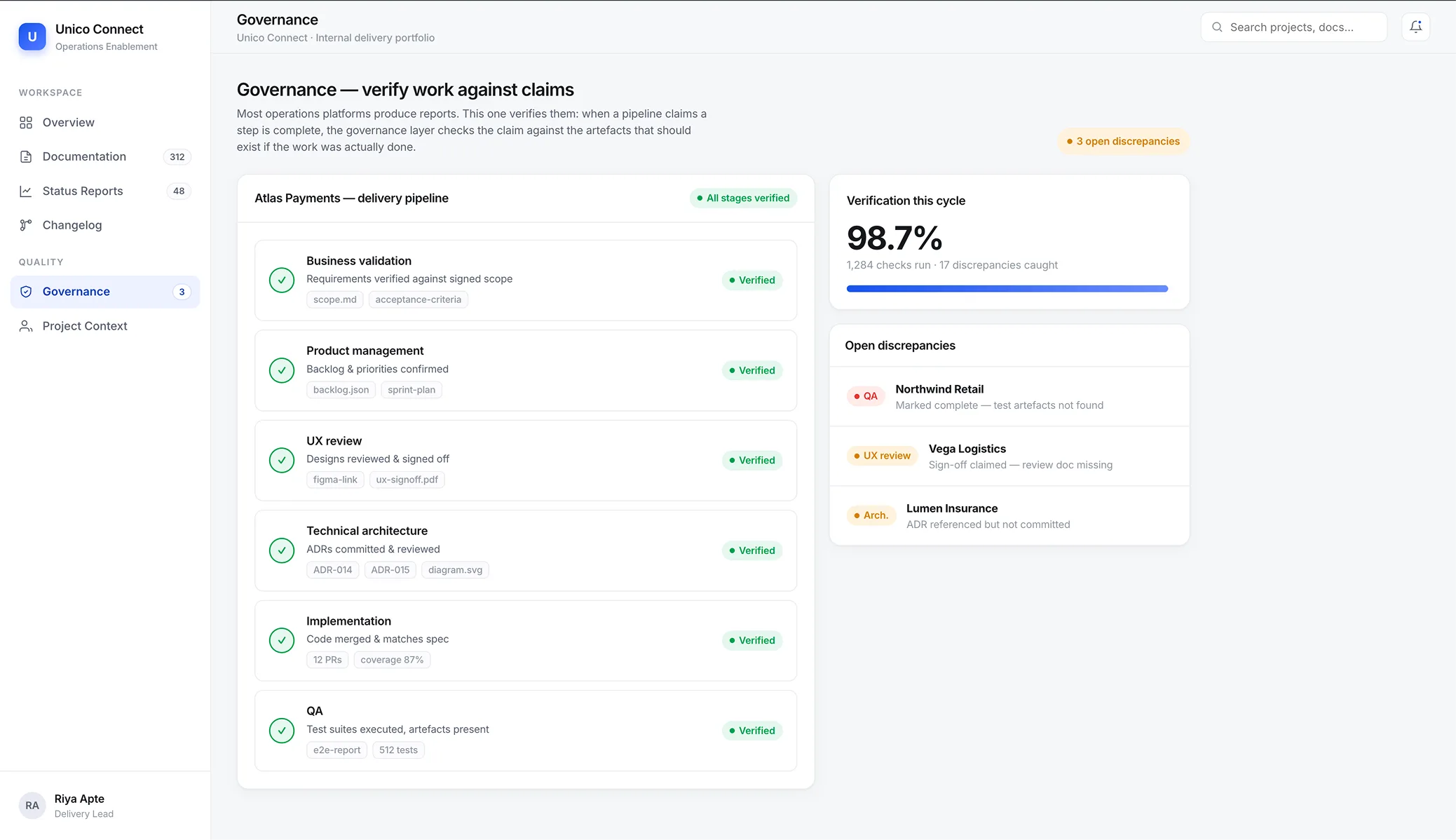
Most operations platforms produce reports; this one verifies them — checking a claimed step against the artefacts that should exist if the work was actually done, addressing one of the harder problems in delivery at scale.
The solution we built
A set of integrated operations capabilities the team operates with through their delivery workflow — documentation, status reporting, changelogs, governance verification and project context, each produced from the actual delivery rather than a parallel reporting layer.
Technical documentation
READMEs, Swagger specs, Postman collections, integration guides and architecture documents generated from the engineering work as it happens — reflecting what was built, not what was planned.
Status reporting
Weekly, monthly and sprint reports assembled from the project’s actual state, landing at the same quality bar across projects so the company reads as one operational entity.
Changelog generation
Release histories generated from conventional commits — useful artefacts for active development and for the audit and support work maintenance engagements require.
Governance verification
Verifies each claimed pipeline step (validation, spec, UX, architecture, implementation, QA) against the artefacts that should exist — making verification a routine step rather than a special audit.
Outcomes & impact
60%
Faster documentation production
Consistent
Status reports across every project
Governed
Delivery work verified against claims
Trusted and verified by our clients


 ISO/IEC 27001:2022
 ISO 9001:2015
 GDPR compliant
Frequently Asked Questions
Let's Build Your Team
Tell us about your project, the operational maturity you expect from your delivery partner and where you want to be in twelve months. We reply within one business day.
Prefer to book directly?
🗓️ Schedule on Calendly →Or email us:
✉️sales@unicoconnect.com