










Built a customer purchase history and admin platform that unifies invoices, returns and exchanges across outlets
A web platform connecting customers and authorised staff to a single view of purchase history across the retailer’s outlets, with invoice access, returns and exchange tracking, OTP-protected customer onboarding and role-based admin controls.
Key Takeaways
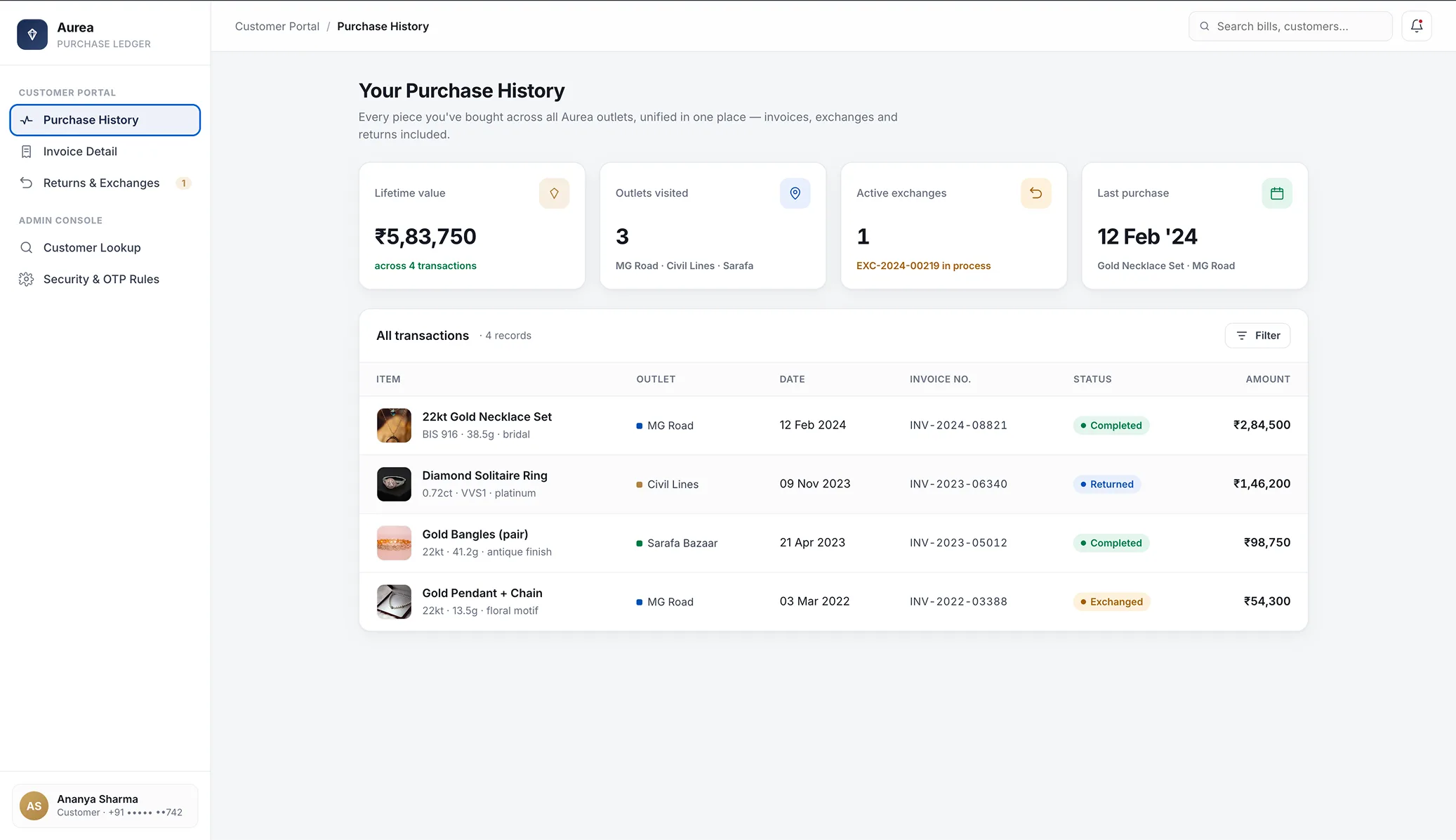
A multi-outlet jewellery retailer came to Unico Connect to bring purchase history out of the cash counter and into a customer-accessible platform. We built a web application connecting customers and authorised staff to a single view of purchase history across the retailer’s outlets, with invoice access, structured returns and exchanges handling, OTP-protected onboarding and a role-based admin panel.
The platform replaces the previous reality where customers had to physically visit outlets to retrieve transaction records.

The Challenge
The client operates a jewellery retail business with multiple outlets, where customer relationships often span years and individual transactions can be significant in value. The category is built on trust and continuity — customers return to the retailer they trust for the next wedding gift, anniversary purchase or exchange. That continuity depends on the retailer being able to access the customer’s history, and on the customer being able to access it too.
Before this engagement, purchase history lived inside the retailer’s point-of-sale and ERP systems, which the customer never saw. If a customer wanted to know what they had bought two years ago, they had to come to an outlet and ask. If they wanted to exchange or return something, staff looked up the transaction manually — often across systems if the original purchase happened at a different outlet. For a category where exchanges and returns are routine, this was friction eroding the customer experience on every interaction.
The constraints were practical: integrate with the existing POS so purchase records flow in automatically, OTP-based authentication for a sensitive dataset and a customer base of varying digital comfort, returns and exchanges handled with the retailer’s real nuances (including the partial-refund treatment of older return bills), and an admin layer tight on access control — authorised staff seeing customer data was acceptable, uncontrolled access was not.
Our Approach

We engaged as a product partner, structured around three things: the customer-facing experience, the admin control layer and the integration with the existing POS and ERP. The first phase was understanding the retailer’s transactional reality, which has nuances a generic e-commerce template does not capture — bill referencing, partial-refund logic on older transactions, and the importance of the bill image itself as a customer-facing artefact.
Key decisions:
Material UI used directly
React with Material UI as the design system, used directly by developers, kept the engagement focused on functionality rather than a parallel design track — the right trade for a clarity-first purchase-history platform.
Real-time POS/ERP integration
Purchase records flow in as transactions happen, contact details stay synchronised, and voided bills reflect automatically — treated as real-time rather than daily-batch so customers and staff never see different things.
Protection by default
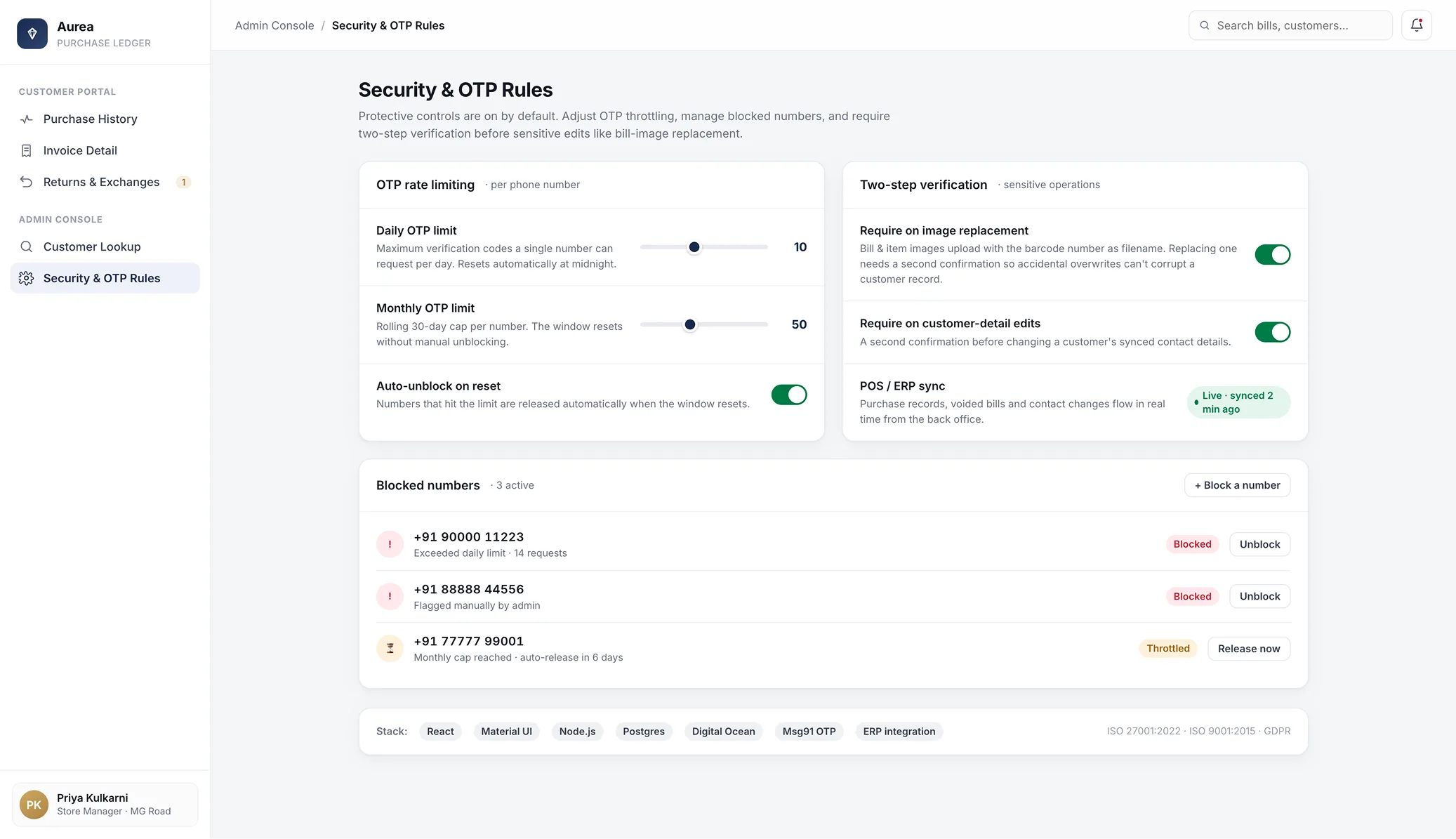
OTP rate limiting (10/day, 50/month per number with automatic reset) and two-step verification on sensitive edits were built in as default behaviour, not added after an incident.
The solution we built
The platform consists of three integrated surfaces: the customer-facing web app, the staff and admin panel, and the integration layer with the retailer’s POS and ERP — with customers and staff seeing the same data, scoped to what each role is allowed to see.
Customer purchase history
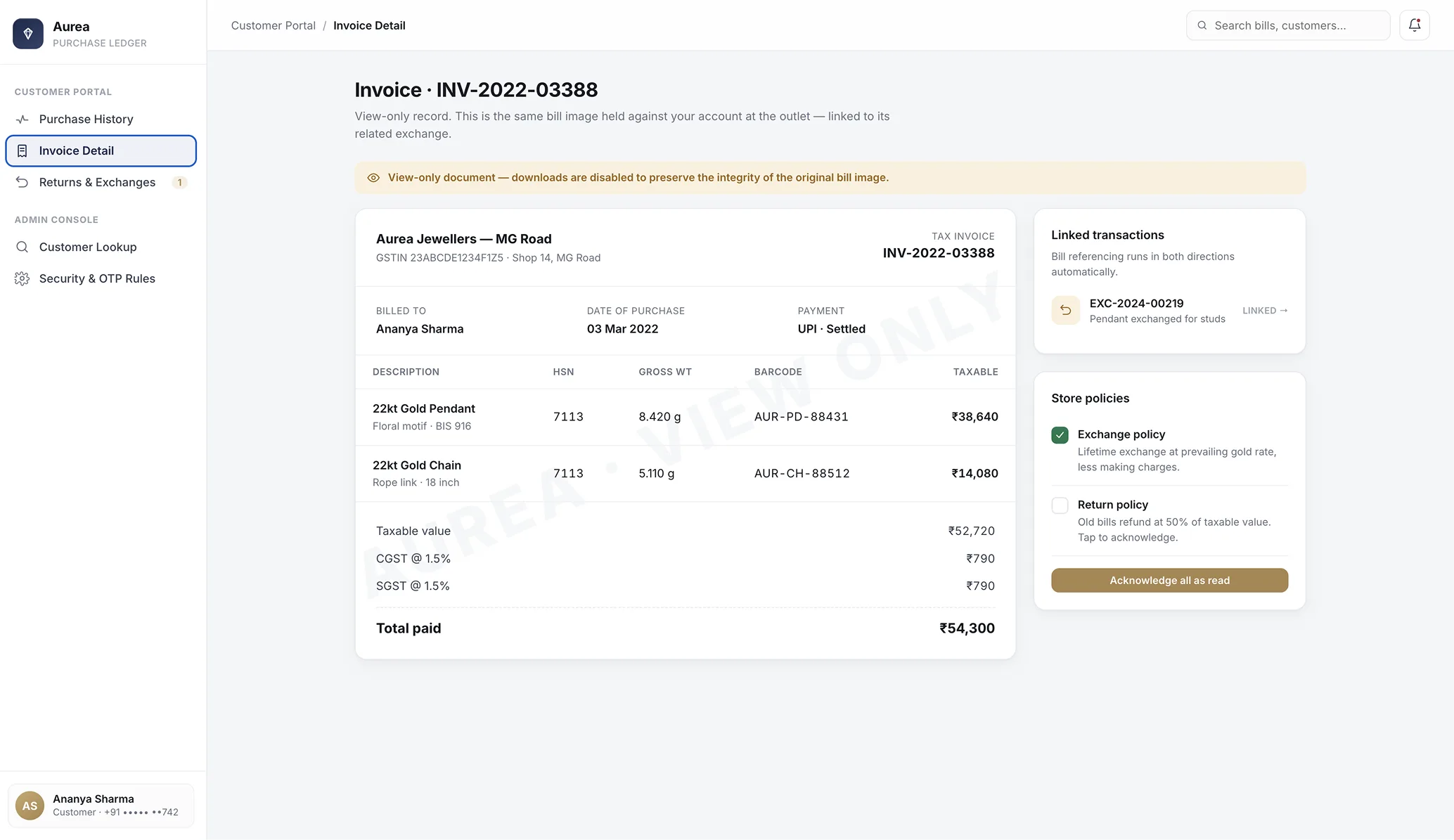
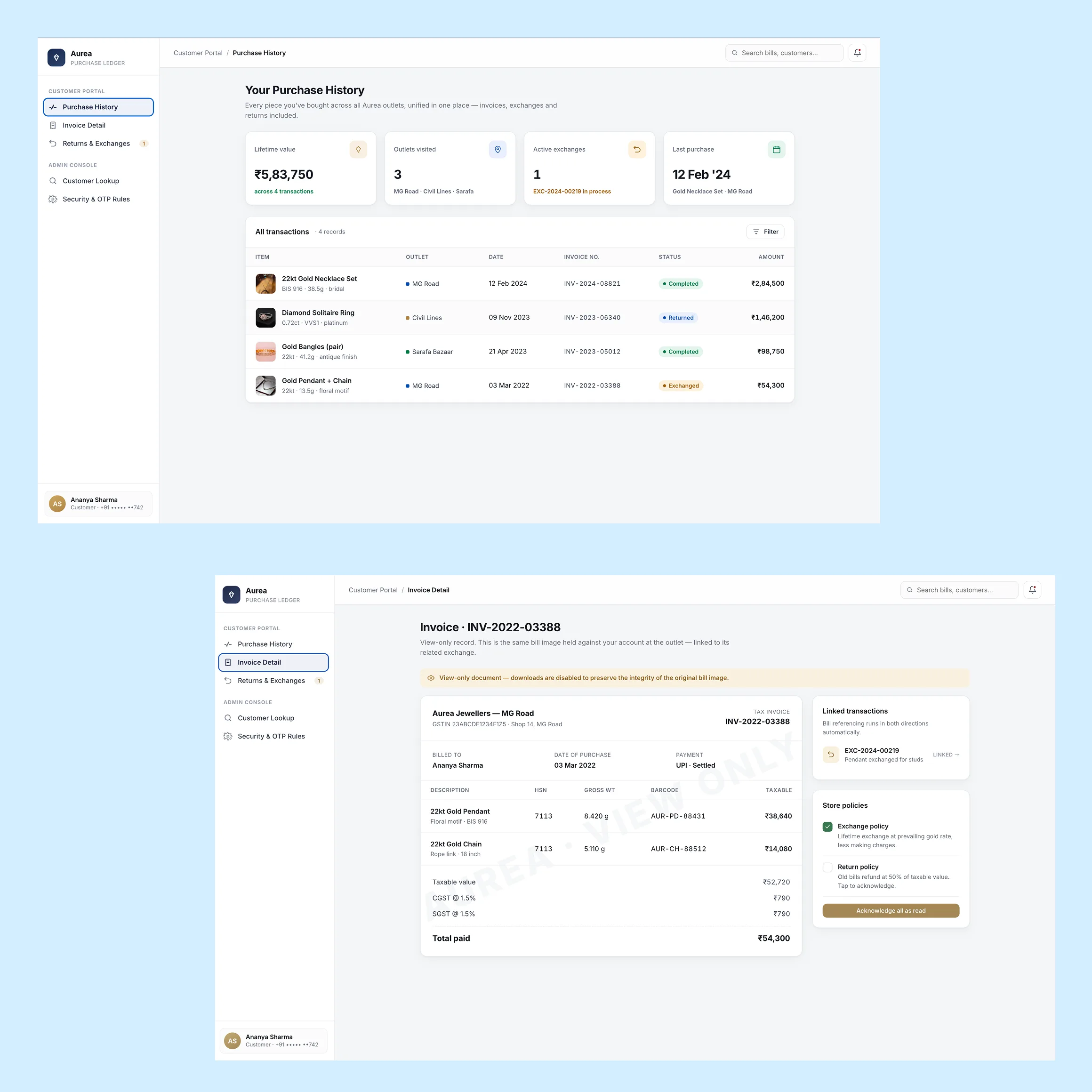
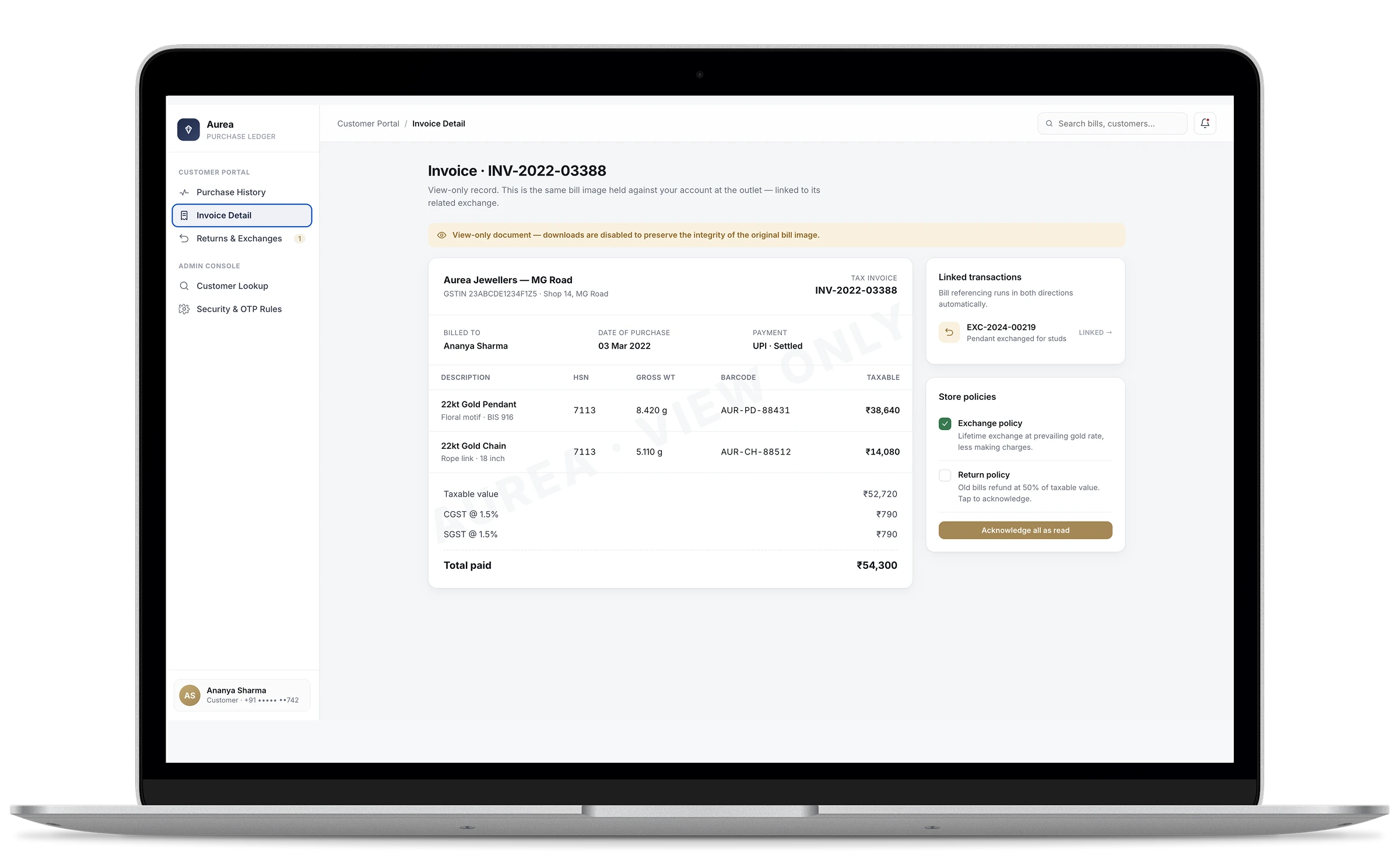
Customers see what they bought across outlets, view invoices (view-only to preserve integrity), see exchange and return references, and acknowledge policies with a “tick as read”.
Role-based admin panel
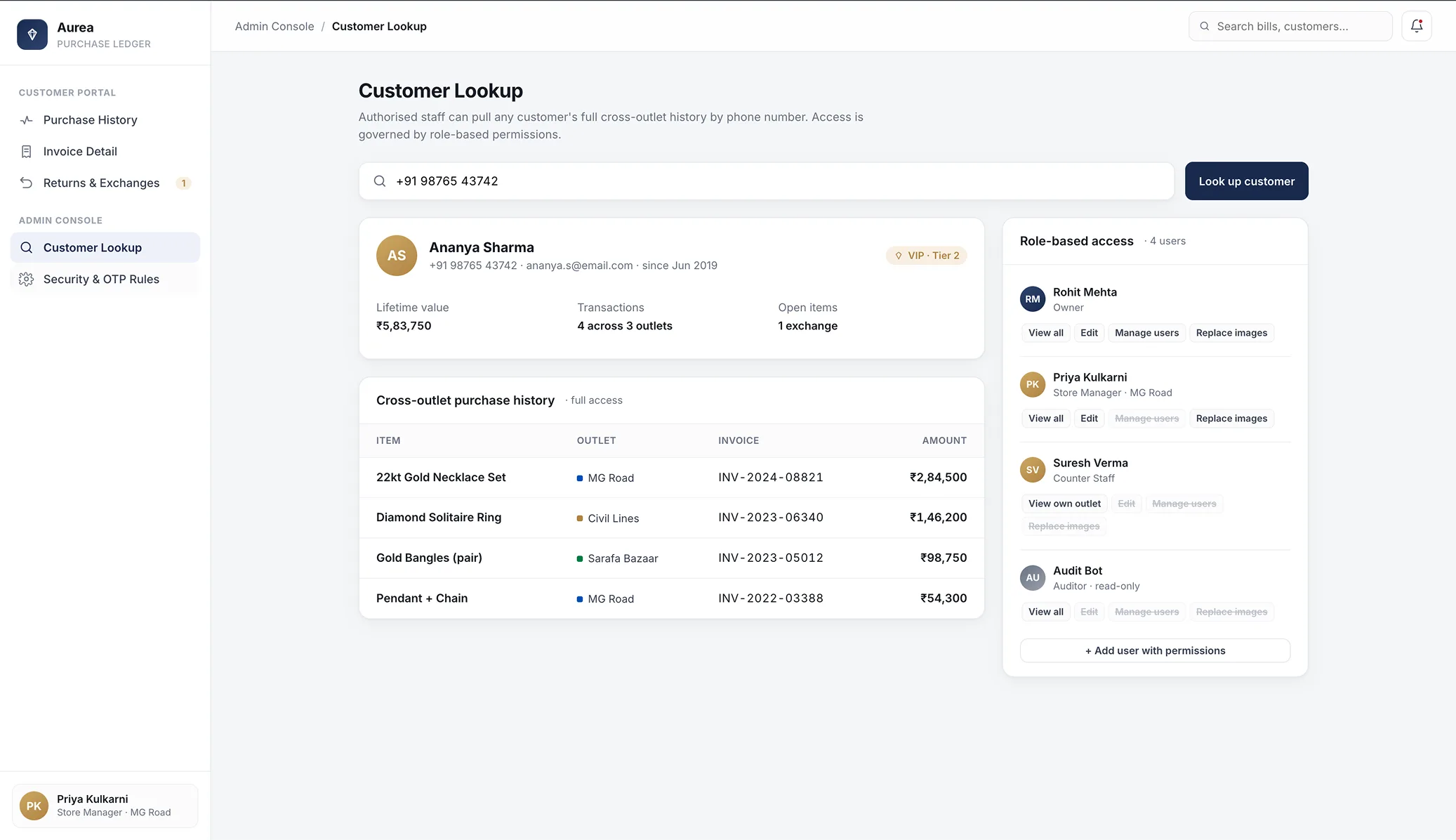
Admins look up any customer’s history across all outlets by phone number, manage contact details, and create or remove users with specific permissions — tight access without blocking the team.
Returns and exchanges
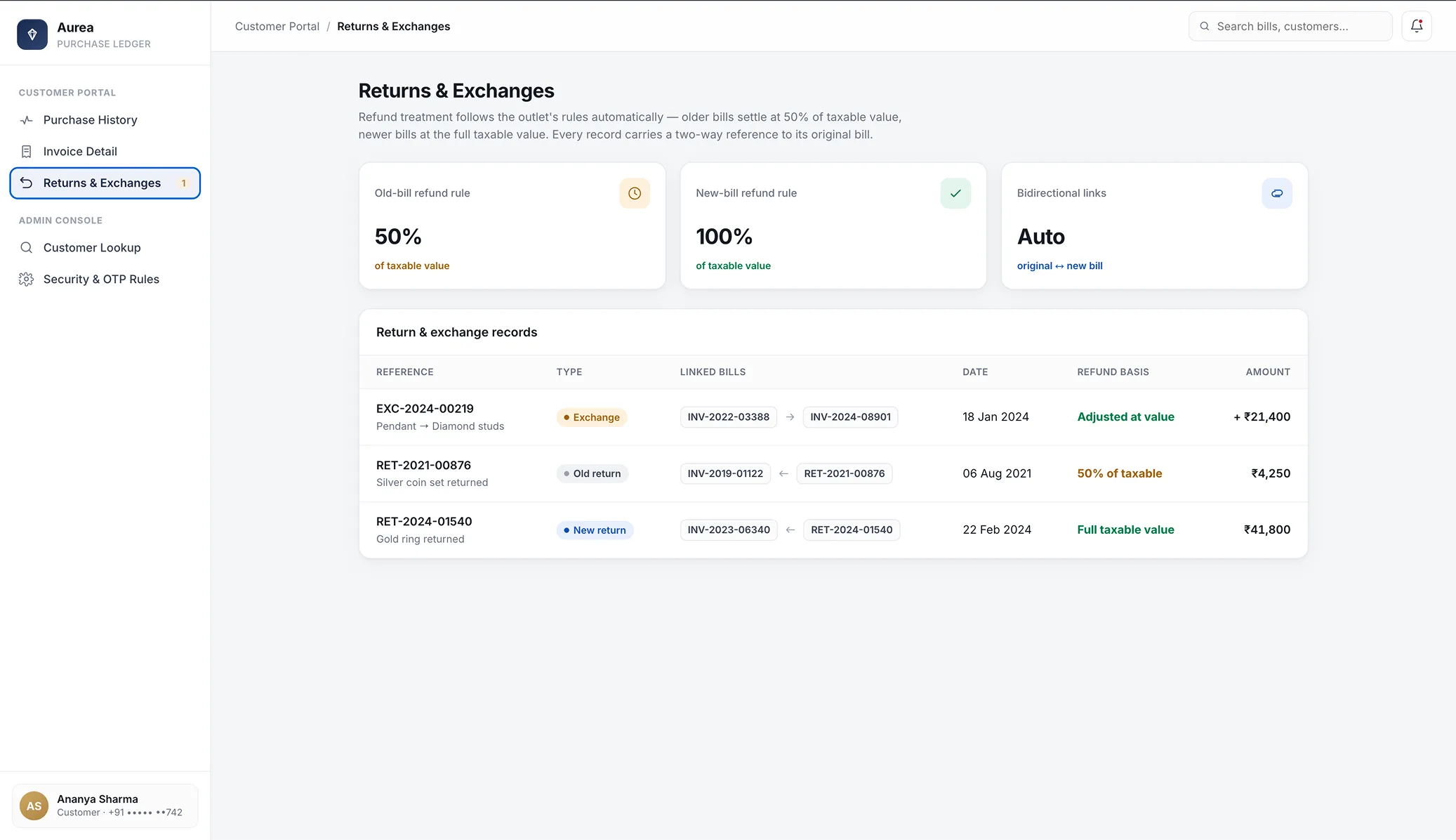
Old return bills apply the partial-refund treatment automatically; new return bills show the full taxable amount. Bill referencing runs in both directions, so any bill shows its related transactions.
OTP and two-step protection
OTP rate limiting protects against abuse without locking out legitimate customers, and two-step verification on image replacement prevents accidental overwrites corrupting a record.
Tech stack




Outcomes & impact
Unified
Purchase history across all outlets
Self-service
Customer invoice access without visiting a store
Two-step
Verification on sensitive edits, OTP rate-limited
Trusted and verified by our clients


 ISO/IEC 27001:2022
 ISO 9001:2015
 GDPR compliant
Frequently Asked Questions
Let's Build Your Team
Tell us about your business, the customer data you have and where you want the platform to be in twelve months. We reply within one business day with next steps.
Prefer to book directly?
🗓️ Schedule on Calendly →Or email us:
✉️sales@unicoconnect.com