











Built the enterprise data layer connecting a Singapore-based pharmaceutical company’s ERP to its e-commerce marketplace
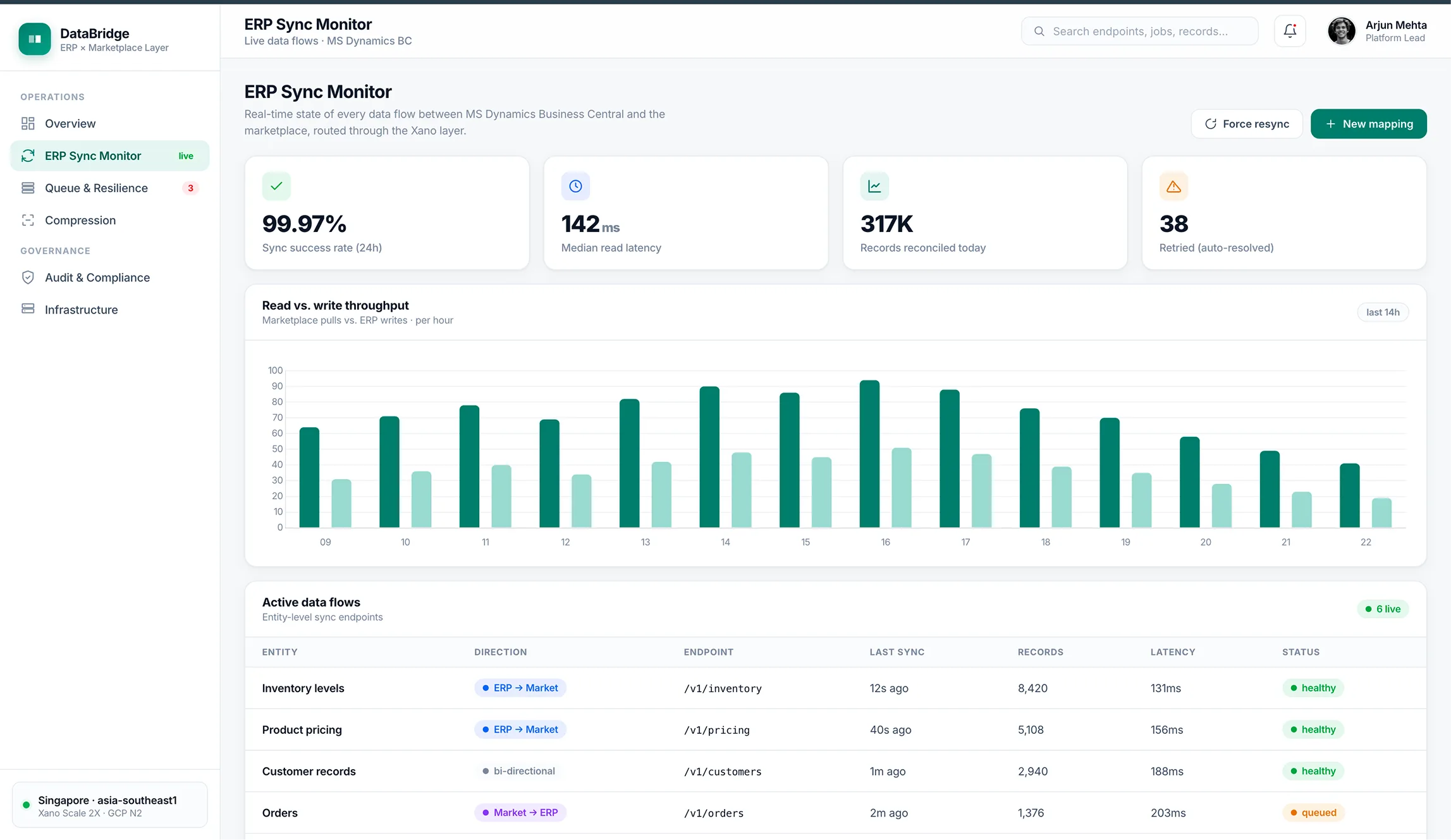
A data management middleware on Xano with GCP-hosted supporting services, sitting between MS Dynamics Business Central and a customer-facing e-commerce platform, designed for the integration discipline that large-pharma operations require at scale.
Key Takeaways
A large Singapore-based pharmaceutical enterprise came to Unico Connect to build the data management layer connecting its MS Dynamics Business Central ERP with its customer-facing e-commerce marketplace. We designed and built the middleware on Xano with GCP-hosted compression and queue services.
It is structured for the operational realities of pharma data at enterprise scale: resilience when the ERP is unavailable, efficient handling of large JSON payloads, and the audit posture pharma compliance requires. The platform now runs as the integration backbone between the two systems.

The Challenge
The client is a large pharmaceutical enterprise headquartered in Singapore, serving suppliers and customers through an e-commerce marketplace. The operational backbone runs on an ERP — MS Dynamics Business Central — and the customer-facing surface is a separate e-commerce platform. The two systems were not designed to talk to each other directly, and the engineering work needed to make them work together had not been built.
The cost of this gap is significant in pharma. Suppliers and customers transacting on the marketplace need ERP-grade data to act on — current inventory, accurate pricing, valid customer records, real-time order state — but the marketplace was working with stale or incomplete copies. The result was operational pain on both sides: customers seeing inventory that did not match availability, suppliers not seeing placed orders, and the operations team reconciling discrepancies that should never have arisen.
The challenge is amplified by scale: significant transaction volumes, large data payloads, and regulatory and audit obligations higher than adjacent categories. The team needed ERP-to-marketplace integration for the MVP with an architecture designed to extend, resilience for ERP downtime, efficient handling of large JSON payloads, and the audit posture pharma compliance requires. They came to Unico Connect specifically for the data middleware — the missing piece between two systems that already existed.
Our Approach

We engaged as a focused engineering partner, structured around the architecture, the integrations and the operational discipline the data layer would need to carry. The first phase was understanding the actual ERP-to-marketplace data flows — every enterprise integration is shaped by the specific quirks of the systems involved, and the gap between them is always more interesting than the architecture diagram suggests.
Key decisions:
Xano as the data management layer
API discipline, a Postgres-backed model and operational primitives (Redis cache, REST endpoints) — run as two workspaces in one instance to keep ERP-facing and marketplace-facing flows cleanly separated while controlling cost.
Queue-backed resilience on GCP
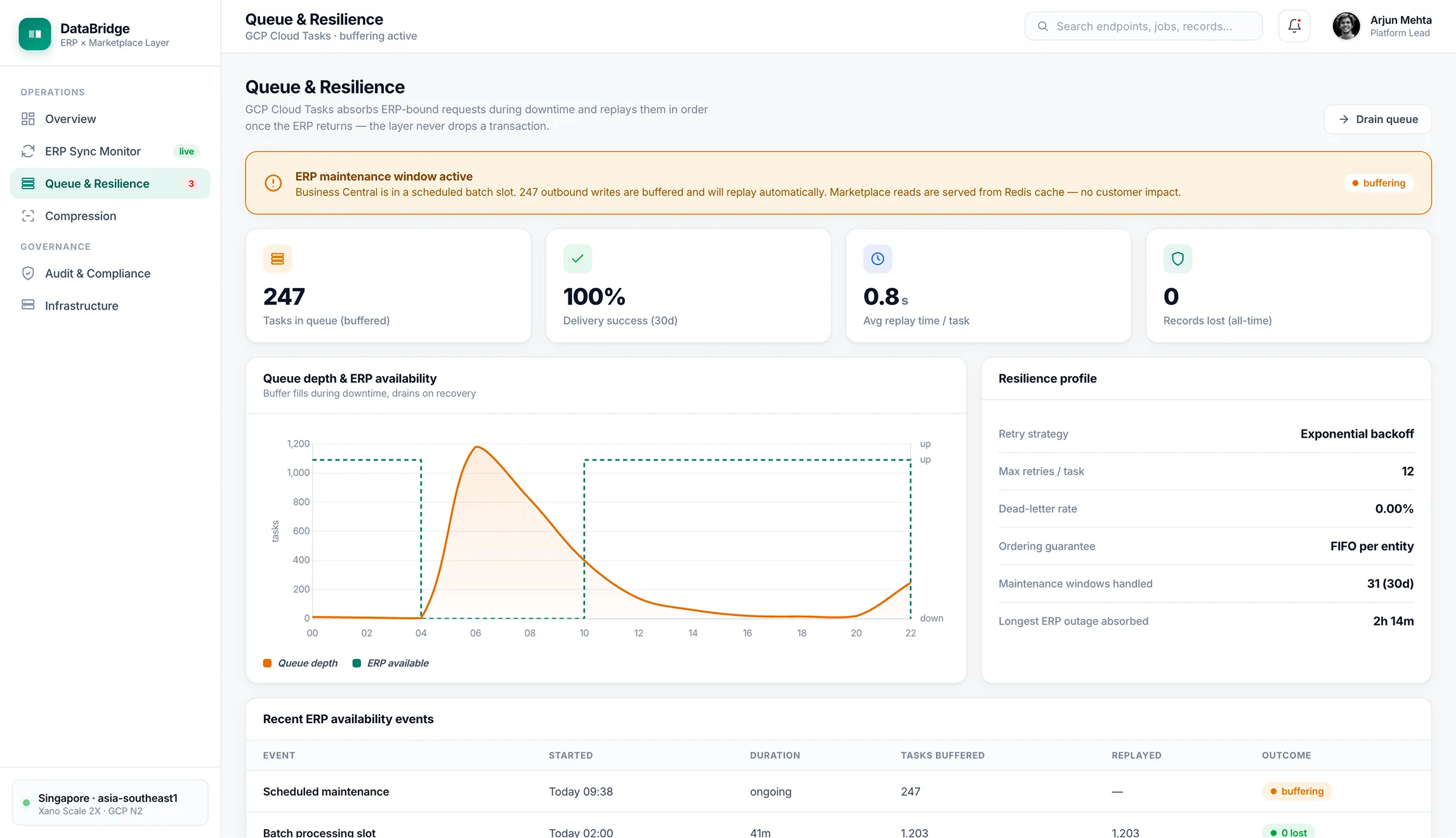
A managed queue absorbs ERP requests during maintenance windows or outages and delivers them once the ERP returns, rather than dropping data when the back-end is down.
Cost-aware enterprise sizing
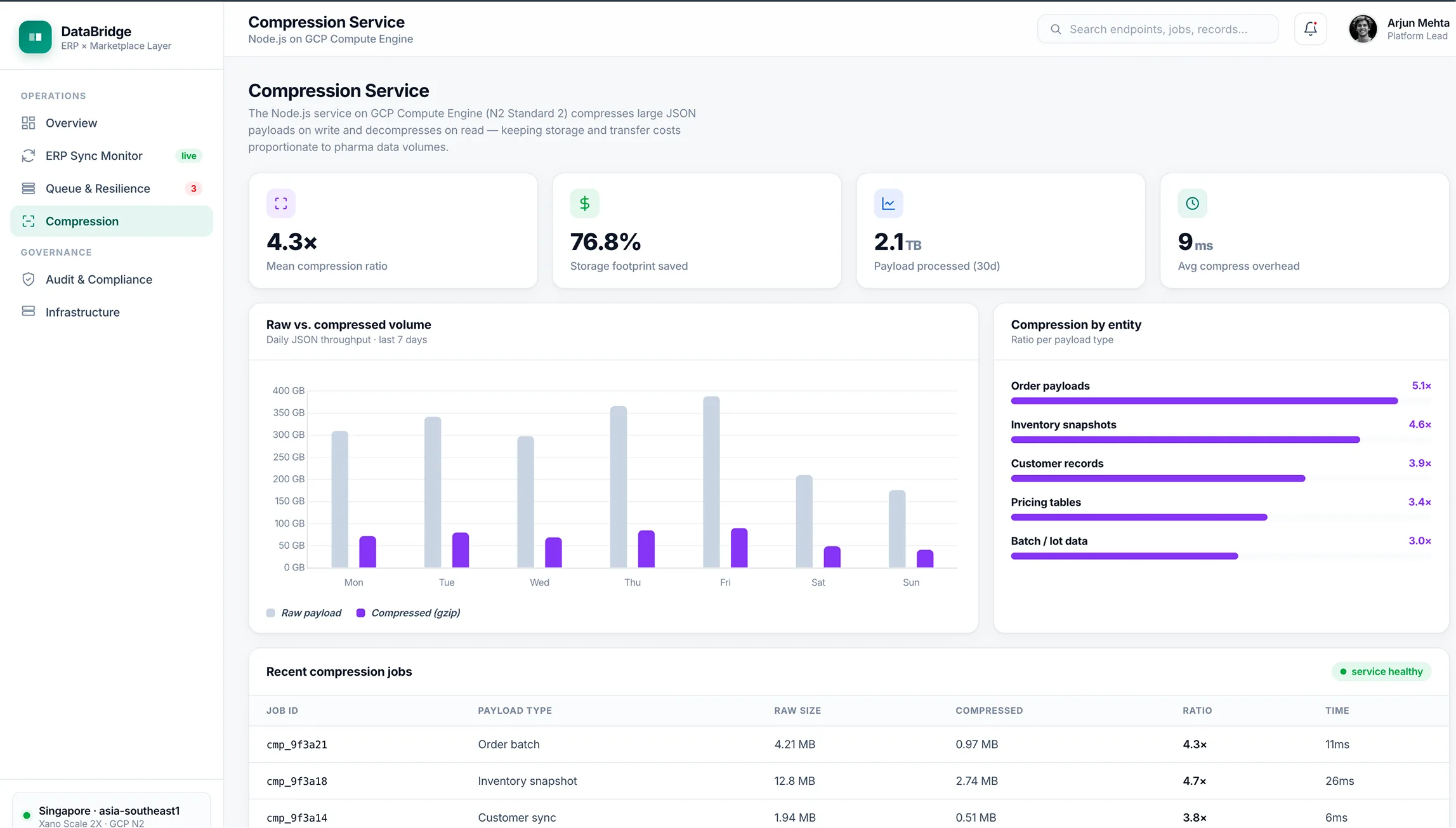
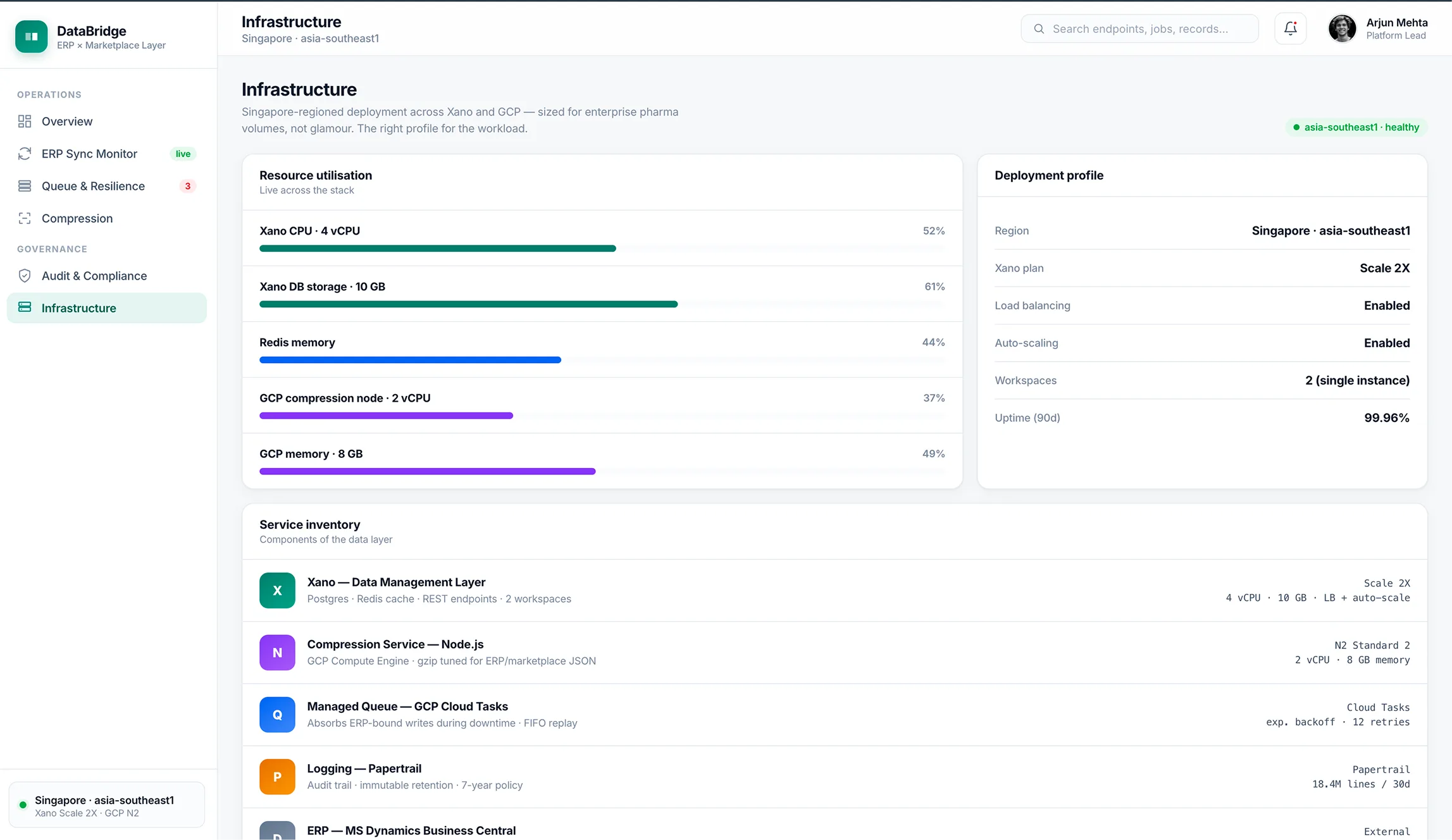
Singapore-region deployment across Xano and GCP, with a Node.js compression service for the large JSON payloads pharma generates — the right choices for the workload, sustained across years of operation.
The solution we built
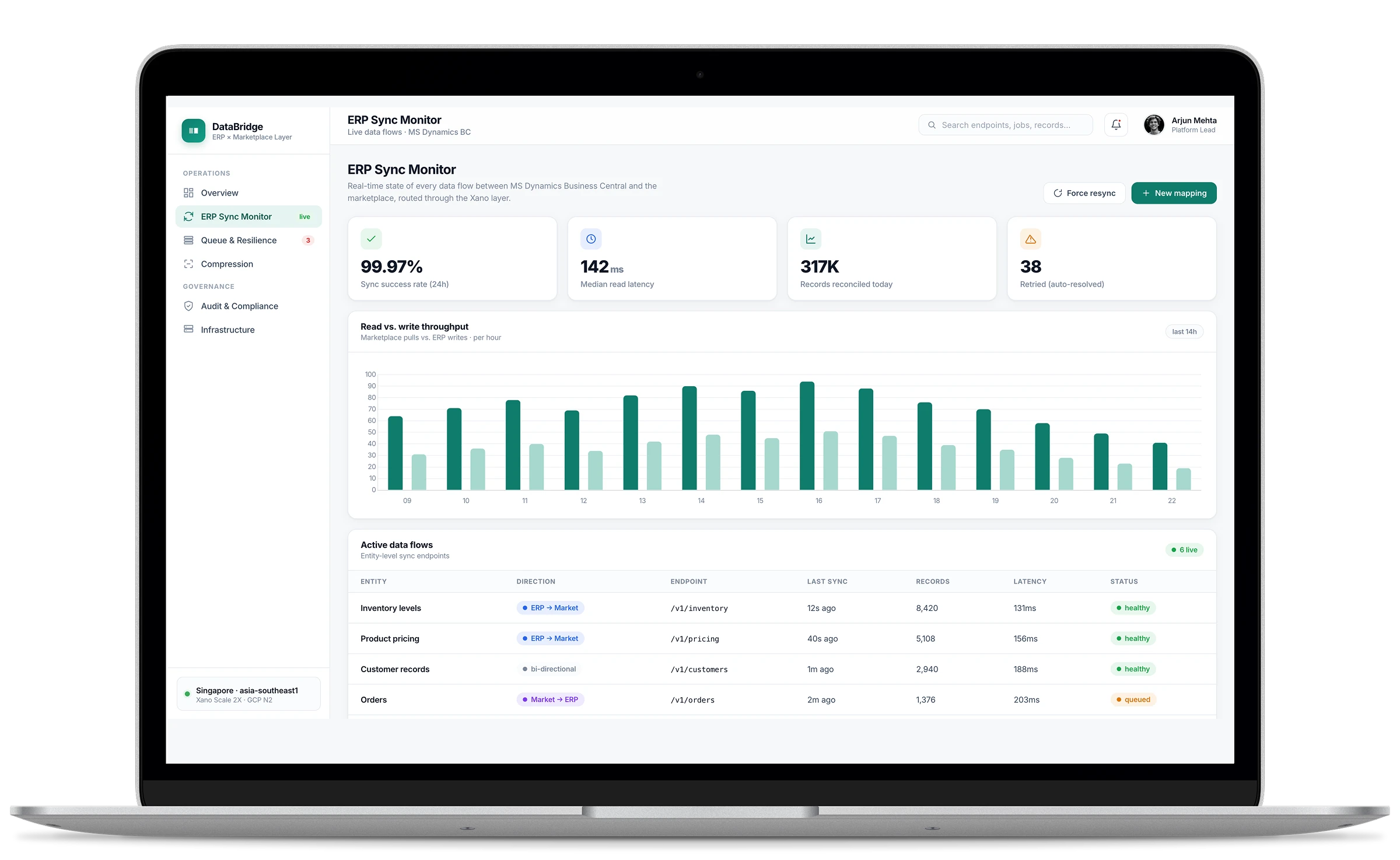
The architecture sits between the customer’s MS Dynamics Business Central ERP and the existing e-commerce marketplace, with several integrated components doing the actual work — fetching and serving ERP data, normalising and delivering marketplace data, and keeping the system resilient and auditable at pharma scale.
Xano data management layer
Server, Postgres database and REST endpoints through which the marketplace talks to the ERP, with a Redis cache reducing repeated-read load on the ERP.
Queue-backed resilience
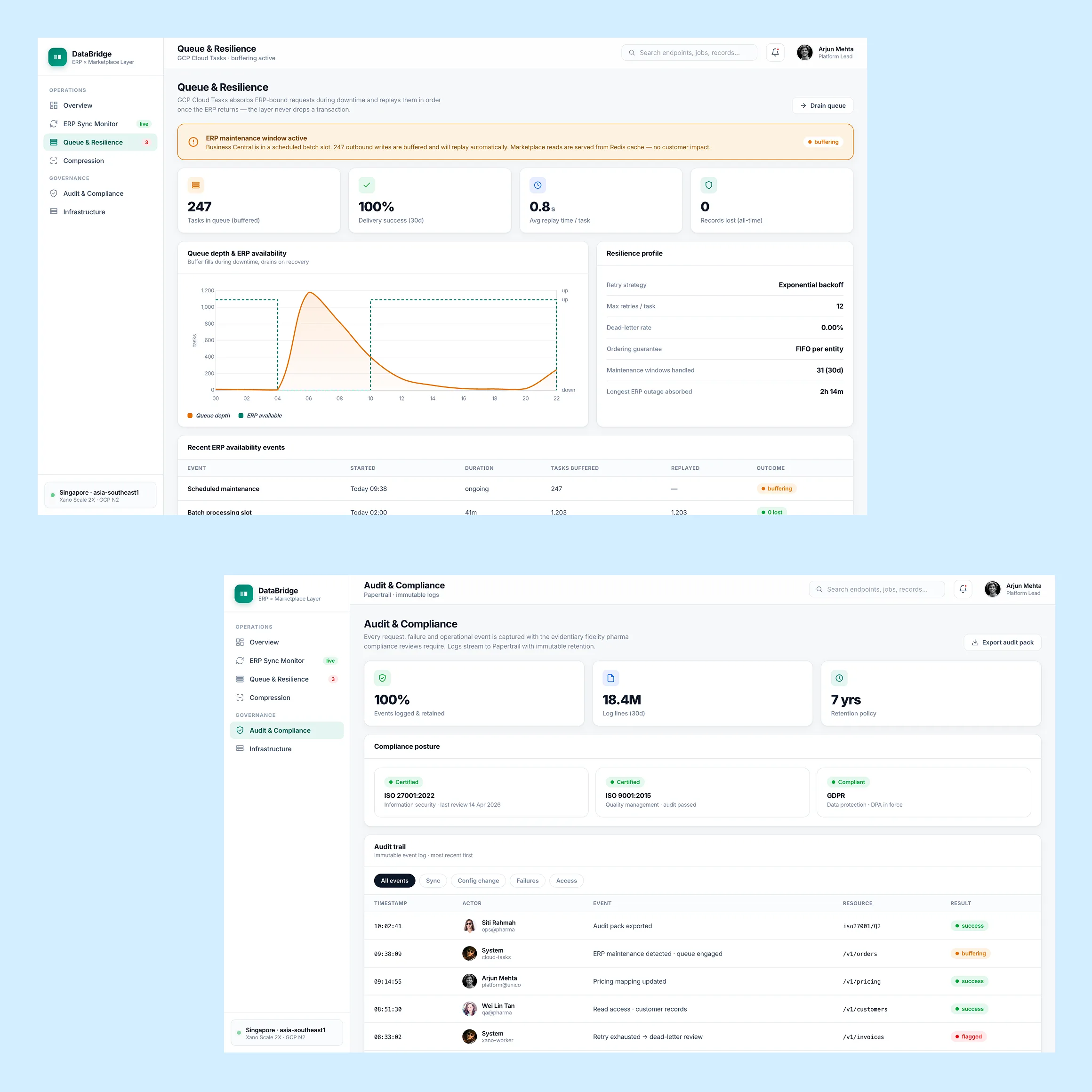
A GCP managed queue absorbs incoming requests when the ERP is unavailable and delivers them once it returns — so the marketplace keeps functioning during back-end downtime.
JSON compression service
A Node.js service on GCP compresses the large JSON payloads ERP-to-marketplace data produces, keeping storage and transfer costs proportionate to the data volumes.
Audit logging
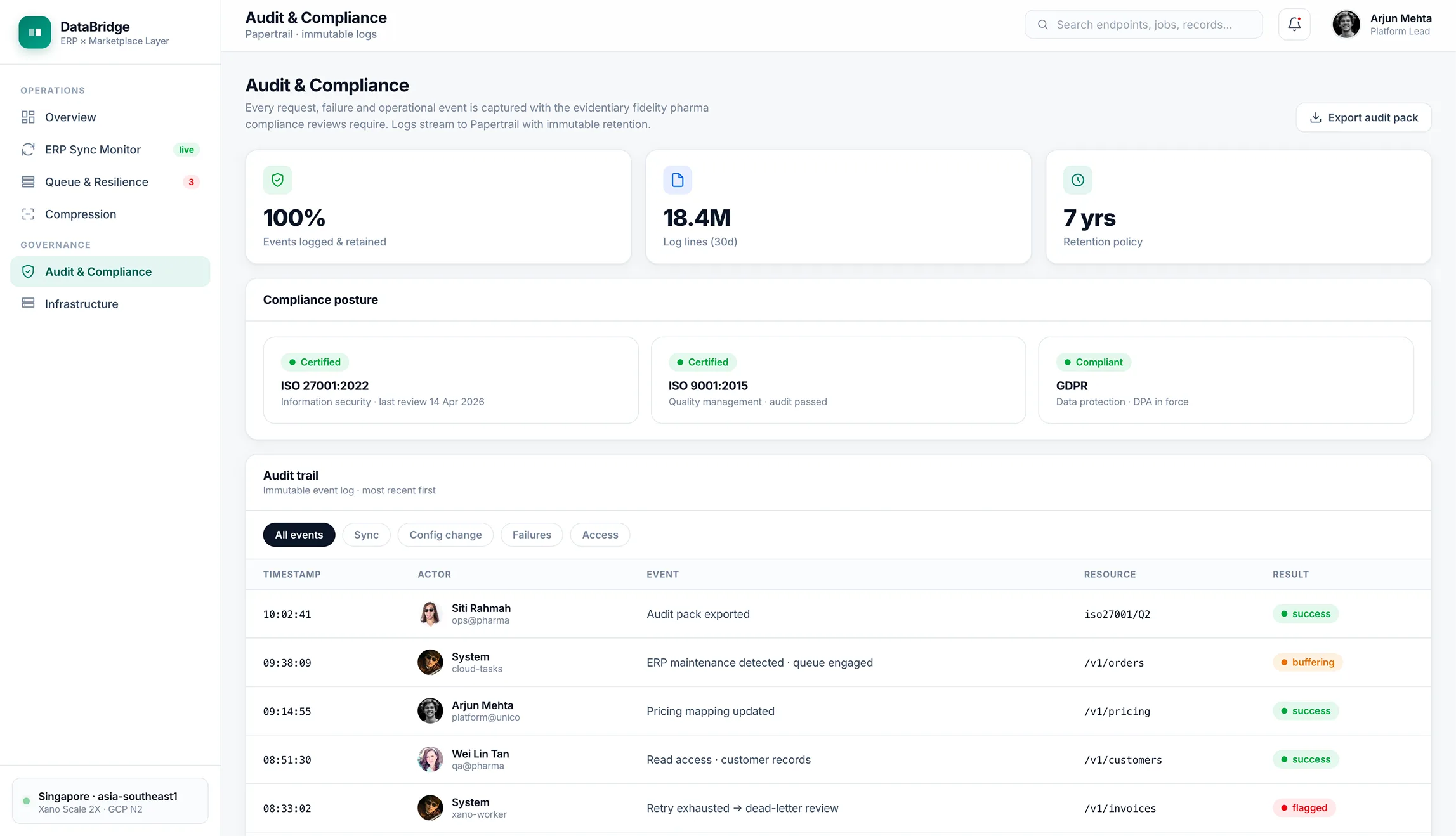
Request failures and operational events captured with enough fidelity to defend a pharma compliance review — evidence that things worked, and that failures were handled.
Tech stack



Outcomes & impact
Live backbone
ERP-to-marketplace integration in production
Queue-backed
Marketplace stays up when the ERP is unavailable
Singapore
Region deployment across Xano and GCP
Trusted and verified by our clients

 ISO/IEC 27001:2022
 ISO 9001:2015
 GDPR-compliant
Frequently Asked Questions
Related insights
View All ai-agents
June 3, 2026
MCP vs Direct API Integrations: Which Architecture Fits Enterprise AI Workflows?
Read More ai-agents
June 20, 2025
From Data to Decisions: How AI Agents Are Transforming Enterprise Workflows
Read More Engineering
June 24, 2026
Best Enterprise Application Development Companies in 2026
Read MoreLet's Build Your Team
Tell us about your systems, the integration work you need and where you want the platform to be in twelve months. We'll get back within one business day with a plan and next steps.
Prefer to book directly?
🗓️ Schedule on Calendly →Or email us:
✉️sales@unicoconnect.com