








How to Become AI Native When Adoption Is No Longer Enough

Malay Parekh
CEO & Director, Unico Connect
In this article
Almost every company now uses AI. Far fewer have changed how they work because of it, and the gap between adopting AI tools and becoming AI native is where most of the value is won or lost. Below we explain the difference and set out a practical framework for closing it, with a ninety day plan for your first workflow.
Quick Answer
AI adoption means using AI tools. Becoming AI native means rebuilding how you work and what you ship around AI from the ground up. Nearly nine in ten organisations use AI, yet only around 6% see meaningful profit impact, and roughly 95% of generative AI pilots never move the bottom line. The teams that win redesign their workflows around AI rather than bolting it on, and the tools they pick matter far less than that redesign. At Unico Connect we moved from traditional engineering to an AI native delivery model, and we use AI to write maintainable code and to enforce evaluation instead of generating volumes of unverified output.
AI Adoption Was the Easy Part
Buying licences and adding an AI feature is straightforward, and nearly everyone has done it. McKinsey reports that nearly nine in ten organisations now use AI in at least one function, but only about 6% qualify as high performers, and only around 21% have redesigned any workflow around AI (McKinsey, 2026). MIT research found that roughly 95% of enterprise generative AI pilots delivered no measurable profit impact, and it traced the gap to weak integration instead of weak models (MIT NANDA, 2025).
Both studies point the same way. Adoption is table stakes, and the return comes from changing the work itself.
AI Native Versus AI Enabled
AI enabled software adds AI as a feature on top of an unchanged process. AI native software is designed around AI from the start, so the model sits in the core logic and the product stops working without it. The same split applies to teams, and the table below shows where the two diverge.
AI enabled versus AI native across how teams build and measure
| Dimension | AI enabled | AI native |
|---|---|---|
| Where AI sits | Bolted on as a feature, such as a summarise button | Embedded in the core logic, so removing it breaks the product |
| How you build | AI added at the end of an unchanged process | AI runs across discovery, architecture, code, review, and QA |
| Team | A specialist AI team on the side | AI fluency is baseline for every role |
| Evaluation | Manual spot checks before launch | Continuous evals, golden datasets, and human review gates |
| Data and tooling | Ad hoc and rebuilt per project | Shared, governed data and internal AI tooling with monitoring |
| How you measure | Tools adopted and seats licensed | Delivery speed, quality, and business outcomes |
Inside an AI Native Build
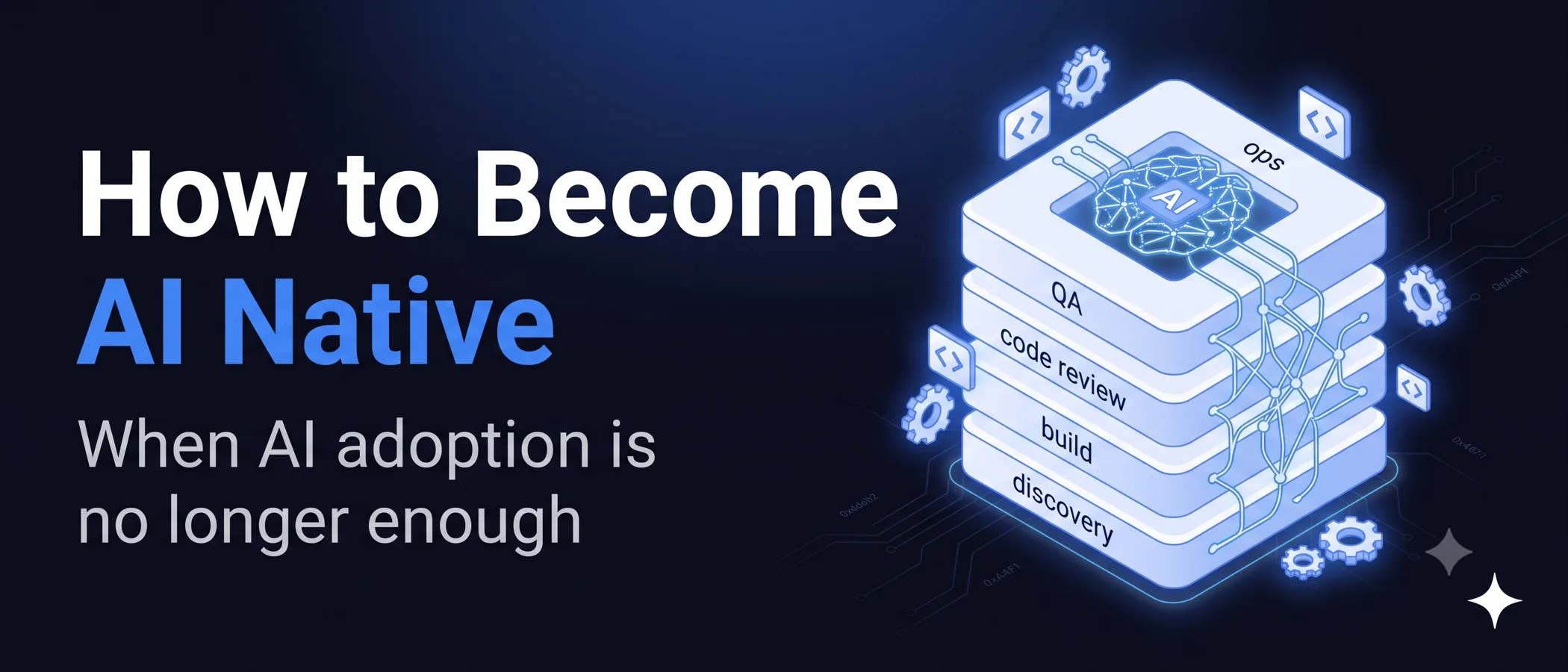
In an AI native team, AI shows up at every stage of delivery as well as in the product. We use it in discovery to explore options faster, in architecture to pressure test designs, in development and code review to ship maintainable code, and in QA to widen test coverage. In one controlled study, developers completed a task about 55% faster with an AI coding assistant (GitHub, 2022). What counts is where the saved time goes, and an AI native team reinvests it in quality, evaluation, and tighter feedback loops.
A Practical Framework to Become AI Native
Becoming AI native is a change to your operating model, and it works best in steps.
- AI literacy should be a baseline for every role, from engineers and designers to product and operations, so it never sits with one specialist team.
- Wire AI into discovery, build, review, QA, and operations. A single feature added at the end of an unchanged process leaves you AI enabled.
- Treat model output like untested code and check it with evals, golden datasets, regression checks, and human review gates.
- Underneath all of this you need clean, governed data and shared internal AI tooling, with versioning and monitoring so models can be retrained safely.
- Govern with security, privacy, and review checkpoints so teams can move fast without creating risk.
How to Measure Whether It Is Working
Track delivery speed, defect rates, and business impact such as revenue or cost. Counts of tools adopted or seats licensed measure activity, and they can look healthy while nothing about the work has changed. McKinsey found that workflow redesign is the single strongest driver of measurable AI impact, so outcome metrics matter more than adoption metrics.
At Unico Connect this is how we work and what we build. Our team shifted from traditional engineering to an AI native delivery model, using AI to write maintainable code and enforce evaluation rather than to generate volumes of unverified output. The AI native development page describes how that shows up in our delivery. For the operating model behind reliable production AI, read our posts on why AI models fail in production and MLOps versus DevOps. Our take on becoming AI native was also featured in DesignRush.
Why Bought Solutions Beat Internal Builds More Often
The same MIT research that produced the 95% figure also looked at how the work was sourced. Solutions bought from specialised vendors and wired into an existing workflow succeeded around 67% of the time, while internally built equivalents succeeded far less often (The GenAI Divide, State of AI in Business 2025, MIT NANDA). Engineering talent is rarely the reason. Internal builds tend to start at the model and work outwards, so they pay for evaluation tooling, data plumbing, and monitoring before they produce anything a business can measure, while bought solutions start from a workflow that already exists and attach to it.
None of this means you should never build. The first AI project in a company is the worst candidate for a ground up build, because you are learning the operating model and the technology at the same time. Buy or adapt for the first workflow, measure it against a baseline, then build once you know what good looks like in your own data.
What the First Ninety Days Look Like
Most teams try to run literacy, tooling, evaluation, and governance at once, and stall on all four. A sequence built around one workflow works better.
- Weeks one to three, pick one workflow that already has a number attached. Choose something measured today, such as ticket resolution time or the share of releases needing a hotfix. A workflow with no baseline cannot demonstrate impact later.
- Weeks four to six, build the evaluation set before the feature. Collect real examples with known good answers. This is the step teams skip, and skipping it is why pilots cannot prove value at the end.
- Weeks seven to ten, ship to a narrow group. Put it in front of a handful of users who will give you honest feedback, and instrument it to show where the output is wrong as well as whether people used it.
- Weeks eleven to thirteen, decide on evidence. Compare against the baseline, then expand, rework, or stop. Stopping on evidence counts as a success, since the alternative is a pilot that runs for a year without a verdict.
After ninety days you should have one workflow that is measurably better and an evaluation habit the next team can reuse. That is a smaller claim than a transformation programme, and it compounds faster.
Frequently Asked Questions
What does AI native actually mean?
An AI native product, team, or workflow is designed from the ground up with AI as core logic, so removing the model would break it. AI enabled software instead adds AI as a feature on top of an otherwise unchanged process.
Is becoming AI native only for AI startups?
No. AI native describes how you build and operate, not what you sell, so any team can become AI native by embedding AI across its delivery lifecycle and redesigning workflows around it.
Why do most AI initiatives fail to show value?
MIT research found that roughly 95% of generative AI pilots show no measurable profit impact, usually because of an integration and learning gap rather than a model quality problem. Adoption without workflow change rarely pays off.
Do we have to replace our current stack to become AI native?
Not necessarily. The shift is about redesigning workflows around AI, and retrofitting it onto unchanged processes will not get you there. In the data, workflow redesign is the strongest driver of impact, ahead of new tooling alone.
How do we know if we are becoming AI native?
Measure outcomes such as delivery speed, quality, and business impact, plus how deeply AI is embedded in everyday work. If the only thing that changed is the number of tools you license, you have adopted AI without becoming AI native.
Conclusion
Adoption gets you in the room. The return comes from becoming AI native, which means redesigning how you build and what you ship around AI, with evaluation, ownership, and outcome metrics behind it. If you want a partner that already works this way to help with that shift, look at our AI development services or hire AI engineers from our team.