

Unico Connect

AI Native Development

Software Built AI Native, Reviewed by Senior Engineers

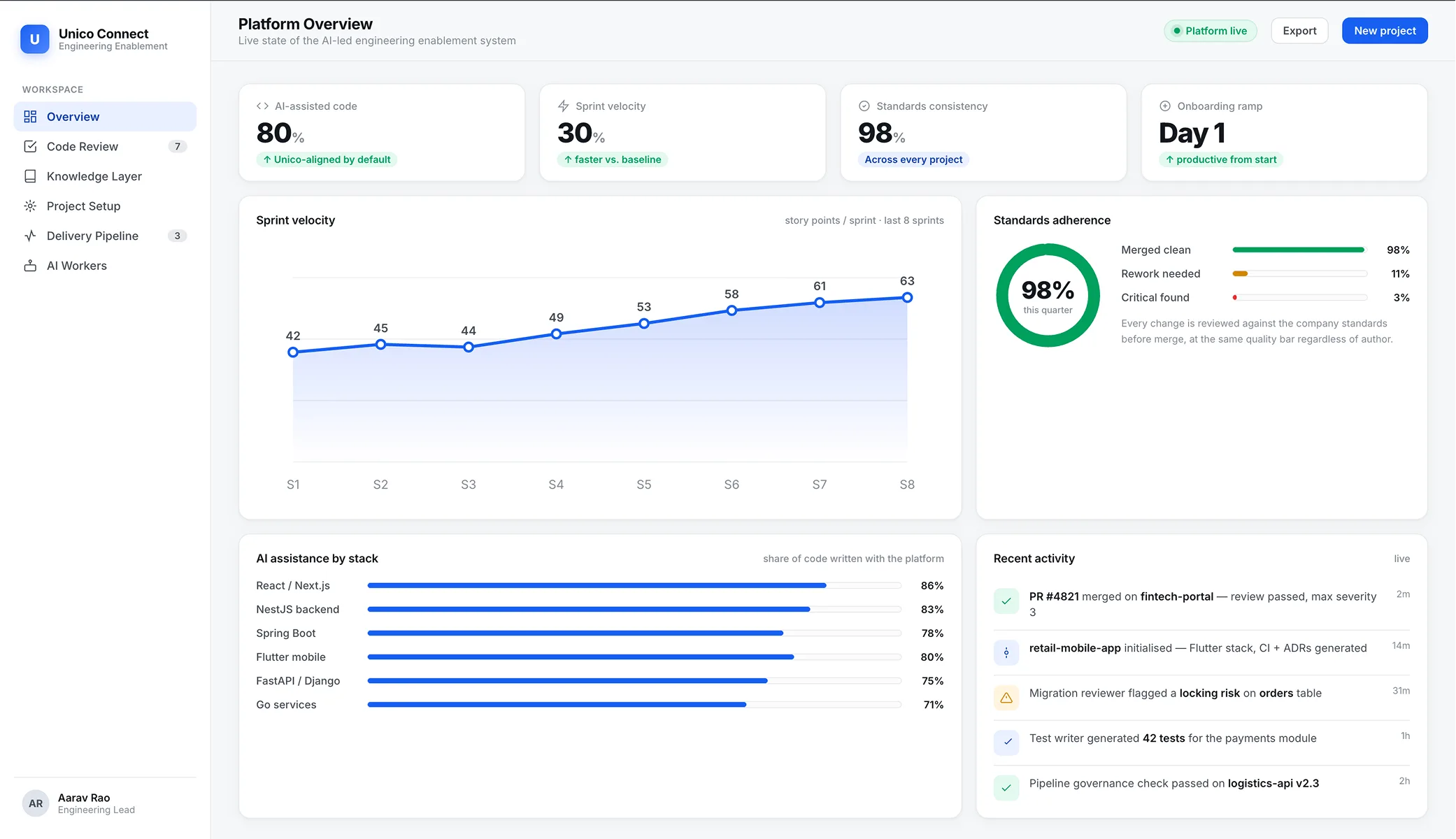
Roughly 80% of our production code is AI generated and engineer reviewed, verified by our internal team. This page shows exactly how that works, stage by stage, from the first brief to production. No mystique, just the operating model.

What is AI native software development?

AI native software development is an engineering model where AI writes most of the code and senior engineers act as architects, reviewers, and decision makers. The default mode is AI generation with human direction, not human coding with occasional AI suggestions.

The distinction from AI assisted development matters. Assisted means an engineer types and a tool autocompletes: the workflow is unchanged and the gains are marginal. Native means the workflow itself is rebuilt around generation, with company standards encoded into the AI layer, automated review on every change, and senior attention moved to architecture and judgment. The tools are available to everyone; the operating model is the differentiator.

We built this model on our own team first and measured it, then applied it to client delivery across web, mobile, custom software, and agentic AI projects. The numbers on this page come from that internal rollout, documented in three public case studies, not from a survey.

Measured on Our Own Delivery, Not a Survey

80%

Of production code AI generated

Every line engineer reviewed before merge

30%

Faster sprint delivery

Measured across engineering teams

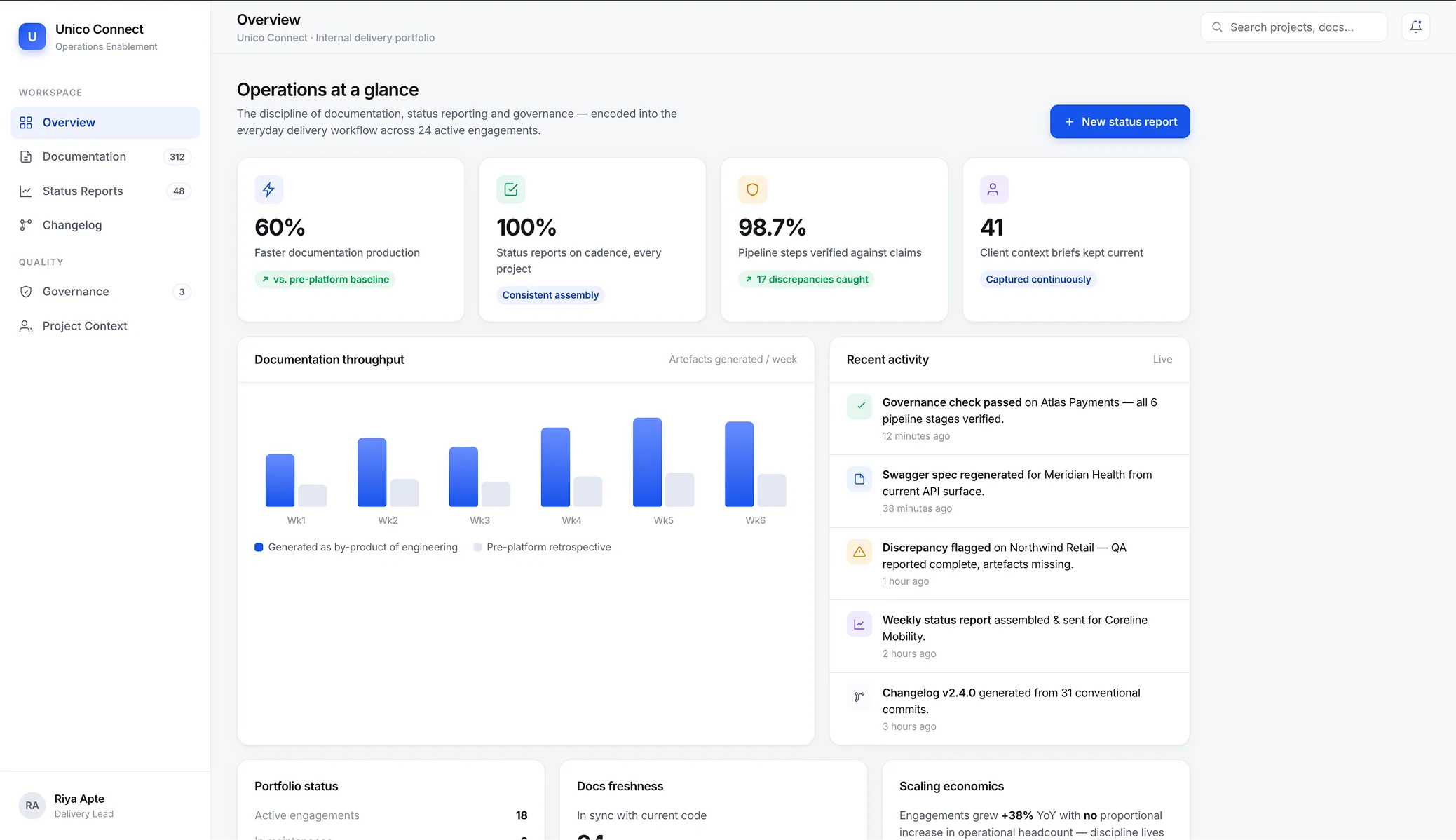
60%

Faster documentation

Drafted by AI, verified against delivery

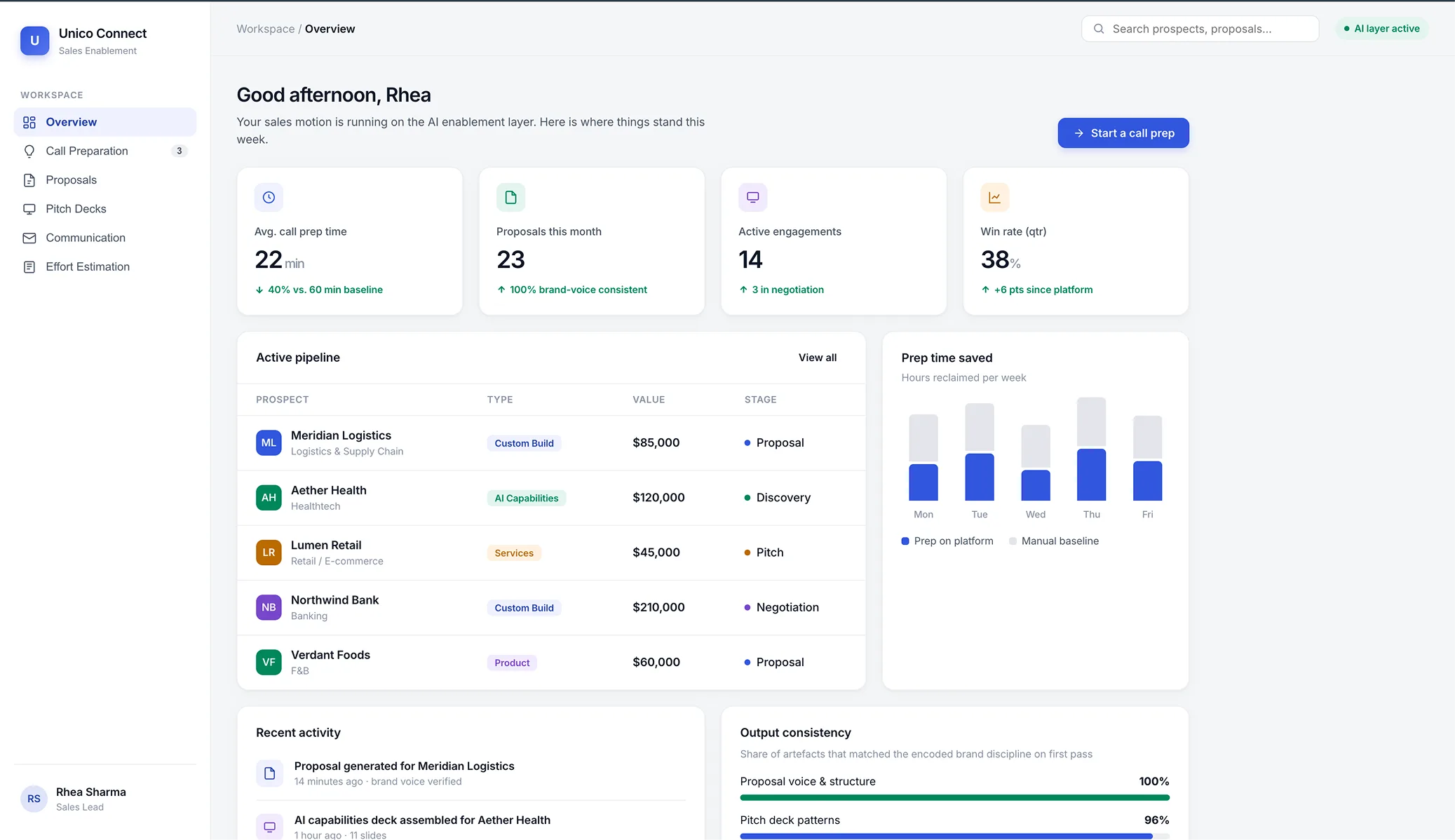
40%

Faster client call preparation

AI led research across the sales motion

Figures measured on Unico Connect internal delivery and verified by our internal team, 2026. Documented in the three case studies below.

The Operating Model

The AI Native Delivery Lifecycle

Seven stages, and at every one of them the same pattern: AI does the volume, engineers own the judgment, and nothing ships without human review. Click through each stage to see what actually changes.

Stage 01 of 07

Requirements & Scoping

What changes

AI reads the brief, the systems it touches, and comparable builds, then drafts scope options, edge cases, and open questions before the first workshop. The back and forth that used to stretch discovery across weeks compresses into days.

What the engineer owns

A senior engineer and a product lead decide what is in scope, define the outcome metric, and publish an estimate range against it. AI proposes; people commit.

Most discoveries close in 1 to 2 weeks with a published scope and an estimate range, not a vague proposal.
  • Claude
  • Scoping playbooks
  • Estimate ranges

Side by Side

The First 6 Weeks, Both Ways

The clearest difference is not the rate card. It is when the client first clicks working software, and how early course corrections happen.

First working demo the client can click: around week 8

  1. Weeks 1 to 2Setup and documentationEnvironment setup, boilerplate, and a requirements document that starts drifting from reality the day it is signed.
  2. Weeks 3 to 5Heads down buildCode accumulates but nothing is demoable. Questions queue up for the weekly meeting and assumptions harden into code.
  3. Weeks 6 to 7Integration painThe pieces meet for the first time. Integration bugs surface late, where they are most expensive to fix.
  4. Week 8+First real demoThe client sees working software for the first time, and the change requests that follow start a new cycle.

First working demo the client can click: week 1 to 2

  1. Week 1Scope plus a working skeletonDiscovery closes with a published estimate range, and the repo already holds a deployable skeleton with CI running.
  2. Week 2First demo on stagingThe core workflow is clickable on a staging URL. The client corrects course while change is still cheap.
  3. Weeks 3 to 4Features at AI speedRoughly 80% of code AI generated and engineer reviewed, with tests and automated review running on every commit.
  4. Weeks 5 to 6Hardening and launch pathSecurity review, performance budgets, and a production gate owned by a human engineer. Launch is a decision, not a scramble.

Typical pattern on mid sized builds, measured on our own delivery. Every project is scoped individually before any number becomes a commitment.

Where AI Still Needs an Engineer

Most AI adoption fails, and the reasons are documented. AI native is not the claim that AI does everything. It is the discipline that decides what AI does, what people own, and how every output gets verified. Our research on trust in AI output and vibe coding risk covers what happens without that discipline.

88% of organizations use AI, only ~6% get high performer impact (McKinsey, 2025)95% of GenAI pilots show no measurable P&L effect (MIT, 2025)Over 80% of enterprise AI projects fail (RAND, 2024)

Architecture and tradeoffs

AI proposes patterns; it does not carry responsibility for a data model the business will live with for years. Senior engineers make the calls that are expensive to reverse.

Ambiguous requirements

AI fills gaps with plausible guesses, which is exactly how projects drift. People resolve ambiguity with the client before the code exists, not after.

Security and compliance

Generated code gets the same scrutiny as human code plus automated scanning on every commit. Trust without verification is how AI projects end up in the failure statistics.

Taste and product judgment

What to build, what to cut, and what users will actually tolerate are human decisions. AI accelerates the making; it does not own the choosing.

The Receipts: How We Rolled It Out on Ourselves

AI Native Development FAQs

AI native software development is an engineering model where AI writes most of the code and senior engineers act as architects, reviewers, and decision makers. The default mode is AI generation with human direction, instead of human coding with occasional AI suggestions. At Unico Connect roughly 80% of production code is AI generated and engineer reviewed, verified by our internal team.

In AI assisted development, engineers write the code and AI suggests fragments: an autocomplete on a traditional workflow. In AI native development the relationship inverts: AI drafts most of the code from context rich briefs, and engineers spend their time on architecture, review, and the decisions that need judgment. The difference shows up in delivery speed and in where senior attention goes.

Yes, when the discipline around it is real. Every line of AI generated code at Unico Connect passes an automated review for logic errors, security anti patterns, and standards drift, and then a senior engineer reviews and owns the merge. Generated code gets more scrutiny than typical human code, not less. Teams that skip the review layer are the ones that get burned.

Measured on our own delivery: sprints run about 30% faster and documentation lands about 60% faster, with roughly 80% of production code AI generated and engineer reviewed. On project timelines this typically means a working demo on staging within the first 2 weeks and an MVP in 2 to 4 months instead of 4 to 8.

It changes what the same budget buys. Our published estimate ranges start at $15,000 to $50,000 for an MVP at a blended rate of $25 to $49 per hour, and AI native delivery means those hours produce more shipped software. The saving shows up as shorter timelines and more scope per dollar rather than a discounted rate card.

Yes. AI review runs first on every pull request and flags issues before a human opens the diff, then a senior engineer does the second pass and owns the merge decision. Architecture, data models, security gates, and production deploys are human decisions at every step. AI raises the floor; engineers set the bar.

Our core stack is Claude Code, Cursor, and GitHub Copilot for development, AI review passes wired into GitHub Actions, AI generated test automation with Playwright, and company standards encoded in CLAUDE.md playbooks so the AI writes code the way our senior engineers do. The tools matter less than the encoded standards and the review discipline around them.

Yes. We start with a technical audit, encode the standards and patterns of the existing system into AI playbooks, and add test coverage so changes are safe to make at speed. Legacy modernization is one of the places AI native delivery pays off most, because reading and mapping a large unfamiliar codebase is exactly what AI accelerates.

Because buying tools is easy and changing the operating model is hard. McKinsey finds 88% of organizations now use AI in at least one function but only around 6% achieve high performer impact, and MIT research covered by Fortune found 95% of generative AI pilots show no measurable P&L effect. The gap is discipline: encoded standards, review gates, and measurement. That operating model is what AI native means.

From Our AI Native Research

View all blogs

Let's Build The Next Big Thing

Fill in the form or schedule a meeting to map out a path to success.

Prefer to book directly?

🗓️ Schedule on Calendly →

For more information about how we handle your personal information, please visit our .privacy policy.