










Built AI ticket triage agents that route customer service and operational queries automatically, lifting routing accuracy and freeing human teams for the cases that need them
A capability case covering the AI ticket classification and triage agents Unico Connect has built across client engagements, automating about 75 percent of routing and classification work for inbound customer service and operational tickets, with the discipline that enterprise operations require.
Key Takeaways
Ticket triage is the operational task that consumes the most time on customer service and enterprise operations teams without producing differentiated value. Unico Connect has built AI ticket classification and triage agents across client engagements that automate about 75 percent of the classification and routing work, freeing human teams for the cases that genuinely require their judgment.
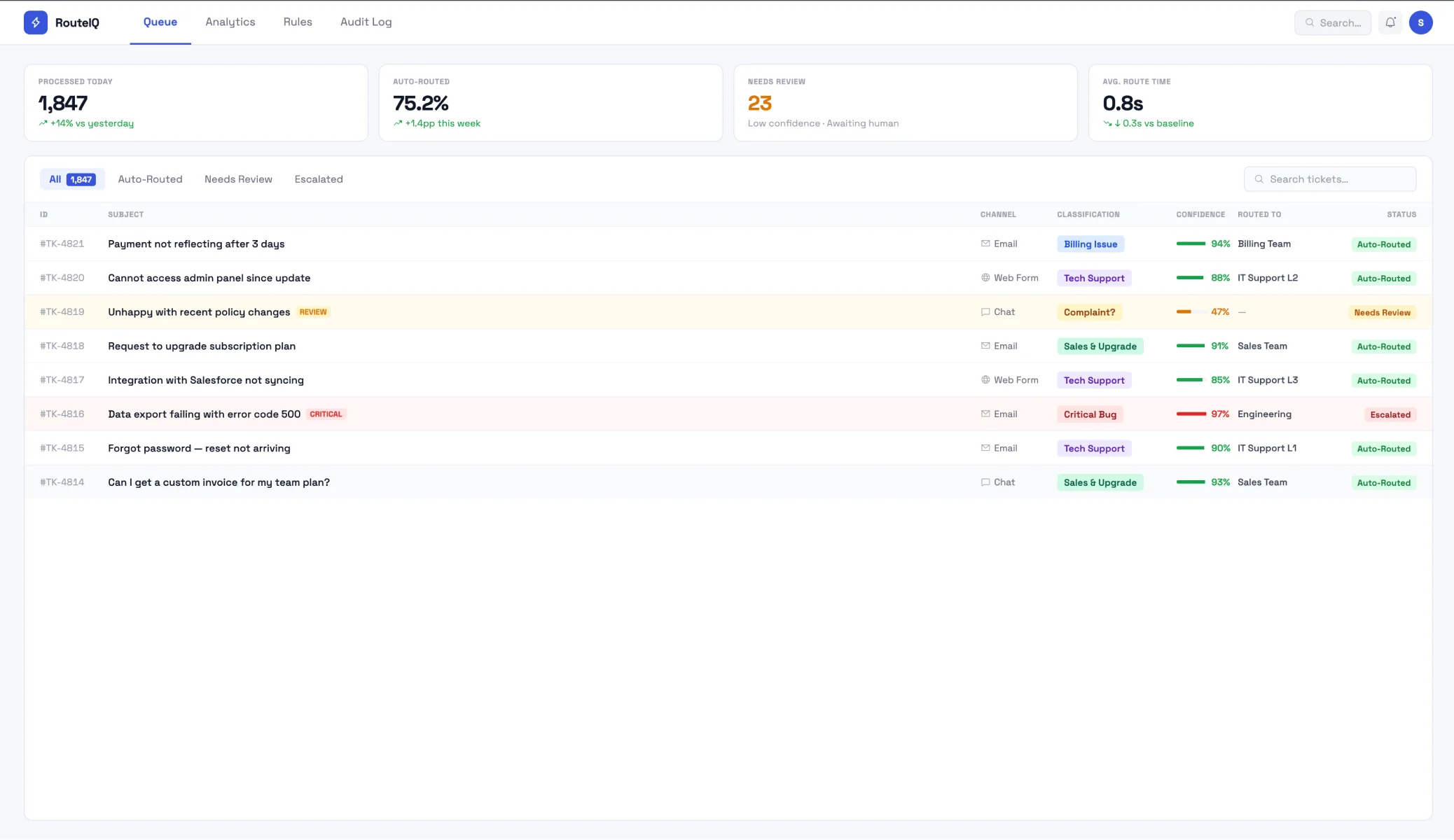
The capability handles inbound tickets across channels, applies the client specific classification taxonomy and routes to the right team queue with the audit trail enterprise operations require. The remaining tickets, the genuinely ambiguous ones, go to human triage with the agent suggestion visible rather than being routed on a guess.

The Challenge
Customer service and enterprise operations teams in any company at scale share a common operational reality. Tickets flow in continuously. They arrive through email, web forms, chat, messaging channels and sometimes through voice transcripts. The first thing that has to happen to each ticket is triage: figure out what category it belongs to, what priority it carries and which team or person should handle it. This is high-volume, low-judgment work that consumes disproportionate human time and produces inconsistent results because human triage at scale is rarely consistent.
The pattern across our client engagements has been consistent. A client in customer service, enterprise operations or IT support has substantial ticket volume. The triage work is being done by humans, which is slow, expensive and inconsistent. Tickets sometimes get routed wrong, which means they have to be re-routed, which adds latency and consumes additional team time. Tickets sometimes sit in a generic queue waiting for someone to classify them, which means customer-facing SLAs slip. The aggregate cost of this triage work is significant; the differentiated value it produces is essentially zero.
The opportunity is the capability we have built across engagements. AI ticket classification agents process inbound tickets, apply the client specific classification taxonomy, route to the right team queue and produce the audit trail that enterprise operations require. The roughly 75 percent automation figure is what we consistently achieve when the classification is tuned to the client actual ticket corpus rather than applied generically. The engagements have spanned the use case spectrum: customer service operations routing to the right product or service team, IT operations classifying by severity, and enterprise operations triaging requests across business functions. Each engagement has its own taxonomy and routing rules, but the underlying capability is the same.
The strategic constraint that shapes these engagements is that the AI cannot be the entire system. The tickets the AI is uncertain about, or where the classification is genuinely ambiguous, need to go to humans without disrupting the workflow. The audit posture matters because enterprise operations cannot adopt a system that makes opaque decisions about customer-facing or operational work. The discipline around when the AI acts and when it defers is what makes the capability deployable in production.
Our Approach

The approach we have developed across client engagements is structured around three things working together: the classification logic that handles the client specific taxonomy, the routing layer that puts tickets in front of the right teams, and the human-in-the-loop discipline that handles the cases the AI is not confident about.
Key decisions:
Classification tuned to the taxonomy, not generic
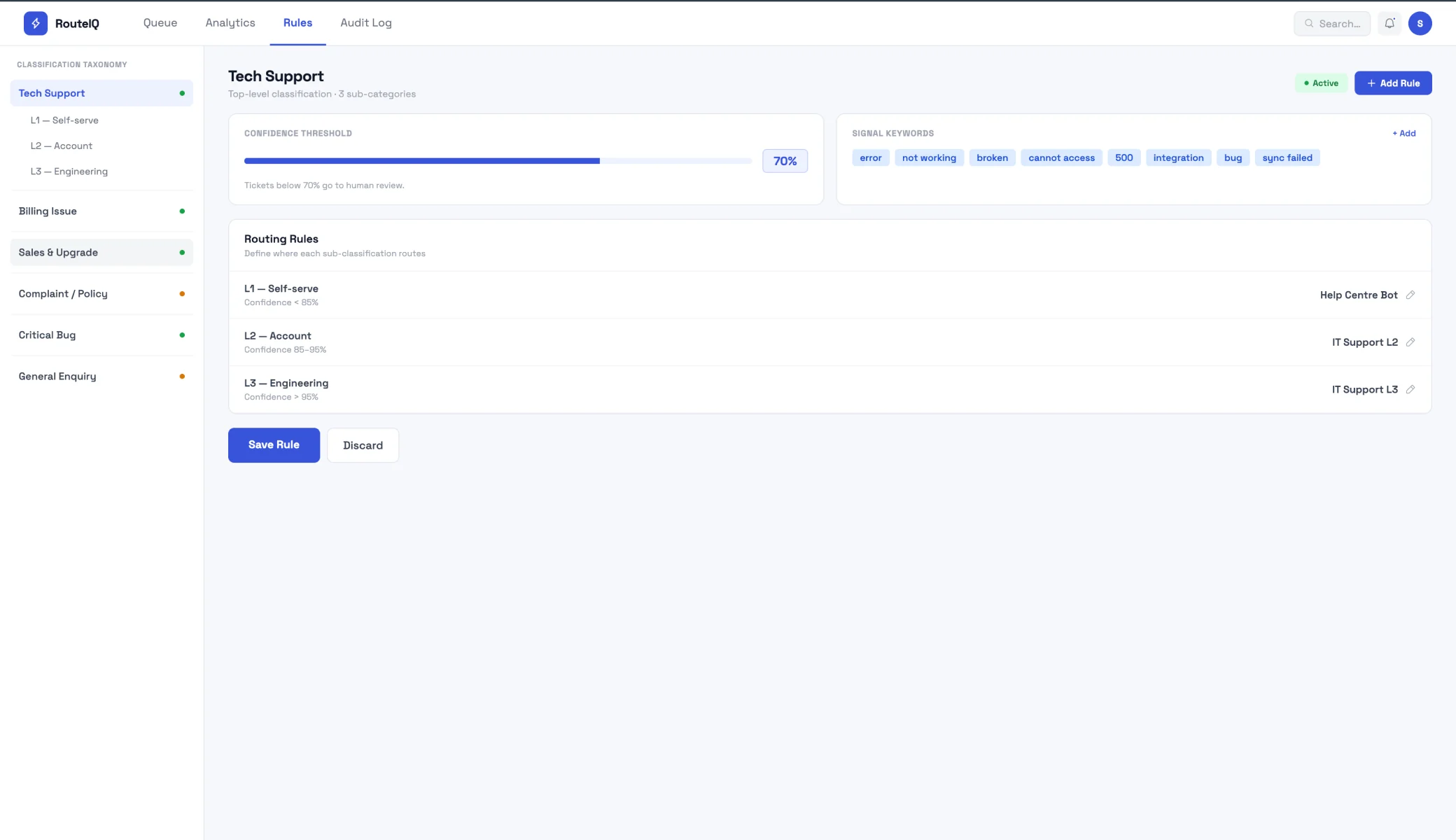
We use LLM-based classifiers tuned to the client taxonomy rather than generic classification approaches. The taxonomy is the client actual operational structure: product categories, severity levels, team responsibilities and escalation tiers, all defined by how the client operations actually work. We train the classifier against the client historical ticket data where it exists, and we tune the confidence thresholds per corpus based on the operational tolerance for misrouting.
Routing that reflects how teams already work
The routing layer takes the classification output and places the ticket in the right queue: the team-specific or product-specific queue for a customer service operation, or the business function or process owner for an enterprise operation. The routing rules are defined by the client and applied consistently by the system, which is the structural change from a prior state where routing depended on whoever was doing manual triage at the moment.
Human-in-the-loop and audit posture as first-class concerns
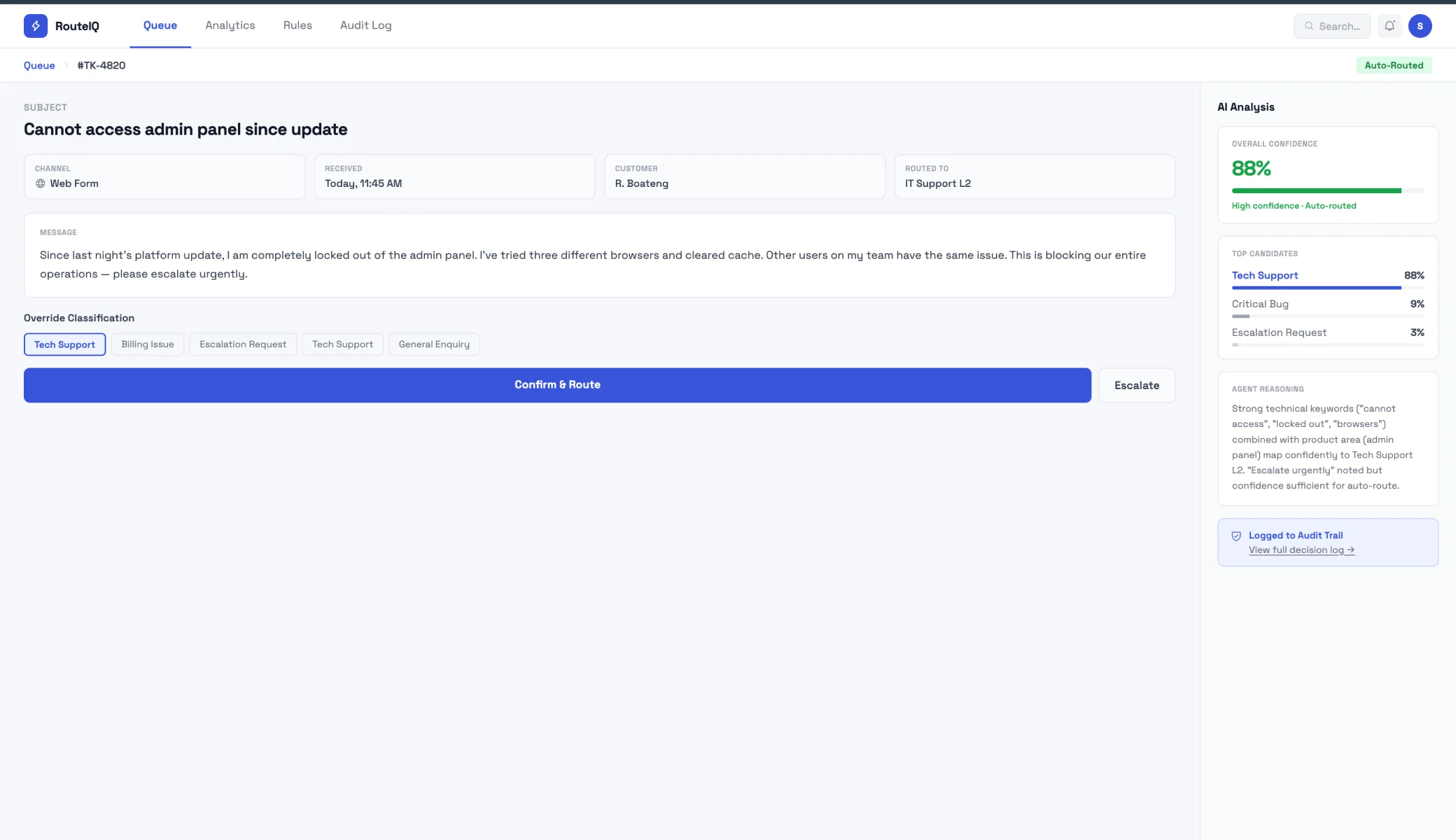
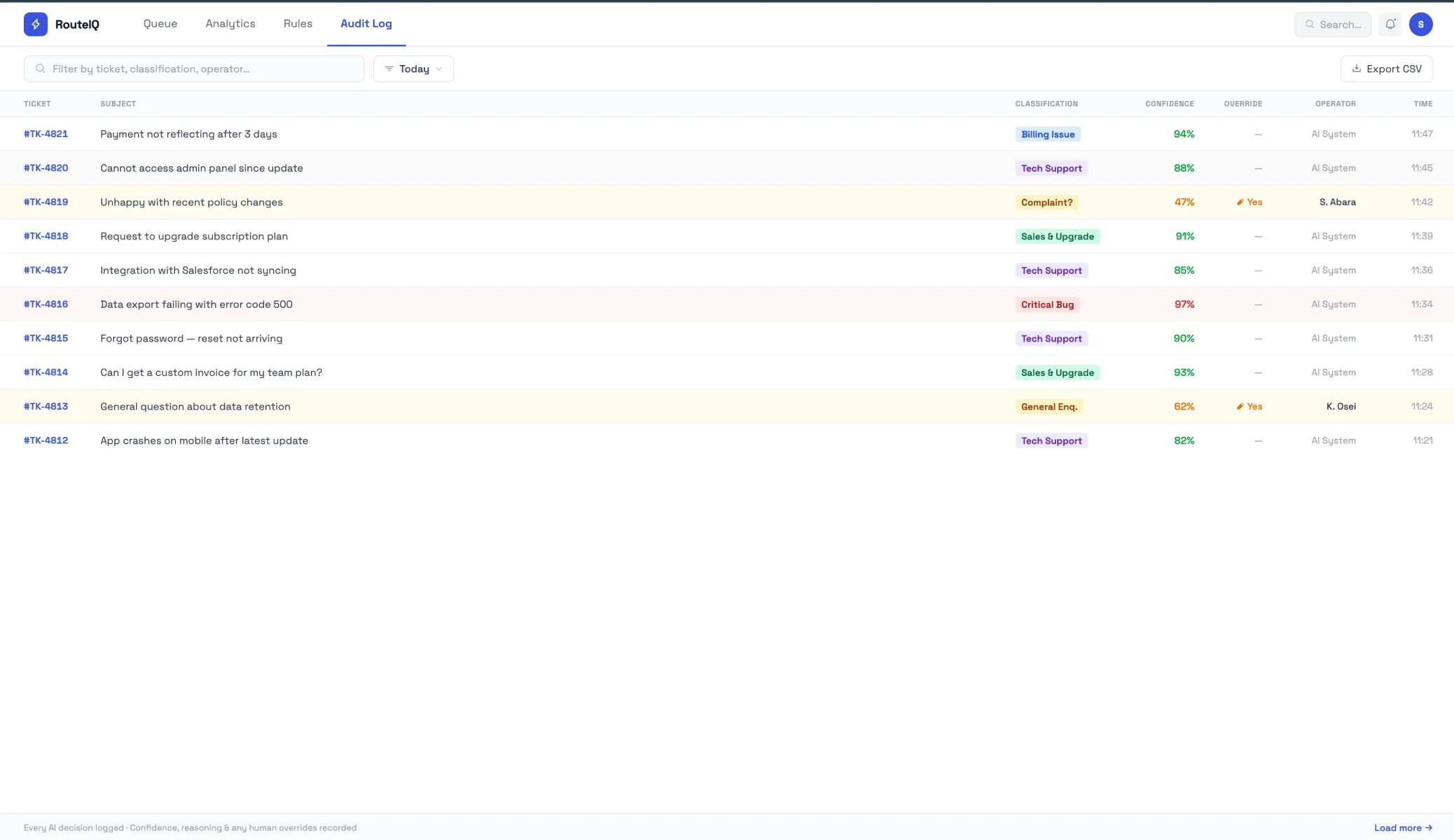
When the classifier is confident the ticket routes automatically; when it is uncertain, the ticket goes to a human triage step with the agent suggestion visible rather than being routed on a guess. The human outcome feeds back as additional training data, so the system improves without a periodic re-training campaign. Every routing decision is logged with the classifier reasoning and the confidence level, so for regulated or audited contexts the behaviour is fully reconstructable.
The solution we built
The capability is structured around the agent, the classification engine, the routing layer and the audit trail, with each engagement tuning the specifics to the client operational reality.
Inbound agent across channels
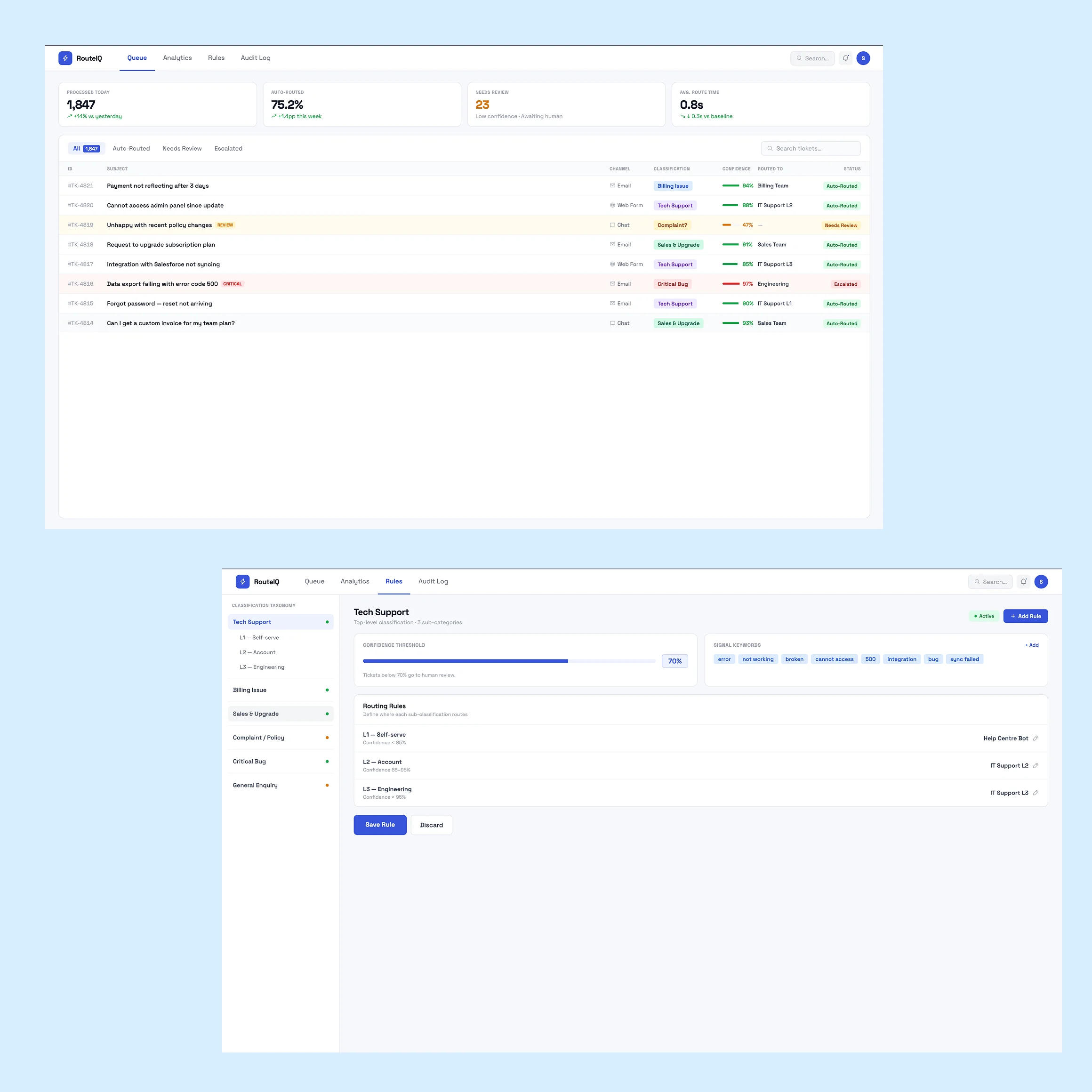
Inbound tickets are processed through the agent as they arrive. The source can be email, web form, chat, messaging channel or any other channel the client uses. The agent normalises the inputs and processes them through the classification engine consistently, regardless of where the ticket came from.
Classification engine with confidence scoring
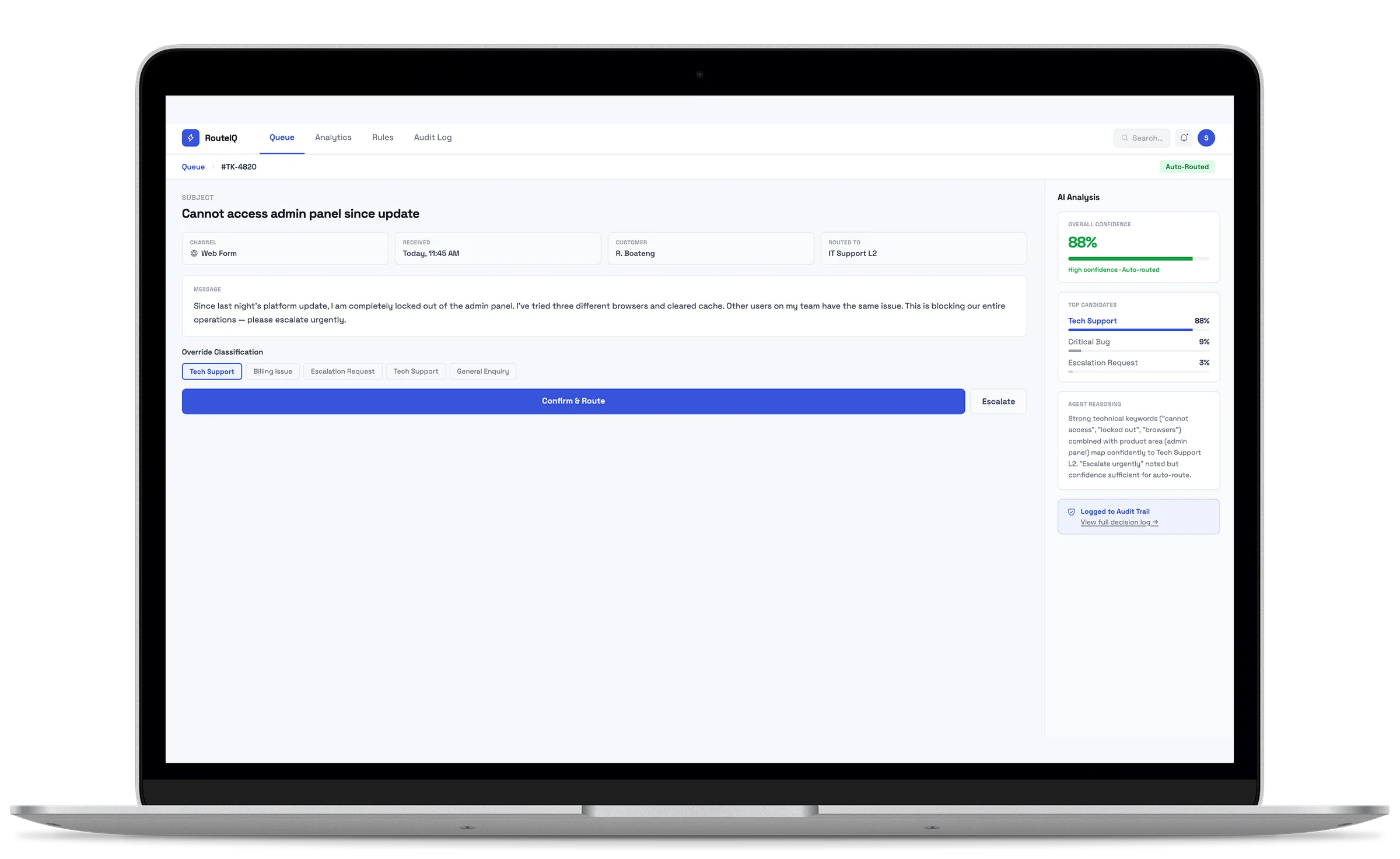
The classification engine applies the client taxonomy: the relevant product or service categories, the severity levels and the routing rules. The output is a classification with a confidence score. The engine is grounded in the client own ticket history and signals uncertainty rather than forcing a label when the content is genuinely ambiguous.
Confidence-gated routing
When the confidence is high, the ticket routes automatically to the correct queue. When it falls below the threshold the client has set for that category, the ticket goes to human triage with the agent classification suggestion visible. The human confirms the suggestion or applies a different one, and either outcome feeds back into the training data that informs future classifications.
Integration with existing operational tooling
The routing layer integrates with the client actual operational tooling. For a Zendesk or Salesforce Service Cloud environment, the agent applies the classification and routes through the platform queue mechanics; for a custom operational tool, it integrates with the platform queue management. The AI sits behind the tooling teams already work in rather than asking them to switch contexts.
Per-ticket audit trail
The audit trail captures every classification decision with the supporting reasoning, the confidence score, the routing outcome and any subsequent re-routing if the initial classification was overridden. For enterprise contexts this is the documentation that compliance and operational review processes require; for customer service contexts it is the data that lets the operations team understand and improve the system over time.
Ticket resolution for routine cases
When the engagement requires it, the capability extends beyond classification. Some tickets can be resolved without human involvement if the AI is confident enough about the appropriate response. The agent generates a response from the client knowledge base and either auto-responds for the highest-confidence cases or drafts a response for human approval, turning ticket triage into ticket resolution for the routine cases.
Tech stack


Outcomes & Impact
Automated classification
About 75 percent of inbound tickets routed automatically
The automation rate has held consistently across client engagements, tuned per corpus rather than promised as a universal threshold. The AI handles the high-confidence routing automatically while humans handle the genuinely ambiguous cases.
Team capacity
Triage shifts from overhead to exception
The default mode becomes automated routing; humans only engage when the system flags genuine uncertainty. Team members who were spending substantial time on triage now spend that time on resolution, and the shift compounds across the operations day.
Customer experience
Faster assignment and fewer misroutes
Customers waiting in generic queues now reach the right team faster, because the system does not wait for human capacity to triage. Misrouted tickets become rarer because the routing is consistent rather than dependent on whoever happened to be triaging.
Audit and governance
Every decision logged and reconstructable
Enterprise contexts use the per-ticket audit trail for compliance and process review; customer service contexts use it to understand routing patterns and identify where the taxonomy itself needs adjustment. The data the system generates becomes input to the next iteration of tuning.
Trusted and verified by our clients


 ISO/IEC 27001:2022
 ISO 9001:2015
 GDPR compliant
Frequently Asked Questions

Tell us about your project
Tell us about your ticket volume, the classification taxonomy you use and where you want the capability to be in twelve months. A 30-minute call is the fastest way to find out whether Unico Connect is the right partner.
Prefer to book directly?
🗓️ Schedule on Calendly →Or email us:
✉️sales@unicoconnect.com