








PoC vs Prototype vs MVP, Which One Your Product Needs First

Malay Parekh
CEO & Director, Unico Connect
In this article
- Quick Answer
- Key Takeaways
- PoC vs Prototype vs MVP Side by Side
- Which Stage to Fund First
- What Each Stage Is For
- PoC vs Prototype vs MVP Cost and Timeline
- The Evidence That Ends Each Stage
- When You Can Skip a Stage
- How AI Changes the Order
- Pilot, MLP, MMP and Other Terms Buyers Confuse
- Starting the Right Stage With Unico Connect
- Frequently Asked Questions
PoC vs prototype vs MVP is the first funding call for a new product or AI feature. A proof of concept (PoC) tests whether the hard part can be built, a prototype tests whether users understand and want the flow, and a minimum viable product (MVP) tests whether people will use it and pay. Fund them in the wrong order and you pay to answer the wrong question.
Quick Answer
Fund first the stage that tests the risk most likely to kill your product. If the technology might not work, start with a proof of concept, a few weeks of throwaway code on your own data. If users might not get or want the flow, start with a clickable prototype tested with five users at a time. If both are answered, build the MVP. You can skip the first two stages, but some form of MVP must face real buyers, even one run by hand.
Key Takeaways
- Screens cannot prove feasibility, and a working PoC cannot prove demand.
- In 2026 guides, Inoxoft estimates a focused clickable prototype at $2,000 to $5,000, TekRevol puts most small to mid level software PoCs at $15,000 to $70,000, and Keyhole Software puts a simple MVP at $40,000 to $120,000.
- Write down what ends each stage, and who decides, before it starts.
- An app generated in Lovable or Bolt becomes your MVP once customers rely on it, so sign in, access rules, tests and deployment you control need to be in place first.
PoC vs Prototype vs MVP Side by Side
Read the last two rows first, because most comparisons leave them out.
Table 1. PoC vs prototype vs MVP on ten decision points
| Decision point | Proof of concept | Prototype | MVP |
|---|---|---|---|
| Question it answers | Can it be built? | Will users understand and want this flow? | Will people use it and pay? |
| Risk it retires | Feasibility | Usability, with an early read on value | Value and business viability |
| Who sees it | Your team and technical leads | Test users, your team and investors | Real users and paying customers |
| Fidelity | Working code for one hard part, no polish | Clickable screens, little or no backend | From a service run by hand to a small product on production foundations |
| What gets built | The riskiest integration, algorithm or model, on real inputs | The core flow, from paper sketches to a high fidelity click through | One core flow end to end, run by hand or coded with sign in, data and security |
| What carries forward | The answer, the architecture choice and the test data | The tested flow and the design intent | The codebase, the users and the usage data |
| Duration as published | 2 to 6 weeks for a basic PoC (TekRevol, 2026), 1 to 4 weeks for an AI PoC (Unico Connect) | 5 days in a GV design sprint, 1 to 4 weeks at high fidelity (Inoxoft, 2026) | 2 to 4 months for a simple MVP (Keyhole Software, 2026), 2 to 3 months on web or mobile (Unico Connect) |
| Main cost driver | Unknowns, and access to real data and systems | Number of screens and flows, and fidelity | Platforms, APIs, payments and compliance |
| Evidence that ends it | It passes a pass bar, set in advance, on real inputs | Test users finish the core task without help | A usage, retention or payment number set before the build starts is reached |
| What kills it | It fails the pass bar, or the fix costs more than it can earn | Users still fail the task, or shrug at the result, after a redesign | The number is missed by the end date and changes stop moving it |
Which Stage to Fund First
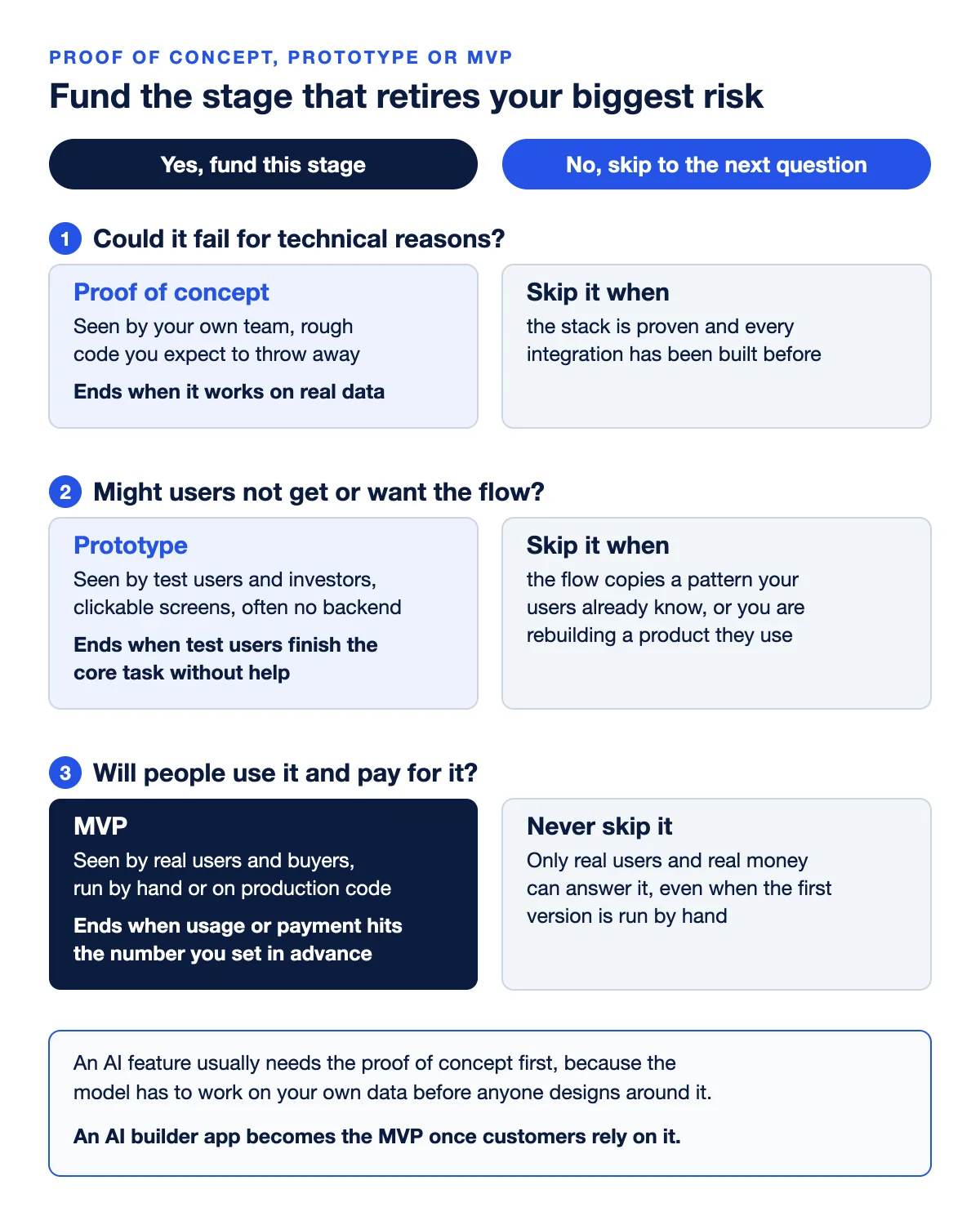
Ask what is most likely to kill the product, then fund the cheapest test of that risk. Marty Cagan of SVPG splits product risk into value, usability, feasibility and business viability, and writes "I still argue that the toughest risk is usually value risk" (SVPG, 2017). We map a PoC to feasibility risk, a prototype to usability risk with an early read on value, and an MVP to value and viability risk. So the PoC is the stage to question, never the MVP.
The stages are not a fixed sequence. When the technology and the flow are both uncertain, run the PoC and the prototype side by side.
What Each Stage Is For
Proof of concept vs prototype vs MVP comes down to one question per stage.
Proof of Concept, Can It Be Built
In software, a proof of concept is a small piece of working code aimed at the one part that might not be possible, such as a legacy integration, a matching algorithm or a model on your data. The UK Register to vote team focused its alpha on an API to the registration systems of over 400 local councils, because the service could not work without it (GOV.UK). Expect to throw the code away.
Prototype, Will Users Get and Want the Flow
A prototype lets you watch a user get lost before the flow is expensive to change. Nielsen Norman Group calls a user interface prototype "a hypothesis" that you test by watching users work with it (NN/g). A GV design sprint builds one in a day and tests it with customers on day five (GV). Liking a flow is not paying for it.
Our UI and UX design team prototypes in Figma and tests flows with real users before a line of code is written. On the Meeveem platform, client prototypes already set the design, and our job was to "take it from prototype to production without losing the design intent".
MVP, Will People Use It and Pay
Only real buyers can show whether people will use a product and pay for it, and an MVP is the first stage built for them. SyncDev, the firm Frank Robinson led as CEO, wrote "Since our first use of the term in 2001, the MVP concept has spread quickly" (SyncDev, archived). That first use came eight years before the MVP definition we use. Eric Ries defined it in 2009 as "that version of a new product which allows a team to collect the maximum amount of validated learning about customers with the least effort" (Startup Lessons Learned). The Agile Alliance says an MVP may be "no more than a landing page, or a service with an appearance of automation, but which is fully manual behind the scenes" (Agile Alliance).
When it is code, build code you keep, with proper sign in, a clean data model and secure APIs. On the Sergo platform, the brief was to "take an internal prototype to a full operations platform", and the prototype was extended "rather than rebuilding".
PoC vs Prototype vs MVP Cost and Timeline
A clickable prototype is usually the cheapest stage, and a hard PoC can cost as much as a small MVP, so keep a PoC to one technical question. Prices in this section were read on November 5, 2026, and each is the figure published by that firm.
Table 2. Published prices and lengths per stage
| Stage | Source | Price as published | Length as published |
|---|---|---|---|
| Clickable prototype | Inoxoft, US and Europe, April 2026 | $2,000 to $5,000 for a focused scope | 1 to 4 weeks at high fidelity |
| Prototype for user testing | Conxion, North Carolina studio | $2,500 to $6,000 | 1 to 2 weeks |
| Software PoC | TekRevol, Houston, 2026 | $15,000 to $70,000 for most small to mid level projects, as little as $5,000 to $10,000 for a simple single purpose PoC | 2 to 6 weeks for a basic PoC |
| AI agent PoC | Unico Connect, our AI Agent PoC | $1,500 to $6,000 | 1 to 4 weeks |
| Simple MVP | Keyhole Software, over 200 projects, 2026 | $40,000 to $120,000 | 2 to 4 months |
Figma prototyping works on every plan, including the free Starter plan, and a Professional full seat costs $20 a month billed monthly (Figma pricing). The AI row comes from our AI agent cost breakdown.
Our custom software cost guide sets our MVP figures against the market. MVPs start at $15,000, inside our published estimate range of $15,000 to $50,000, and take 2 to 3 months on web or mobile.
The Evidence That Ends Each Stage
Write the exit evidence down before a stage starts, with a number, an end date and the person who decides. Without it, a PoC drifts, a prototype gets polished, and an MVP gets defended instead of judged.
40%
Minimum share of users very disappointed to lose it, the Sean Ellis benchmark for product market fit
A proof of concept ends when
- The technical question and its pass bar are written down before any code
- It passes on your own data and systems
- A named owner calls pass or kill on a fixed end date
A prototype ends when
- Test users finish the core task without help, in rounds of five
- The problems found in the last round are fixed and retested
- The product lead picks the flow to build and the ideas to drop
An MVP ends when
- A usage, retention or payment number set before the build starts is reached or missed by the end date, and the founder calls continue, change or stop
- You can name the next thing to build from what users did, not what they said
Skip a stage only when its question already has an answer you trust.
Skip the PoC if
- The stack is proven and every integration has been built before
- No new algorithm or AI model sits in the core flow
- Each vendor API has public docs and a sandbox you have tested
Skip the prototype if
- The flow copies a pattern users already know, such as sign up and checkout
- You are rebuilding a product people already use, with the same flows
- It is an internal tool for a team you can sit beside and watch
Go straight to an MVP if
- Both questions above already have answers
- You can run it by hand first, as a concierge MVP, and charge for it
- A landing page or a sales call can test demand before any build
Never skip the MVP itself, even if version one is a spreadsheet and an inbox you run by hand.
How AI Changes the Order
AI usually moves the PoC to the front and makes the prototype cheap.
An AI Feature Usually Needs a PoC First
The open question is whether a model does the job on your data. Set the pass bar, then test on records from your own systems that the model has not seen.
On our AI development projects, the PoC is the short part. A proof of concept takes 1 to 4 weeks and a production deployment typically takes 2 to 4 months, depending on data readiness, model complexity, and integration surface. Most AI proofs of concept stall before a full rollout. IDC documented the pattern in research with Lenovo, finding that about 88% of AI proofs of concept never reach widescale deployment, with only four of every 33 launched graduating to production.
When an AI Builder Prototype Becomes the MVP
An app a founder generates in an AI builder is a cheap prototype until customers rely on it with their own data. Then it is your MVP, and sign in, access rules, error handling, tests and deployment you control should already be in place.
Our AI app builder comparison priced five builders. Replit Core and Base44 Starter start lowest at $20 a month, billed monthly, against $25 for Lovable Pro and Bolt Pro and $30 per user for v0 Plus, as read on November 2, 2026. Andrej Karpathy, who coined vibe coding in February 2025, called it "not too bad for throwaway weekend projects" (Karpathy on X). The UK service manual is blunter and tells teams "Do not just copy prototype code into production" (GOV.UK).
Two expensive traps
- A prototype shown as a product. Keep a polished click through behind a password, as the UK service manual tells government teams, and call it a prototype.
- A vibe coded prototype shipped as the MVP. Once users trust it with their data, the security work the prototype skipped is overdue.
Pilot, MLP, MMP and Other Terms Buyers Confuse
A pilot is a limited live rollout of something already built, and our guide to moving an AI pilot to production covers what follows one. A minimum lovable product (MLP), which Aha! CEO Brian de Haaff argued for in 2013, aims for a first version customers love rather than tolerate (Aha!). A minimum marketable feature or product (MMF or MMP) is about earning. In the Agile Alliance wording, "MMF is about delivering value to customers, whereas MVP is about learning more about the ultimate product" (Agile Alliance).
Starting the Right Stage With Unico Connect
Unico Connect works with founders and product teams on whichever stage comes first, whether that is an AI proof of concept on your own data, a Figma prototype tested with users or a first version on production foundations. Our MVP development team also takes over apps that began in an AI builder or a no code tool and now need production engineering.
Frequently Asked Questions
Do I need a proof of concept before building an MVP?
A proof of concept comes first only if the product might fail for technical reasons, such as a new algorithm, an AI model or an integration nobody on your team has built. Then run a short PoC with a pass bar and an end date. On a proven stack, skip it and spend the money on a prototype or the MVP.
Can a prototype be turned into the MVP?
A prototype carries into the MVP only as far as its foundations allow. A clickable prototype in Figma Design has no backend, so its tested flow and screens carry forward but no code does. A coded prototype, even one from Figma Make or an AI builder, carries forward only if it has a database, sign in and access rules worth keeping. Decide before building it whether it is a keeper.
How much does a software prototype cost?
Inoxoft estimated a focused clickable prototype at $2,000 to $5,000 in April 2026, and in November 2026 the North Carolina studio Conxion listed $2,500 to $6,000 for one built for user testing. Screen count, fidelity and who builds it drive the spread.
Does an AI feature need a proof of concept first?
An AI feature usually needs a PoC first, because the model has to work on your own data before anyone designs around it. The exception is a model your team has already tested on the same kind of data. You can prototype the flow at the same time, with a person playing the AI behind the screen.
How is a proof of concept different from a demo or a pilot?
A PoC is internal working code that answers one technical question on your data. A demo is a scripted walk through built to persuade, and it proves neither feasibility nor demand. A pilot comes after a build and puts a working product in front of a limited group of real users in one setting.
Should I show investors a prototype or an MVP?
Show investors an MVP if you have one, because usage or payments are evidence a prototype cannot give. With only a prototype, show it as a prototype and bring what test users did with it. Presenting a prototype as a live product backfires once questions about users, data or revenue start.