









Why AI Models Fail in Production, the MLOps Gap Explained

Vasim Gujrati
Solutions Architect, AI & Platforms, Unico Connect
In this article
Most AI models fail to reach production because teams optimize for static model output and underinvest in ongoing operational readiness. The blockers sit in evaluation at scale, deployment orchestration, continuous monitoring, clear ownership and active feedback loops. Those areas are where the MLOps gap appears, and engineering teams close it with the operational workflows covered below.
The Gap Is Operational, Not Theoretical
IDC documented the pattern in research with Lenovo, finding that about 88% of AI proof of concepts never reach widescale deployment, with only four of every 33 launched graduating to production (IDC and Lenovo, 2025). When a pilot fails, the model is rarely the cause. The failures cluster around integration, deployment friction and what happens after launch.
Two operating model problems sit behind that number, and neither one is about model quality. Models commonly degrade after launch as live data drifts away from the data they were built on, often without any error alert firing. Rollouts also stall for months when governance is unclear and environments are inconsistent, so a model that works in a notebook waits a long time to reach users.
What the MLOps Gap Actually Includes
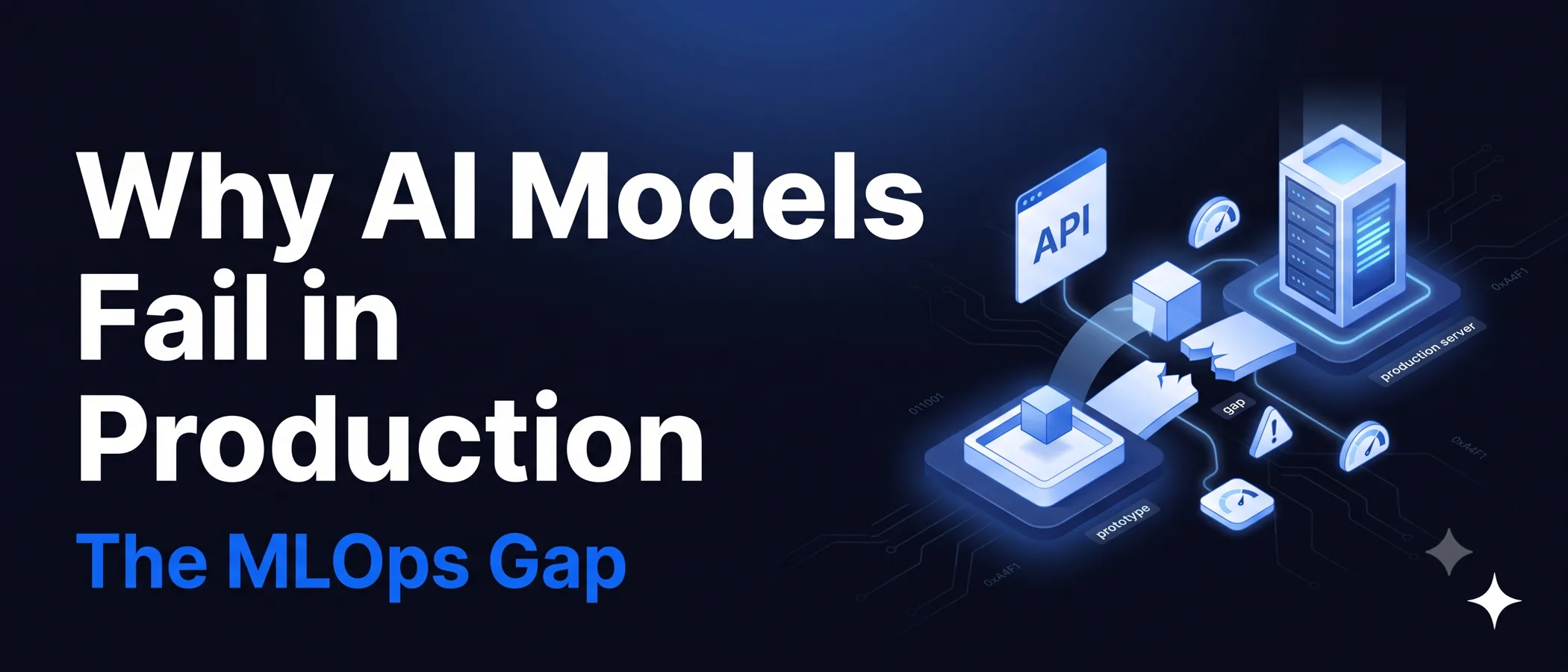
The MLOps gap is the operational divide between an isolated model artifact and a production grade software system. To close it, you build deterministic frameworks around probabilistic model behavior. In practice that includes task specific evaluation suites, automated regression coverage, multi environment deployment controls, real time latency monitoring, and structured human in the loop review for high risk cases.
Prototype success versus production readiness
A prototype proves that a model can work under idealized, sandboxed conditions. Production readiness means you can prove the system works repeatedly and predictably under real cost, latency, reliability and security constraints. An LLM wrapper that summarizes one PDF in a local terminal will fall over under concurrent webhook traffic if it has no rate limiting, error handling or fallback cache. Shipping AI to production takes resilient failure handling, clear engineering ownership and explicit quality thresholds.
Four Reasons AI Projects Stall Before Launch
1. Teams measure model quality, not production value
Vague success criteria delay launch decisions. A model returning 95% benchmark accuracy is useless if the integration does not fix the workflow bottleneck it was built for. A launch decision needs proof that the workflow creates usable value, and a benchmark score only tells you the model performs well. Without KPIs tied to the product, teams get stuck in an endless optimization loop.
2. Evals are added too late
Development evaluations measure general capability, while production evaluations measure workflow specific safety, consistency and latency. If evals are not wired into the CI/CD pipeline from day one, a team cannot tell whether a new prompt iteration quietly broke an existing edge case. Our post on CI/CD pipelines for AI applications walks through how to build one.
3. Deployment is treated as a handoff
Tossing a model over the wall to an operations team guarantees friction. Deployment is a continuous engineering lifecycle, and hosting an endpoint is only one part of it. Production AI needs release discipline, which means environment consistency, strict versioning of both model weights and system prompts, and deterministic rollback.
4. No one owns monitoring after launch
Google warns in its Rules of Machine Learning that silent failure happens more in machine learning systems than in other kinds of systems. If nobody owns post launch monitoring, teams miss quality drift, latency spikes and context specific hallucinations. An unmonitored model generates bad output that corrupts data or breaks downstream systems without ever tripping a standard error alert.
What Teams That Reach Production Do Differently
Successful teams treat AI as a product engineering problem instead of an isolated experiment. At Unico Connect, our AI native workflows build operational concerns into the whole lifecycle, from discovery and architecture to automated testing and infrastructure. Mature teams do not wait until the model is built to work out how to host it. They design the system with failure paths, guardrails and telemetry hooks from day one.
A practical four step operating model
- Define thresholds. Set acceptable latency bounds and error tolerance limits before writing core code.
- Embed early evals. Add automated evaluation assertions to the CI/CD pipeline during the earliest development phases to catch regressions.
- Orchestrate pipelines. Manage data ingestion, model versioning and isolated inference environments with reproducible infrastructure as code.
- Deploy with fallbacks. Roll out in canary phases, and fall back to deterministic rules or a cache when AI confidence drops below a set threshold.
Where Our Experience Adds Credibility
We hold this view because we ship high stakes workflows, such as putting Gemini multimodal capabilities into production and building a WhatsApp voice agent for enquiries and a separate ordering agent for a B2B logistics client. In those systems we use custom evaluation frameworks to enforce QA and regression discipline, and we continuously balance the trade offs between latency, API cost and extraction accuracy. We design deployment, monitoring and maintenance on the assumption that models will eventually drift, a view also featured in DesignRush News. Our MLOps versus DevOps guide sets out the operating model behind this, and our agentic AI services cover agent specific work.
In most failed AI projects the foundation model was strong enough. What broke was execution across systems, process and ownership. In enterprise AI, the teams that stand out are the ones mature enough to operate and maintain the system reliably long after the demo.
Frequently Asked Questions
What is the MLOps gap in AI models in production?
The MLOps gap is the distance between a promising prototype and a fully operational system that has continuous evaluation, automated deployment pipelines and ongoing post launch monitoring. Closing that gap is what turns a demo into a dependable product.
How do evals reduce model deployment challenges?
Evals reduce deployment challenges by giving you measurable, objective release criteria. They test for accuracy, consistency and safety during the build phase, so launch decisions stop being subjective and critical edge cases get caught before the code reaches production.
Why is monitoring essential for production AI systems?
Monitoring is essential because model output degrades after launch from data drift, API updates and shifting user inputs, even when the demo performed flawlessly. Continuous monitoring catches these silent regressions, triggers human review and keeps the system reliable over time.
Conclusion
Reaching production is an operating model problem, not a model problem. Define thresholds tied to business value and embed evals early. Treat deployment as an engineering lifecycle, and own monitoring after launch. If you need AI that survives contact with real users, look at our AI development services or hire AI engineers from our team.