









How Much Does AI Agent Development Cost in 2026?

Malay Parekh
CEO & Director, Unico Connect
In this article
- Quick Answer
- Key Takeaways
- Cost Ranges at a Glance
- How These Ranges Compare to the Market in July 2026
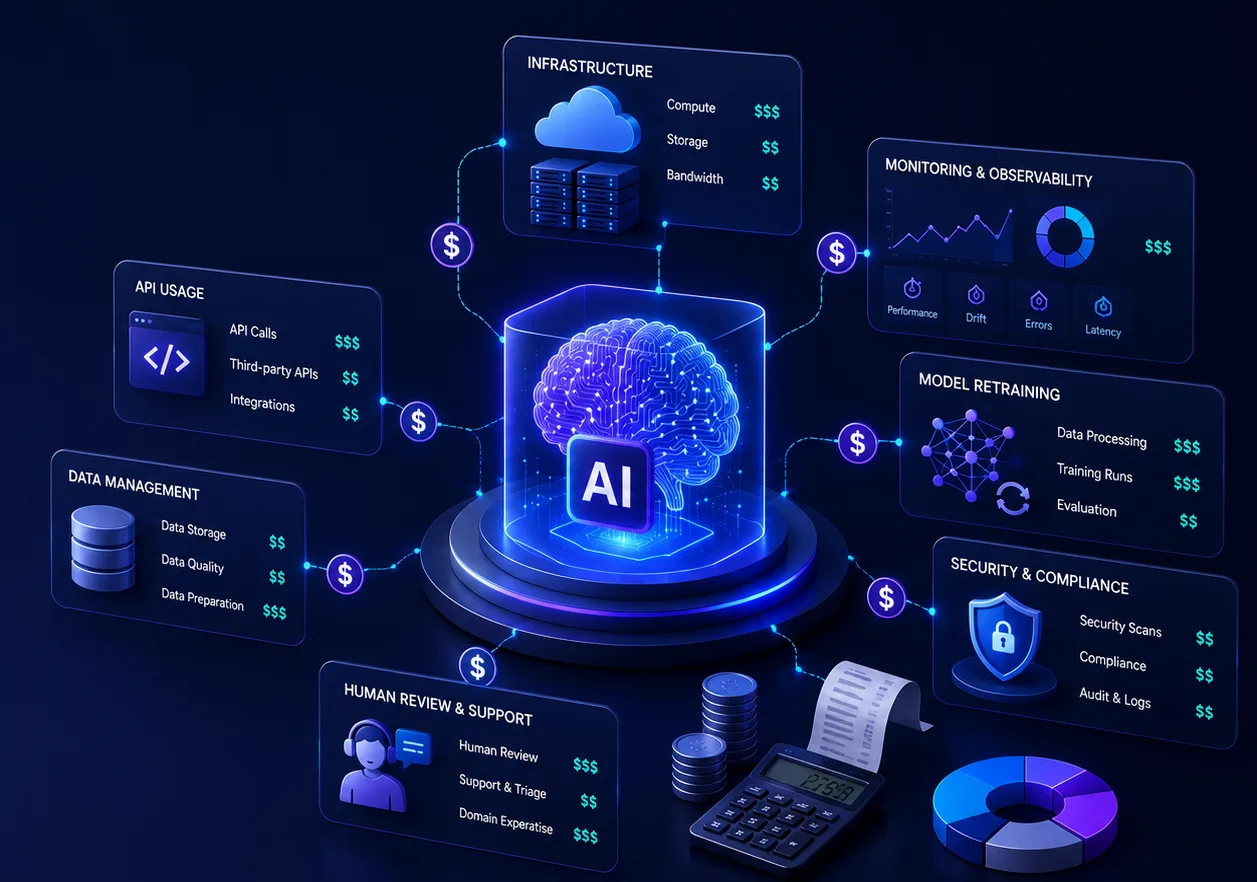
- What Drives the Cost of AI Agent Development?
- Real Examples From Our Agent Builds
- How Do AI Model Costs Factor In?
- Fixed Price vs. Time and Materials
- Compliance Heavy Agents
- What Is the ROI on an AI Agent Investment?
- Frequently Asked Questions
Last verified: 11 June 2026. Tier ranges are our published estimate ranges from real projects; final pricing is scoped per project. For the broader market picture, see the AI development cost guide.
Quick Answer
AI agent development in 2026 ranges from $5,000 for paid discovery and $10,000 for a simple proof of concept to $150,000+ for enterprise orchestration. The primary cost driver is not the AI model itself but integration complexity, data pipeline work, and production grade guardrails and monitoring systems.
Key Takeaways
- Five pricing tiers spanning $5,000 discovery through $150,000+ enterprise orchestration
- LLM inference costs are ongoing monthly expenses, separate from development investment
- Compliance-heavy industries (FinTech, Healthcare) add 15 to 25% to base development cost
- Fixed price engagement suits well scoped PoCs; time and materials better for exploratory enterprise builds
- The Unico AI Adoption Discovery program ($5,000 to $8,000, 3 weeks) de-risks investment before full commitment
Cost Ranges at a Glance
| Engagement Type | Timeline | Cost Range | Best For |
|---|---|---|---|
| AI Adoption Discovery | 3 weeks | $5,000 to $8,000 | Validation, requirements, working PoC |
| Single Task Agent PoC | 2 to 4 weeks | $10,000 to $25,000 | Testing viability before full build |
| Production Single Agent | 8 to 12 weeks | $25,000 to $75,000 | Document processing, internal ops, support |
| Business Process or Multi Step Agent | 3 to 6 months | $75,000 to $150,000 | Complex workflows, multiple data sources |
| Enterprise Orchestration | 5 to 8+ months | $150,000+ | Multi agent systems, mission critical, compliance heavy |
These are the ranges Unico Connect charges, taken from our own agent projects rather than industry surveys. Paid discovery, at $5,000 to $8,000 over 3 weeks, is the one exception to our $10,000 fixed scope minimum. Where a project lands within a tier depends on the factors below.
How These Ranges Compare to the Market in July 2026
Published industry pricing guides as of July 2026 put custom AI agent builds at roughly $10,000 for a simple rule based agent up to $450,000 and beyond for enterprise multi agent systems, with most mid market projects landing between $40,000 and $150,000. Our bands sit inside those ranges with a lower entry point, because the discovery program keeps early scope deliberately small. Two market findings are worth building into any budget. Model API fees typically account for only 8 to 15 percent of the total build cost, since integration engineering, security, and MLOps dominate. And annual maintenance typically runs 15 to 30 percent of the original build cost, so a realistic three year budget is roughly two to three times the initial quote. There is a fuller account of what AI product maintenance actually costs after launch. If a proposal shows most of the budget going to model fees or shows no maintenance line at all, treat both as red flags. When you are comparing agencies rather than budgets, our list of top AI development companies sets out who builds what.
COST ESTIMATOR
AI Agent Cost Calculator
Pick what matches your project and get a realistic estimate range. These are our published estimate ranges, not quotes: final pricing is scoped per project.
Published Unico Connect estimate ranges (verified June 2026) at a blended rate of $30 to $60 per hour. Integrations add roughly 15 to 30%, and compliance work adds about 20%, consistent with industry cost drivers. Every project is scoped individually before any number becomes a quote.
What Drives the Cost of AI Agent Development?
Most cost guides focus on the model itself. That analysis misses the mark. Here are five factors that actually determine the budget.
1. Integration Complexity
An AI agent querying a single internal database costs a fraction of one needing to read from a CRM, write to an ERP, call third party APIs, and authenticate across systems with different credential models. Each new integration point adds scoping, development, and testing overhead.
2. Data Pipeline and RAG Setup
Most enterprise agents work with proprietary data, not just base model training data. This requires building a RAG (Retrieval Augmented Generation) pipeline: ingesting documents, chunking them, embedding into vectors, indexing into a vector store (Pinecone, Weaviate, pgvector), and maintaining currency as data changes.
3. LLM Model Selection
GPT-6 Astra or GPT-6.1 Sol, Claude Sonnet 5.5 or Claude Opus 5.5, Gemini 4 Argon, or a self hosted open weights model each carry tradeoffs as of October 2026. Frontier models cost more per token and API call. Smaller, fine tuned models reduce inference cost but require upfront fine tuning investment, and the frontier moves several times a year, so design the system to swap models without a rebuild.
4. Guardrails and Safety Systems
A demo agent in a browser needs minimal guardrails. A production agent touching customer data, sending emails, updating records, or triggering financial transactions absolutely requires them. Input validation, output filtering, hallucination detection, human in the loop checkpoints, and audit logging typically account for 20 to 30% of a production build.
5. Compliance Requirements
Regulated industries make compliance mandatory. For FinTech, Healthcare, financial services, or contexts handling personally identifiable information, plan for compliance work from the outset. Anticipate 15 to 25% added cost in these sectors.
Real Examples From Our Agent Builds
WhatsApp Voice and Ordering Agents for a Logistics Client
A B2B courier and logistics operator in India served repeat business customers on WhatsApp, the channel they already used, and routine enquiries were tying up human agents.
We built two AI agents on WhatsApp and integrated them with the operator platform. A voice agent answers customer enquiries, including voice notes, and a B2B ordering agent takes repeat orders from business customers. In the same engagement we optimised the AWS infrastructure behind the platform.
Results: both agents are live, routine enquiries now cost less to serve, and the cloud footprint is tuned for cost and performance. The details are in our WhatsApp agents case study. When agents like these sit inside a wider delivery or dispatch build, our guide to logistics and dispatch build costs covers that budget.
AI Learning Platform: Highlands Community Charter School
For Highlands Community Charter School, we built a unified web and mobile learning platform for 15,000+ students, with Brain AI, a retrieval augmented knowledge base that surfaces content and recommendations from each student's progress, and two way live translation across student, teacher and parent surfaces.
Results: 97% translation accuracy for multilingual classrooms and 50% faster content turnaround for teachers and administrators.
How Do AI Model Costs Factor In?
Development cost is a one-time or periodic investment. Model inference cost is ongoing and scales with usage. These are separate budget lines requiring independent planning.
How Token Pricing Works
LLMs charge per token, where roughly 0.75 words equals one token. Every message sent to the model (input) and every response generated (output) incurs token cost. Production agents typically use both input tokens and output tokens.
In an illustrative scenario, 1,000 interactions a day at about 2,000 combined tokens each come to 2 million tokens a day, or roughly 60 million a month. With three quarters of those tokens as input, list prices on 16 October 2026 put that at about $90 a month on Gemini 3.8 Flash, $240 on Claude Sonnet 5.5 or GPT-6.1 Sol, and $1,200 on Claude Fable 5.1 or GPT-6 Astra, before caching or batch discounts. Gemini 3.8 Flash doubles in price on 1 January 2027, and Anthropic reports that agents typically use about 4 times the tokens of a chat interaction.
Important note: LLM pricing changes frequently. Always verify current per-token pricing directly with OpenAI, Anthropic, or Google before finalising budgets.
Strategies to Control Inference Costs
Semantic caching: Store embeddings of past queries and return cached responses for semantically similar questions.
Model tiering: Route simple, structured queries to smaller, cheaper models and escalate only to frontier models for complex reasoning.
Prompt compression: Shorter, well-structured prompts cost less.
Fixed Price vs. Time and Materials
| Factor | Fixed Price | Time and Materials |
|---|---|---|
| Best for | Well-scoped PoCs | Exploratory builds |
| Budget predictability | High | Variable |
| Requirement clarity | Must be high | Can be refined |
| Risk allocation | Supplier absorbs | Client absorbs |
| Flexibility | Low | High |
Recommendation: run a fixed price AI Adoption Discovery first. That 3-week exercise produces the requirements clarity needed to confidently scope a fixed price PoC or production build.
Compliance Heavy Agents
US FinTech (SOC 2, PCI DSS): 15 to 25% added build cost.
UK Financial Services (FCA). The FCA has no AI specific rules and applies existing ones such as the Consumer Duty and the Senior Managers and Certification Regime, so plan logging and explanation work around those duties.
Singapore (MAS Technology Risk Management): Imposes model risk management and adversarial testing requirements.
India BFSI (RBI). RBI has no AI specific direction yet. Its draft Guidance on Regulatory Principles for Model Risk Management of 24 June 2026 would cover all models used by regulated entities, including AI and ML models, so plan model documentation and validation now.
Germany and EU (EU AI Act, GDPR): Classifies many financial and HR AI applications as "high-risk."
US Healthcare (HIPAA): Any agent accessing PHI requires Business Associate Agreements with all sub-processors.
What Is the ROI on an AI Agent Investment?
Choice Digital: We built the loan origination and KYC system for Choice Digital, a FinTech client in the USA, where the AI had to meet strict regulatory compliance requirements.
StayVista. For StayVista, a vacation rental platform in India, we built systems that support a 50 percent increase in booking capacity and a 30 percent reduction in operational cost.
A Simple ROI Framework
Time saved per interaction × hourly cost × monthly volume = monthly savings
Example: an internal support agent handling 500 repetitive monthly queries, each saving 15 minutes of a $40/hour team member's time, generates $5,000 monthly savings. At $30,000 development cost, payback is 6 months.
Most well scoped AI agent investments generate payback within 6 to 18 months.
Frequently Asked Questions
What affects AI agent development cost the most?
Integration complexity is the single largest cost driver in most projects. The number of external systems the agent must connect to determines more of the budget than AI model selection.
How long does it take to build an AI agent?
A focused single task PoC takes 2 to 4 weeks. A production ready single agent with proper integrations takes 8 to 12 weeks. A business process or multi step agent runs 3 to 6 months. Multi agent systems and enterprise grade deployments in regulated industries can run 5 to 8+ months.
What is the difference between a PoC and a production build cost?
A PoC validates that the agent can do the task with your data under ideal conditions. A production build adds the work making the agent reliable at scale: error handling, retry logic, authentication with live systems, guardrails, monitoring, audit logging. Production builds typically cost 3 to 5 times more than the PoC for the same functional scope.
Do development costs include the model API fees?
No. Development cost and LLM inference cost are separate budget lines. Development cost is a one-time investment. Inference cost is ongoing and scales with usage.
Should I choose fixed price or time and materials?
Fixed price works well for well scoped, clearly defined builds: typically single-task agents after a Discovery phase. Time and materials is better for multi agent systems and enterprise builds.
How do I know if an AI agent investment is worth it?
Map the current-state process your agent would replace. Quantify the time spent, error rate, and volume. Apply: time saved × hourly cost × volume = monthly savings. If payback is under 18 months and the process is stable, the investment typically makes sense. Our AI agent development team scopes these builds to your use case.