








Enterprise AI Platform vs Direct Model API Access

Vasim Gujrati
Solutions Architect, AI & Platforms, Unico Connect
In this article
- Quick Answer
- Key Takeaways
- What Each Option Actually Is
- The Comparison That Actually Decides It
- Three Things the Documentation Says That Buyers Assume the Opposite Of
- Where a Platform Earns Its Margin
- Where Direct API Access Wins
- What MCP Does and Does Not Change
- For Startups
- For Large Institutions
- The Lock In Nobody Prices
- How to Decide in Five Questions
- Frequently Asked Questions
- Conclusion
Most teams treat this as a technical question, and it is not one. The same model called through an enterprise platform and called directly returns nearly identical responses. The differences are almost entirely about who holds the contract, whose network the data crosses, whose identity system governs access, and what an auditor sees afterwards.
A more useful question is which set of problems you already have. We answer it with what the three major platforms document, including three points where their own documentation says the opposite of what most buyers assume.
Quick Answer
Call model APIs directly when speed matters more than governance, when you want the newest models the day they ship, and when nobody is going to audit you soon. Buy an enterprise AI platform such as Amazon Bedrock, Microsoft Foundry or Google Gemini Enterprise Agent Platform when data residency, private networking, existing cloud identity, per team spend controls and audit logging are requirements rather than preferences. Governance, far more than model capability, is what decides it. A common category error is treating Model Context Protocol as a third option. MCP standardises how a model reaches your tools and data, so it sits underneath both choices. Unico Connect builds on both paths and picks between them based on the governance requirements a client can evidence rather than on platform preference.
Key Takeaways
- The model responses come back nearly identical on either path, so compare the two on governance, networking, identity and procurement.
- Picking a regional endpoint on Google does not give you data residency. Google documentation states that endpoints do not guarantee data residency or in region ML processing, so when processing has to stay inside a jurisdiction, check the ML processing commitment Google documents for your model and endpoint.
- Check each tool before you promise fully private traffic. Microsoft documents that several agent tools keep using public endpoints even inside a network isolated deployment.
- A platform can architecturally hide your prompts from the model vendor, and that is often what gets a model family through a security review. AWS documents that model providers have no access to Bedrock logs, prompts or completions.
- Plan for MCP as the connection standard that sits under whichever option you choose.
- Keep a model abstraction and keep evaluations outside the platform either way, because those two things keep the decision reversible.
What Each Option Actually Is
Direct model API access means your application holds credentials for a model provider and calls that provider directly, usually over the public internet. You own everything around the call, which is both the advantage and the cost.
An enterprise AI platform means a cloud provider sits between you and several model families. Amazon Bedrock, Microsoft Foundry and Google Gemini Enterprise Agent Platform are the three most enterprises evaluate. You get one contract, one identity system, one audit surface and one bill across multiple model providers.
A routing layer is something you build or buy on top of either, to send different requests to different models. That is a separate decision, and our post on multi model production AI strategy deals with it.
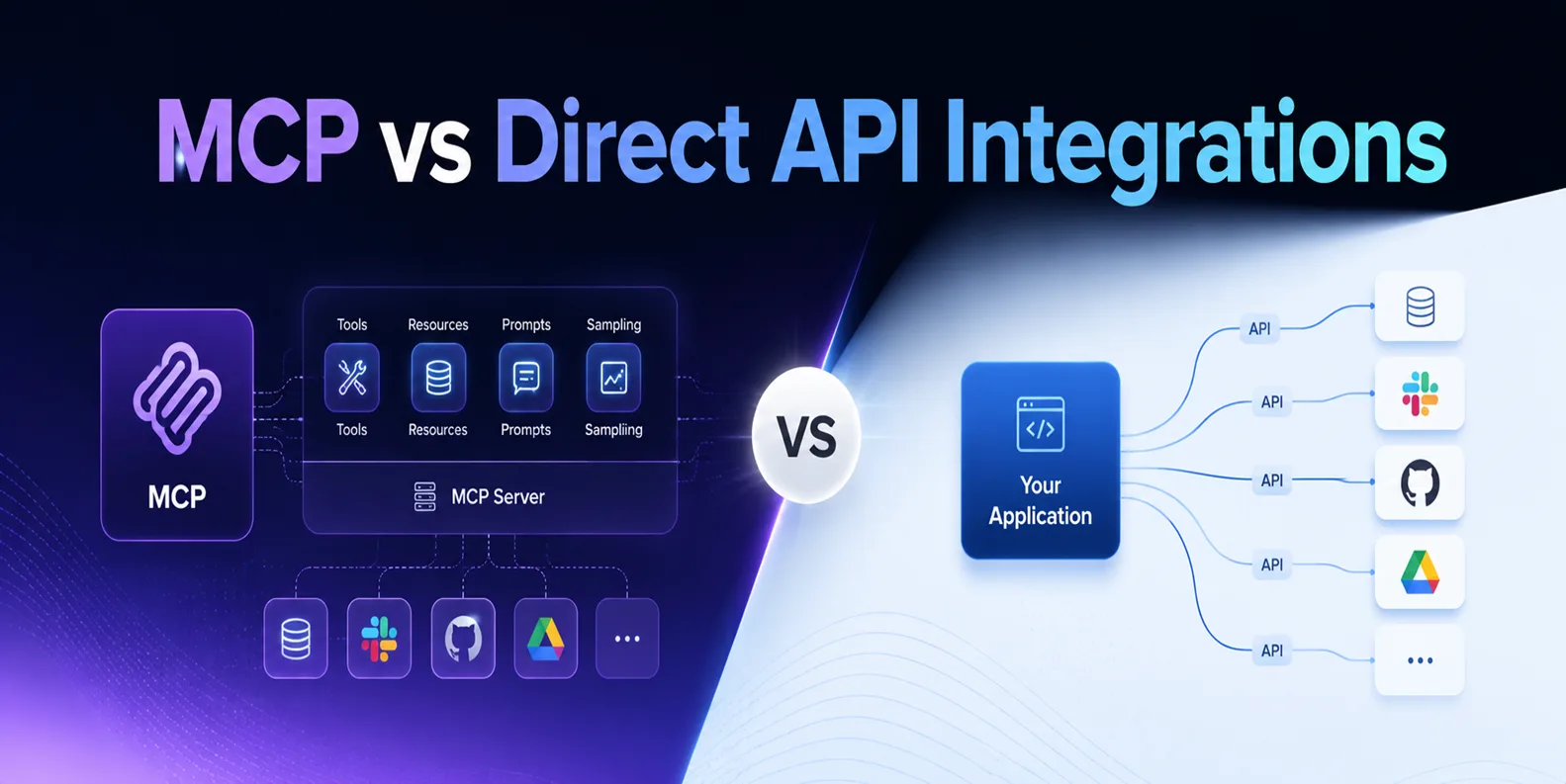
Model Context Protocol is how a model reaches your tools and data, whichever of the above you chose. For the protocol level detail, read MCP versus direct API integrations.
The Comparison That Actually Decides It
Enterprise AI platform compared with direct model API access
| Dimension | Direct model API | Enterprise AI platform |
|---|---|---|
| Time to first working call | Minutes. An API key and a request | Days to weeks. Account, project, roles, quota |
| Access to the newest models | Same day the provider ships them | Whenever the platform finishes onboarding them |
| Commercial relationship | One contract per model provider | One contract covering many providers |
| Data residency control | Whatever the provider offers | Usually region pinned, which is often the whole reason to buy |
| Identity and access | You build it, or you inherit a shared key problem | Existing cloud identity, roles and policies apply |
| Audit and logging | You build it | Built in, and an auditor already recognises the format |
| Spend controls | Provider level limits only | Quotas per team and per project |
| Private network access | Public internet, unless the provider offers a private link | Private endpoints inside your own network |
| Switching cost later | Low if you kept an abstraction | Real. Governance, tooling and pipelines all move with you |
| Where the margin goes | To the model provider | To the model provider plus the platform |
Three Things the Documentation Says That Buyers Assume the Opposite Of
Each of these comes from the vendor documentation itself, and each one routinely surprises people in procurement conversations.
A regional endpoint is not data residency
This is the most common misunderstanding in the category. Picking a region for your requests feels like picking where processing happens, but Google documentation says explicitly that it does not work that way. The deployments and endpoints page carries the line that endpoints do not guarantee data residency or in region ML processing.
Processing location is set by a separate mechanism. The data residency documentation splits the question in two. Data at rest stays in the location you chose, whichever endpoint you call. ML processing location follows your endpoint choice. Jurisdictional multi region endpoints keep processing inside a boundary such as the United States or the European Union. Locational endpoints keep it inside the broader jurisdiction of their region for the models Google lists, so a request to a United States region is processed in the United States. Global endpoints can process it anywhere.
Anyone selling into Europe should read one more detail on that same page. The EU multi region endpoint covers EU member states only, and the United Kingdom and Switzerland are explicitly excluded. A team that assumed the EU endpoint covered British customers has a compliance gap it does not know about. Storage and processing location are only part of control, and our guide to sovereign AI architecture covers jurisdiction, model portability and operations.
Network isolation does not isolate everything
Microsoft documents a full network isolation path for Foundry, including setting public network access to disabled and injecting the agent client into your own virtual network subnet. The network isolation guide is thorough.
It also contains a caveat most summaries omit. Several agent tools, including Bing Grounding, Websearch and SharePoint Grounding, are supported inside a network isolated deployment but still communicate over public endpoints. Microsoft states directly that if your organisation requires all traffic to remain within a private network, these tools may not meet your compliance requirements.
The same page carries a second planning cost. Outbound networking settings cannot currently be updated. A delegated subnet cannot be changed, and virtual network injection cannot be added to an existing deployment. Adding outbound isolation later means redeploying, so settle it before you build.
The platform can hide your prompts from the model vendor
This one works in your favour, and it is underrated. AWS data protection documentation describes a Model Deployment Account, one per model provider in each region, owned and operated by the Bedrock service team. AWS performs a deep copy of the provider inference software into that account. Because providers have no access to those accounts, they have no access to Bedrock logs, customer prompts or completions.
That is a structural guarantee rather than a contractual promise, and it is frequently the single argument that gets a model family through a security review. Call the same model provider directly and the contract is all you have to point to.
Where a Platform Earns Its Margin
The platform margin buys six things, and if none of them is a requirement, you are paying for nothing.
- Data residency, with the caveat above that you must configure the right mechanism rather than assume the region does it.
- Private networking. AWS documents VPC interface endpoints with PrivateLink so that data is not available over the internet, built on AWS PrivateLink. Microsoft documents the private endpoint and DNS equivalent.
- Identity you already run. Existing roles and policies govern model access, so you are not inventing a parallel permission system.
- Audit logging in a format an auditor recognises. On AWS that is CloudTrail, which saves you designing a log of your own.
- Spend control by team and project, so the bill becomes a forecast instead of a surprise.
- One procurement path. For large institutions, adding a model family to an existing cloud agreement is a fraction of the work of a new vendor contract. Engineers never see that difference, but for everyone else it is enormous.
The AWS shared responsibility model still applies throughout, because a platform moves the boundary of responsibility without removing your side of it.
Where Direct API Access Wins
- New models reach you first, while platforms onboard new releases on their own timeline, sometimes months behind.
- Provider specific features arrive intact. Platform abstractions often lag on them, and those features are frequently why you picked the model.
- There is one less system to debug between your request and the answer.
- You pay the model provider and nobody else, with no platform margin on top.
- Direct integration behind your own abstraction is the easiest setup to move later, with nothing to unpick.
What MCP Does and Does Not Change
Buyers often ask about MCP as if it were a third option in this comparison, which misreads what it does.
Model Context Protocol standardises how a model reaches tools, files and systems, so it answers how a model gets to your data. An enterprise AI platform answers a question at a different layer, namely who governs the model call and where it happens. You can run MCP servers against a directly called model API or against a model served through a platform. Microsoft network isolation documentation lists a private MCP tool as supported and routed through your own virtual network subnet, a good example of the two layers working together.
Where MCP does change things is the integration maths. Without a standard, connecting several models to several systems means building a bespoke integration for each pair. With one, each system is built once and every compatible model can use it. That cuts integration sprawl, but it gives you no data residency, private networking, identity integration or audit logging, and it was never meant to.
If someone asks whether to choose an enterprise AI platform or MCP, the question mixes two layers. Choose your governance posture first, then use MCP underneath it either way.
For Startups
Default to direct API access behind a thin abstraction of your own.
The governance features you would pay a platform for are mostly ones you do not need yet, and the speed penalty is real when you are still finding out what works. The one discipline worth keeping from day one is the abstraction layer, because it costs almost nothing early and is what makes the platform decision easy later.
The exception is a startup selling into regulated buyers. If enterprise security reviews are part of your sales motion, the platform answer arrives much sooner than your headcount suggests, because you inherit the requirements of your customers.
For Large Institutions
Default to a platform, then carve out exceptions.
If you already run identity, networking and audit in a cloud, extending them over model access is far cheaper than rebuilding them beside it. The pattern that works in practice is a platform as the governed default for anything touching regulated or customer data, plus a small sanctioned path to direct provider access for research and evaluation work, with clear rules about what data may cross it.
The pattern that fails is the reverse, an unsanctioned direct path that grows quietly because the governed one was too slow. It is the same shadow IT dynamic we describe in building internal tools without engineers, and the fix is the same too. Make the sanctioned path fast enough that people use it.
The Lock In Nobody Prices
Switching model providers is usually easy if you kept an abstraction. Switching platforms is not, because inference is only one of the things that moves. You also move identity bindings, audit pipelines, quota policy, deployment tooling and whatever platform specific orchestration you adopted along the way. The Microsoft constraint above is a concrete example. Outbound networking cannot be changed in place, so an architecture decision made in week one is still binding in year two.
Two things keep it reversible and both are cheap at the start.
- Own your abstraction. Your application should call your interface, never a vendor SDK directly. For the evaluation side of keeping that decision live, see our model choice guide.
- Keep evaluations outside the platform. If your eval set only runs inside the tooling of one vendor, you cannot compare alternatives fairly, so the comparison never happens.
Recent renames make the point. Microsoft documentation now sits under the Microsoft Foundry name, and Google documentation for Vertex AI generative features now resolves to Gemini Enterprise Agent Platform, with a dedicated page covering the name changes. A capability you buy survives a rename, while code built deep into one product surface does not always survive it.
How to Decide in Five Questions
- Does any regulation or customer contract require inference in a named region? If yes, platform, and check the documented ML processing location for your model and endpoint rather than assuming the region.
- Must these requests stay off the public internet? If yes, platform, and check tool by tool that nothing you depend on is a public endpoint exception.
- Will an auditor ask who invoked which model against which data? If yes, platform, unless you want to build that.
- Do you need a provider capability the day it ships? If yes, direct, at least for that path.
- Is this experimental work that may not survive the quarter? If yes, direct, behind your own abstraction.
Most organisations of any size answer yes on both sides, and then the right architecture is both paths, with an explicit rule about which workloads go where. When Unico Connect maps this for a client, we write that rule down first as a data classification table, because the argument always comes down to which data is allowed on which path.
Frequently Asked Questions
What are the benefits of an enterprise AI platform versus direct model API access for large institutions?
Data residency, private networking, integration with identity and access management you already run, audit logging in a recognised format, spend controls per team and per project, and a single procurement path across several model providers. One more structural benefit is easy to miss. AWS documents that model providers have no access to Bedrock logs, prompts or completions, because inference runs in a deployment account the provider cannot reach, so the guarantee comes from the architecture and does not depend on contract terms.
Does choosing a region give me data residency?
No, and this is the most common misconception in the category. Google documentation states that endpoints do not guarantee data residency or in region ML processing. Data at rest stays where you chose it, but ML processing location follows your endpoint choice. Jurisdictional multi region endpoints hold processing inside a boundary such as the United States or the European Union, while a locational endpoint holds it inside the broader jurisdiction of its region for the models Google lists, not necessarily inside that region itself. The EU endpoint covers EU member states only, and explicitly excludes the United Kingdom and Switzerland.
If I isolate the network, is all my AI traffic private?
Not necessarily. Microsoft documents that certain agent tools, including Bing Grounding, Websearch and SharePoint Grounding, continue to use public endpoints even inside a network isolated Foundry deployment, and states that these may not meet compliance requirements where all traffic must stay private. Check tool by tool, because the isolation setting alone does not cover everything.
Should a startup use an enterprise AI platform or direct API access?
Direct API access behind your own thin abstraction, in almost every case. At that stage most of the governance a platform sells is not yet a requirement, and speed matters more. The exception is selling into regulated buyers, where you inherit the requirements of your customers before you have your own.
Is Model Context Protocol an alternative to an enterprise AI platform?
No, and this is a common category error. MCP standardises how a model reaches tools and data. A platform governs where the model call happens and who is allowed to make it. They sit at different layers, and Microsoft documentation lists a private MCP tool running through a customer virtual network inside an isolated Foundry deployment, which shows the two working together.
Does an enterprise AI platform cost more than calling models directly?
Generally yes on a per request basis, because the platform takes a margin on top of the model provider. Whether it costs more in total depends on what you would otherwise build. If you would need to construct audit logging, quota management and private networking yourself, the platform is often cheaper overall.
Can I use both an enterprise AI platform and direct API access?
Yes, and for most organisations past a certain size this is the right answer. Use the platform as the governed default for regulated and customer data, and keep a small sanctioned direct path for evaluation and research with explicit rules about what data may cross it. Write the rule as a data classification table rather than as a platform preference.
How do I avoid lock in with an enterprise AI platform?
Own the abstraction your application calls rather than calling a vendor SDK directly, and keep your evaluation suite outside the platform so you can compare alternatives fairly. Some architecture choices also cannot be reversed in place. Microsoft documents that outbound networking settings cannot currently be updated and that adding virtual network injection requires redeploying, so decide isolation posture before you build.
Which enterprise AI platform should we evaluate?
Start with whichever cloud already holds your identity, networking and compliance posture, because that is where most of the value comes from. Amazon Bedrock, Microsoft Foundry and Google Gemini Enterprise Agent Platform are the three most commonly evaluated. Naming in this category changes often, so compare current documented capabilities rather than the brand you remember.
Conclusion
The choice between an enterprise AI platform and direct model API access is a governance decision that looks like a technical one. If data residency, private networking, existing identity, audit logging and per team spend control are requirements, a platform pays for itself and the margin is the price of not rebuilding all of it. If they are not requirements yet, direct access is faster and cheaper, and it gets new models first. Whichever way you go, read the vendor documentation instead of the marketing, because the vendors state all three details above in plain terms and most buyers still assume them backwards. Keep your own abstraction and keep evaluations outside any single vendor. Treat MCP as the layer underneath both paths. If you want help mapping which workloads belong on which path, see our AI integration services and AI development services, or talk to our team.