









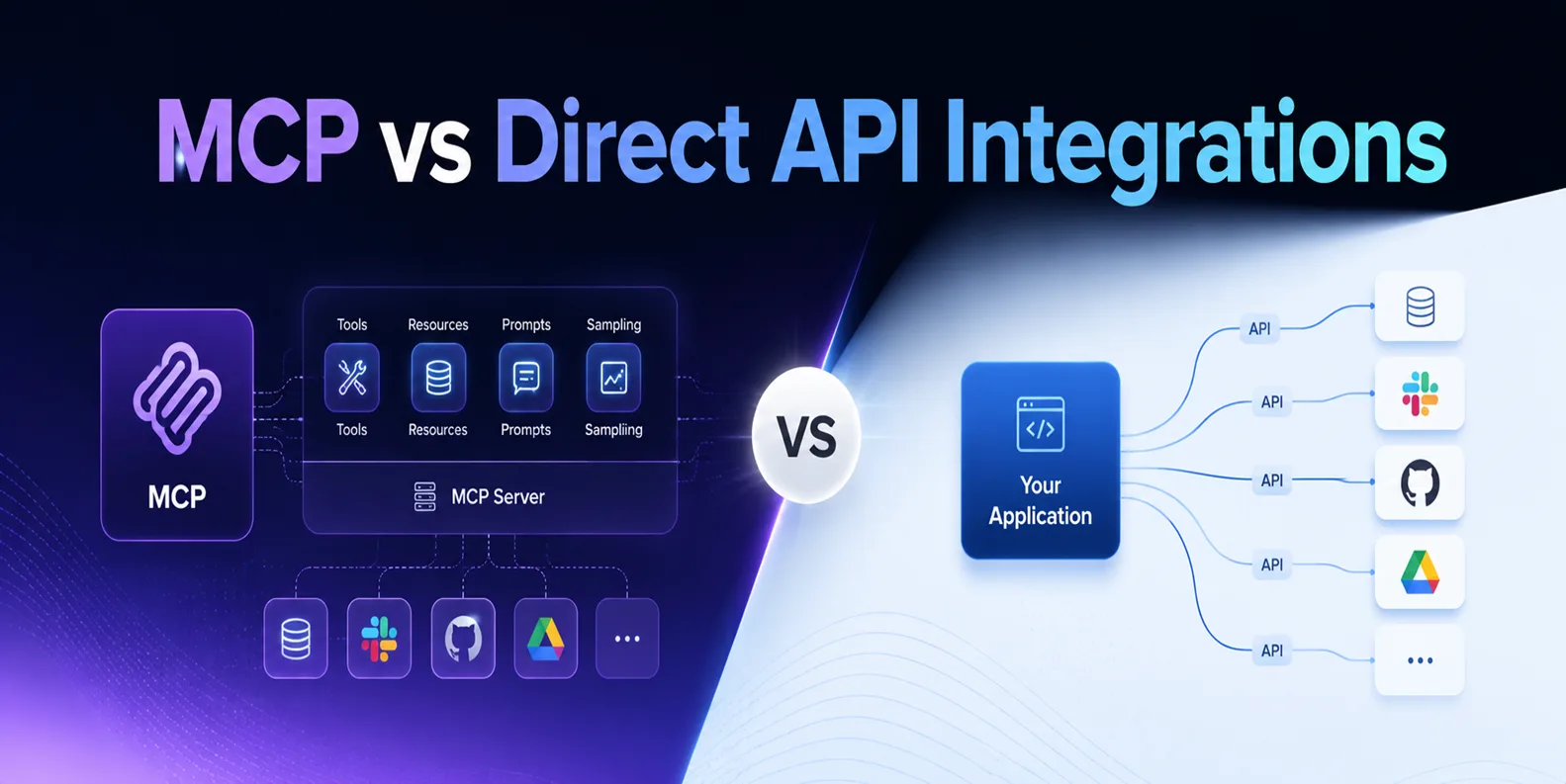
MCP vs Direct API Integrations, Which Architecture Fits Enterprise AI Workflows?

Vasim Gujrati
Solutions Architect, AI & Platforms, Unico Connect
In this article
- Quick Answer
- Key Takeaways
- What Direct API Integrations Actually Solve Well
- Where Direct API Architectures Start Breaking Down
- How MCP Changes Enterprise AI Workflow Design
- MCP vs Direct API Integrations: Side-by-Side Comparison
- When Enterprises Should Choose Direct APIs vs MCP
- What Unico Has Learned From Building AI Workflow Systems
- Frequently Asked Questions
Direct API integrations connect each AI agent point-to-point to the external systems it uses, while the Model Context Protocol (MCP) adds a standardized layer for context and tool management. As enterprise AI workflows grow from isolated copilots into connected operational systems, integration complexity across CRMs, ERPs, communication platforms and vector databases is accelerating.
That creates serious operational problems, namely duplicated integrations, fragmented workflows, inconsistent permissions and governance complexity that becomes unmanageable. Neither architecture is better in every case. Direct APIs still work very well for simpler, single-purpose workflows, while MCP becomes more valuable as orchestration gets more complex and several AI agents need secure, standardized access to the same enterprise data.
Industry research shows what is at stake. Gartner predicts at least 30% of generative AI projects will be abandoned after proof of concept by the end of 2025, and broader estimates put the share that never reach production or deliver business value as high as 70 to 80%. Lack of governance, fragmented data environments and integration problems are among the main causes. The choice between MCP and direct API integrations is an operational question about how you will run and scale your enterprise AI infrastructure.
Quick Answer
Direct API integrations connect an AI agent point-to-point to each system, which makes them fast and simple for single-purpose tools. The Model Context Protocol (MCP) adds a standardized layer so that many agents can share governed access to the same tools. Neither wins in every case. When we scope an agent build at Unico Connect, we choose direct APIs for focused MVPs and internal copilots, and we choose MCP once multiple agents need secure, governed access across shared enterprise systems.
Key Takeaways
- Direct APIs and MCP are complementary. MCP sits on top of your APIs and standardizes how agents discover and reach them, so adopting it does not replace the APIs underneath.
- Build MVPs, internal copilots and single-purpose, low-latency tools on direct APIs, which deploy faster and are easier to debug for that kind of work.
- At scale, direct APIs leave you with connector sprawl, duplicated authentication, fragmented context and inconsistent governance.
- MCP is worth adding for multi-agent coordination, centralized governance and audit, and tool reuse. You expose a data source once, and every authorized agent gets governed access.
- Plan governance before a second or third agent starts sharing the same systems. That is usually when the complexity shows up, and it comes earlier than most teams expect.
What Direct API Integrations Actually Solve Well
In a direct API architecture, the AI application calls an external service endpoint directly and handles authentication, request formatting and response parsing locally. Engineering teams still prefer direct integrations for MVPs, internal assistants, single-purpose AI tools and low-latency systems.
You get faster deployment, less abstraction overhead, easier debugging and highly predictable workflows. When a system only needs to do one task, like an internal copilot querying a single SQL database, a middleware protocol adds overhead the system does not need. An AI assistant wired straight to a Slack webhook and a Jira API can triage support tickets quickly without a complex orchestration layer, and in focused cases like that, direct APIs stay the most operationally efficient option.
Common Enterprise Use Cases for Direct APIs
Secure AI integrations via direct APIs work best for internal copilots, AI-enabled dashboards, focused customer support assistants, lightweight AI workflow automation and department-specific AI tools that need little cross-functional data access.
Where Direct API Architectures Start Breaking Down
The scaling problems with direct APIs show up as enterprise AI systems expand. Teams soon run into connector sprawl, authentication logic duplicated across multiple agents, fragmented context handling and inconsistent governance. Maintenance overhead grows exponentially once several AI agents run cross-functional workflows over the same enterprise systems.
An API-first AI integration architecture that works perfectly for one agent becomes a serious maintenance bottleneck when five different agents need access to the same systems. Picture HR workflows, finance assistants and customer support systems that all need secure read/write access to Salesforce and Workday. When isolated agents share overlapping enterprise tools and permissions, you get significant security vulnerabilities and collisions on API rate limits. The APIs themselves do not fail here. The breakdown comes from orchestration complexity, and it exposes the limits of point-to-point AI middleware architecture.
How MCP Changes Enterprise AI Workflow Design
The Model Context Protocol (MCP) is an open standard introduced by Anthropic in November 2024 and since adopted by providers including OpenAI and Google. It acts as a standardized coordination and interoperability layer for enterprise AI systems. Instead of each agent carrying its own custom integrations, MCP provides shared context management, centralized tool access, tool standardization and reliable coordination between agents. MCP works alongside your APIs and does not replace them. It standardizes how AI models discover and interact with the endpoints underneath.
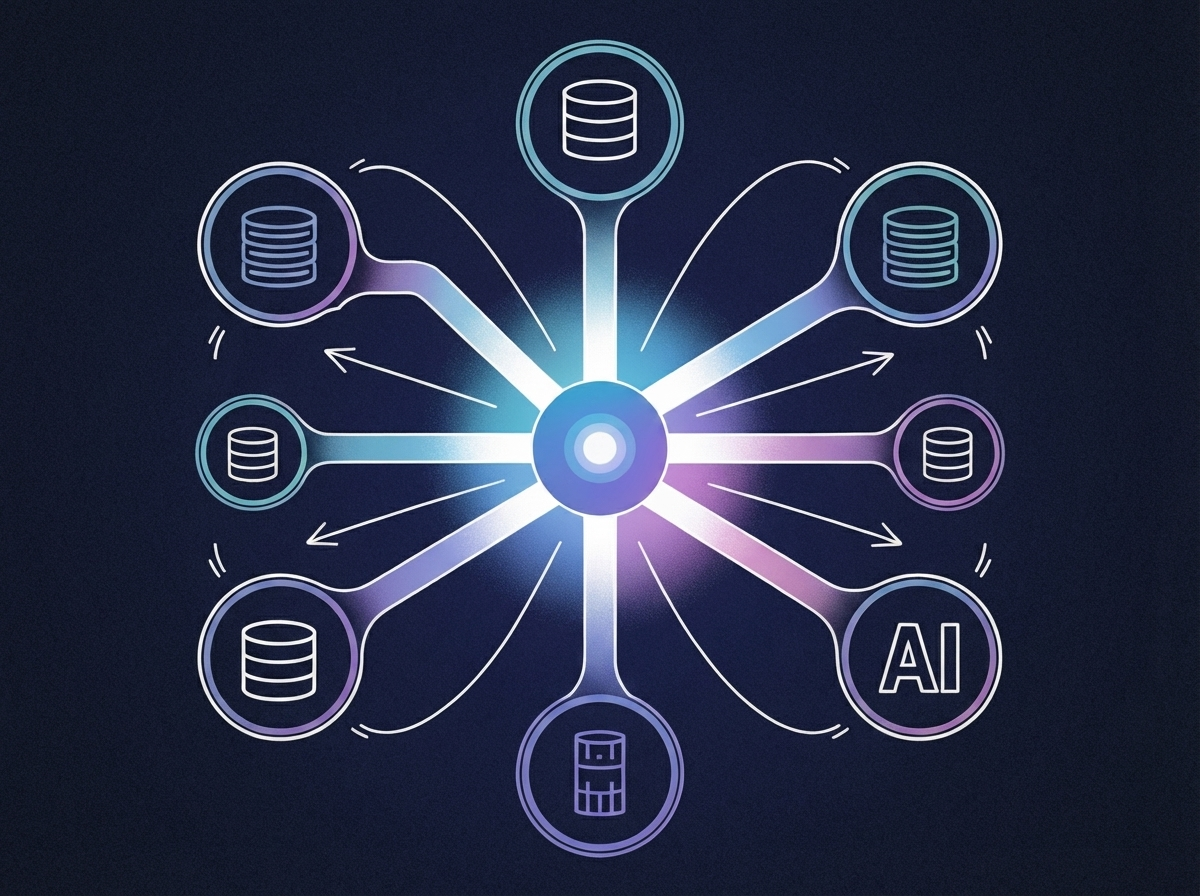
Once an organization moves toward multi-agent systems, MCP becomes essential for enterprise governance, workflow orchestration at scale and operational visibility. In a traditional point-to-point architecture, adding a new internal data source means updating the integration logic in every individual agent. With an MCP server you expose the data source once, and every authorized agent gets secure, governed access to it straight away. That sharply cuts duplicated orchestration logic across enterprise environments, so engineering teams can spend their time on business logic instead of maintaining dozens of brittle connectors.
Why MCP Matters More in Agentic AI Workflows
Agentic AI workflows depend on dynamic coordination between multiple agents. MCP provides the infrastructure these workflows need for shared enterprise tools, centralized permissions and workflow chaining, which keeps orchestration scalable and visible while autonomous AI orchestration frameworks carry out complex tasks.
MCP vs Direct API Integrations: Side-by-Side Comparison
Base the choice on your operational maturity, the size of your organization and how complex the orchestration will get, and do not follow technology trends blindly.
| Dimension | Direct API Integrations | Model Context Protocol (MCP) |
|---|---|---|
| Best for | MVPs, single-purpose tools, internal copilots | Multi-agent systems, shared enterprise orchestration |
| Connection model | Point-to-point to each endpoint | One standardized layer over shared tools |
| Deployment speed | Faster, low overhead | More upfront setup |
| Adding a data source | Update the integration in every agent | Expose once; all authorized agents get governed access |
| Governance | Fragmented, per-agent | Centralized access control and audit logs |
| Scaling cost | Rises sharply as agents multiply | Scales with shared tooling |
| Debugging | Easier, predictable | More moving parts |
The right fit depends on your environment. For a standalone internal tool, direct APIs are enough. A fleet of autonomous agents coordinating across shared enterprise AI workflows needs MCP to prevent maintenance gridlock.
When Enterprises Should Choose Direct APIs vs MCP
Your orchestration requirements and operational maturity should drive this decision.
Choose Direct APIs in these cases
- You are building focused applications or early-stage products.
- Your engineering team is smaller and prioritizing speed to market.
- The system handles low-complexity workflows with minimal data sources.
- Your agents do not need to share context or tools with other AI systems.
Choose MCP in these cases
- You need enterprise-wide orchestration and shared enterprise AI infrastructure.
- You are deploying complex multi-agent AI systems.
- You operate in governance-heavy environments requiring centralized audit logs and access control.
- Your workflows require agents to dynamically discover and chain new tools without redeployment.
For a concrete platform example of the MCP pattern in daily use, see how we build Xano backends with Claude Code and the Xano Developer MCP.
What Unico Has Learned From Building AI Workflow Systems
At Unico Connect we have built multimodal workflows, AI-assisted engineering systems and complex AI workflow automation environments, and the same orchestration patterns keep coming up. Simpler architectures scale better at the start, so beginning a proof of concept on direct APIs is almost always the right call.
Governance gets complicated earlier than most engineering teams expect, though. As soon as a second or third AI agent needs access to the same secure databases, the maintenance burden grows exponentially. We also keep seeing that human-in-the-loop systems stay operationally important, and a unified protocol makes it much easier to standardize how agents present data to the people in the loop. Direct APIs remain a sound way to build secure AI integrations for focused systems, while AI orchestration frameworks like MCP become far more valuable as shared tooling expands. We weigh the same trade-off when scoping AI integration services for clients. When the consumer is another application instead of an agent, our API integration and partner portals guide walks through the system to system patterns and design decisions.
Frequently Asked Questions
Is MCP replacing Direct API integrations in enterprise AI workflows?
No. MCP builds on top of APIs and does not replace them. The two coexist, with Direct API integrations providing the underlying system access and MCP adding the orchestration and coordination that standardize how AI models securely interact with those APIs.
When do enterprise AI systems typically need MCP architecture?
Enterprise AI systems need MCP architecture once they move to multi-agent orchestration. It becomes necessary when your engineering team is dealing with heavy governance complexity, shared enterprise tools, cross-functional workflow coordination and a strict requirement for centralized visibility.
Are Direct API integrations better for smaller AI workflow automation projects?
Yes. For small-scale AI workflow automation, Direct API integrations deploy much faster, keep infrastructure simpler, carry lower maintenance overhead at first and give you highly predictable workflows, which makes them the most efficient choice.
How does MCP improve AI tool interoperability?
MCP improves AI tool interoperability by giving agents shared context, centralized tool access and coordination, and standardized communication protocols. Entirely different foundation models and agents can then run coordinated workflows without engineers building a custom connector for each node.
What is the biggest scaling challenge with enterprise AI infrastructure?
Integration sprawl is the biggest scaling challenge. As systems grow, fragmented governance, maintenance complexity and orchestration logic duplicated across several AI middleware architectures create severe operational bottlenecks that slow down feature delivery.