









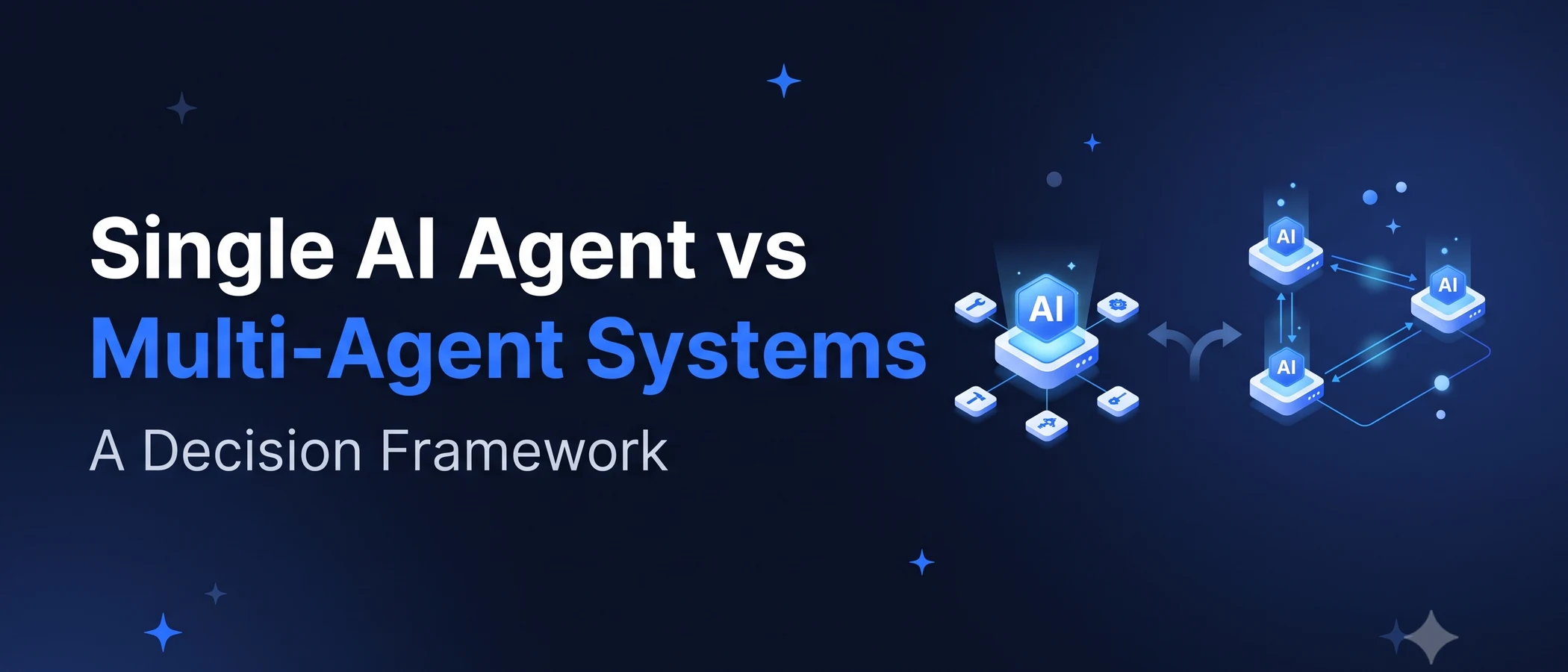
Single AI Agent vs Multi-Agent Systems, A Decision Framework

Vasim Gujrati
Solutions Architect, AI & Platforms, Unico Connect
In this article
- Single AI Agent vs Multi-Agent Systems, The Decision in Brief
- Decision Gate 1, Does the Workflow Need More Than One Agent?
- Decision Gate 2, When Is One AI Agent Enough?
- Decision Gate 3, When Should You Move to a Multi-Agent Architecture?
- Single-Agent vs Multi-Agent Trade-Offs
- When a Hybrid Agent Architecture Is the Better Choice
- Five-Step AI Agent Architecture Decision Framework
- Common Architecture-Selection Mistakes
- Frequently Asked Questions
For a bounded workflow with one primary objective, shared context, and tightly connected tasks, one agent is usually enough. A multi-agent system makes sense when specialist tasks can be separated, tested, and operated independently. More agents do not automatically improve quality, and they often bring extra cost and latency along with new failure modes.
We compare the two across workflow structure, specialist requirements, cost, latency, reliability, evaluation effort and operational complexity, and one principle runs through all of it. Start with the minimum sufficient architecture and add agents only when evidence supports the change. For the money side of that decision, our AI agent development cost guide breaks down what each tier costs.
Single AI Agent vs Multi-Agent Systems, The Decision in Brief
Use one agent when the workflow has one clear business outcome, the same context flows through most steps, and the tasks are sequential or tightly connected. A single agent is also the better fit when the workflow sits inside one policy boundary and one ownership boundary, and when you can evaluate it end to end without splitting success criteria across different components.
Go multi-agent when the tasks are separable, each specialist role can be evaluated on its own, and running work in parallel creates measurable value. Context separation that improves accuracy or security strengthens the case, and so does a workflow whose parts need independent scaling or ownership.
A hybrid architecture is often the right middle ground when only one or two specialist tasks need separate reasoning. Tools, APIs, retrieval layers, and deterministic services are not automatically agents. They become agentic only when they interpret context and choose actions on their own.
| Workflow signal | Recommended architecture | Reason |
|---|---|---|
| One objective and shared context | Single agent | Lower coordination overhead |
| One coordinator plus limited specialisation | Hybrid | Selective complexity |
| Several independent specialist tasks | Multi-agent | Separate evaluation or parallel execution |
Decision Gate 1, Does the Workflow Need More Than One Agent?
The first test is classification. Not every component in a workflow should be treated as an agent, and sorting them correctly keeps you from adding agents the design does not need.
Classify Every Workflow Component
An agent interprets context and selects actions under uncertainty. A tool performs a specific operation when requested. A deterministic service applies fixed business logic. A workflow rule controls a predictable transition. A retrieval component supplies relevant information. A human checkpoint reviews or approves a sensitive decision. When teams blur these categories, they often create unnecessary multi-agent complexity.
Apply the Agent Necessity Test
A component may need an agent when it must interpret ambiguous input, choose between several valid actions, adapt based on an intermediate result, decide which tool to use, work with incomplete information, or escalate when confidence or authority is insufficient. It probably does not need an agent when its result is determined by fixed rules, exact repeatability is required, the inputs and outputs are fully specified, or it performs calculation, validation, or data transformation.
A voice ordering workflow shows the mix in one place.
| Workflow component | Classification |
|---|---|
| Speech transcription | Service |
| Product catalogue search | Tool |
| Order-intent interpretation | Agent capability |
| Price calculation | Deterministic service |
| High-value order approval | Human checkpoint |
One useful test is to sketch the workflow and ask what breaks if a component is not agentic. If nothing meaningful breaks, that component probably should not be a separate agent.
Decision Gate 2, When Is One AI Agent Enough?
Workflow Signals That Favour One Agent
One agent is generally sufficient when the workflow has one clear objective and most steps require the same working context. Tasks are sequential or strongly dependent, and the agent uses a limited, related set of tools. When one team owns the complete workflow and one security boundary is sufficient, a single agent keeps latency low and behaviour predictable.
One Agent Can Still Use Several Capabilities
A single agent may use multiple tools, retrieval systems, memory, external APIs, and deterministic business services. It can work with model routing and human approvals too. The architecture stays single agent for as long as one core component keeps responsibility for deciding what happens next.
Warning Signs of an Overloaded Single Agent
Strain shows up as system instructions that keep expanding, unreliable tool selection, and context interference. When we use AI-assisted tools such as Cursor or Claude for heavy refactoring, we occasionally see the model struggle to isolate evaluation failures or repeat specialist errors. Before adding another agent, though, teams should test whether clearer routing, context filtering, or deterministic validation solves the problem.
For a B2B logistics client we built two WhatsApp AI agents, a voice agent that answers customer enquiries and a separate ordering agent for repeat business customers. Voice note transcription, live data lookups and order submission to the client platform run inside those two agents instead of becoming agents of their own. Our WhatsApp conversational AI agents case study covers this capability in more detail.
Decision Gate 3, When Should You Move to a Multi-Agent Architecture?
Check Whether the Work Can Be Decomposed Cleanly
A task suits specialist agents when each subtask has defined inputs and outputs. Each result must be evaluated independently, and the subtasks should be able to run in parallel and need different domain instructions. Most important of all, one specialist failure does not invalidate the rest of the work.
Identify Valid Reasons for Adding a Specialist Agent
A separate agent is justified when a specialist model materially improves one task, or when shared context causes instruction interference. A primary coding agent can generate the logic, for example, while an independent evaluation agent reviews it in isolation. Multi-agent designs also make sense when parallel work meaningfully reduces processing time, or when different information permissions must remain isolated.
Avoid False Decomposition
Do not create agents just by handing out job titles such as Researcher, Analyst, or Reviewer. Each proposed agent should have a distinct capability, explicit inputs and outputs, independent success criteria, and a measurable effect on the final outcome.
Ask what measurable performance, control, or scaling benefit would be lost if the proposed agent were merged back into the main agent. If nobody has a clear answer, another agent may not be necessary.
Single-Agent vs Multi-Agent Trade-Offs
Choose the architecture that performs best on the actual workflow, however elegant the alternative sounds. The tradeoffs become clear when you compare quality, cost, latency, reliability and maintenance against one success metric, the cost per successful workflow.
| Factor | Single agent | Multi-agent | Decision question |
|---|---|---|---|
| Quality | Unified context | Specialist capability | Is the improvement measurable? |
| Cost | Fewer calls | More coordination | What is the cost per success? |
| Latency | Fewer handoffs | Potential parallelism | Does parallelism save time? |
| Reliability | Smaller failure surface | Better isolation | Which design recovers better? |
| Maintenance | Simpler ownership | More components | Can the team operate it? |
Quality and Accuracy
A single agent retains a unified understanding of the objective and avoids information loss between steps. It can struggle, though, when one prompt has to carry unrelated specialist responsibilities. A multi-agent system may improve specialist performance and support independent checks, but it can introduce contradictory outputs or compounding errors at the handoff stage.
Cost
A single agent usually requires fewer model calls and has lower coordination and evaluation overhead. Multi-agent systems can use smaller, cheaper specialist models, for example swapping a large generalist model for a fast, task-specific model, but they add routing, reviewer, and aggregation calls. The metric that decides between them is cost per successful workflow.
Latency
A single agent has fewer handoffs and produces more predictable completion times. In a multi-agent system, independent tasks can run in parallel. Routing and reconciliation still add time, and they often increase P95 latency and runtime variance.
Reliability and Failure Surface
Single agents have fewer failure points and are easier to trace. Multi-agent systems can isolate specialist failures but introduce routing, handoff, state, and aggregation vulnerabilities.
Maintenance and Governance
Adding agents increases the number of prompts, policies, model-version dependencies, and permission management rules. A multi-agent system also needs substantially more regression test coverage. For the controls that keep this manageable, read our post on governing AI agents at enterprise scale.
When a Hybrid Agent Architecture Is the Better Choice
A hybrid architecture is often the best answer when one agent should remain responsible for the business outcome, but one or two tasks need specialist judgment. It also fits when most operations can remain deterministic, centralised governance is required, selective parallel execution is valuable, or the architecture is likely to evolve gradually. In practice that looks like one coordinating agent, several deterministic tools or services, one specialist analysis agent, optional validation components, and human approval for sensitive actions.
That pattern works well in order processing with exceptional commercial validation, customer intake with occasional fraud analysis, property analysis with specialist image interpretation, or business workflows with separate compliance review. Once a hybrid or multi-agent model is justified, the next step is designing the orchestration, agent identity, and tool interfaces so the system can coordinate tasks, control access, and handle tool calls reliably in production.
The mistake we see most often is teams reaching for multiple agents because it sounds sophisticated, then paying for it in latency and debugging time. In our own delivery work the winning systems start as one agent, earn every split with evidence, and add specialists only where an independent evaluation or a genuinely separate model changes the outcome.
Malay Parekh, CEO, Unico Connect
Five-Step AI Agent Architecture Decision Framework
Use these steps to choose between a single agent, a hybrid, and a multi-agent design on the basis of workflow evidence instead of assumptions.
Define the Business Outcome and Operating Constraints
Pin down the required business result before anyone evaluates architecture. Set targets for accuracy, task completion and latency, then write down the expected workflow volume, the operating cost you can accept and the consequences of failure. Agree on what production success looks like before you decide how many agents to build.
Map the Workflow and Classify Every Component
Map inputs, outputs, task dependencies, decision points, and integrations. Mark where failures or human handoffs may occur. Then classify each component as an agent, tool, deterministic service, retrieval layer, or workflow rule. Calculations and fixed validations should not become independent agents by default.
Build and Measure a Single-Agent Baseline
Build the least complex viable architecture first and run it through normal, edge, and failure scenarios. Measure task completion, output accuracy, tool selection errors and human escalation, and record the cost per successful workflow along with P50 and P95 latency. Judge any added agent against this baseline to find out whether it solves a real limitation.
Identify a Bottleneck and Test One Specialist Split
Select one measurable weakness, such as context interference, poor tool selection, or excessive sequential latency, and introduce only one specialist agent at first to address it. Test that agent with the same thresholds and cost methodology you used for the baseline, then weigh the quality gain against the added handoff failures and maintenance complexity. Keep the split only when the improvement is material.
Choose the Minimum Sufficient Architecture
If specialisation adds too little value, stay with one agent. A hybrid is the right call when one or two capabilities improve results, and a multi-agent design earns its place when several independent tasks justify separate reasoning, evaluation, or ownership. Write down the evidence behind the decision. If you need engineering help past the architecture choice, our agentic AI development services cover validating the use case, building the selected architecture, integrating it with your existing systems and monitoring its production performance. You can also hire AI engineers directly. Revisit the architecture as volume, risk, integrations, or ownership grow, and let evidence drive each change.
Common Architecture-Selection Mistakes
Assuming more agents mean better intelligence
Agent count is not a measure of the maturity or quality of a system, and more agents often just mean more complexity.
Turning every capability into an agent
Calculations, retrieval pipelines, input validations, and fixed business rules should often remain deterministic scripts.
Splitting the workflow before creating a baseline
Without a single-agent baseline, teams cannot prove that adding another agent improved the final outcome.
Creating roles instead of technical boundaries
A label such as researcher or reviewer is no reason on its own to create an independent agent. A technical boundary and the input and output structure must warrant the split.
Measuring cost per API call
Pricing a system by individual API calls gives a misleading number. Measure the cost per successful workflow, which includes failed runs, retries, and human review.
Ignoring evaluation and maintenance
Each added agent brings more interfaces, prompts, tests, and failure paths. As AI writes more of the code or executes more of the logic, testing has to get more rigorous.
Selecting architecture from framework features
Framework support for complex multi-agent patterns does not show that your specific workflow needs them.
Frequently Asked Questions
How do you know when one AI agent is enough?
One agent is enough when the workflow has one outcome, shared context, tightly connected tasks, and no independently measurable specialist capability. If the same context and the same decision owner can carry the workflow from start to finish, splitting it usually adds coordination you do not need.
When should a team use multi-agent systems?
Use multi-agent systems when specialist tasks can be evaluated separately, parallel execution creates measurable value, context isolation improves accuracy or security, or different capabilities need independent scaling or ownership. A long prompt or a large number of tools does not justify the split on its own.
How does single-agent vs multi-agent cost compare?
Single-agent systems usually cost less because they need fewer calls and less orchestration. Multi-agent systems add routing, specialist, reviewer, and aggregation costs, although smaller specialist models or parallelism can sometimes offset that. Compare the cost per successful workflow instead of model call count alone.
When is a hybrid agent architecture more appropriate?
A hybrid architecture fits when one coordinating agent should own the business outcome, but one or two specialist tasks need separate reasoning, evaluation, or access. It is often the most practical middle ground between simplicity and specialisation.
What should be measured during AI agent architecture selection?
Measure completion rate, accuracy, model calls, cost, P50 and P95 latency, handoff failures, retries, human review, and maintenance effort. Together they show whether the added complexity is buying better outcomes.