









MLOps vs DevOps, Key Differences Every Engineering Leader Should Know

Vasim Gujrati
Solutions Architect, AI & Platforms, Unico Connect
In this article
- Quick Answer
- Key Takeaways
- Why This Comparison Matters Now
- Side by Side Comparison
- What Actually Breaks, and Why DevOps Does Not See It
- The Four Capabilities MLOps Adds
- LLMOps, Where the Model Is Not Yours
- Where DevOps Is Enough and When You Need MLOps
- Cost, Complexity, and Team Impact
- A Practical Transition Framework
- What AI Native Engineering Teams Do Differently
- Where These Numbers Come From
- Frequently Asked Questions
- Conclusion
DevOps helps engineering teams ship and operate traditional software reliably. MLOps extends that operating model to systems whose behavior depends on changing models and data as well as on static code. It is the layer you add to DevOps once probabilistic model behavior reaches production. Below we compare the two on lifecycle, tooling, monitoring and cost, and set out the criteria that tell you which one a given system needs.
Quick Answer
MLOps differs from DevOps because it governs data and models as well as code. DevOps governs code, configuration, and binaries through integration, testing, and delivery. MLOps governs all of that plus datasets, model weights, and statistical behavior, because an AI system can degrade silently even when the code never changes. Use plain DevOps for deterministic software with stable logic. Add MLOps once your product depends on models that learn, drift or get retrained. Those systems need evaluation gates and drift monitoring, plus a rollback that restores code, model and data together. At Unico Connect we treat the evaluation set as the core artifact of any LLM system.
Key Takeaways
- MLOps sits on top of working DevOps and assumes it is already in place. A team without reliable CI/CD, versioned configuration and a rollback it has tested is not ready to add model operations, so fix those first.
- Silent failure is the defining difference. Broken code announces itself with an error, while a degraded model returns a confident answer that happens to be worse, and nothing in a standard pipeline notices. Everything MLOps adds exists to make that failure visible.
- Code, data and model weights each version independently, and each can break the system on its own. Plan a rollback that restores all three together, because reverting only the deployment can leave the new model or the new data preparation in place.
- Most teams in 2026 need LLMOps rather than classic MLOps. If you call a hosted model instead of training your own, there is no retraining loop to build, but the model changes underneath you on the vendor schedule, so pin versions where you can and keep a regression suite ready to run.
- Adopt MLOps in stages. Each of the three steps below pays off on its own, and a team that completes dataset and model versioning plus evaluation gates has removed most of the risk without buying an enterprise platform.
Why This Comparison Matters Now
Enterprise AI adoption is now broad enough that operational discipline has stopped being optional. In the McKinsey State of AI survey published on 25 August 2026, nearly nine in ten respondents report regular use of AI in at least one business function, and 44 percent now report AI scaling across the enterprise, up from 38 percent a year earlier (McKinsey, 2026). The survey ran from 4 May to 8 June 2026 with 1,719 participants across 97 nations.
Value has not kept pace with adoption. In the same survey, 37 percent of respondents attribute at least some EBIT impact to AI, about the same share as the year before, and the proportion of AI high performers has stayed flat at roughly 6 percent. That gap between adoption and realised value is operational, and the operating model a team applies decides which side of it a system lands on.
Delivery speed alone does not settle it. The DORA 2024 report found elite performers make 182 times more deployments per year than low performers, along with 127 times faster lead time and 8 times lower change failure rate (DORA, 2024 Accelerate State of DevOps). If someone quotes those ratios at you in 2026, keep in mind that DORA retired the elite to low performance clusters in its 2025 report and now groups teams into seven profiles, so the multipliers are a 2024 snapshot and no longer a current finding. Either way, a deployment ratio tells a leader very little if the model behind each deployment is silently degrading, which is why the line between what standard DevOps covers and what MLOps adds has become a direct leadership question.
Side by Side Comparison
The difference between MLOps and DevOps becomes concrete when you look at the artifacts each pipeline governs.
MLOps vs DevOps across the production lifecycle
| Area | DevOps | MLOps | Why it matters |
|---|---|---|---|
| Primary artifacts | Code, configuration, and binaries | Code, datasets, and model weights | Data dependencies break systems even when the application code is unchanged |
| Testing approach | Unit, integration, and end to end tests | Statistical evaluation, data validation, and bias checks | Code that runs is not the same as a model that infers accurately |
| Deployment pattern | Immutable application rollouts | Shadow deployments, A/B tests, and champion challenger setups | Model quality has to be proven against live traffic safely |
| Monitoring scope | CPU, memory, latency, and error rates | Data drift, concept drift, feature skew, and output quality | Standard telemetry misses silent model failures |
| Rollback | Revert to the previous binary | Revert code, model version, and data schema together | Rolling back needs synchronized state, not a single revert |
| Team ownership | Engineering, QA, and IT operations | Data engineers, ML engineers, and backend developers | AI failures need data expertise, not just infrastructure triage |
What Actually Breaks, and Why DevOps Does Not See It
The case for MLOps is easier to understand through failure modes than through definitions. In the AI systems we run in production, four of them account for most incidents, and standard delivery tooling is blind to all four.
Training and serving skew. The model was trained on data prepared one way and receives data prepared another way in production. It can be as small as a field normalized differently, a changed default value or a currency that arrives unconverted. Every test passes and the service returns 200 while the predictions are quietly wrong. Across the AI systems we run, this is the single most common cause of a model that performed well in evaluation and badly once deployed.
Data drift. The input distribution moves away from what the model was trained on, for example because of new customer segments, a new product line or a marketing campaign that changes who arrives. Nothing is broken. The world stopped resembling the training set, and accuracy decays gradually enough that nobody attributes it to the model.
Concept drift. This one is harder to catch, because the inputs look the same while the relationship between input and correct answer has changed. Fraud patterns adapt, user expectations shift, a competitor changes pricing. A model can be perfectly healthy by every input based measure and still be answering a question from last year.
Feedback loops. The model output influences the data the model later learns from. A recommender that promotes an item generates engagement on that item, which confirms the decision to promote it. The system becomes confidently self reinforcing, and the loop is invisible unless you deliberately measure it.
None of these four produce an error. Uptime, latency and error rate all look fine, so a DevOps dashboard reports a healthy system while the thing the system exists to do gets worse.
The Four Capabilities MLOps Adds
Underneath the tooling debates, MLOps is four capabilities. A team either has them or does not, whatever the platform is called.
Versioning of all three artifacts. Code, dataset and model weights are versioned together and linked, so that any prediction in production can be traced back to the exact model and the exact data that produced it. Without this, a post incident investigation cannot even establish what was running.
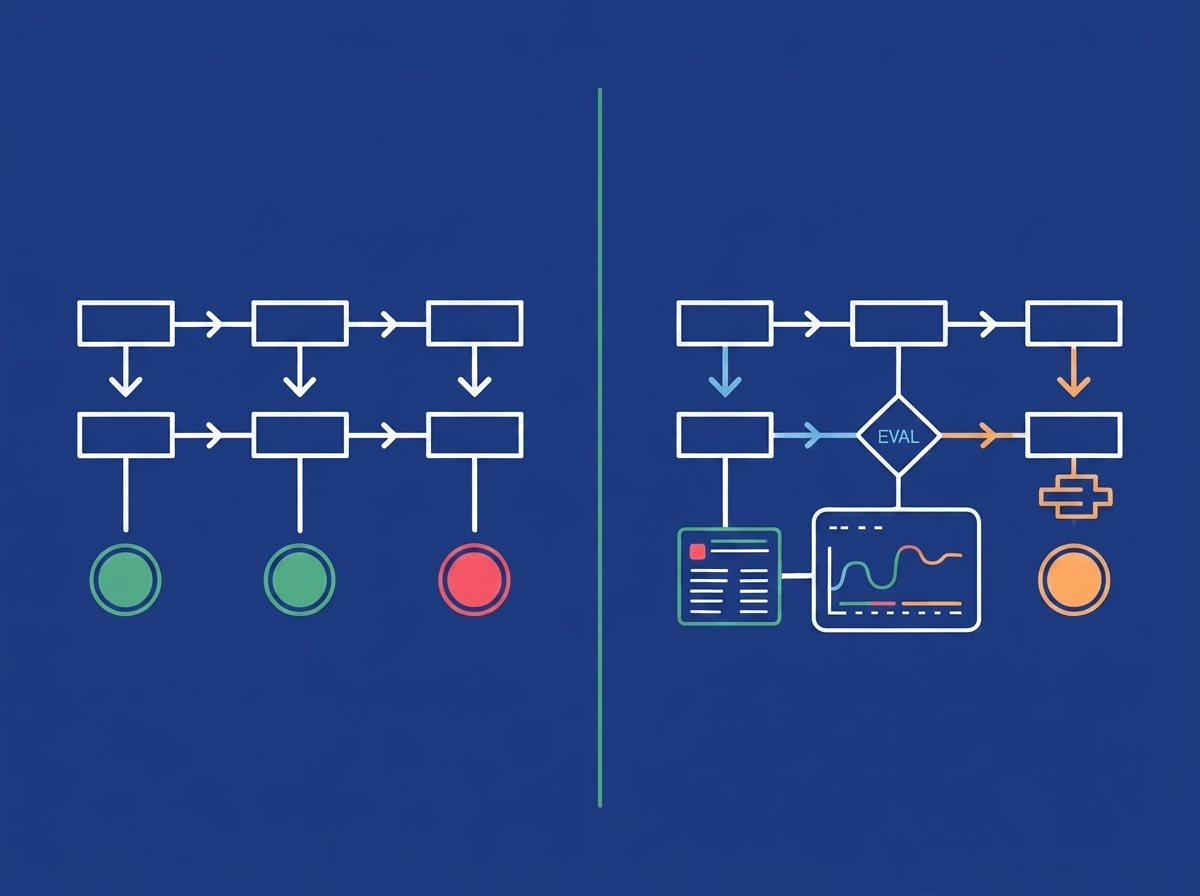
Evaluation as a release gate. A clean compile says nothing about how well a model performs. The pipeline needs to run the candidate against a held out evaluation set and block promotion on the result, in the same way failing tests block a code deploy. This is the control most teams are missing.
Drift and quality monitoring. Instrument the statistical behaviour of the system as well as its infrastructure. That means input distributions, output distributions, confidence and, wherever possible, ground truth accuracy once real outcomes arrive. We go through what to instrument in detail in our AI observability guide.
Synchronized rollback. When something goes wrong you must be able to restore the previous model, the previous code and the previous data preparation together. Rolling back the deployment while leaving the new model in place is a common and painful half measure.
LLMOps, Where the Model Is Not Yours
Most teams putting AI into production in 2026 call a hosted model instead of training their own, and that changes the operating problem enough to deserve its own name.
The training pipeline goes away. There is no retraining schedule, no feature store and no model weights to version, so a large part of classic MLOps does not apply.
In its place comes a different set of concerns. The first is that the model changes without you. A vendor ships a new version and behaviour shifts underneath a prompt you tuned months ago, which means you need pinned versions where possible and a regression suite you can run on demand. The second is that the prompt becomes the artifact. Prompts, system instructions and tool definitions now determine behaviour, so they need version control, review and evaluation in the same way code does, and we cover prompt versioning and evaluation gates in a separate post. Cost also becomes a live variable. Spend scales with usage and with output length, so it belongs on a dashboard next to latency. Evaluation is still the gate, and it is the piece teams skip most often, shipping prompt changes straight to production on the strength of trying three examples by hand.
That last point is why we treat the evaluation set as the core artifact of any LLM system, and why the same set doubles as the instrument for picking a model in the first place. For how to build one and use cost per successful task as the decision metric, see our walkthrough on choosing an AI model for production.
As a rule of thumb, training or fine tuning your own model means you need MLOps, and calling a model somebody else trained means you need LLMOps. Teams that do both, which is increasingly common, need the versioning and evaluation discipline from the first and the prompt and cost discipline from the second.
Where DevOps Is Enough and When You Need MLOps
When DevOps is usually enough
Standard DevOps is sufficient for conventional software delivery and stable business logic. If your application relies on deterministic database queries and rigid API routing, keep the architecture simple. Systems with low risk inference, minimal model lifecycle, and no ongoing retraining do not need heavy statistical evaluation pipelines or data lineage tracking.
When MLOps becomes necessary
MLOps matters when your system uses continuously changing data or dynamically retrained models. If you ship AI features tied to search ranking, forecasting, classification, or output quality from a generative model, treat MLOps as a requirement. Production AI introduces silent failure modes that traditional CI/CD does not cover, so teams need a model registry, structured evaluation, active drift monitoring, and a defined retraining policy to prevent output from degrading unnoticed. On why models lose accuracy as live data shifts, our team weighed in for DesignRush News.
Cost, Complexity, and Team Impact
MLOps adds both cost and operational complexity. Continuous data pipelines, persistent model evaluation, and strict data governance need specialized infrastructure, and they need engineering process discipline even more. For an engineering leader the trade is more overhead and higher upfront spend in exchange for far lower long term production risk, and it means restructuring ownership so data engineers work closely with backend developers. Not every team needs a full enterprise grade MLOps stack on day one.
A Practical Transition Framework
Moving from standard pipelines to AI ready infrastructure should happen in increments. Build on the CI/CD maturity you already have and avoid attempting a full transformation at once.
Step 1, stabilize the DevOps basics. Version all code and configuration, confirm CI/CD is consistent across environments, and prove your rollback works.
Step 2, add model and data controls. Version datasets and model artifacts alongside code, add evaluation gates to the release pipeline, and require approval based on evaluation results as well as a successful build.
Step 3, add monitoring, retraining, and governance. Monitor model quality, drift, and latency from day one, define retraining triggers and ownership, and keep audit logs of model versions, evaluation results, and deployment decisions.
Every step is worth doing even if you stop there, and a team that finishes step two is already in a far better position than one running production AI on a pure DevOps model.
What AI Native Engineering Teams Do Differently
At Unico Connect we build AI evaluation into release discipline from the start. Strong MLOps connects technical signals to business outcomes. In our WhatsApp voice to order logistics work, for example, we monitor transcription accuracy, the multilingual language pipeline and order intent mapping alongside API uptime. We use AI to write maintainable code and avoid generating volumes of unverified scripts, so speed never breaks the architecture. Our cloud and DevOps services cover the broader cloud and delivery picture, and if your models stall after the demo, start with why AI models fail in production. You can also hire AI engineers who work this way.
Where These Numbers Come From
The adoption figures come from the McKinsey State of AI survey published 25 August 2026, which reports nearly nine in ten respondents using AI in at least one business function and 44 percent scaling it across the enterprise. The deployment frequency benchmark comes from the DORA 2024 Accelerate State of DevOps report and is cited as a DevOps performance reference, without any claim that it describes AI systems. We deliberately quote the 2024 multipliers rather than the larger 208 times figure from DORA 2019, because quoting the older and bigger number alone would be selective, and because DORA has since retired that performance model entirely. Both are linked inline above. The failure modes, the four capabilities and the LLMOps distinction come from our own delivery practice on AI systems we run in production, and are not survey findings. No vendor tooling costs are quoted, because they change frequently and the argument does not depend on them.
Frequently Asked Questions
How does MLOps differ from DevOps?
MLOps differs from DevOps in how many artifacts it has to keep working and in how they fail. DevOps versions and ships one artifact, the code, and a failure usually throws an error. MLOps versions three that move independently (code, data and model weights), and its failures are silent because a drifted model still returns a confident answer. That is why MLOps adds evaluation gates, drift monitoring and a rollback that restores all three together.
What is the difference between MLOps and DevOps in production systems?
DevOps focuses on integrating, testing, and delivering deterministic code reliably. MLOps must also manage data ingestion, model weights, and statistical drift, treating data and models as dynamic production assets that can fail even when the code is unchanged.
When should you use MLOps instead of standard DevOps?
Use MLOps when performance degrades as real world data changes. If your product relies on predictive models, generative AI output, or continuous learning, standard DevOps telemetry cannot capture the silent failures that appear after launch.
How does an MLOps pipeline change testing and monitoring?
A standard pipeline tests for compilation and execution errors. An MLOps pipeline adds statistical evaluation gates, data validation, and bias checks, and it monitors data and concept drift so model output stays accurate against shifting live data.
Is MLOps versus DevOps mainly a tooling difference or a process difference?
It is mostly a process difference. Specialized tools like model registries and feature stores help, but the main shift is continuous validation, rigorous data governance and synchronized rollback of code, model and data.
Why does MLOps change team structure and ownership?
Because model quality depends on data quality, ownership extends beyond backend engineers. MLOps needs cross functional coordination between data engineers, ML engineers, and backend or DevOps engineers to stay accountable for production accuracy.
What is LLMOps and how is it different from MLOps?
LLMOps is the operating model for systems built on a hosted large language model rather than a model you train. The training pipeline disappears, so there is no retraining schedule, no feature store and no weights to version. In exchange you take on prompt versioning, evaluation gates on prompt changes, cost per task as a live metric, and the fact that the vendor can change the model underneath a prompt you tuned months ago. Most teams shipping AI features in 2026 need LLMOps rather than classic MLOps.
Do we need to hire an MLOps engineer?
Usually not as a first move. The early wins are process rather than headcount, meaning versioned datasets and models, an evaluation gate in the release pipeline, and drift monitoring, all of which an existing platform or backend engineer can implement on top of working CI/CD. A dedicated specialist earns their place when you are retraining regularly, running several models in production, or operating under regulatory obligations that require auditable model lineage.
What is training and serving skew?
It is a mismatch between how data was prepared for training and how it arrives at inference time, such as a field normalized differently or a default value that changed. In the AI systems we run in production, it is the most common reason a model that evaluated well performs badly once deployed, and it is invisible to standard monitoring because nothing errors. The service still returns a valid response, just a worse one.
Conclusion
DevOps is the foundation, and MLOps is what you add on top of it when models and data become live production assets that can drift. Match the operating model to the system by keeping plain DevOps for deterministic software and adopting MLOps in stages once AI behavior, retraining and drift enter the picture. To build production AI on a disciplined operating model, see our AI development services or hire AI engineers from our team.