









We Built a Production Website in 4 Hours with Claude Fable 5. When ChatGPT Launched, It Took a Team Months.

Vasim Gujrati
Solutions Architect, AI & Platforms, Unico Connect
In this article
Updated 21 September 2026. The build described here was done with Claude Fable 5 in June 2026. Anthropic has since released Claude Fable 5.1, on 1 September 2026, and Fable 5 is now marked legacy. We left the build log below as it was, since it records what happened, and updated the model context.
We built cyfox.tech, the full marketing website for a software outsourcing firm, in about four hours with Claude Fable 5. That included a new logo, original copy, a custom responsive build, and search and answer engine optimization, shipped to production the same afternoon. When ChatGPT first launched, in November 2022, the same simple site was a one to two month project once you counted client feedback rounds, a designer, a content writer, an SEO team, and a frontend engineer. What follows is a build log, and also a small, concrete measure of how far AI model output has moved in three and a half years.
Quick Answer
Using Claude Fable 5, we took a complete marketing website from a blank brief to live in production in roughly four hours, including a new logo, written copy, a custom build, and SEO and AEO setup. When ChatGPT launched in late 2022, the same simple marketing site was still a one to two month job for a full team once client feedback and revision rounds were counted, because the best AI of that moment could draft a paragraph but could not plan, build, and ship a coherent website. The site itself is no simpler today. Model output has improved dramatically, and that shift is the core of how we deliver AI native development.
Unico Connect builds production web apps and marketing sites on this same model, with a senior engineer reviewing the code.
Key Takeaways
- One engineer supervising one frontier model took the site from brief to live in about four hours, logo and deploy included.
- When ChatGPT launched, this same simple site was a one to two month project across a full team, client feedback included. Nothing about the site got easier, so the gap comes from better model output.
- Fable 5 did the volume, generating the layout, the components and the first draft copy. A senior engineer owned the structure, the brand judgment, the review and the production gate, which is why the speed did not lower the review bar.
- Semantic structure, metadata, schema and clean answer engine ready copy went in on the first pass, so SEO and AEO were built into the site from the start instead of bolted on afterward.
- Client projects run on this same operating model. This one was small enough to compress into an afternoon.
What We Built
cyfox.tech is the marketing site for a firm offering nearshore software engineering to companies in the United States and Canada. The hero line is direct and reads "Your engineering team, extended."
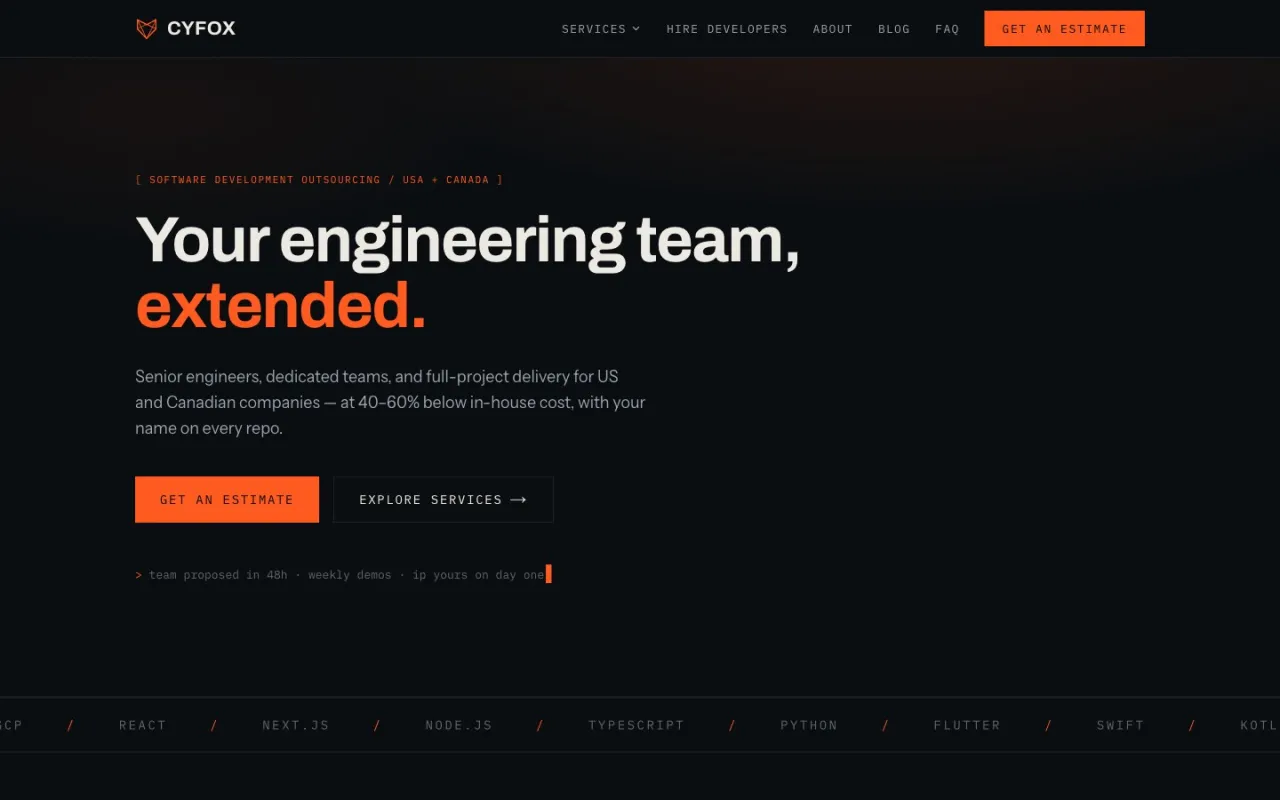
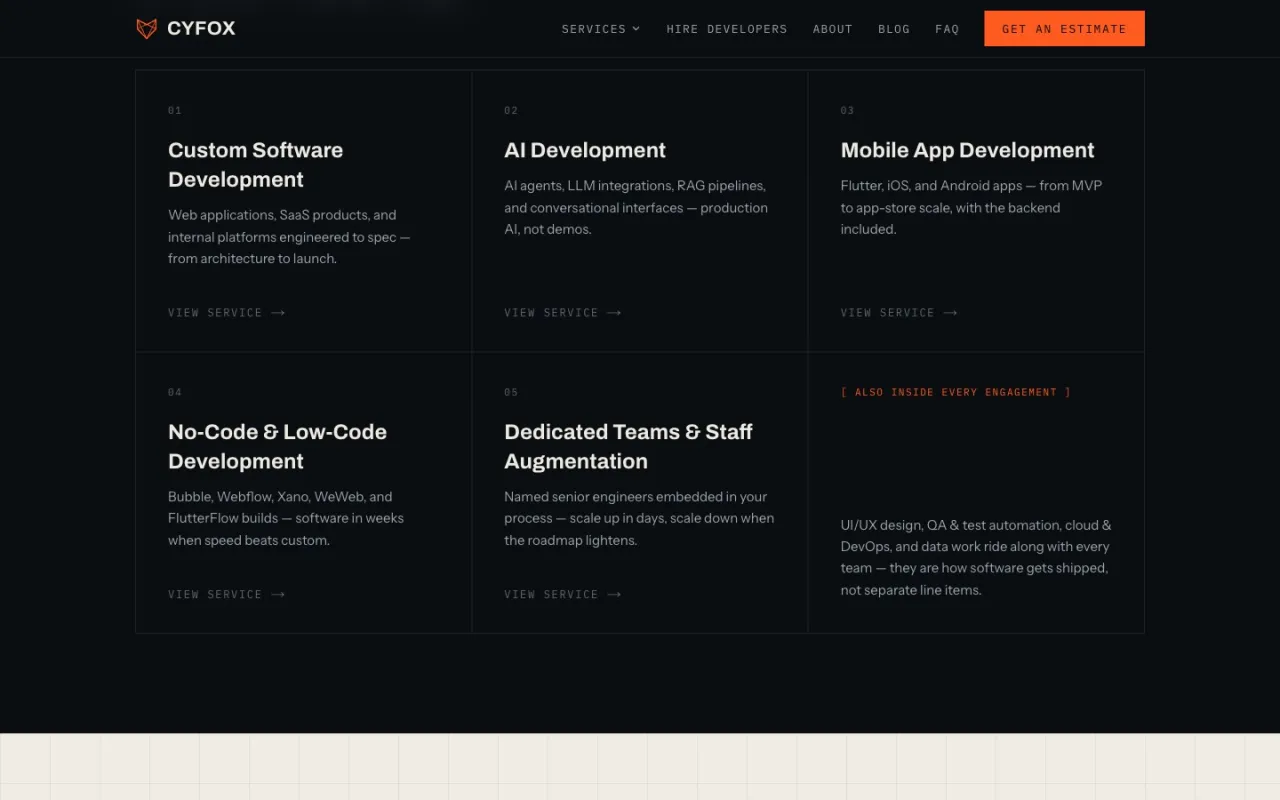
It carries the full set of sections a credible B2B services site needs, starting with a services grid across custom software, AI development, mobile, no code and low code, and dedicated teams.
It also has a why outsource section with the proof points buyers weigh, a four step how it works flow, an expandable FAQ that handles the real objections, and a security posture block. One of those proof points is the operating model itself, AI accelerated and human reviewed.
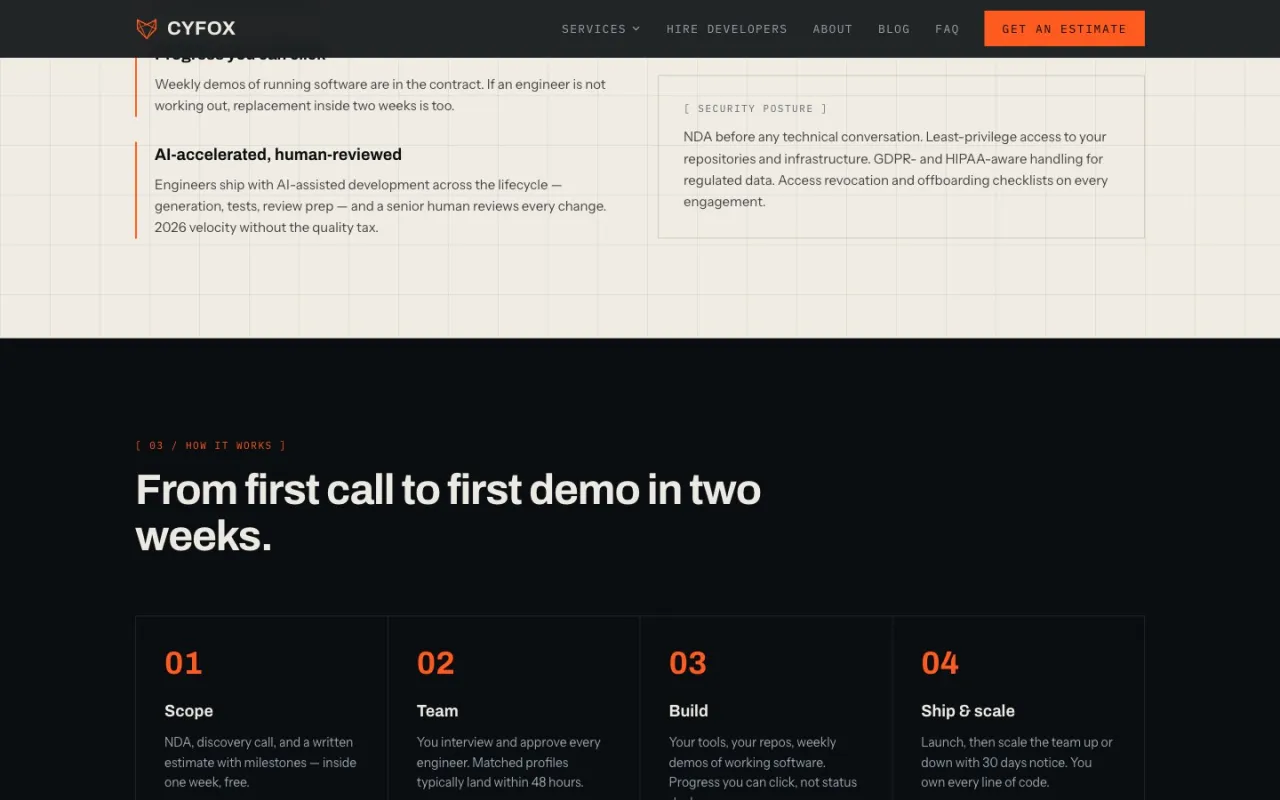
It is a responsive production website with original copy and a fresh brand mark. We did not start from a template and swap the text out.
The Four Hours
The work moved through four phases. Each one followed the split we describe on our AI native development page, with the model doing the volume and the engineer owning the judgment.
- Brief and structure. We defined the audience, the offer, the sections, and the tone, then had Fable 5 propose the information architecture and page outline. Deciding what the site needed to say stayed with us, and drafting the structure around that decision went quickly.
- Generation and assembly. Fable 5 generated the layout, the components, and a first draft of every section against our coding standards. The engineer reviewed that output, corrected it and wired it together instead of typing it from scratch.
- Brand and copy. The new logo and brand mark, plus the written copy, all started as model drafts, and we refined them into something with a point of view. Taste and voice are human calls. The model took away the blank page problem.
- SEO, AEO, and deploy. Semantic markup, metadata, structured data, and answer engine ready phrasing went in while the site was being built. A review pass and the deploy to production closed it out.
The Same Build, When ChatGPT Launched
The table below compares both ways of building a simple marketing website like this one. The times in the first column show what each step took the traditional way, which was still the only way when ChatGPT became public in November 2022.
Building a simple marketing website
| Step | When ChatGPT launched (Nov 2022) | With Claude Fable 5 todayWhat AI now does |
|---|---|---|
| Structure and sitemap | Strategist and designer map it by hand, 1 to 2 days | Drafted in minutes from the brief, human approves |
| Visual design | UI designer in Figma, 4 to 6 days | Generated to brand, refined by an engineer |
| Logo and brand mark | Brand designer, 2 to 3 days | Generated and iterated inside the session |
| Copywriting | Content writer, 3 to 5 days | First draft generated, edited for voice |
| Responsive frontend build | Frontend engineer, 6 to 10 days | Generated and assembled under review |
| SEO and metadata | A dedicated SEO team pass | Built in from the first pass |
| AEO and answer ready copy | Not a practice yet in 2022 | Schema and answer ready copy, built in |
| QA and responsive checks | A separate QA cycle | Continuous and AI assisted |
| Client feedback and revisions | Several rounds across the whole team, 1 to 3 weeks | Same session iteration, reviewed live |
| Total, end to end | A full team, 1 to 2 months with feedback | 1 engineer plus 1 model, about 4 hours |
Times in the first column are typical traditional estimates for a simple marketing site, including the client feedback and revision rounds that stretch calendar time to one to two months. That was the only path available when ChatGPT became public in November 2022. The second column is what the same steps took on this build.
These estimates are illustrative rather than stopwatch times, but the shape is real. The old way meant a full team and one to two months of calendar time, much of it lost to handoffs and client feedback rounds, for what one engineer and one model now do in an afternoon. None of the old work was waste. It was what a marketing site cost when humans produced every artifact by hand.
Why This Is Possible Now
The website did not get simpler. The model output got dramatically better, and that curve is measurable.
ChatGPT was a real breakthrough when it launched in November 2022. It could draft a paragraph or autocomplete a function, but it could not plan, generate, and assemble a coherent multi section website that holds together and ships. Benchmarks have tracked the climb since then, and the starting point is worth stating exactly. When SWE-bench was introduced in October 2023, the paper that launched it measured the best performing model it tested, Claude 2, solving 1.96 percent of real GitHub issues. Less than three years later Anthropic reports 80 percent for Claude Fable 5 on SWE-bench Pro.
Two caveats come with that arc. SWE-bench Pro is a different and harder benchmark than the original SWE-bench, so the two numbers show a direction of travel and cannot be compared like for like. The 80 percent figure also comes from Anthropic, which builds the model, rather than from an independent board. We pulled the full benchmark set apart in our Claude Fable 5 and Mythos 5 breakdown.
Production reports point the same way. Anthropic says that during early testing Stripe found Fable 5 compressed months of engineering into days, performing a codebase wide migration in a single day inside a 50 million line Ruby codebase, work that would otherwise have taken a whole team over two months by hand. Our four hour website is a small, everyday version of the same shift.
That shift is why we rebuilt our delivery around AI from the ground up instead of bolting AI onto an old process. Our AI native development page walks through how that works, stage by stage.
Where the Models Are Now
This build ran on Claude Fable 5 in June 2026. Anthropic released Claude Fable 5.1 on 1 September 2026, and the Fable 5 model page now carries a legacy label with a note to migrate. Anthropic says Fable 5.1 costs an estimated 25 percent less than Fable 5 for typical workloads, through cheaper cache reads.
If you are reading this as a buying guide, note that the four hours did not depend on one model version. The same build today would run on a newer and cheaper model. What carries forward is the operating pattern, which is a frontier model doing the volume and a senior engineer owning structure, taste, review and the deploy gate. Model versions turn over every few months, and the pattern is what we sell.
What Still Took a Human
The build was faster, but it was still supervised. The parts that decided whether the site was good were all human.
- What to say. The offer, the positioning, and the order of the argument were human decisions.
- Taste. Visual hierarchy, the brand mark, and the copy voice are judgment calls. A model can draft them, but a person still has to own them.
- Review. Every section was checked before it shipped, the same review discipline we apply to client code.
- The deploy gate. A person decided the site was ready for production, so nothing went live on autopilot.
The balance that made this work was model speed under senior review. A capable model gets you a fast draft, and closing the gap between that draft and a production site you would put your name on still takes engineering judgment.
What This Means If You Are Buying a Website
Websites still cost money. What changes for a buyer is that the same budget buys far more, and the same timeline ships far sooner. A marketing site that was a one to two month line item is now an afternoon. A larger web application or a custom software build takes longer, and the same model plus senior review pattern shortens it too, by an amount that depends on scope.
Everyone has access to Fable 5, so access will not decide which teams win the next few years. The winners will be the teams that already know how to put a frontier model to work safely, with the standards, review, and judgment that turn raw capability into something you can ship.
Frequently Asked Questions
Can you really build a production website in four hours?
Yes, for a focused marketing site of this size, with one engineer supervising Claude Fable 5. The four hours covered structure, build, copy, a new logo, SEO and AEO setup, and the deploy. Larger applications take longer, and the same model plus senior review pattern shortens them too, by an amount that depends on scope.
Was the whole site generated by AI?
Most of the build was. Fable 5 generated the layout, components, and first draft copy against our coding standards, and a senior engineer reviewed every part, made the brand and structure decisions, and owned the deploy. The model supplied the volume while the judgment stayed with the engineer.
Does a faster build mean lower quality?
No, because the review bar did not move. The speed came from the model taking over the manual production work, and no quality step was skipped to get it. Every section was reviewed before it went live, exactly as it would be in client work.
How much does an AI native website cost?
It depends on scope. What this build shows is that the same budget now buys far more site, and the same timeline ships far sooner. Our published estimate ranges are on the web app development and custom software development pages.
What did the build use?
A modern web stack, with Claude Fable 5 for generation and a senior engineer for review, structure, and the production deploy. SEO and AEO were built in from the first pass through semantic markup, metadata, and structured data.
Can you build ours this way?
Yes. This is the same AI native operating model we run for client work, from marketing sites to full platforms. Talk to us about what you want to ship.
The Bottom Line
Read the four hour website as a measurement. When ChatGPT launched, the same simple site was a one to two month, multi person project, and the only thing that has changed since is how much capable output a model produces under good supervision. That curve is still bending, and the advantage goes to the teams who have already rebuilt how they work around it. Our AI native development approach sets out how we do that across every project.