









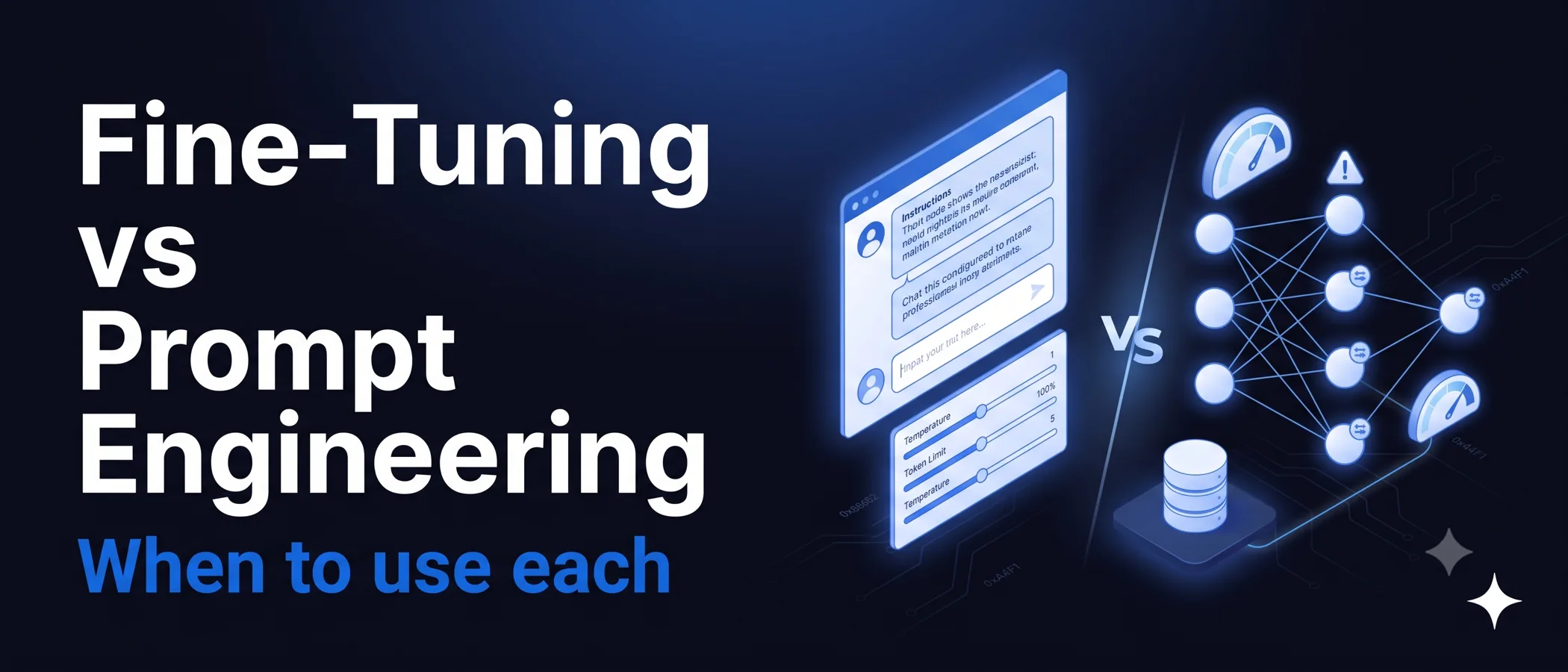
Fine Tuning vs Prompt Engineering, When to Use Each

Vasim Gujrati
Solutions Architect, AI & Platforms, Unico Connect
In this article
Most engineering teams should start with prompt engineering. It is faster to test and cheaper to change, and it keeps up as requirements move. Fine tuning is justified only for a repetitive task where the quality gap is measurable and getting it wrong is costly. So the question to ask of any workflow is whether it needs new instructions or new learned behavior. Below we compare the two on cost, consistency and complexity, then set out the criteria that tell you which approach a given workflow needs.
Quick Answer
Use prompt engineering when requirements change often, when knowledge must stay current, or while you are still validating the product. Reach for fine tuning when a narrow, high volume task demands strict formatting or tone that prompting cannot hold reliably. Prompt engineering changes what you tell the model. Fine tuning changes how the model behaves. Start with the lighter option and add training only when evaluation proves prompting has plateaued. The default at Unico Connect is to exhaust prompt and context work first, then measure.
Key Evidence That Shapes the Decision
Prompt design is still the dominant customization technique in enterprise AI, followed by retrieval, and fine tuning remains niche (Menlo Ventures, 2025). Once a narrow workflow reaches production, though, inference economics start to drive the architecture. Sending a very large prompt on every API call adds latency and token cost on each request, while a smaller specialized model can handle the same narrow task far more cheaply once it is trained.
The trade is about quality as well as cost. Research on text classification has shown that a fine tuned smaller model can outperform a much larger general model used zero shot on focused, repeatable tasks (arXiv, 2024). The decision comes down to whether your inference volume and consistency needs justify the upfront training effort.
What Each Approach Actually Changes
What prompt engineering changes
Prompt engineering changes runtime instructions, in context examples and output constraints. Dynamic retrieval, tool use definitions and structured output templates sit in the prompt layer as well. The underlying model stays unchanged, so the approach is fast to revise when a workflow pivots. If a downstream API schema changes, an engineer edits the system prompt instead of starting a retraining run.
What fine tuning changes
Fine tuning changes the internal model weights, and with them the learned behavior. It does not keep the model supplied with fresh knowledge. What it locks in is consistency, stylistic control and repeated execution of a narrow task. That control carries real operational weight. Fine tuning demands careful data preparation, ongoing monitoring and structured maintenance, so the customized model becomes a software product you own across its lifecycle.
How the Two Compare
Choosing an approach is mostly a matter of matching engineering effort to the bottleneck you have. The table below lines the two up factor by factor.
Prompt engineering vs fine tuning across cost, data, and maintenance
| Decision factor | Prompt engineering | Fine tuning | Best choice when |
|---|---|---|---|
| Setup time | Hours to days | Days to weeks | Speed to market is critical |
| Upfront cost | Negligible, inference only | High, compute and data curation | You are validating early product fit |
| Data needs | 3 to 5 few shot examples | 50 to 100 curated examples to start, thousands if needed | Bounded repetitive tasks dominate |
| Flexibility | Immediate edits | Rigid, needs retraining | Business logic changes often |
| Output consistency | Variable, can drift | High and predictable | Format errors break downstream APIs |
| Maintenance | Low, prompt versioning | High, regression testing | A dedicated MLOps team exists |
| Best fit tasks | Reasoning, Q and A, summarizing | Extraction and classification | Routing high volume fixed schema data |
When Prompt Engineering Should Stay Your Default
Prompt engineering is the right default more often than teams expect. It wins when product requirements are fluid and when workflows are knowledge heavy. Querying internal policies, for example, calls for dynamic retrieval instead of training, because facts injected into a prompt stay traceable while facts baked into weights go stale fast. Low volume and low risk use cases rarely justify the infrastructure that fine tuning brings. Prompt engineering is a durable production choice in its own right, and it now sits inside the wider discipline of context engineering for production AI.
What to improve before you train
Before you commit to fine tuning, exhaust the prompt layer. Test structured few shot examples, wire in reliable tool use and enforce strict output validation. At Unico Connect we refine workflow design before adding architectural complexity, because hallucinations often trace back to weak retrieval grounding or an ambiguous prompt rather than a weak base model. If the gap is knowledge grounding, our comparison of RAG versus fine tuning sets the options side by side.
What Each Option Actually Costs
Teams usually frame the choice as a quality question and then settle it on cost. Three costs change with that choice, and each is worth pricing on its own.
- Cost to get started. Prompt engineering starts near zero and iterates in hours. Fine tuning needs a curated dataset, a training run and an evaluation harness before it produces anything, and that normally takes days to weeks.
- Cost per request in production. A tuned smaller model can be markedly cheaper per call than a large model driven by a long prompt, because you stop paying for thousands of instruction and example tokens on every request. That saving is how tuning pays for itself, and it only shows up at volume.
- Cost to maintain. Prompts move with a model release and can be edited the same day. A tuned model is pinned to the base it was trained on, so a new base version means retraining and revalidating. Teams that tune successfully budget for that as routine work. Tuning availability also depends on the vendor. OpenAI, for example, already blocks new fine tuning jobs for organizations that have not fine tuned before, and active existing customers lose the ability to create them on 6 January 2027 (OpenAI, 2026).
The break even point is driven by request volume and prompt length. A low volume workflow with a short prompt almost never justifies tuning. The clearest candidate is a high volume workflow that currently ships a long system prompt plus several examples on every call, because the per request saving multiplies by traffic while the training cost stays fixed.
By default we exhaust prompt and context work first, then measure. If a workflow still falls short of the quality bar with a well built prompt, a strong retrieval layer and a tested evaluation set in place, consider tuning. Reaching for tuning before those three exist usually trains a model to imitate a workflow nobody has validated yet.
When Fine Tuning Becomes the Better Option
Fine tuning earns its cost when a task is narrow, repeated, and operationally important. Watch for repeated failures in classification, erratic entity extraction, unreliable routing, or format errors that break downstream pipelines. When passing a large, complex context on every call gets slow and expensive, training a smaller specialized model cuts latency and cost together. The case is strongest once you can show that long prompts have become brittle and costly under real production load.
What teams need before they commit
Fine tuning needs lifecycle ownership. Before starting, teams should curate enough representative training examples, define exact evaluation criteria and plan for long term maintenance. The work continues past the first training run. You monitor concept drift, run regression tests on every change and treat the customized model as an integrated software product. We hold model generated logic to the same code review and testing bar as any other production code.
A Practical Decision Framework
To settle the choice, work through five steps in order.
- Name the failure mode by deciding whether the system fails from missing knowledge or from inconsistent formatting.
- Fix the prompt layer first, exhausting few shot prompting, tool calls and output validation before you touch weights.
- Run automated evaluation on representative tasks to prove prompting has plateaued. A few weak examples do not show a plateau.
- Compare cost and maintenance. Find the break even point between heavy prompt inference cost and the ongoing overhead of maintaining a custom model.
- Ship the lightest architecture that meets the quality threshold.
Workflow discipline matters more than tooling here, so optimize for better prompts and resilient workflows before reaching for new infrastructure. Our guide on why AI models fail in production explains what stalls models after the demo regardless of approach.
Frequently Asked Questions
Is fine tuning versus prompt engineering just a quality comparison?
No. The better option depends on the failure mode, the inference scale and the operational trade offs. Supervised fine tuning improves formatting and consistency, while prompting is stronger for reasoning and dynamic logic.
How do you know when prompt engineering is enough?
It is enough when outputs become consistently reliable after you improve prompt structure, add dynamic retrieval, and enforce backend validation for edge cases. If those changes close the gap, you do not need to train.
What are the most common fine tuning use cases?
The highest return comes from repetitive bounded tasks, such as domain specific classification, rigid entity extraction, request routing, and generating tightly structured API payloads.
Does fine tuning reduce cost in production?
It can, in narrow high volume workflows, by letting you run a smaller and faster model. The saving only holds when inference volume is large enough to justify the training and maintenance costs.
When should an enterprise choose model customization?
Choose customization when workflow requirements are stable, the business needs deterministic formatting, and evaluation shows that prompt only optimization has plateaued.
Conclusion
Match the approach to the problem in front of you. Use prompt engineering for fluid, knowledge heavy or early stage work, and fine tune when a narrow task needs consistency that prompting cannot hold. Start light and measure carefully, then add complexity only when the evidence demands it. To build production AI on that discipline, see our AI development services or hire AI engineers from our team.