









Lovable Backend in 2026, Lovable Cloud vs Supabase vs Xano and How to Choose

Saurav Jagdale
Technical Lead, Unico Connect
In this article
- Quick Answer
- Key Takeaways
- What Backend Lovable Uses by Default
- Lovable Cloud vs Supabase vs Xano, Side by Side
- Which Lovable Backend Fits Your App
- Is Lovable Cloud Worth It Once Users Arrive
- Moving the Backend to Your Own Supabase Project
- Putting Xano Behind the Lovable Front End
- What Each Lovable Backend Costs
- Switching Your Lovable Backend Without Losing Data
- Security and Regulated Data on Any Backend
- Our Verdict for Lovable Apps With Real Users
- How Unico Connect Helps Lovable Teams Choose a Backend
- Frequently Asked Questions
Your Lovable backend is the part of the app the preview never shows, and it decides what a later move will cost. Lovable launched Lovable Cloud (built on Supabase) as its built in backend on September 29, 2025. It switches Cloud on when a feature needs a backend, either automatically or after asking in chat. Most comparisons stop at Lovable Cloud vs Supabase, but a Xano backend behind the Lovable front end is worth pricing too. We build on Xano and Supabase and rescue Lovable apps, so weigh our view accordingly.
Quick Answer
Lovable Cloud (built on Supabase) is the default Lovable backend. Stay on it while the rules fit one Lovable project and someone watches the credit balance, because an empty balance pauses the backend. Move to your own Supabase project, Pro from $25 a month plus usage, when the company needs the account and bill in its own name or needs point in time recovery. Put Xano behind the Lovable front end when server side rules, background jobs, AI agents or several front ends carry the product. On Xano, Essential is $85 per month billed annually. No switch is one click, so decide before real users sign up.
Key Takeaways
- Lovable Cloud is built on Supabase, but Lovable manages and bills it, so no Supabase account or invoice sits in your name.
- Building and running the app share one credit balance, and an empty balance pauses the backend.
- Xano connects as an external API through its OpenAPI spec, and an existing Cloud app rewrites its data calls to use it.
- The Cloud export carries password hashes, while files, Edge Function code and secrets move separately.
What Backend Lovable Uses by Default
The default is Lovable Cloud, which Lovable describes as a built in backend with a database, storage, authentication, realtime and functions. Lovable runs backups and pausing, paid plans pick the instance size from a short list, and the usage is billed in credits.
Some Cloud rules only bite after launch. Each Cloud project gets its own isolated database. The region, Americas, Europe or Asia Pacific, cannot change once Cloud is on. Extensions come only from a fixed list, which includes vector and pg_cron.
Apps created since May 2026 ship on TanStack Start with server side rendering, while earlier apps are React single page apps built on Vite. Lovable says only older React and Vite apps need Cloud to hold credentials for a direct integration.
20
credits a month in the Lovable Cloud grant on Free, Pro and Business, which Lovable marks temporary
Lovable docs, project usage, read October 21, 2026
14 days
of daily database backups kept, roughly, with no point in time restore
Lovable docs, database, read October 21, 2026
Lovable Cloud vs Supabase vs Xano, Side by Side
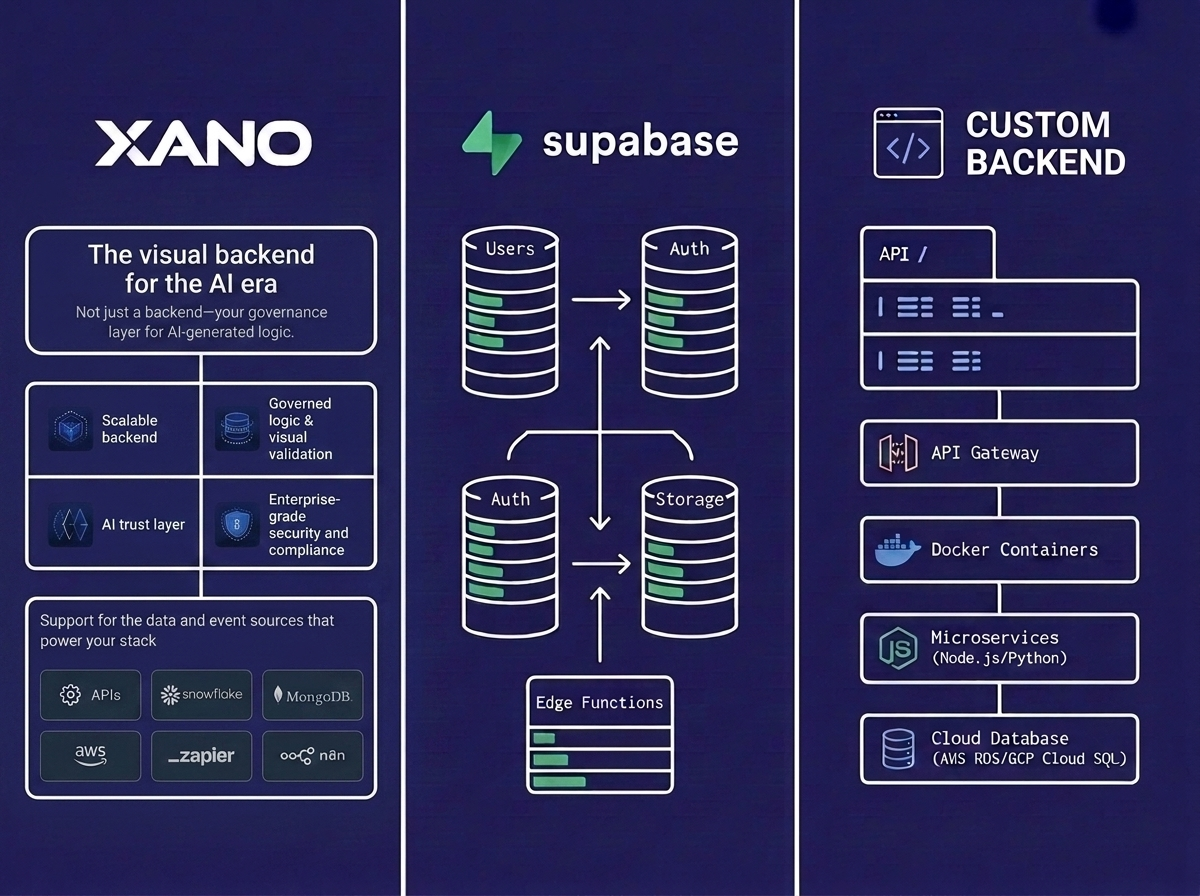
Lovable Cloud trades control for automatic setup, your own Supabase puts the account and the bill in your name, and Xano moves rules, jobs and AI agents behind one API. For the wider product question, see how Xano and Supabase compare beyond Lovable.
Table 1. What each backend gives you
| What you get | Lovable Cloud | Your own Supabase | Xano behind Lovable |
|---|---|---|---|
| Database | Managed Postgres, one isolated database per project, fixed extension list | Dedicated Postgres per project, compute from Micro to 16XL | Postgres, 100,000 records on Free, direct database access from Essential |
| Sign in | Email, Google and Sign in with Lovable by default, set up from chat | Supabase Auth from the Supabase dashboard, 100,000 monthly active users on Pro | Xano endpoints issue JWE tokens the app sends with authenticated calls |
| Server logic and jobs | Server functions in TanStack Start apps, Edge Functions in older apps, scheduled Jobs | Edge Functions, 2 million invocations included on Pro | Function stacks, background tasks, 10 on Essential and unlimited on Pro |
| AI agents and MCP | AI calls billed in credits, and Lovable can publish the app as an MCP server it hosts | Hosted Supabase MCP server for AI tools | Agent Builder and MCP Builder on every plan, Free included |
| Compliance options | SOC 2 Type II, ISO 27001:2022 and AIUC-1, but no BAA and no PHI | SOC 2 Type 2 report and ISO 27001 certificate on Team and Enterprise, HIPAA add on with a BAA from Team | SOC 2, ISO 27001 and GDPR from Essential, HIPAA with a BAA as a Pro add on or on Custom |
| Backups | Daily, roughly 14 days kept, no point in time restore | Daily, 7 days on Pro and 14 on Team, point in time recovery add on from Small compute | 7 day rolling on Essential, 14 day rolling on Pro |
| Region | Americas, Europe or Asia Pacific, fixed once Cloud is on | Chosen at project creation, and the data stays there | 15 regions on Essential and Pro, US only on Free |
| Export and lock in | Export of databases up to 15 GB, once per 24 hours, with Supabase the only supported destination | Standard Postgres that any Postgres tool can dump and restore | CSV or YAML export and direct database access, while the logic is rebuilt if you leave |
Sources are vendor pricing pages and docs read October 21, 2026, including the Supabase security page and its docs on backups, SOC 2, HIPAA and MCP.
Which Lovable Backend Fits Your App
Mark the cell in each row that fits your app today, and the column with the most marks is your starting point. Lovable itself advises moving parts only when you hit a real constraint.
Table 2. Which backend fits your app
| What to check | Stay on Lovable Cloud | Your own Supabase | Xano behind Lovable |
|---|---|---|---|
| Paying customers | Fine while one Lovable project holds the rules and someone owns the credit balance | Paying users, and investors ask who holds the backend account | Paying users whose orders or approvals run on server rules |
| Data you hold | No health data, and buyers accept Lovable SOC 2, ISO 27001 and daily restores | SOC 2 and ISO 27001 documents from Team, or a backend HIPAA BAA from Team plus a written Lovable agreement | SOC 2 and ISO 27001 from Essential, or a backend HIPAA BAA from Pro plus a written Lovable agreement |
| Business rules | Mostly screens that create, read, update and delete records | Rules that fit row level security and a few Edge Functions | Multi step workflows, pricing logic and integrations in one place |
| Scheduled jobs and AI agents | Occasional scheduled jobs, paid in credits | Supabase Cron and Edge Functions that Lovable deploys | Background tasks, AI agents and MCP servers in Xano |
| Several apps on the same data | Not possible, one database per project | Possible, but each Lovable project overwrites the shared secrets | Web, mobile and admin front ends call one API |
| Who writes backend code | Lovable, from chat | Lovable, after you approve each migration, plus a developer who reviews SQL | A backend developer or partner who designs the API |
Is Lovable Cloud Worth It Once Users Arrive
Often, yes, even with paying users, while a single app holds the business logic and a named person keeps the credits topped up. Setup is automatic, and there is no second vendor account or bill. The trade is control. There is no point in time restore, and since March 24, 2026 new Cloud projects no longer get separate Test and Live environments.
Out of credits means a paused backend
Lovable pauses the database, storage and sign in once the monthly Cloud grant and your general credits are gone, and daily build credits cannot pay for Cloud. The published site stays up, but anything that needs the backend stops. Set a low balance alert or auto top up before launch, and avoid usage limits that block Cloud, which pause it too.
Moving the Backend to Your Own Supabase Project
Your own Supabase project keeps Lovable as the builder while the account, dashboard, bill, backups and compute sit with your company. To connect Supabase to Lovable, a workspace owner or admin links the Supabase organization once, then anyone with edit access connects a project. Lovable keeps writing the schema and deploying Edge Functions, and runs each migration after you approve it. You also gain the option of point in time recovery and, on Team, SOC 2 and ISO 27001 documents. Our guide to where Supabase hits its limits covers the next ceiling.
You give up Lovable conveniences built for Cloud.
- The Cloud views in the editor, from Database and Users to Logs
- Auth emails from your own domain
- Setting up social login, managed Google sign in or SAML SSO from chat
- Signed in browser testing and sensitive data scanning
- Built in Paddle or Stripe payments and agent integrations on older React and Vite apps
Putting Xano Behind the Lovable Front End
Xano fits when the product is mostly rules rather than screens. It now positions itself as one backend platform to build, run and govern AI built software. It builds no front end, so Lovable keeps the screens while Xano holds data, logic, background tasks and integrations.
Lovable does not mention Xano in its docs, and the instructions come from Xano. Build the API first, download its OpenAPI spec and attach it to your Lovable prompt, saying the API uses authentication so Lovable wires up login and tokens. Xano warns that AI builders sometimes invent endpoints, so review every generated call.
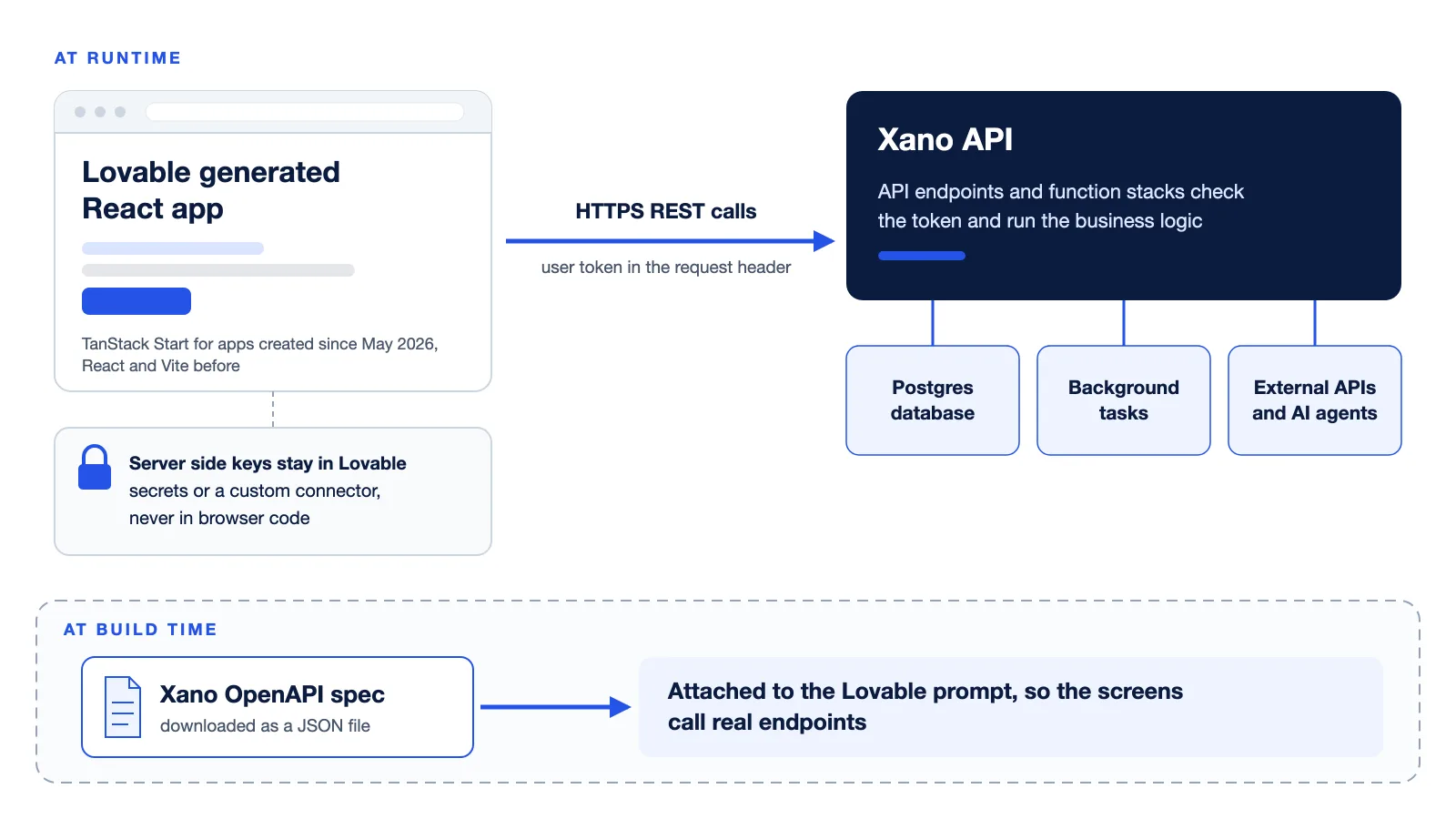
- Sign in lives in Xano. Its endpoints issue encrypted JWE tokens that the app sends with authenticated requests. Sign in with Lovable and Lovable managed Google work only on Cloud.
- Every data call changes. Lovable supports moving Cloud only to Supabase, so an existing app gets its data, sign in, storage and realtime calls rewritten for Xano, and its Edge Functions rebuilt there.
- The logic is the lock in. Data leaves as CSV or YAML, and Xano says its logic can be translated to another language, but that is a rewrite to price up front.
We have built this pattern with other front end builders. For Instant Ex, a European fintech, we shipped a cross border remittance product on a Xano backend with FlutterFlow, moving money from Europe to Africa across five corridors with 85 percent of transfers completing in under 10 minutes.
What Each Lovable Backend Costs
No vendor publishes a monthly total for a Lovable app, and we do not estimate one. Lovable bills its plan directly, and its credits, shared by everyone in your workspace, pay for building with Lovable, hosting and the built in backend on Lovable Cloud, and AI features in your deployed app.
Table 3. What each option costs
| What you pay for | Published price, read October 21, 2026 | Billed by |
|---|---|---|
| Lovable plan | Free at $0, Pro from $25 a month or Business from $50 a month for 100 monthly credits, billed monthly | Lovable |
| Lovable Cloud usage and app hosting | Credits after a 20 credit monthly Cloud grant marked temporary, with instance costs shown only as an in app estimate | Lovable |
| Supabase plan | Pro from $25 a month for 8 GB of disk per project, 250 GB egress, 100 GB file storage and 100,000 monthly active users, Team from $599 a month | Supabase |
| Supabase compute and recovery | Micro at $10 up to 16XL at $3,730 a month, billed hourly, $10 compute credit on paid plans, point in time recovery $100 a month per 7 days on at least the Small compute size | Supabase |
| Xano plan | Essential is $85 per month billed annually, Pro is $224 per month billed annually | Xano |
| Xano HIPAA | A HIPAA BAA at $500 per month on Pro | Xano |
Our breakdown of what Xano costs at scale covers Xano add ons, and our backend pricing comparison covers Supabase overages.
Switching Your Lovable Backend Without Losing Data
Moving from Lovable Cloud to Supabase is not one click, the reverse move is not supported, and a remixed Cloud project stays on Cloud. To hand the move to a team, see how we move Lovable apps off Lovable Cloud.
Build the destination while Cloud runs
Create the Supabase project and apply the files in supabase/migrations or drizzle/migrations in order. For Xano, build the API, then import each table from its Lovable CSV export, or restore the export into Supabase first and pull the data over a direct Postgres connection.
Export the database, then fill the gaps
The Cloud export holds the database, structure and data, for databases up to 15 GB in a file of at most 5 GB, once every 24 hours and only while the backend runs. It is a compressed PostgreSQL archive that needs pg_restore with zstd support, not a SQL file. Storage files, Edge Function code and secrets are not in it.
Plan the sign in outcome
The Cloud export carries user accounts with their password hashes, so users keep their passwords when it is restored into a Supabase project. Anyone signed in at the switch signs in again, and each sign in provider and redirect URL is set up again at the destination. People who joined through Sign in with Lovable need another way in. Xano does not document importing password hashes, so plan a reset flow if sign in moves to Xano.
Test, freeze writes, then switch
Replace app connectors and Lovable AI gateway calls, which do not move. Test a deployment against the new backend and time the export and restore, which set how long writes stay paused. Then pause writes, take the final export once 24 hours have passed since the last one, restore it and point the app at the new backend, as the Lovable hosting guide describes.
Download before you remove Cloud
Remove Lovable Cloud permanently deletes the instance, including exports saved to its storage. Keep your own copy of the final export.
Security and Regulated Data on Any Backend
Row level security matters on both Supabase routes, because Lovable Cloud is built on Supabase. In 2025, security researcher Matt Palmer disclosed CVE-2025-48757. Palmer scanned 1,645 projects from the Lovable public showcase and found 170 of them, roughly 10.3 percent, with inadequate row level security, exposing 303 endpoints in total. Lovable has disputed the CVE, and its position is that customers own the security of their app data. Lovable now runs a quick security scan every time you publish. That scan is a good baseline, and it is not an audit. Work through our Supabase RLS security checklist before launch.
Keep admin keys out of the browser
Keep the Supabase service role key and any Xano or third party secret in server side secrets or a Lovable custom connector, never in browser code.
Regulated Data Changes the Answer
Health data rules out Lovable Cloud and limits Lovable itself. Lovable says it is not HIPAA compliant and signs no Business Associate Agreements, and its terms bar protected health information in apps you build with Lovable unless your plan or a separate written agreement allows it. A BAA with Supabase or Xano covers only that vendor, so talk to Lovable sales before any health data flows, whichever backend you pick. Xano terms last updated September 24, 2026 require the plan or add on it designates and a signed BAA before any regulated health data is processed.
Our Verdict for Lovable Apps With Real Users
Stay on Lovable Cloud if
- one Lovable project carries the product and an owner watches credits
Move to your own Supabase if
- the company must own the account and the bill, or needs point in time recovery
Put Xano behind Lovable if
- workflows, AI agents or several front ends sharing one API carry the product
How Unico Connect Helps Lovable Teams Choose a Backend
Unico Connect is an Enterprise tier partner in the Xano global partner program, its highest tier, and we were the first agency to reach it, in October 2025. In a case study about us, Xano reports a 50 percent increase in development speed and a 40 percent reduction in development cost. We read your app against the signals above, then harden it on Lovable Cloud, move the backend to a Supabase project in your name, or have our Xano development team build the API behind your screens.
Frequently Asked Questions
Is Lovable Cloud the same as Supabase?
Not quite. Lovable Cloud (built on Supabase) shares its open source foundation, with Postgres, auth, storage and Edge Functions, but Lovable runs and bills it. Your own Supabase project puts the account, dashboard and bill in your name.
How much does Lovable Cloud cost?
Lovable Cloud has no separate price. Usage draws first on a temporary 20 credit monthly Cloud grant on Free, Pro and Business, then on general credits, and daily build credits cannot pay for it. Paid Lovable plans start at $25 a month, billed monthly, for 100 credits.
What happens to a Lovable app when the workspace runs out of credits?
The published site stays live, but Lovable pauses the database, storage and sign in. The data is kept, and you can open or export it again once you add credits or the monthly grant refreshes, then wake the backend.
Can a Lovable front end use Xano as its backend?
Yes, as an external API, following instructions from Xano rather than Lovable. Attach the Xano OpenAPI spec to your Lovable prompt, say the API uses authentication, and review every call Lovable generates.
Can two Lovable apps share one backend?
Not on Lovable Cloud, where every project gets its own database. Several projects can share one external Supabase project, but Lovable says each then overwrites the secrets of the other, including LOVABLE_API_KEY, so features that use that key stop working. With Xano, web, mobile and admin front ends call the same API.
Do users have to reset passwords when a Lovable app changes backend?
Not for a Supabase restore. The Cloud export carries user accounts with their password hashes, so users keep their passwords when it is restored into a Supabase project. Signed in users sign in again, and a backend with no documented hash import, such as Xano, needs a reset flow.