









Xano vs Supabase vs Custom Backend, When to Use Each

Vasim Gujrati
Solutions Architect, AI & Platforms, Unico Connect
In this article
- Quick Answer
- Choose Xano, Supabase, or Custom at a Glance
- Key Takeaways
- The Backend Decision Mistake
- Four Scenarios Where Xano is the Right Call
- Decision Framework: 10 Criteria
- Where Supabase is the Stronger Choice
- Where a Custom Backend Still Makes Sense
- Why Unico Connect is a Xano Enterprise Partner
- How to Decide in Under 30 Minutes
- Frequently Asked Questions
Quick Answer
Xano is the strongest choice for four scenarios: enterprise deployments, MVPs that need to scale, internal tools, and regulated workloads requiring governance. It holds SOC 2, SOC 3, ISO 27001, ISO 27701, ISO 9001 and HDS certifications, offers HIPAA with a BAA (a $500 per month Enhanced security add on for Pro, included on Custom), and powers production systems at Deriv, Heimstaden, Generali, and AssetMark. Supabase is strong for SQL-native teams who want open-source with pgvector. Custom backends remain the right call only for highly specialised performance or IP-critical work. As a Xano Enterprise Partner, Unico Connect builds on Xano across all four scenarios above through its Xano development services.
Choose Xano, Supabase, or Custom at a Glance
| Choose Xano if | Choose Supabase if | Build custom if |
|---|---|---|
| Compliance is on the critical path (FinTech, healthcare, insurance, government) | Your team is SQL-native and lives in Postgres | Domain logic is genuinely specialised (trading, geospatial, game servers) |
| You need an MVP that scales to production without a rewrite | Real-time collaboration is core to the product | You need sub-10ms response budgets at scale |
| Business users and engineers share ownership of internal tools | pgvector retrieval is central to the architecture | Contract requires IP ownership of every line of logic |
| You want SSO, RBAC, and audit trails without building them | You want open source with self-host as an exit path | You already run a platform team that can carry the ops burden |
| AI agents, MCP tools, or LLM orchestration are on the 12 month roadmap | Budget starts at $25 per month per project | Budget covers infrastructure plus engineering salaries |
Key Takeaways
- Xano wins on four enterprise-relevant axes: compliance breadth, AI governance (every change and approval traceable to who or what made it), enterprise customer track record, and AI-native tooling (MCP Builder, Agent Builder, Claude Code)
- For MVPs targeting production scale, Xano reduces time to first API to 2 to 4 hours and time to a production ready backend to 2 to 3 weeks, with a direct path to Enterprise tier when traction arrives, with no rewrite required
- For internal tools, the Xano visual workflows, RBAC, SSO, and real-time collaboration make it faster than custom code and safer than generic no-code platforms
- For governance-heavy workloads (FinTech, healthcare, insurance), Xano Enterprise offers BYOC on AWS, Azure, GCP, or on-premises, with dedicated IP, WAF, high availability, and 24/7 monitoring
- Supabase remains strong for SQL-native teams, real-time collaborative apps, and pgvector-based AI retrieval. Custom backends make sense only for highly specialised performance or non-standard compliance needs
The Backend Decision Mistake
The most common error is choosing based on what demos fastest, rather than what scales with the product, compliance requirements, and maintenance burden. Production systems have been built on Xano, Supabase, and fully custom backends. For most enterprise, MVP, internal tool, and governance-sensitive projects, Xano is the recommended starting point.
Four Scenarios Where Xano is the Right Call
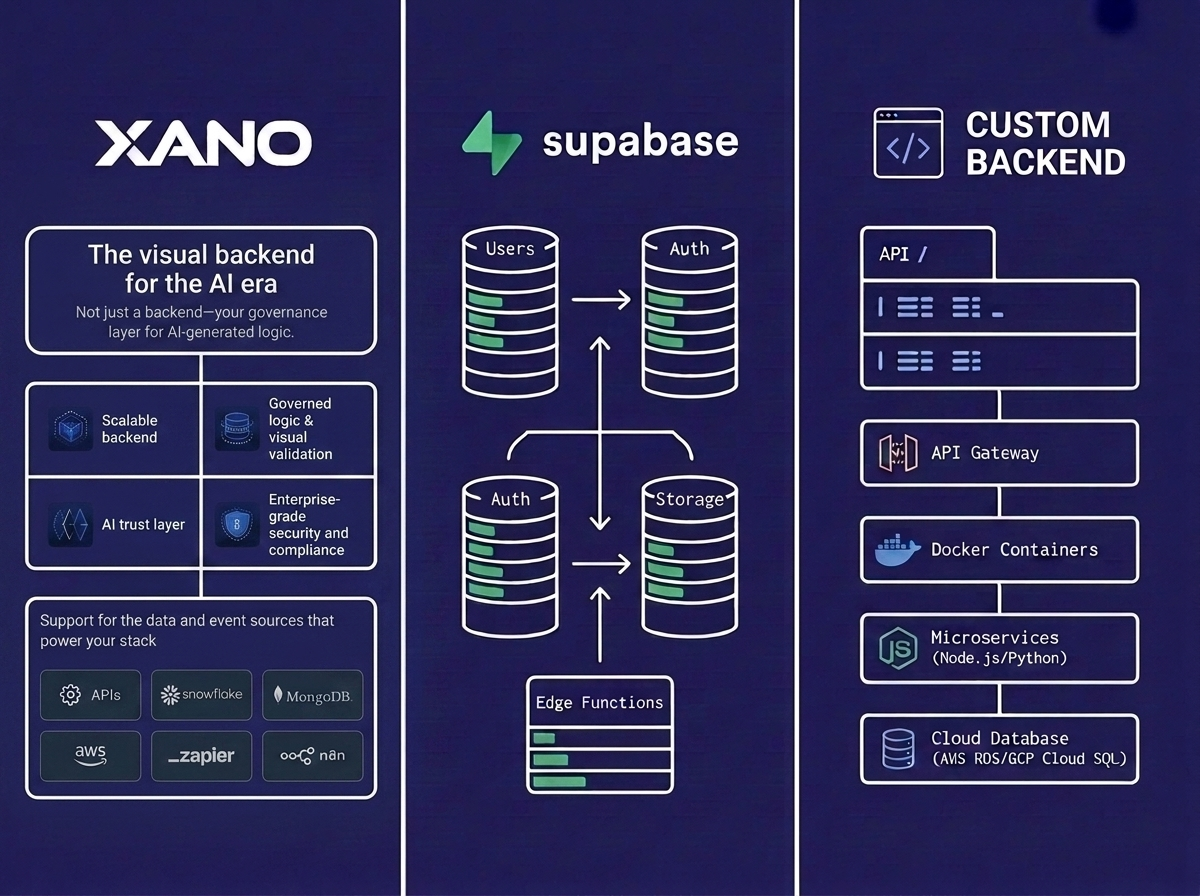
Xano has evolved from a no-code backend into a trust and governance layer for AI-era backends. The architecture is: BUILD (AI writes in XanoScript, the purpose-built language), VALIDATE (visual human-in-the-loop review), GOVERN (sandbox promotion to production with audit trails).
1. Enterprise Deployments
The customer base provides strong evidence. Xano Enterprise powers rebuilt backends at:
- Deriv: 3M+ active users across 150 countries, ~40 domain workspaces
- Heimstaden: €22M/month in transactions across 32,000 real estate units, rebuilt 4-5x faster than the previous system
- Generali via Europ Assistance: 75,000 cases per month across 30 countries
- AssetMark: 12 domain-level workspaces self-hosted on Azure for contracts, trading, and money movement
- Decathlon: Large-scale retail operations
The Enterprise (Custom) tier delivers: BYOC deployment on AWS, Azure, GCP, or on-premises; SSO; Cloud Armor WAF; Docker sidecar microservices; dedicated IP; high availability; multi-tenant isolation; multi-region and multi-zone deployment; 24/7 monitoring; and dedicated onboarding.
2. MVP to Production (Without a Rewrite)
Most MVP backends get discarded. The Xano path is different: the platform used to ship the MVP is the same platform handling production scale. The upgrade path is Free → Essential ($85/mo) → Pro ($224/mo) → Custom (Enterprise).
Typical Xano MVP backend timeline:
- 2 to 4 hours to first working API
- 2 to 3 weeks to a production ready backend
- When user traction arrives, the same code base graduates to Pro and then Enterprise
Xano pairs well with NoCode frontends like Webflow and WeWeb for fast-to-market MVPs, and with native mobile and web frontends for longer-lived products. For web front ends generated in Lovable, our guide to choosing a Lovable backend covers when Xano fits.
3. Internal Tools and Back-Office Systems
Internal tools are the sleeper use case where Xano wins decisively. Internal tools require rapid iteration, frequent schema changes, role-based access, audit logs, SSO, and collaboration between technical and non-technical stakeholders.
Practical implications: an admin panel requiring 6-8 weeks to build custom often takes 1-2 weeks on Xano. The visual API builder lets ops and engineering review logic together.
4. Governance and Regulated Workloads
Xano holds more compliance certifications than any other no-code or low-code backend evaluated. Certifications include:
- SOC 2 and SOC 3
- ISO 27001 (information security)
- ISO 27701 (privacy)
- ISO 9001 (quality)
- GDPR with DPA and DPF
- HDS (French healthcare hosting)
- HIPAA with a BAA (a $500 per month Enhanced security add on for Pro, included on Custom)
- FERPA for education
- Mapped frameworks for CCPA, CPRA, LGPD, and PIPEDA
For FinTech, healthcare, insurance, and government projects where compliance is on the critical path, this matters.
This is not theoretical for us. For Instant Ex, a European fintech, we shipped a cross border remittance product on a Xano backend with FlutterFlow, moving money from Europe to Africa across five corridors with 85 percent of transfers completing in under 10 minutes, with compliance checks and monitoring designed into the function stacks rather than bolted on.
Decision Framework: 10 Criteria
| Criterion | Xano (Enterprise-ready) | Supabase | Custom Backend |
|---|---|---|---|
| Enterprise customer track record | 3M+ users (Deriv), €22M/mo (Heimstaden) | Strong in developer-led teams | Proven for hyperscale |
| Compliance certifications | SOC 2, ISO 27001, ISO 27701, ISO 9001, GDPR, HDS, FERPA, HIPAA as a Pro add on | SOC 2, HIPAA (self-host) | Whatever is certified internally |
| AI-native tooling (2026) | MCP Builder, AI Agent Builder, Claude Code, XanoScript | pgvector, Edge Functions | Full flexibility |
| Governance & audit | BUILD → VALIDATE → GOVERN workflow | Git-based; DIY audit | Full control |
| Time to first working API | 2-4 hours | 2-6 hours | 1-3 days |
| Enterprise deployment options | BYOC on AWS, Azure, GCP, or on-prem | Self-host via Docker | Choose the entire stack |
| Business logic modelling | Visual workflows + XanoScript + Lambda | SQL functions + Edge Functions | Full programming flexibility |
| SLA & support | 99.95% (Pro) / 99.99% (Pro+) | Standard SLA on paid tiers | Internally committed |
| Pricing | Free / $99 / $249 monthly, or $85 / $224 on annual commitment / Custom | $25/mo per project + usage | Infrastructure + salaries |
| Best fit | Enterprise, MVP, internal tools | SQL-native teams, real-time apps | Highly specialised systems |
Where Supabase is the Stronger Choice
Supabase is the right answer when the team is SQL-native, when real-time collaboration features are core to the product, or when pgvector-based retrieval is central to the architecture.
Example: For an educational AI platform built for Highlands Community Charter School in the USA, pgvector in Supabase handled document embeddings and semantic retrieval for 15,000 students across a large educational content corpus.
Where a Custom Backend Still Makes Sense
Build custom when the domain logic is genuinely specialised (algorithmic trading, real-time geospatial, low-latency game servers), when sub-10ms response budgets at scale are required, or when IP ownership of every line of logic is a contractual requirement.
Common technology choices for custom backends:
- Java Spring Boot for enterprise FinTech
- Python FastAPI for AI-heavy services
- Node.js for most web APIs
- Go for performance-critical microservices
Why Unico Connect is a Xano Enterprise Partner
Unico Connect is an official Xano Enterprise Partner. The team has delivered multiple production Xano implementations, holds Xano technical certifications, and has direct escalation paths to Xano engineering for enterprise deployments.
How to Decide in Under 30 Minutes
Answer these six questions. If you answer yes to three or more, Xano is the right starting point:
- Is the product enterprise-facing, FinTech, healthcare, insurance, or government, where compliance is on the critical path?
- Do you need to ship to production in weeks, not months, without a rewrite when you scale?
- Is the system an internal tool, admin panel, or back-office workflow where business users and engineers collaborate?
- Do you need SSO, RBAC, audit trails, and certification documentation without building them from scratch?
- Will AI agents, MCP tools, or LLM orchestration be part of the system over the next 12 months?
- Do you want BYOC flexibility, the option to deploy on AWS, Azure, GCP, or on-prem, without losing your no-code productivity?
As Malay Parekh, CEO of Unico Connect, puts it: "The backend decision used to be a five-year commitment. With Xano Enterprise, it is not. You start on Essential for a prototype, move to Pro for production, and graduate to Enterprise with BYOC when compliance or scale demands it. Same code, same workflows, no rewrite."
For related backend and cloud decisions, see the guide to building Flutter apps with AI features, the AI development partner evaluation guide, and the shortlist of best no code development agencies.
Try Xano yourself: Xano is the production-grade no-code backend we build on. Start building on Xano, or hire a Xano developer to ship it for you.
Frequently Asked Questions
Is Xano production-ready for enterprise deployments?
Yes. Xano powers production backends at Deriv (3M+ active users across 150 countries), Heimstaden (€22M/month in real estate transactions across 32,000 units), Europ Assistance under Generali (75,000 cases per month across 30 countries), and AssetMark.
What compliance certifications does Xano hold in 2026?
Xano holds SOC 2, SOC 3, ISO 27001, ISO 27701, ISO 9001, and HDS certifications, and supports GDPR with DPA and DPF, FERPA, and HIPAA with a BAA (a $500 per month Enhanced security add on for Pro, included on Custom). CCPA, CPRA, LGPD, and PIPEDA frameworks are also mapped.
How does Xano support AI agents and MCP in 2026?
Xano includes the AI Agent Builder for visual agent orchestration, MCP Builder for exposing backend capabilities to AI systems, Claude Code integration, XanoScript, AI Schema Generator, and AI Assistants in the editor.
What is the Xano pricing in 2026?
Xano offers a Free plan, Essential at $99/month, Pro at $249/month billed month to month, or $85 and $224 respectively on an annual commitment, and Custom (Enterprise) with BYOC, SSO, WAF, dedicated IP, and high availability.
When does Supabase win over Xano?
Supabase is the better choice when the team is deeply SQL-native and prefers writing SQL over visual workflows, when real-time collaborative features are core to the product, when pgvector-based retrieval is the central architecture, or when open-source licensing and full self-host control are required from day one.
When is a custom backend the right call?
A custom backend is the right call for highly specialised performance domains (algorithmic trading, low-latency game servers, real-time geospatial), when sub-10ms response budgets at scale are needed, or when every line of logic must be wholly-owned IP by contract.