









Supabase vs Firebase in 2026, Which Backend to Pick and When to Switch

Vasim Gujrati
Solutions Architect, AI & Platforms, Unico Connect
In this article
- Quick Answer
- Key Takeaways
- Supabase vs Firebase, Feature by Feature
- Postgres Tables or Firestore Documents
- Realtime, Offline and Push for Mobile Apps
- Auth and the Security Model
- Supabase vs Firebase Pricing as Usage Grows
- Vector Search and AI Features
- Moving From Firebase to Supabase
- Firebase vs Supabase, Which to Choose by Use Case
- Planning a Supabase Build or a Move Off Firebase
- Frequently Asked Questions
Supabase vs Firebase is a backend choice that gets expensive to reverse once users sign up. Supabase is an open source backend built on Postgres, a relational database you query with SQL. Firebase is an app platform from Google whose main database, Cloud Firestore, stores data as documents in collections. Every vendor figure was read on November 2, 2026.
Quick Answer
Choose Supabase when your data is relational, your team wants SQL and row level security, and you want an exit to plain Postgres. Choose Firebase when a mobile app must work offline, its screens read self contained documents, and you want the database, push and crash reports in one Google project. On cost, Firestore is cheaper at every size we priced on base Firebase Authentication, but once you need multi factor sign in, Supabase is cheaper from 100,000 users.
Key Takeaways
- Supabase is Postgres with SQL, joins and transactions. Firestore stores documents, and SQL Connect adds Postgres inside Firebase.
- Firestore bills every document read, write and delete. Supabase bills compute, disk, egress and monthly active users, not API requests.
- Firestore works offline on Android and Apple devices by default. Supabase has no built in offline cache.
- Our cost model favors Firestore on base Firebase Authentication, and Supabase from 100,000 users with multi factor sign in.
Supabase vs Firebase, Feature by Feature
Supabase leads on SQL, vector search and the exit path, Firebase on offline mobile use, push and sign in with no per user fee.
Table 1. Supabase and Firebase compared on 13 points
| What you compare | Supabase | Firebase |
|---|---|---|
| Database | Postgres, a relational SQL database, one per project | Cloud Firestore, a NoSQL document database. SQL Connect adds Cloud SQL for PostgreSQL |
| Joins | SQL joins, transactions and views | None in Standard edition. Enterprise edition pipeline subqueries join, but not offline |
| Realtime | Broadcast, Presence and Postgres Changes. 500 concurrent connections on Pro, then $10 per 1,000 | Snapshot listeners on documents and queries. Each added or updated result document bills a read |
| Offline use | No built in cache. Add a sync layer such as PowerSync | On by default in Android and Apple apps, off on the web. Last write wins |
| Sign in | Password, magic link, one time password and social sign in. SAML SSO from Pro. Basic MFA on every plan | Email, phone, anonymous and social. MFA, SAML and OpenID Connect need Identity Platform |
| Auth pricing | 100,000 monthly active users on Pro, then $0.00325 each | Base product has no per user fee. Identity Platform is free to 50,000, then $0.0055 each to 100,000 |
| Access rules | Row level security filters rows like a WHERE clause | Security Rules are not filters and reject queries that could return a blocked document |
| Billing meter | Plan fee, hourly compute, disk, egress and monthly active users. Unlimited API requests | Each document read, write and delete, plus storage and egress |
| Free plan | 500 MB database, 50,000 monthly active users, paused after one week of inactivity | Spark, with 1 GiB stored, 50,000 document reads, 20,000 writes and 20,000 deletes per day |
| Server code | Edge Functions on Deno, 2 million calls on Pro, then $2 per million | Cloud Functions on Blaze only, 2 million calls free, then $0.40 per million |
| Client SDKs | JavaScript, Flutter, Swift, Kotlin, Python and C#. No push service | Android, Apple, web, Flutter and Unity. Cloud Messaging push at no cost |
| Vectors and AI | pgvector up to 2,000 indexed dimensions, queried in SQL | Firestore vector search up to 2,048 dimensions, server libraries only. AI Logic calls Gemini from apps |
| Exit | Apache 2.0, self host with Docker. A standard Postgres dump restores anywhere | Runs as a Google Cloud project. The export is built to go back into Firestore |
Sources are the Supabase and Firebase pricing pages and product docs, read November 2, 2026.
Postgres Tables or Firestore Documents
Pick Postgres when your data has relations you will query across, and Firestore when each screen reads one self contained document. Postgres keeps each fact in one row and links rows with keys, so one SQL query can join orders to customers and products and total the result. Google describes Firestore as a NoSQL document database with no tables or rows, optimized for large collections of small documents.
A Firestore screen reads one document or one collection. To fill it, teams copy the fields each screen needs into that document, then update every copy when the source changes. That pattern fights you on reports, admin dashboards and questions nobody planned for, which Postgres answers with a new query. Firestore Enterprise edition can now join collections on the server through pipeline subqueries, but those do not work offline.
Firebase SQL Connect, the Postgres Option Inside Firebase
Firebase Data Connect became Firebase SQL Connect on April 22, 2026. Google states the features and APIs are unchanged. It is managed PostgreSQL powered by Cloud SQL, free to 250,000 operations per month on Blaze then 0.90 dollars per million, with the Cloud SQL instance billed separately.
You define operations in GraphQL, or in native SQL while that feature is in Preview, and deploy them to the server. Apps call them through generated SDKs for Android, iOS, Flutter and web, so clients never send their own SQL. It pairs with Firebase Authentication, supports vector search and realtime subscriptions, and Google lists Cloud SQL from $9.37 a month.
Realtime, Offline and Push for Mobile Apps
For a mobile app, Firebase has the edge on offline use and push, while both platforms stream live updates. Supabase says Postgres Changes checks each event against every subscriber on a single thread, and suggests Broadcast above about 3,000 concurrent subscribers on the same changes. Firestore listeners bill a document read each time a result document is added or updated. We found no independent benchmark with a published method comparing the two on performance, so treat speed multiples as marketing.
Offline Is the Biggest Mobile Difference
Firestore caches the data an app is using, so the app can read, write, listen to and query it offline. Google turns this on by default for Android and Apple apps, leaves it off on the web, and resolves conflicting edits as last write wins. Supabase has no built in offline cache. Its partner catalog lists PowerSync, a Postgres to SQLite sync layer for local first apps. If a field service or delivery app must work in a dead zone, that gap alone can decide for Firestore.
Push Notifications and a Hybrid Setup
Supabase has no push service. Its own guide sends push from Edge Functions through Expo or straight to Firebase Cloud Messaging. Cloud Messaging and Crashlytics cost nothing on any Firebase plan, so one workable split keeps them and moves data to Supabase. On Nuos, the smart home apps we built use Firebase Cloud Messaging next to a Node.js backend.
Auth and the Security Model
Both cover standard sign in, but Supabase includes basic multi factor sign in on every plan, while Firebase puts it behind an upgrade. Supabase Auth covers password, magic link, one time password, social sign in and SSO, and issues JWTs that row level security (RLS) policies read. Firebase Authentication covers email, phone, anonymous and social sign in with no per user fee, though each phone SMS is billed. Multi factor authentication, SAML, OpenID Connect and blocking functions need the optional Identity Platform upgrade.
The two security models fail in opposite directions. Supabase says to think of a policy as a WHERE clause added to every query. The real risk is RLS left switched off, because a table in an exposed schema without RLS is readable and writable by any role with a grant on it. Google says Firestore rules are not filters, so a query that could return a forbidden document fails whole, which breaks a screen rather than leaking data.
Each side has an admin path that skips the rules. On Supabase it is a secret key, or the legacy service_role key, and on Firebase the Firestore server libraries. Keep both on a server. Our Supabase RLS security checklist covers policy setup.
For regulated data on Supabase, compliance is strong, with SOC 2 Type 2, HIPAA available on the Team plan and above with a signed business associate agreement, and ISO/IEC 27001:2022 certification added in 2026, as our Supabase production readiness guide details. On the Google side, the Firebase privacy and security page makes no mention of HIPAA or PCI anywhere, but Google Cloud lists Firestore and Identity Platform among the products its HIPAA business associate agreement covers.
Supabase vs Firebase Pricing as Usage Grows
Base Firebase Authentication keeps Firestore cheaper at all three sizes we priced, by only $4.51 at 100,000 users. Multi factor sign in flips that from 100,000 users. On Supabase, Pro is 25 dollars per month for 8 GB of disk per project, 250 GB egress, 100 GB file storage and 100,000 monthly active users. Overages are published per unit, at 0.125 dollars per GB of database, 0.09 dollars per GB of egress, 0.0213 dollars per GB of storage and 0.00325 dollars per monthly active user. Compute is extra. Pro and Team include 10 dollars of compute credit, which covers exactly one Micro.
On Firebase, beyond the free quota, Firestore Standard edition in Iowa charges 0.03 dollars per 100,000 document reads, 0.09 per 100,000 writes, 0.01 per 100,000 deletes and 0.15 dollars per GiB per month of storage. Our backend pricing comparison lists every plan.
Table 2. Estimated monthly bill at list prices, November 2, 2026
| Line item | 10,000 users | 100,000 users | 500,000 users |
|---|---|---|---|
| Supabase Pro plan | $25 | $25 | $25 |
| Supabase compute, less the $10 credit | Small, $5 | Medium, $50 | XL, $200 |
| Supabase disk above 8 GB | $0 | $2.38 | $16.09 |
| Supabase egress above 250 GB | $0 | $22.50 | $202.50 |
| Supabase users above 100,000 | $0 | $0 | $1,300 |
| Supabase total | $30 | $99.88 | $1,743.59 |
| Firestore reads | $2.55 | $29.55 | $149.55 |
| Firestore writes and deletes | $0.36 | $8.50 | $44.90 |
| Firestore storage | $0.13 | $2.64 | $13.82 |
| Google Cloud egress | $4.39 | $54.68 | $265.15 |
| Firebase total, base Authentication | $7.43 | $95.37 | $473.42 |
| Identity Platform users above 50,000 | $0 | $275 | $2,115 |
| Firebase total with Identity Platform | $7.43 | $370.37 | $2,588.42 |
How we built this estimate
- Each monthly active user makes 1,000 reads, 100 writes and 10 deletes a month, spread evenly over 30 days.
- Each read returns about 5 KB, so egress is 50 GB, 500 GB and 2,500 GB on both platforms, and stored data is 2 GB, 20 GB and 100 GB.
- Supabase bills provisioned disk, which autoscales to 27 GB and about 137 GB for the larger apps.
- Firestore Standard edition in Iowa. Multi region nam5 is double the Iowa rate for reads, writes and deletes.
- We chose the Supabase compute sizes, with the spend cap off for the two larger apps.
- Email and social sign in only. File storage, functions, realtime overages, backups and tax are excluded.
At 500,000 users Supabase charges $1,300 for the 400,000 users above its allowance, while base Firebase Authentication charges nothing per user. Add multi factor sign in on Firebase and Identity Platform pricing reverses the order at 100,000 and 500,000 users, because the upgrade bills every user above 50,000. Supabase charges $75 a month for phone based multi factor sign in on the first project, too little to change that order. SAML users cost $0.015 each after the first 50 on both platforms.
Cost traps on each side
- Firestore reads per screen. Every query costs a minimum of one read, even when it returns nothing, and a query with an offset of 10 that returns a single document is charged 11 reads. In our 500,000 user model, screens that read ten times as many documents add about $1,350 a month in read charges alone.
- No hard cap on Firestore. Budgets and alerts do not stop usage and can lag by up to a couple of days.
- Supabase compute per project. The Pro spend cap does not cover compute, and each extra project runs its own instance from $10 a month.
For an India first app, Supabase has a Mumbai region, Firestore has Mumbai and Delhi, and Identity Platform SMS to India costs $0.07 a message against $0.01 in the US.
Vector Search and AI Features
For an AI app that searches your own data, Supabase is the simpler fit. pgvector on Supabase indexes vectors up to 2,000 dimensions, or 4,000 with halfvec, and similarity search sits in SQL beside your filters and joins. One catch is that the Supabase REST API cannot call pgvector operators directly, so you wrap the search in a Postgres function. Firestore vector search tops out at 2,048 dimensions, does not work with realtime listeners and runs only from the Python, Node.js, Go and Java libraries.
Firebase is stronger inside the app. Firebase AI Logic calls Gemini models from Android, Apple, web, Flutter and Unity apps, with a Google proxy keeping the Gemini API key off the device and App Check guarding against abuse. Genkit is the open source framework from Google for AI and agentic applications.
Moving From Firebase to Supabase
Move when reports and admin screens keep forcing you to copy fields across documents, or when you need multi factor sign in past 50,000 users. Stay if the app depends on the Firestore offline cache.
The move itself is a staged migration of data, users and files, and Supabase documents each part. Supabase publishes customer stories such as Mobbin migrating two hundred thousand users off Firebase. Effort grows with collection count and nesting, password users, stored files and rule complexity.
Keep Firebase Auth at first
Register your Firebase project as a third party auth provider in Supabase, so current sign ins work against the new database while data moves. Supabase bills those users as third party monthly active users.
Design tables, then copy collections
The Supabase tool copies one Firestore collection into one Postgres table, flattened into text, numeric, boolean or jsonb columns. Split nested arrays into related tables with its hooks or a script. Every document you read out of Firestore is a billed read.
Move users and decide on passwords
Export users to JSON and import them into auth.users with the two documented scripts, after saving the Firebase password hash parameters. The documented import leaves passwords empty, although Supabase Auth can verify Firebase scrypt hashes written in its own format. Plan that conversion, or a reset or first login flow.
Copy files and fix links
The storage script downloads each file from Firebase and uploads it into a private Supabase bucket whose permissions you set in the dashboard. Then rewrite stored file URLs.
Turn rules into policies and cut over
Supabase announced that from October 30, 2026, a new table in the public schema needs an explicit grant before the Data API can reach it. Grant each app role its tables, write a row level security policy for every exposed table, test each role, run a final sync, then switch the app.
Firebase vs Supabase, Which to Choose by Use Case
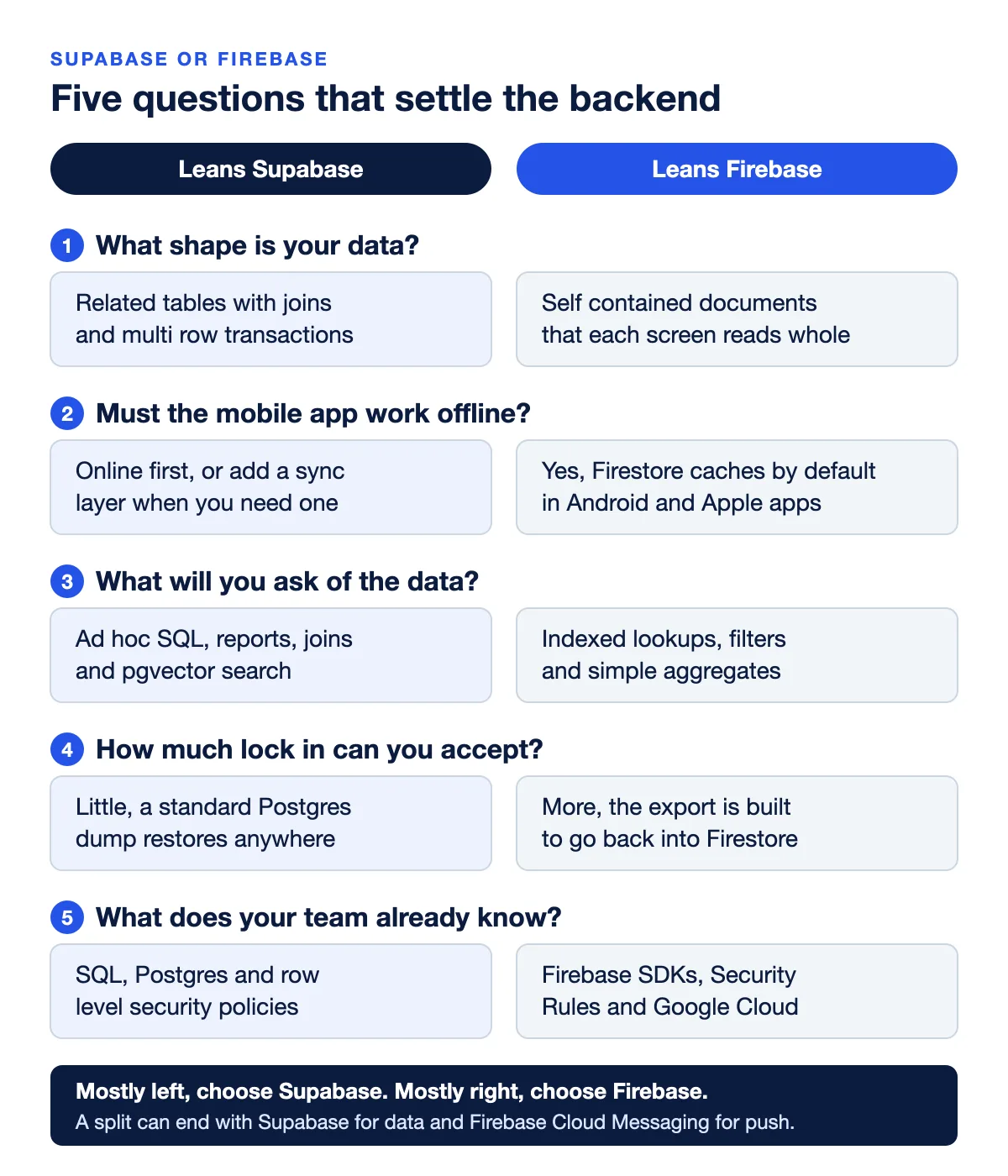
Supabase fits relational web products and AI search, and Firebase fits offline mobile apps built around documents.
Choose Supabase if
- You are building a web SaaS, dashboard or marketplace with related data and reports
- You want SQL and joins instead of copying fields across documents
- You are building AI search over your own data
- You need multi factor sign in for a large user base
- You want an open source license and the option to self host
Choose Firebase if
- Your mobile app must keep working offline
- Screens read self contained documents, like feeds, chats and profiles
- You want the database, push, crash reports and Remote Config in one project
- Your app fits inside the Firestore free quota
- Your team knows Security Rules and Google Cloud better than SQL
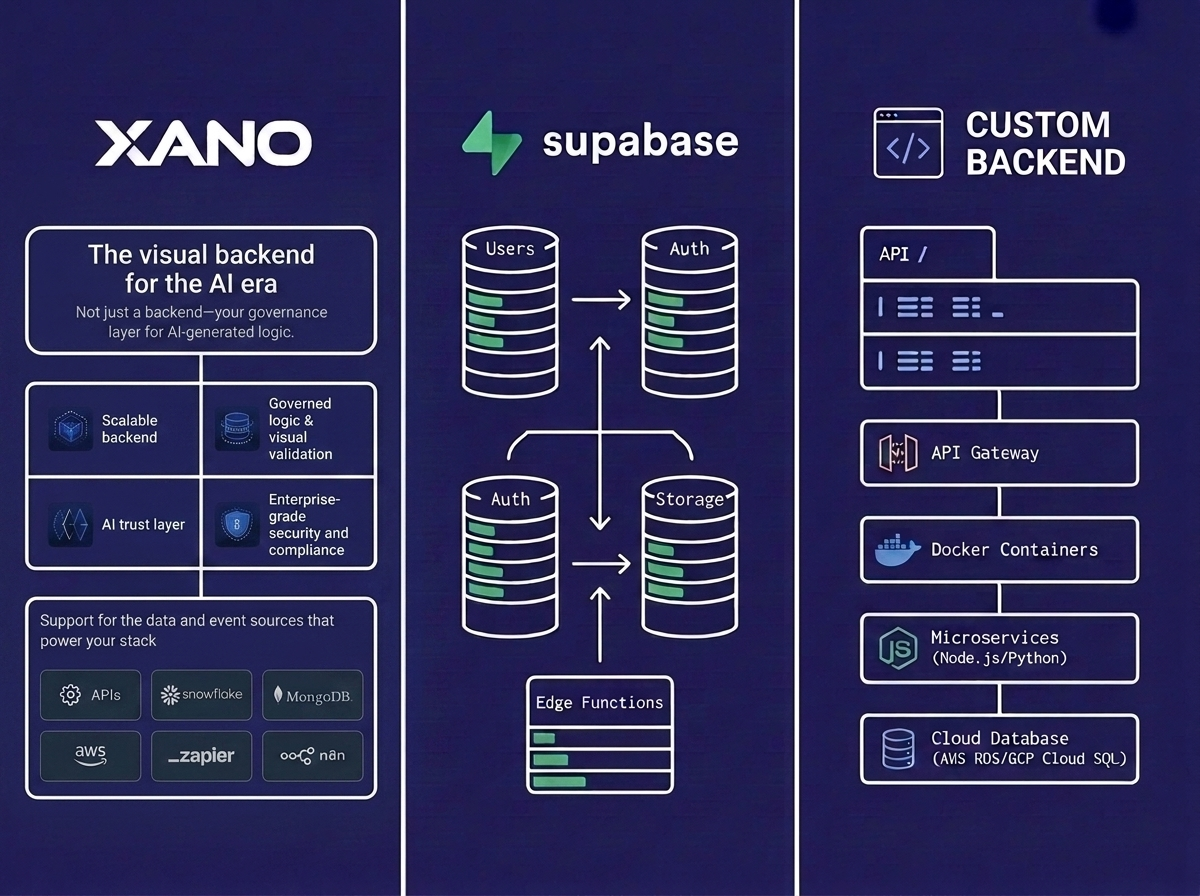
If you want Postgres while users stay on Firebase Authentication, try SQL Connect first. If the product is mostly server side logic, Xano is a third option, and our Xano vs Supabase comparison covers it. We are an Enterprise tier Xano partner, so we are not neutral there.
Planning a Supabase Build or a Move Off Firebase
Unico Connect builds production backends on Supabase and Firebase for web and mobile products. If Supabase is your pick or you are planning a move off Firestore, you can hire a Supabase developer from our team to model the schema, the row level security policies and the data migration with you.
Frequently Asked Questions
Is Supabase cheaper than Firebase for my app?
Not on base Firebase Authentication in our model, unless your app is read heavy. At list prices, Firestore costs about $7, $95 and $473 a month at 10,000, 100,000 and 500,000 monthly active users, against $30, $100 and $1,744 on Supabase. Add multi factor sign in through Identity Platform and Firebase rises to about $370 and $2,588 at the two larger sizes.
Does Supabase work offline like Firestore?
No. Supabase has no built in offline cache, while Firestore caches the data an app uses and syncs writes on reconnect, by default in Android and Apple apps. An offline Supabase app needs a sync layer such as PowerSync.
Is Firebase SQL Connect, formerly Data Connect, the same as Supabase?
No. Both run Postgres, but SQL Connect apps reach a Cloud SQL instance in your Firebase project only through operations you define and deploy, in GraphQL or, in Preview, native SQL. Supabase exposes the database directly, through a REST API that row level security protects. Pick SQL Connect when users already sign in with Firebase Authentication, and Supabase when clients should query tables directly.
Can I use Supabase for data and keep Firebase for push and crash reports?
Yes. Cloud Messaging and Crashlytics cost nothing on any Firebase plan, and the Supabase push guide sends messages through Expo or straight to Cloud Messaging.
Which is better for an AI app with vector search?
Supabase, for most apps that search their own data. pgvector keeps embeddings in Postgres with up to 2,000 indexed dimensions, so similarity search runs in SQL beside your filters. Firestore vector search runs only from server libraries, SQL Connect offers vector search on Postgres, and Firebase AI Logic calls Gemini models straight from a mobile app.