









Benefits of Xano Backend Development with No-Code

Vasim Gujrati
Solutions Architect, AI & Platforms, Unico Connect
In this article
Xano has become one of the most popular no-code backend platforms — and not by accident. It combines a visual builder, automatic API generation, compliance certifications, and the scalability to run real production workloads. For startups and enterprises that want the speed of no-code without giving up the rigour of a proper backend, Xano is increasingly the default choice. This guide walks through the platform, its key features, and the concrete benefits Xano delivers in 2025.
Quick Answer
Xano is a no-code backend platform that lets teams build scalable, production-grade backends — database, APIs, business logic, authentication, and integrations — without writing code. The biggest benefits are dramatic speed (a production ready backend in 2 to 3 weeks), lower cost, enterprise grade security (GDPR, ISO, and SOC 2 and 3 compliance on the Essential and Pro plans, plus a HIPAA add on for Pro), strong scalability, and reduced operational burden. It is the right choice for MVPs that need to scale, internal tools, and many production applications.
Key Takeaways
- Xano is a no-code backend platform that produces real, scalable, secure backends — not just prototypes
- Speed advantage is large, and Xano reduces time to first API to 2 to 4 hours and time to a production ready backend to 2 to 3 weeks
- Strong security defaults, with GDPR, ISO, and SOC 2 and 3 compliance on the Essential and Pro plans and a HIPAA add on available on Pro
- Best used by skilled developers and product teams together; not just for non-engineers
- The mature pattern is Xano for the long tail and most production work; custom backend for the deeply differentiated 10%
What Is Xano?
Xano is an all-in-one no-code backend platform that lets teams design and operate production-grade backends through a visual interface. It generates RESTful APIs automatically from your database schema, includes a visual workflow builder for business logic, provides authentication and authorisation primitives, and integrates with third-party services and APIs out of the box.
Unlike toy no-code tools, Xano is built for production. It scales horizontally, holds enterprise compliance certifications, and is used by serious startups and enterprises shipping real customer-facing products.
Key Features of Xano
The platform centres on seven capabilities:
- Visual database builder — design schemas with a graphical interface, no SQL required
- Automatic API generation — RESTful APIs generated from your data model with one click
- Visual workflow engine — assemble business logic by composing function blocks visually
- Authentication and authorisation — built-in user management, roles, and access control
- Third-party integrations — connect to any external service via APIs or pre-built connectors
- Built-in scalability — handles increased traffic and data volumes without re-architecture
- Enterprise compliance, with GDPR, ISO, and SOC 2 and 3 compliance on the Essential and Pro plans and a HIPAA add on available on Pro
These features turn Xano from "no-code platform" into "production backend platform that happens to be no-code".
Benefits of Xano Backend Development
1. Rapid Development and Deployment
Xano compresses backend development timelines dramatically. Schema design, API endpoints, business logic, and authentication all move faster on Xano. With skilled Xano backend developers, Xano reduces time to first API to 2 to 4 hours and time to a production ready backend to 2 to 3 weeks.
The compounding effect is significant: teams ship faster, iterate faster, and validate ideas with users sooner than competitors running traditional backend stacks.
2. Cost-Effective Solution
Xano reduces the cost of backend development materially. Smaller engineering teams ship more, infrastructure is fully managed, and Xano prices in fixed, published steps rather than a usage meter. For startups, this means an MVP backend at a fraction of the cost of custom development.
The savings compound over the life of the application — fewer engineers needed to operate the backend, less time spent on maintenance, and lower infrastructure bills.
3. Balanced Accessibility and Expertise
Xano's visual interface lowers the barrier to backend work, but it does not eliminate the need for engineering judgment. The platform shines in the hands of experienced developers who design clean data models, robust APIs, and maintainable workflows.
The right adoption pattern is product managers and designers contributing where they can, with senior engineers owning architecture and consequential decisions.
4. Strong Security Features and Compliance
Security is a first-class concern in Xano. Authentication, authorisation, data encryption, and audit logging come built in. GDPR, ISO, and SOC 2 and 3 compliance on the Essential and Pro plans, and a HIPAA add on available on Pro, let regulated industries deploy without building custom compliance infrastructure.
For healthcare, finance, and other regulated sectors, this is one of the strongest reasons to choose Xano. The platform side of that compliance work is already done.
5. Flexibility and Customisation
Xano is no-code but not closed. Power users can write custom code blocks when they need to, integrate with arbitrary external APIs, and shape the platform to specific business logic. The visual layer accelerates common work; the code layer handles the rest.
This is what separates Xano from purely visual no-code platforms — you don't hit a ceiling on customisation when business logic gets complex.
6. Scalability and Performance
Xano is built on production-grade cloud infrastructure. It handles increased load without requiring re-architecture, and supports horizontal scaling for high-traffic applications. The platform scales with the business — from MVP through enterprise scale.
For teams that worry about no-code's scalability ceiling, Xano's real-world track record across consumer apps and enterprise deployments answers that concern.
7. Simplified Maintenance and Updates
Operational burden drops significantly. Security patches, performance tuning, infrastructure upgrades, and platform maintenance happen automatically. Engineering teams focus on product, not on keeping the lights on.
This is one of the most underrated benefits — the time saved on operations compounds across the life of every application built on the platform.
8. Seamless Integration Capabilities
Xano connects to almost anything through APIs and pre-built integrations. CRM, payment, analytics, AI, communication, and operational tools all integrate cleanly. The platform's API-first design means custom integrations are straightforward when off-the-shelf connectors don't cover a specific need.
9. Enhanced Collaboration
The visual environment makes Xano easier for non-developers to understand. Designers, product managers, and stakeholders can review schemas and workflows directly, ask sharper questions, and contribute meaningfully to design discussions. The result is fewer hand-off failures and better-aligned product decisions.
10. Reduced Technical Debt
Custom backends accumulate technical debt over years. Xano centralises the operational and architectural concerns at the platform level, so the application code (workflows, schemas, APIs) stays cleaner over time. The platform's maintained primitives also evolve continuously, reducing the kind of stagnation that plagues legacy custom backends.
11. Rapid Prototyping and Iteration
Xano excels at prototyping. Build a functional backend in hours, integrate it with a no-code frontend, gather user feedback, iterate based on real usage. The cost of running an experiment drops dramatically — which is exactly what early-stage product teams need.
When Xano Is Not the Right Fit
Honest framing: Xano is excellent for most use cases. It is generally not the right choice when you have extreme scale requirements, unique infrastructure constraints, or business logic that genuinely cannot map onto the platform's primitives. For those projects, custom backend remains the right answer.
For the other 80% of projects, Xano is faster, cheaper, and lower-risk than building from scratch. Unico Connect's Xano developer team helps enterprises identify the right approach and execute on it.
Try Xano yourself: Xano is the production-grade no-code backend we build on. Start building on Xano, or hire a Xano developer to ship it for you.
Frequently Asked Questions
Is Xano really suitable for production applications?
Yes. Xano is built for production — strong scalability, enterprise compliance certifications, robust authentication, and proven deployments across consumer and enterprise apps. It is no longer a prototyping-only tool.
Can Xano replace a traditional backend team?
For most projects, yes. Xano significantly reduces the engineering effort required to run a production backend. Most teams using Xano well operate with smaller backend teams than they would otherwise need — though senior engineering judgment is still essential for architecture and integration design.
How does Xano compare to Supabase and Firebase?
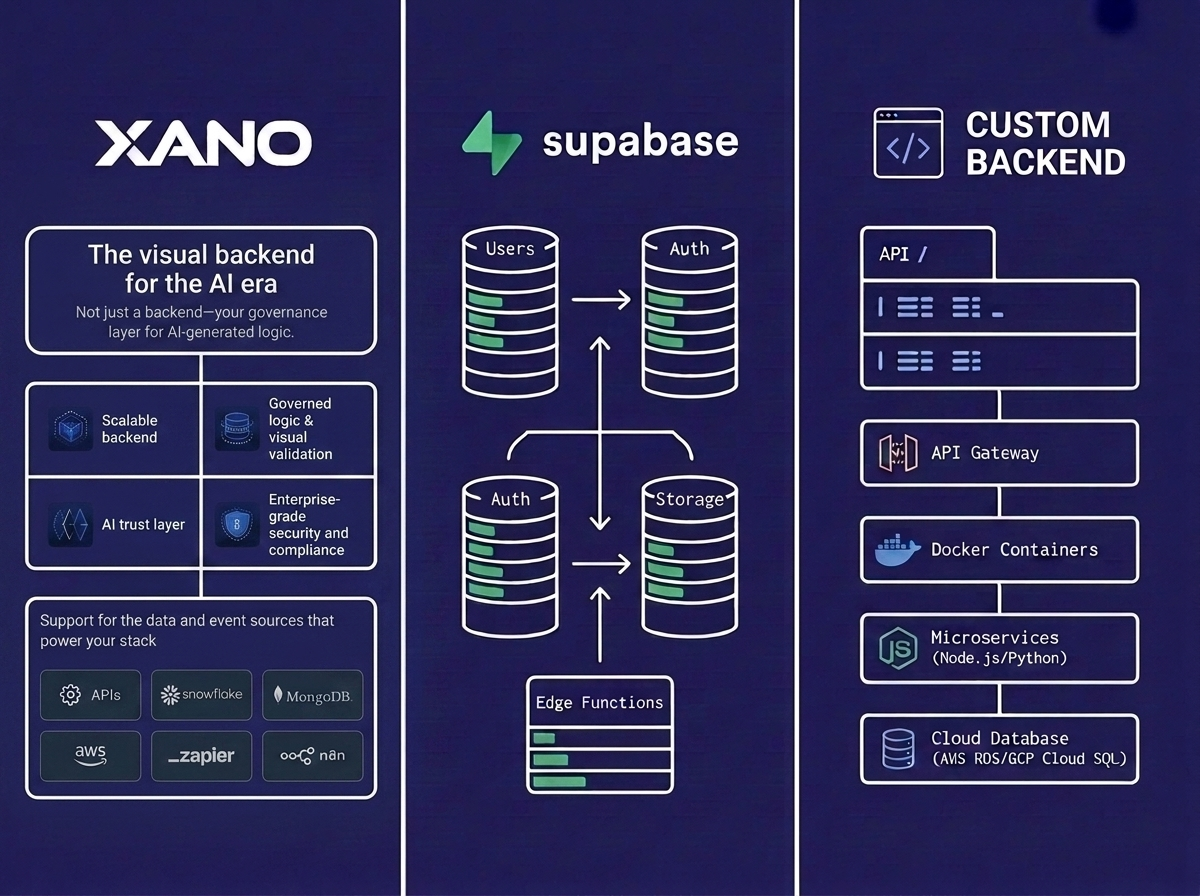
Xano is no-code with a visual builder and is excellent for teams that don't want to write SQL or backend code. Supabase is Postgres-native and ideal for SQL-fluent teams that want open-source flexibility. Firebase is best for real-time mobile apps tightly integrated with Google Cloud. All three are mature; pick based on team skills and use case.
Is Xano secure for sensitive data?
Yes. Xano runs on dedicated infrastructure from its Essential plan up, with a choice of 15 server regions including the EU, the UK, and India for data residency, and GDPR, ISO, and SOC 2 and 3 compliance on the Essential and Pro plans. A HIPAA add on is available on Pro, dedicated plans run single tenant, and custom plans add bring your own cloud deployment. It supports encryption in transit and at rest, role based access control, audit logging, and other enterprise security controls. It is used in production by regulated organizations in healthcare and finance.
How much does Xano cost?
Xano prices in fixed, published steps rather than a usage meter. Xano has a Free plan at $0, an Essential plan at $85 per month, and a Pro plan at $224 per month, with the paid plans billed annually. A Custom plan is available for larger scale through Xano sales. Compared with the cost of building, hosting, and operating a custom backend, Xano typically wins on total cost of ownership.
Can I migrate from Xano to a custom backend later?
Yes, with careful planning. Build with portability in mind — clean APIs, well-documented data models, avoid heavy platform-specific patterns. Many teams successfully migrate critical paths to custom backend once they're proven, while keeping the rest on Xano.
Conclusion
Xano has matured into one of the strongest no-code backend platforms available — fast enough for MVPs, scalable enough for production, secure enough for regulated industries, and flexible enough for serious engineering teams. For most modern product teams, the right starting point is Xano; custom backend is a deliberate choice for the parts of the application that genuinely require it. To explore how Unico Connect builds production backends on Xano, see our Xano development as an Enterprise Partner and Xano developer services.