









What Does It Cost to Maintain an AI Product After Launch?

Vasim Gujrati
Solutions Architect, AI & Platforms, Unico Connect
In this article
- Quick Answer
- Key Takeaways
- Why AI Maintenance Costs Are Different From Traditional Software
- What Actually Contributes to AI Product Maintenance Cost?
- AI Product Maintenance Cost Ranges by Product Type
- Infrastructure and Inference Costs Drive Long-Term AI Spend
- Monitoring, AI Evals, and Reliability Management
- How Better Engineering Decisions Reduce AI Maintenance Cost
- Frequently Asked Questions
AI product maintenance costs usually run from about $500 to $20,000+ a month, and they go far beyond traditional cloud hosting. The spend covers continuous monitoring, running inference, governance, scaling the system and human oversight. Exact costs depend heavily on how complex the AI is, how much inference it runs, which third party integrations it touches and how mature the operations behind it are. Plan post-launch operations as an optimization cycle that keeps running for as long as the product is live.
Quick Answer
Maintaining an AI product after launch typically costs from about $500 a month for a simple internal chatbot up to $20,000+ a month for a complex multi-agent enterprise system. Hosting is not what drives that spend. It comes from inference and token usage, monitoring and evals, governance, scaling and human-in-the-loop oversight, and managing it is a continuous optimization cycle that lasts for the life of the product.
Key Takeaways
- Put AI maintenance in the budget as a recurring monthly cost that you keep revisiting and tuning after launch.
- Because models are probabilistic, you pay continuously for monitoring, evals and oversight beyond what deterministic software needs.
- Model your costs under a traffic spike before you commit to a number. In a spike, server cost grows linearly, but unoptimized token usage can grow much faster than traffic when retries, agent loops or growing context multiply the tokens behind each request. That inference volatility causes the biggest budget surprises.
- Human-in-the-loop workflows (approvals, exception handling, compliance) often cost more than the software itself, so a budget that counts only infrastructure is likely to come in low.
- Architect for observability from day one and add optimizations such as model routing and semantic caching. Those choices cut long-term cost materially, and bolting monitoring on after launch leaves you with more technical debt.
Why AI Maintenance Costs Are Different From Traditional Software
A traditional SaaS application runs deterministic logic, so if the code does not change, the output stays the same. AI software maintenance deals with probabilistic systems instead. Deployed models behave unpredictably over time in ways such as unprompted hallucinations, retrieval variability in RAG pipelines and prompt drift as the underlying APIs update.
So maintaining AI-powered applications is never static work. It needs continuous monitoring, rigorous operational oversight and repeated rounds of prompt optimization. Good AI product lifecycle management means evaluating the system constantly after launch so output quality does not degrade. Compare a deterministic billing service, which runs reliably with standard uptime checks, with a production AI workflow that handles document extraction. The extraction workflow needs active, continuous evaluation against baseline truth sets to confirm that data drift has not skewed its core extraction logic.
The problem predates generative AI. Google research on hidden technical debt in machine learning systems showed that the model code is only a small fraction of a real-world ML system. The surrounding infrastructure is vast and complex, and the paper found that such systems commonly incur massive ongoing maintenance costs.
What Actually Contributes to AI Product Maintenance Cost?
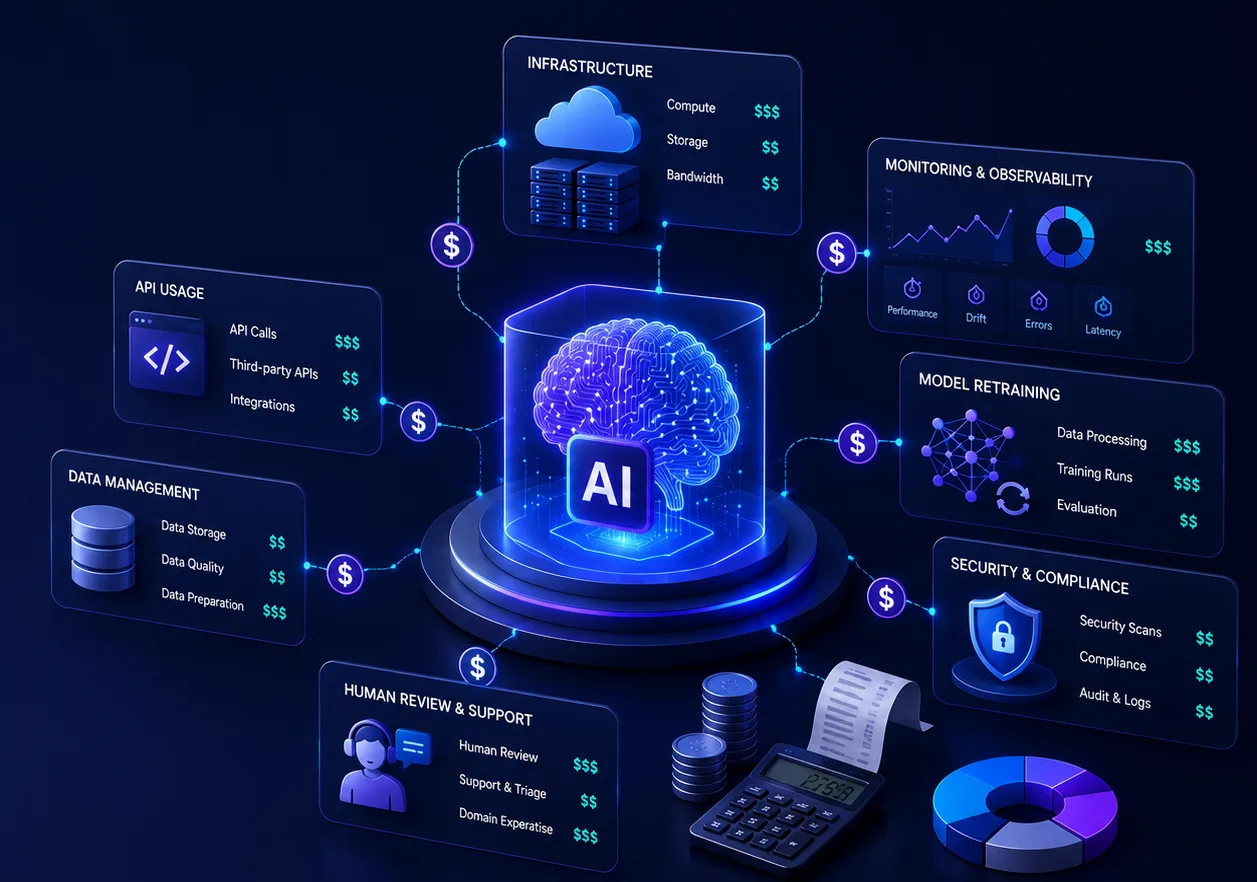
The cost to maintain AI applications splits into several operational categories, and each of them varies widely. The baseline is infrastructure hosting plus API and inference usage, which scale directly with token limits and computational load. On top of hosting, budget for monitoring and observability tools, security and compliance audits, prompt optimization cycles and strict governance management.
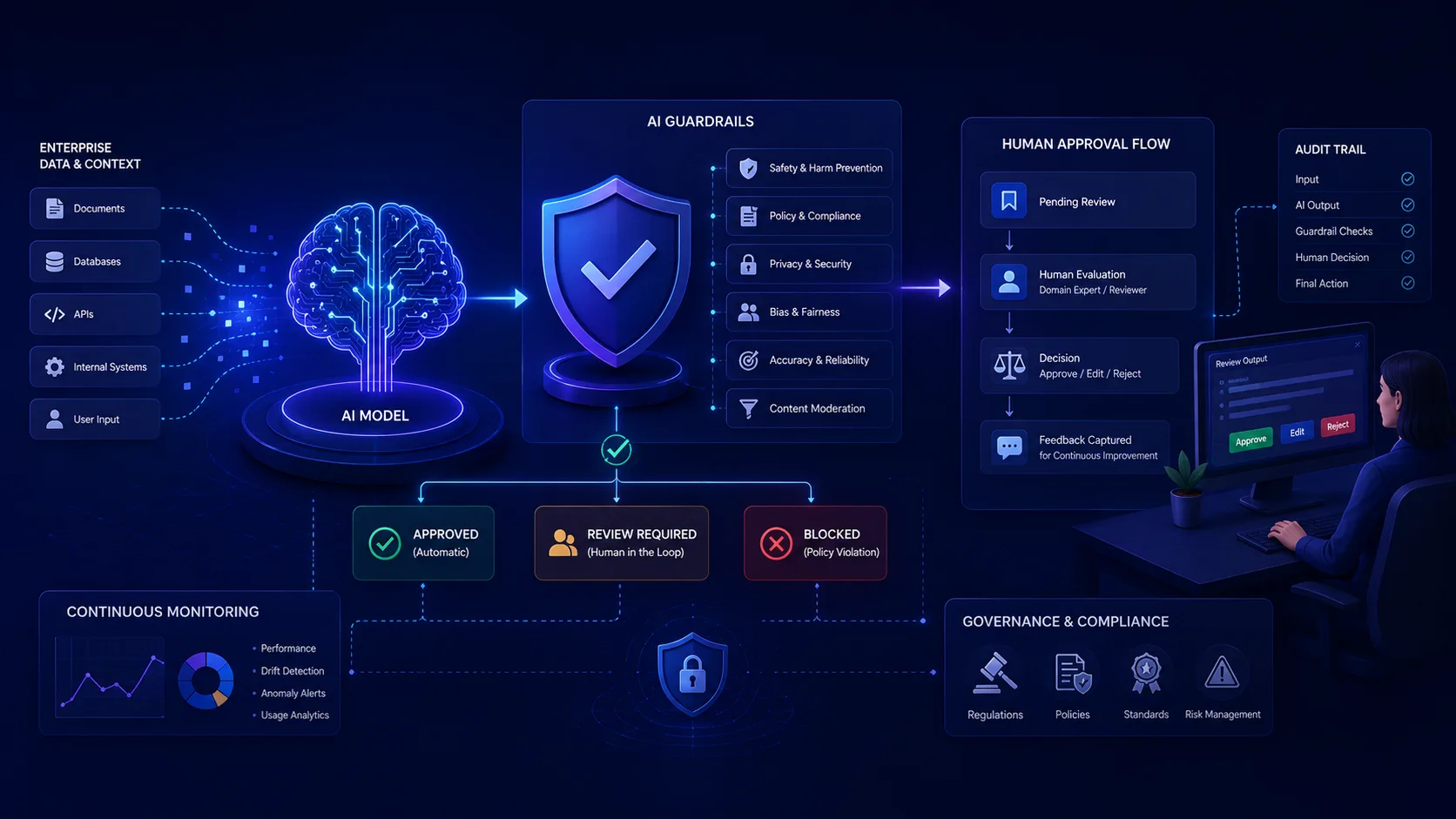
Post-launch AI maintenance costs compound quickly once a system adds multi-agent orchestration or starts processing multimodal AI inputs. AI operational expenses also have to cover human-in-the-loop workflows such as manual approvals, exception handling and compliance reviews, and the staff those workflows need often cost more than the software. As enterprise systems scale, governance turns into a primary cost driver, because it is needed to prevent data leakage and keep the model safe.
In our experience at Unico Connect, the biggest budgeting surprises come from inference volatility and operational unpredictability. When a client application gets a sudden traffic spike, standard server costs scale linearly, but unoptimized LLM token usage can grow much faster than traffic when retries, agent loops or growing context multiply the tokens behind each request. Treat the operational overhead of AI product support and maintenance as an equal mix of technical infrastructure and human administrative processes.
AI Product Maintenance Cost Ranges by Product Type
To estimate AI system maintenance cost, start from the architecture of the specific product. Operational costs swing widely with traffic volume, backend integrations, compliance requirements, latency expectations and workflow complexity.
| Product type | Relative monthly cost | Primary cost drivers |
|---|---|---|
| Internal chatbot / wiki assistant | Lowest (from ~$500) | Inference volume, light monitoring |
| Customer-facing RAG application | Moderate | Retrieval infrastructure, evals, higher traffic |
| Regulated-industry RAG (e.g. healthcare) | High | Compliance and governance overhead |
| Multi-agent / multimodal enterprise system | Highest (to $20,000+) | Orchestration, GPU, human-in-the-loop |
AI application maintenance services differ sharply even between products that look alike. Two RAG applications might look identical, yet the one running in a regulated healthcare environment carries heavy compliance and governance overhead, which pushes its AI infrastructure cost far above the cost of an internal company wiki assistant. Enterprise AI systems also need dedicated operational workflows, and those raise the pricing baseline.
Infrastructure and Inference Costs Drive Long-Term AI Spend
The core of long-term AI spend is token-based pricing together with persistent inference costs, and both scale in a fundamentally different way from traditional computing. AI infrastructure cost covers the LLM execution plus the supporting architecture around it, such as persistent vector databases, retrieval infrastructure, heavy logging pipelines and orchestration layers.
Engineering teams keep weighing managed API-based model usage, which brings variable token costs, against self-hosted open-source models, which bring fixed and expensive cloud GPU costs. The optimization decisions they make here show up directly in the monthly bill. Intelligent model routing (sending simple queries to smaller, cheaper models), semantic caching, aggressive prompt optimization and careful latency-cost tradeoffs can cut LLM operational cost significantly. Keeping peak performance and operational efficiency in balance is ongoing engineering work, the same discipline we describe in AI development workflows.
Monitoring, AI Evals, and Reliability Management
Probabilistic models generate dynamic responses, so a deployed system needs continuous, careful monitoring that goes well beyond standard uptime pings. For AI software maintenance that means tracking hallucinations, evaluating retrieval quality, catching prompt drift and checking that responses stay consistent.
Automated AI evals are an operational necessity, not an optional optimization layer. A reliable AI monitoring and observability stack includes continuous production testing, reliability scoring and mandatory human review checkpoints for low-confidence outputs. In our internal QA workflows, for example, we routinely send random samples of generated responses through a secondary "evaluator" LLM that scores factual alignment against the source documents. Proactive monitoring catches logic degradation early, which greatly reduces long-term operational instability and keeps AI model monitoring costs from running away before a problem reaches end users.
How Better Engineering Decisions Reduce AI Maintenance Cost
High AI maintenance costs often trace back to poor initial architecture, and deliberate engineering decisions improve maintainability directly. A modular system with an observability-first architecture lets the team isolate a failing component quickly. Aggressive semantic caching, dynamic model routing and strict workflow isolation cut unnecessary compute cycles.
These practices reduce operational inefficiency, prevent infrastructure waste and make monitoring less complex. Teams that try to bolt monitoring onto an application after launch take on substantially more technical debt than teams that architected for observability from day one. Sustainable post-launch AI maintenance depends on planning operations ahead of time instead of managing costs reactively, a discipline closely related to keeping AI code maintainable at scale.
Run your AI maintenance budget through this checklist.
- Infrastructure forecasting. Estimate token volume and vector storage scaling assumptions over a 12-month period.
- Monitoring stack planning. Budget for specialized LLM observability and evaluation platforms.
- Human review workflows. Allocate dedicated personnel for exception handling, compliance and QA.
- Compliance planning. Make sure ongoing data privacy audits and security updates are factored into sprint cycles.
- Scaling assumptions. Map out exactly how API rate limits and inference costs behave during unexpected traffic spikes.
Frequently Asked Questions
How much does AI product maintenance cost per month?
AI product maintenance costs typically range from $500 for simple internal chatbots to over $20,000 for complex, multi-agent enterprise systems. Where a product falls in that range depends on its infrastructure choices, inference volume, workflow complexity and specialized monitoring requirements.
Why are AI operational expenses higher than traditional software maintenance?
AI operational expenses run higher because AI systems generate probabilistic outputs, while traditional software is deterministic. That means AI software maintenance has to include continuous monitoring, automated model evaluation, hallucination detection and ongoing operational oversight to keep responses from drifting.
What increases the cost to maintain AI applications at scale?
The cost to maintain AI applications rises steeply when you add complex multi-agent workflows, take on higher traffic volumes, face stricter governance or expand infrastructure to process heavy multimodal inputs.
Does AI monitoring and observability reduce long-term operational risk?
Yes, reliable AI monitoring and observability lower operational risk over the long term because they surface issues early, support accurate reliability management and give the team clear operational visibility. They keep workflows stable by catching prompt drift and logic degradation before either one affects end users.
What is included in AI application maintenance services?
AI application maintenance services cover continuous model monitoring, infrastructure management, prompt optimization, data governance enforcement and the staff for human-in-the-loop support workflows. Our AI development team runs all of it end to end.