








AI Development Cost in 2026, a Pricing Guide

Malay Parekh
CEO & Director, Unico Connect
In this article
Last verified on 26 September 2026. Market figures carry their sources, and the estimate ranges are our own published numbers.
AI development in 2026 costs anywhere from about $5,000 for a rule based chatbot to over $2 million for an enterprise multi agent platform, though most businesses end up in a much narrower band. At our published AI and ML engineering rate of $30 to $60 per hour, a production AI system we build typically lands between $50,000 and $150,000, with an AI pilot starting at $15,000. US agencies bill roughly 3 to 5 times that hourly rate. Below are our ranges and the published market ranges, along with the running costs most budgets forget, a three year total cost of ownership view and a calculator for estimating your own project.
Quick Answer
A production AI system typically costs $50,000 to $150,000 at globally priced agency rates in 2026, with AI pilots and MVPs from $15,000 to $50,000 and enterprise multi agent platforms at $150,000 and up. Published 2026 market guides put the same work at $40,000 to $400,000 or more, and US specialists bill $150 to $300 per hour against $30 to $60 at strong agencies in India. Beyond the build, plan for running costs of 15 to 25% of the build per year, covering LLM usage, hosting, and monitoring.
Key Takeaways
- Prove the use case with an AI pilot or MVP before you commit to a bigger build. Our published estimate ranges put a pilot or MVP at $15,000 to $50,000, a production AI system at $50,000 to $150,000 and an enterprise multi agent build at $150,000 and up.
- Published 2026 market guides put most production builds at $40,000 to $400,000, and US specialists bill $150 to $300 per hour. Compare scoped quotes across rate markets before you sign.
- Data work, integrations and evaluation infrastructure consume most of the budget, and the model itself is rarely the cost driver. Focus your scoping effort on those three.
- Running costs (LLM tokens, vector databases, hosting, monitoring) add 15 to 25% of the build cost per year, and sometimes more for token heavy agents, so budget for them before launch.
- Plan a three year budget of 1.5 to 2 times the initial build, which is where total cost of ownership typically lands.
AI Development Cost by Project Type (2026)
| Project type | Typical market cost (2026 guides) | What it includes |
|---|---|---|
| Rule based chatbot (FAQ, forms) | $5,000 to $30,000 | Scripted flows, no LLM |
| AI / LLM chatbot | $30,000 to $80,000 | NLP, basic integrations |
| RAG knowledge assistant | $80,000 to $180,000 | Retrieval over your own data |
| Autonomous AI agent | $50,000 to $150,000 | Multi step, tool use |
| Multi agent system | $150,000 to $400,000+ | Orchestration, high autonomy |
| MVP / proof of concept | $25,000 to $60,000 | One focused use case |
| Enterprise platform (compliance) | $200,000 to $1M+ | Security, scale, governance |
Figures aggregated from 2026 AI development pricing data published by Appinventiv, Uvik and DecipherZone.
What Unico Connect Charges for AI Development
Most agencies hide pricing behind a contact form. Unico Connect publishes its AI development ranges instead, and they use our AI and ML engineering rate of $30 to $60 per hour with a $10,000 minimum engagement.
| Tier | Unico Connect estimate range | Timeline | Scope |
|---|---|---|---|
| AI pilot / MVP | $15,000 to $50,000 | 4 to 10 weeks | Single workflow, RAG or chatbot, 1 to 2 integrations, basic evals |
| Production AI system | $50,000 to $150,000 | 2 to 6 months | A full AI product with a tool using agent, memory, 3 to 5 integrations, guardrails, eval harness |
| Enterprise multi agent | From $150,000 | 6 to 12 months | Orchestration, SSO, compliance, audit logging, fine tuning |
These are estimate ranges, not fixed bids. Every project is scoped individually, and integrations or compliance work moves a project within or beyond its band. US agencies typically bill 3 to 5 times our hourly rate for the same scope. That gap comes from the rate market and not from the quality of the work, which ships from a team that has delivered 250+ products.
COST ESTIMATOR
AI Development Cost Calculator
Pick what matches your project and get a realistic estimate range. These are our published estimate ranges, not quotes: final pricing is scoped per project.
Published Unico Connect estimate ranges (verified June 2026) at a blended rate of $30 to $60 per hour. Integrations add roughly 15 to 30%, and compliance work adds about 20%, consistent with industry cost drivers. Every project is scoped individually before any number becomes a quote.
What Drives AI Development Cost?
Most of the budget goes to the work around the model. Two projects that both say "chatbot" can differ by 10 times in cost because of the five factors below.
- Data work. Data engineering and building the retrieval pipeline consume an estimated 30 to 50% of project time on RAG builds. (industry pricing data, 2026)
- Integrations. Each CRM, database, or internal system the AI must read from or act on adds scope. Enterprise integration work can account for 35 to 55% of cost. (DecipherZone, 2026)
- Security and compliance. Regulated industries add roughly 25 to 35% for access controls, audit trails, and data handling. (industry pricing data, 2026)
- Evaluation infrastructure. AI outputs are non deterministic, so production systems need automated evals and monitoring. Evaluation is a recurring line item, and it is one of the most commonly underbudgeted costs in AI agent builds. (DecipherZone, 2026)
- Autonomy level. A system that answers questions costs less than one that takes actions. Scope and autonomy decisions drive 60 to 70% of the total. (DecipherZone, 2026)
Ongoing and Running Costs
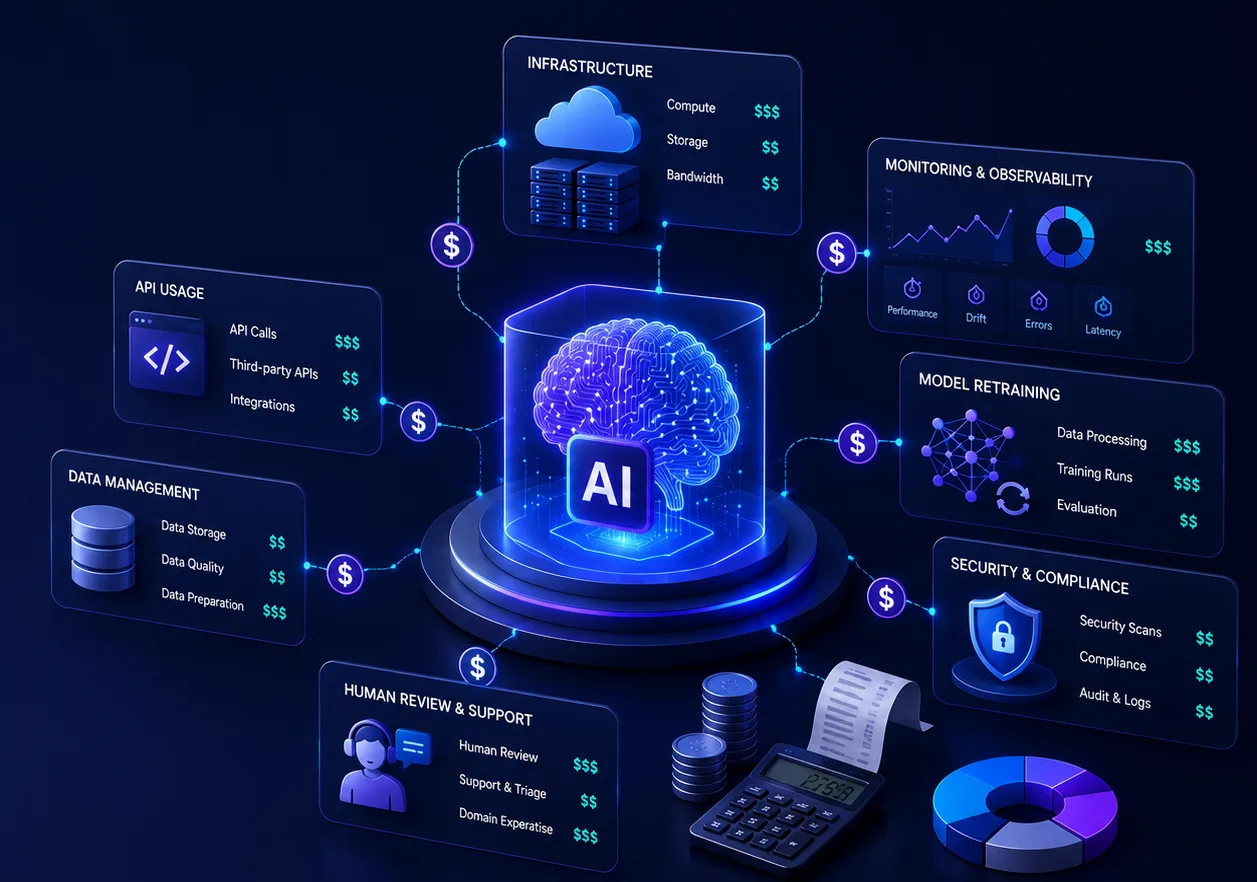
Spending carries on after launch, and a budget that ignores the monthly lines below fails in month three.
| Cost line | Typical monthly range |
|---|---|
| LLM API usage (tokens) | $100 to $5,000+ at SMB scale; $5,000 to $25,000 for heavy enterprise agents |
| Hosting and infrastructure | $200 to $3,000 |
| Vector database | $50 to $1,000 |
| Monitoring and evals | $100 to $1,500 |
| All lines above, maintenance included | 15 to 25% of build cost per year |
For token heavy agent systems, year one running costs can reach 40 to 80% of the build cost, so cost controls and caching belong in the architecture from day one. (DecipherZone)
Total Cost of Ownership Over Three Years
A realistic three year view of a $100,000 production AI system adds up like this.
- The build itself costs $100,000
- Running costs at 20% per year add $60,000
- Two substantive feature iterations add $30,000 to $50,000
- The total comes to roughly $190,000 to $210,000, or about 2 times the build
Across project sizes, total cost of ownership lands between 1.5 and 2 times the initial build. Almost all of the variance comes from token usage and from how often the product evolves.
How to Control AI Development Costs
- Start with a pilot. A $15,000 to $50,000 pilot that proves value beats a $200,000 system built on assumptions. About 88% of AI proof of concepts never reach production (IDC / Lenovo, 2025), which IDC ties to low readiness in data, processes and IT infrastructure, and a pilot is the cheapest way to find those gaps.
- Build on foundation models. Prompting and retrieval over GPT, Claude or Gemini covers most business cases, and fine tuning or training a custom model is rarely justified.
- Fix the data before the build starts, because most overruns are data problems discovered late.
- Insist on an eval harness in the original scope. Building one in from the start costs less than retrofitting it after the first quality incident.
- Choose your rate market deliberately. The gap between a $30 to $60 per hour team in India and $150 to $300 in the US is the biggest single lever on the total, as long as you can verify delivery quality through shipped products, reviews and platform partnerships. For a shortlist, start with our comparison of AI development companies.
Methodology
Market ranges are aggregated from published 2026 pricing guides and surveys, linked at each table. Our estimate ranges are our own bands, priced at our published AI and ML engineering rate of $30 to $60 per hour and reviewed quarterly. Last verified on 26 September 2026.
Frequently Asked Questions
How much does AI development cost in 2026?
At globally priced agency rates, AI pilots run $15,000 to $50,000, production AI systems $50,000 to $150,000, and enterprise multi agent platforms $150,000 and up. Published 2026 market guides put the same work at roughly $40,000 to $400,000, with the full range running from $5,000 for a rule based chatbot to over $2 million for enterprise platforms.
What is the hourly rate for AI development in 2026?
US based AI specialists bill roughly $150 to $300 per hour. Strong agencies in India bill $30 to $60 per hour for the same stack, a gap of roughly 3 to 5 times in the hourly rate. Eastern European rates fall in between, at roughly $50 to $120 per hour.
How much does an AI chatbot cost?
A rule based chatbot with scripted flows costs $5,000 to $30,000. An LLM chatbot with natural language and basic integrations runs $30,000 to $80,000 in 2026 market guides, and a RAG assistant that answers from your own documents runs $80,000 to $180,000. At our published ranges, most chatbot and RAG builds land in the $15,000 to $50,000 pilot band or the $50,000 to $150,000 production band.
What are the ongoing costs of an AI system?
Plan for 15 to 25% of the build cost per year, covering LLM API usage, hosting, vector databases, monitoring, and maintenance. Token heavy agent systems can reach 40 to 80% of the build cost in the first year, which is why usage caps and caching belong in the architecture.
How much does it cost to build an AI agent?
Published 2026 market guides put a focused autonomous agent at $50,000 to $150,000 and a multi agent system at $150,000 to $400,000 and beyond. Our own published estimate ranges put a production single agent at $25,000 to $75,000, a business process or multi step agent at $75,000 to $150,000 and enterprise orchestration, including true multi agent systems, at $150,000 and up. A production single agent is one agent in production, while a production AI system at $50,000 to $150,000 is a full AI product. Paid discovery, at $5,000 to $8,000 over 3 weeks, is the one exception to our $10,000 fixed scope minimum. The full breakdown is in our AI agent development cost guide.
How can I reduce AI development costs?
Start with a scoped pilot, use foundation models instead of custom training, fix data quality before the build, insist on evaluation infrastructure in the original scope, and choose your rate market deliberately. The biggest saving is avoiding the wrong build, since most failed AI spend traces back to use cases that a cheap pilot would have filtered out.
Why are your published ranges lower than US agency quotes?
Our hourly rates are lower, and the scope stays the same. US specialists quote the same production AI system at $150 to $300 per hour, while our team in India bills $30 to $60 per hour for AI and ML engineering, with the work shipping from the team behind 250+ delivered products. Ask for a scoped quote through the AI development service page and compare it yourself.
Conclusion
AI development cost in 2026 comes down to scope, autonomy, data readiness and the rate market you buy from. Anchor on the published ranges above and budget running costs of 15 to 25% per year. Before you scale the spend, run a pilot that proves the use case. For a scoped estimate against your actual requirements, use the calculator above or talk to our AI team.