









Trust in AI Output Drops 27.5%, The Case for Continuous AI Evaluations

Malay Parekh
CEO & Director, Unico Connect
In this article
Originally published in DesignRush News, April 2026, authored by Malay Parekh, CEO of Unico Connect. This is the canonical version on our own site.
Quick Answer
Between 2023 and 2025, developer trust in AI-generated output fell from roughly 40% to 29% — a 27.5% relative drop. Adoption keeps rising; confidence in what AI produces does not. The gap is not a prompting problem. It is an evaluation problem. Production AI teams close it by treating evals the way they treat tests — continuous, automated, embedded in the workflow.
The Trust Gap is Real
Stack Overflow's 2025 Developer Survey put hard numbers on what most engineering leaders already feel.
- Only 29% of developers trust AI output, down from ~40% in 2023.
- 66% of developers regularly deal with AI solutions that are "almost right, but not quite."
- 45% report that debugging AI-generated code takes longer than debugging their own.
- Workday research found that 37% of the time saved by AI tools is spent correcting low-quality outputs.
Put together: adoption is mandatory, output is improving, but the gap between plausible and correct has widened faster than tooling can keep up.
Why Prompt Engineering Isn't the Fix
The first wave of AI productivity advice told teams to write better prompts. That guidance was right for a Q3 2023 toolchain. Today, the bottleneck has moved.
A typical production AI feature in 2026 has:
- Multiple model calls in sequence (planner → retriever → executor → validator)
- Tool use across 3–5 external systems
- RAG over private data that changes weekly
- Fallback logic for partial answers or refusals
You cannot eyeball quality across that surface area. You need an evaluation layer.
What "Continuous Evaluation" Actually Means
A working evaluation layer has four ingredients. Most teams have one or two. Few have all four.
1. An Evaluation Dataset, Versioned Like Code
Treat evals like test fixtures. Hand-curate a representative set of inputs that mirror real production traffic. Tag each input with the expected behaviour (not the expected exact answer — behaviour). Version the set in git. Grow it from real production failures.
2. Multiple Scoring Methods
A single LLM-as-judge score is not enough. Combine:
- Deterministic checks (regex, JSON schema validity, latency thresholds, cost ceilings)
- Reference-based scoring when there is a known right answer (exact match, semantic similarity)
- LLM-as-judge with rubrics for open-ended quality dimensions (helpfulness, faithfulness to source)
- Human review on a sampled subset, especially for high-risk flows
3. Production-Linked Sampling
Run evals on every change to prompts, models, retrieval, or tools — but also sample live production traffic. New failure modes appear in the wild that the curated set never anticipated. Feed those back into the dataset.
4. A Dashboard the Team Actually Looks At
If the eval results live in a Notion doc that gets read once a month, the team will continue to ship by feel. Surface the score deltas in CI, on Slack on regression, and as a release gate. The same way you would treat a unit test failure.
What This Looks Like in Production
At Unico Connect, evals are wired into the build pipeline for every AI feature we ship. A few patterns that work:
- Eval-driven prompt iteration. When tuning a prompt, run the full eval set before and after. Reject changes that move any metric by more than 5% in the wrong direction, even if the headline number looks good.
- Model-swap regressions. Whenever a customer asks "can we switch to a cheaper model?", we don't answer with intuition. We run the eval set on the candidate model and report the deltas. Half the time, the cheaper model is fine for the use case. The other half, the regression is brutal.
- Drift detection. RAG pipelines decay. Reindexing schedules, source-doc updates, and seasonal query patterns all shift quality. We monitor a small set of "canary" queries continuously, the same way you would monitor an uptime endpoint.
The Compliance Angle
In regulated workloads — healthcare, finance, anything customer-facing — eval traceability is not optional. Audit and change-management requirements assume that you can demonstrate, after the fact, why a system made the decision it made. AI features without evals fail that test the first time they get audited.
Treat the eval log as part of the audit trail. Retain inputs, outputs, scores, and the model + prompt versions used.
Where to Start if You Have Nothing
Most teams reading this have zero formal evaluation infrastructure. Here is a 2-week starting plan:
- Week 1 — pick one AI feature. Collect 50 real inputs from production logs. Hand-label expected behaviour. Set up the cheapest possible scoring (LangSmith, LangFuse, or even a plain script).
- Week 2 — run the eval on every prompt or model change for that one feature. Add the result as a GitHub status check on the PR.
That is the minimum viable eval layer. Everything else — dashboards, drift detection, human review pipelines — is iteration from there.
The Bigger Point
The trust gap will not close because AI gets better. AI is already better than it was when trust was 40%. The gap closes when teams can demonstrate quality — to themselves, to their customers, and to their compliance officers. Continuous evaluation is that demonstration.
Frequently Asked Questions
How is AI evaluation different from traditional software testing?
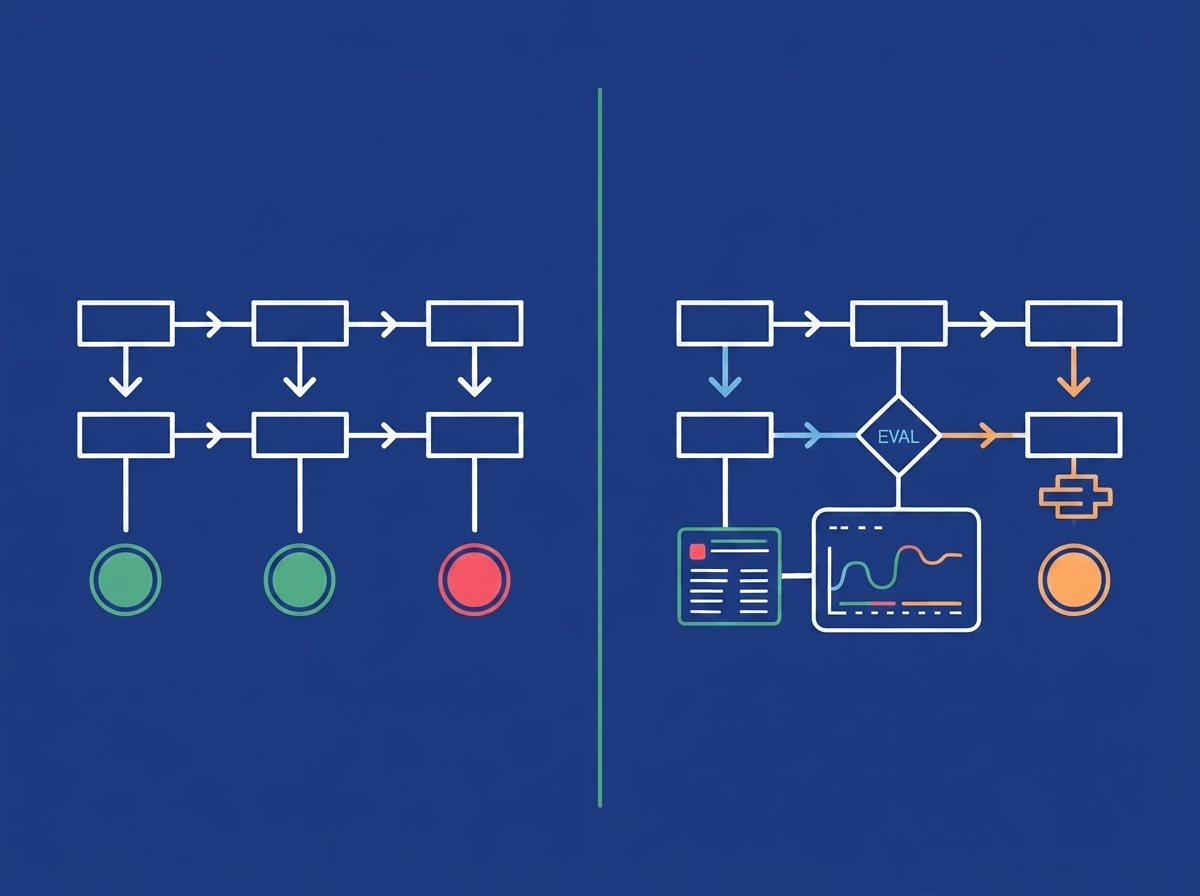
Traditional tests verify deterministic behaviour against fixed expected outputs. AI evaluation scores probabilistic outputs against rubrics. The same input can produce different outputs and both can be acceptable. Evaluation frameworks handle that variance through statistical sampling and multi-dimensional rubrics rather than pass/fail assertions.
Which evaluation tools do you use at Unico Connect?
We use LangSmith and LangFuse for trace-level eval and observability, plus custom scoring scripts for domain-specific rubrics. For RAG pipelines we also run reference-based grading with Ragas. The tool matters less than the discipline — a plain CSV of inputs and a script that runs the model and grades the output is enough to start.
How often should evaluations run?
On every change to the prompt, model, retrieval pipeline, or tool integrations. Plus continuous sampling on live traffic (every few hours for canary queries, daily for the full set). Treat evals like CI — automatic and fast enough that they do not block the team.
What does it cost to build an evaluation layer?
A first eval layer can be built in 1–2 engineer weeks. Tooling is largely open source or under $200/month for a small team. The ongoing cost is data labelling — every new failure mode in production should be added to the eval set, which takes 1–2 hours of review per week. Our AI development team builds these evaluation layers.