








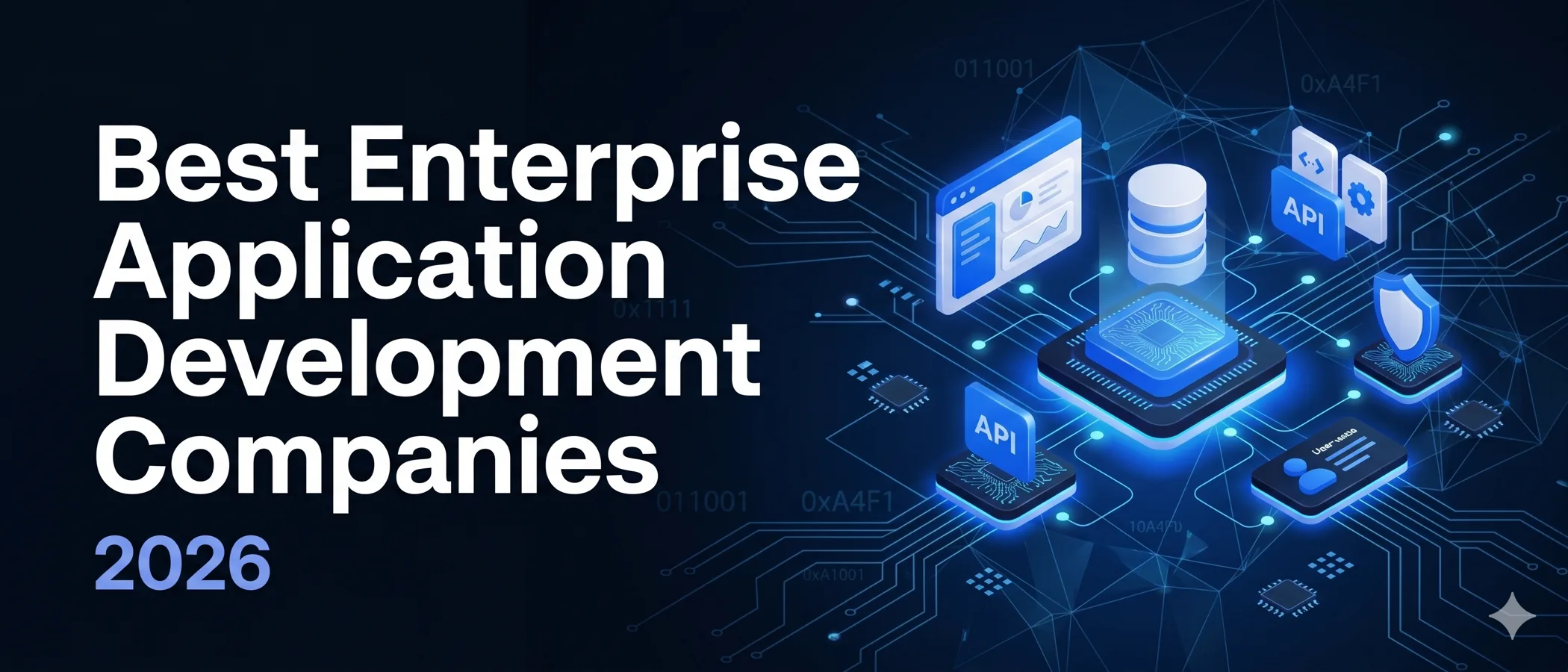
Best Enterprise Application Development Companies in 2026

Malay Parekh
CEO & Director, Unico Connect
In this article
- Quick Answer
- Key Takeaways
- Why the Right Enterprise Application Development Company Matters
- What to Look For in an Enterprise Application Development Company
- Best Enterprise Application Development Companies in 2026 at a Glance
- Common Pitfalls in Choosing an Enterprise Development Partner
- How Unico Connect Approaches Enterprise Application Development
- Frequently Asked Questions
- How We Chose These Companies
- Conclusion
Enterprise application development is the work of building the software a large organization runs on, meaning multi-role platforms, internal systems, integrations across existing tools, and increasingly AI-powered workflows. Budgets for that work keep growing, and worldwide IT spending is forecast to reach $6.37 trillion in 2026, up 14.2%, with software among the fastest-growing categories (Gartner, July 2026). Picking the right development partner decides whether that investment becomes a system that scales and passes security review, or a rebuild eighteen months later. Below we compare the leading enterprise application development companies in 2026 by focus and fit, then set out how to choose between them.
Quick Answer
The best enterprise application development companies in 2026 combine deep engineering with the discipline that production demands, which comes down to a sound architecture, real security and compliance, clean integrations with systems like ERPs and CRMs, and a plan to scale. Strong choices in 2026 include ScienceSoft, EPAM, Intellectsoft, Simform, Unico Connect, Softeq, Cubix, Appinventiv, Itransition, and Tata Consultancy Services. We group them by what each company is best suited for and do not rank them. The right fit depends on your industry, the scale you need, whether the job is modernizing a legacy system or building new, and how much weight you put on AI-native delivery and transparent pricing.
Key Takeaways
- Worldwide IT spending is on track for $6.37 trillion in 2026, up 14.2%, with software among the fastest-growing segments (Gartner, July 2026), so more money now rides on whether your partner delivers a system that scales or leaves you with a rebuild.
- Ask each partner how it plans for architecture, integration, security, and scale from day one, since enterprise software is judged on those four rather than on feature count.
- Put AI-native delivery on your 2026 checklist. Gartner forecasts that task-specific AI agents will sit inside 40% of enterprise applications by the end of 2026, against less than 5% in 2025 (Gartner). Ask every shortlisted firm for evidence of AI features it has built.
- Verify credibility through independent signals, such as security certifications like ISO 27001, case studies you can check, and Clutch or GoodFirms reviews with real volume, and give a logo wall little weight.
- Shortlist by the kind of system you are building. Very large transaction systems call for a global integrator, and modernization work for a specialist. Where intelligent features are core to the software, an AI-native firm fits.
Why the Right Enterprise Application Development Company Matters
An enterprise application serves many concurrent users, connects to the systems a business already runs, enforces role-based access and audit trails, and has to stay maintainable for years, which puts it in a different class from a single-team app. Get the architecture or the data model wrong early and the cost compounds into slow queries, brittle integrations, failed security reviews, and eventually an expensive rebuild.
AI is what changed in 2026. Gartner puts task-specific AI agents inside 40% of enterprise applications by the end of 2026, a jump from less than 5% the year before (Gartner). Gartner also warns that $234 billion of enterprise application software spend is at risk of what it calls agentic arbitrage between now and 2030, as agentic AI reshapes how enterprises buy and build (Gartner, July 2026). That raises the bar twice over. The software still needs production-grade engineering, and the team now also needs practical AI experience to build agents and AI features responsibly, so shortlist the companies that do both well.
The fastest way to judge an enterprise development partner is to look past the pitch at the proof: a real security posture you can verify, case studies in your kind of system, and an honest answer about how it handles scale and integration. In 2026, add one more question. Ask how they use AI in delivery, because that increasingly decides both speed and cost.
Malay Parekh, CEO, Unico Connect
What to Look For in an Enterprise Application Development Company
- Architecture and scale planning. Data modeling, API design, and a clear path to production load. Our comparison of monolith vs microservices shows how one architecture decision plays out.
- Security and compliance built in. Role-based access, encryption, audit trails, and certifications such as ISO 27001, designed in from the start instead of bolted on at the end.
- Real integration experience. Clean connections to ERPs, CRMs, payment systems, and data platforms through a proper middleware layer.
- AI-native delivery. Whether the team uses AI to build faster at the same quality bar, and whether it can build AI features and agents into the product. We explain why this matters in 2026 on our AI-native development page.
- Transparent commercials and proof. Published or clearly explained pricing, real case studies, and independent reviews on Clutch or GoodFirms.
Best Enterprise Application Development Companies in 2026 at a Glance
Each company here leads on a different scale or scenario, which the "best suited for" column spells out. We are one of the ten, sitting mid table instead of first, and the order is not a ranking, so read our row with that bias in mind. Put at least three on your shortlist and check their security certifications and reviews in independent directories yourself.
Best enterprise application development companies in 2026
| Company | Headquarters | Enterprise focus | Best suited for |
|---|---|---|---|
| ScienceSoft | USA | Enterprise software and IT consulting, many industries | Large-scale enterprise software with deep domain expertise |
| EPAM Systems | USA | Global product engineering and digital platforms | Global enterprises needing scaled, multi-region engineering |
| Intellectsoft | USA | Enterprise digital transformation | Transformation programs in finance, logistics, construction |
| Simform | USA | Cloud-native apps and application modernization | Modernizing legacy systems onto cloud-native architecture |
| Unico Connect | Mumbai, India (Presence in USA) | AI-native enterprise platforms, integrations, modernization | AI-native enterprise apps built to scale, with published pricing |
| Softeq | Houston, USA | Full-stack software plus embedded and hardware | Enterprise products that span hardware and software |
| Cubix | USA | Enterprise apps with AI, blockchain, and IoT | Emerging-technology enterprise applications |
| Appinventiv | Noida, India | Enterprise mobile and application development | Enterprise mobile platforms at scale |
| Itransition | Decatur, USA (global delivery) | ERP and CRM consulting make up 35 percent of its service mix, rated 4.9 from 42 on Clutch | Enterprises whose application estate is really an ERP and CRM problem |
| Tata Consultancy Services | Mumbai, India | Global IT services at very large scale | Very large, transaction-intensive global systems |
Each profile covers what the company builds and the kind of buyer it fits best.
ScienceSoft, best for large-scale enterprise software with deep domain expertise
More than three decades of delivery across healthcare, finance, retail, and manufacturing sit behind ScienceSoft, a long-established software and IT consulting firm headquartered in the United States. That breadth of domain experience, paired with engineering depth, makes it a good match for large organizations that want a partner with a long track record in their specific industry.
EPAM Systems, best for global, multi-region engineering
EPAM Systems makes sense for global enterprises that need substantial, distributed engineering capacity and the process maturity that comes with it, particularly for large platform builds and digital modernization programs. The firm is a global product engineering and digital platform company, headquartered in the United States and operating at large scale across many countries.
Intellectsoft, best for enterprise digital transformation
Intellectsoft focuses on enterprise digital transformation from its United States headquarters, building custom software that simplifies operations in sectors such as finance, logistics, and construction. Consider it if you are an established organization modernizing the core processes you already run instead of starting from a blank page.
Simform, best for cloud-native modernization
Pick Simform if you are moving legacy software to the cloud and rebuilding it for scale and reliability. Based in the United States, it specializes in cloud-native application development and in modernizing existing systems onto current architectures.
Unico Connect, best for AI-native enterprise apps built to scale
Unico Connect is an AI-native software company that starts every enterprise build with the architecture and data model, builds security and compliance in, and integrates cleanly with the systems a business already runs. It is ISO/IEC 27001:2022 certified, an Enterprise-tier partner in the Xano global program for data-heavy backends, and publishes pricing rather than hiding it behind a sales call. AI generates roughly 80% of its production code and engineers review that output, which compresses delivery without lowering the quality bar. It suits startups and enterprises that want an application engineered to scale, pass security review, and ship with AI built in.
Softeq, best for enterprise products spanning hardware and software
Softeq, a full-stack development firm headquartered in Houston, takes on work from enterprise software through to embedded and hardware engineering. It is worth a call when an enterprise product crosses the line between software and devices, as connected and IoT systems do.
Cubix, best for emerging-technology enterprise apps
Cubix suits organizations whose enterprise product depends on AI, blockchain, or IoT as a core feature. It builds enterprise applications that lean on emerging technologies like these and is headquartered in the United States.
Appinventiv, best for enterprise mobile platforms
Appinventiv builds enterprise mobile and application platforms at scale from its headquarters in Noida, India, and has a presence in the United States and beyond. It is a good pick for enterprises whose primary surface is mobile and who need a partner experienced in shipping to large user bases.
Itransition, best when the estate is really an ERP and CRM problem
Of all the firms here, Itransition has the Clutch service mix that matches this category most directly. The company is headquartered in Decatur, Georgia, and was founded in 1998. ERP consulting and systems integration is its largest line at 20 percent, and CRM consulting and integration ties for second with custom software development at 15 percent each, which is what most enterprise application programs consist of once the slideware is removed. On Clutch it holds 4.9 from 42 reviews, with minimums from 25,000 dollars, hourly billing of 25 to 49 dollars and a team of 1,000 to 9,999. It fits a large organization modernizing a platform estate better than one commissioning a single new application.
Tata Consultancy Services, best for very large global systems
Tata Consultancy Services, headquartered in Mumbai, is one of the largest global IT services firms and has a long record of building and running high-volume, transaction-intensive systems across banking, telecom, and healthcare. Choose it when you are among the largest global enterprises and your scale and governance needs call for a major integrator.
Common Pitfalls in Choosing an Enterprise Development Partner
- Do not trust self-published rankings, since many firms rank themselves first on their own blogs. Look instead for verifiable signals such as certifications, independent reviews, and case studies in your domain.
- Security is easy to underweight, and for enterprise software a failed security or compliance review can stop a launch. Confirm the certifications and the review process up front.
- Check integration as closely as the interface. A polished application that cannot talk cleanly to the ERP, CRM, and data systems around it ends up adding manual work for your team.
- AI claims need testing. Ask specifically how the partner uses AI in delivery and how it builds AI features, then ask for evidence, because vague answers usually mean vague capability.
How Unico Connect Approaches Enterprise Application Development
Enterprise applications at Unico Connect are built by an AI-native team that models the data and the integrations first. Security and role-based access are designed in from the start (we are an ISO 27001 certified company), and AI runs across delivery so senior engineers spend their time on architecture, security, and review while AI handles the boilerplate. For data-heavy products we also build on Xano as an Enterprise-tier partner, which can cut backend cost and timeline. Our enterprise app development guide walks through the build-versus-buy decision, and the custom software development cost guide covers what drives cost.
Frequently Asked Questions
What is an enterprise application development company?
It is a firm that designs, builds, and maintains the software a large organization runs on, meaning multi-role platforms, internal business systems, integrations between existing tools, and AI-powered workflows. Unlike a firm that ships a simple app, an enterprise developer has to handle many concurrent users, connect to systems like ERPs and CRMs, enforce role-based access and audit trails, and keep the system maintainable for years.
How do I choose an enterprise application development company?
Start with verifiable credibility, meaning security certifications such as ISO 27001, independent Clutch or GoodFirms reviews with real volume, and case studies in your industry, all of which tell you more than a logo wall. Then look at the engineering itself, namely how the team handles architecture, integration, security, and scale, and for a 2026 build, how it uses AI in delivery and builds AI features. Keep at least three firms in the running and compare them on fit as well as price.
How much does enterprise application development cost?
At our published estimate ranges, a mid sized multi role platform costs $50,000 to $150,000, and enterprise systems cost $150,000 and up, though rates vary widely by region and partner. The number of integrations, the depth of role-based permissions, compliance requirements, and the volume of legacy data to migrate move the price more than feature count does. For a fuller breakdown of the numbers, see our custom software development cost guide.
Should we build a custom enterprise application or buy a suite?
Buy an off-the-shelf suite when a mature product already fits most of the workflow and that workflow is not where you compete. Build custom when the process is your competitive edge, when per-seat license fees scale painfully, when disconnected systems force costly workarounds, or when you need to own the data model and the roadmap. Many enterprises run a hybrid, using a suite for commodity functions and custom software for the core that sets them apart.
How long does enterprise application development take?
A mid-sized platform typically takes four to eight months, and a larger enterprise system eight to eighteen months. Integrations, compliance review, data migration, and how quickly decisions get made set the pace more than feature count does. Strong partners ship working software in increments from the first weeks instead of holding everything for a single delivery at the end.
How is AI changing enterprise application development?
AI is changing both how enterprise applications get built and what they do. AI-native teams use AI across delivery to build faster at the same quality bar, which changes the economics of a build. The applications themselves also increasingly embed AI, and Gartner forecasts that by the end of 2026, 40% of enterprise applications will include task-specific AI agents. When you choose a partner, practical AI engineering experience now matters as much as traditional software skill.
How We Chose These Companies
Because we appear on this list we flag the bias here, and our own entry went through the same vetting as the other nine. This list prioritizes verifiable signals over self-published rankings. Company focus and positioning were drawn from the public profile of each firm and reputable industry directories such as Clutch and DesignRush, first compiled in June 2026 and re-verified against the live profiles on 11 August 2026. Itransition was added on 18 September 2026 to bring the list to ten.
Its figures come from the live Clutch profile, namely 4.9 from 42 reviews, minimums from 25,000 dollars, 25 to 49 dollars per hour, and a founding year of 1998. It was selected on its published service mix rather than its positioning, since ERP and CRM consulting make up 35 percent of its mix and that is what this category usually means in practice. One firm from the original list was removed at the 11 August re-verification because we could not confirm active operations to our standard. We did not invent ratings or review counts, and where we describe a company we stick to what it is publicly known for. Market figures link to their primary source at Gartner.
Conclusion
Enterprise application development in 2026 is judged on architecture, security, integration, scale, and increasingly on how well a partner uses and builds AI. The companies above range from global integrators and modernization specialists to AI-native builders. Which one is right depends on your industry, your scale, and how central intelligent features are to your product. If you want to know how Unico Connect builds enterprise applications as an AI-native, ISO 27001 certified team, start with our enterprise application development services.