








Why No-Code/Low-Code Web Development Is Perfect for Startups

Malay Parekh
CEO & Director, Unico Connect
In this article
Startups live and die on speed of validation. The faster a founder can put a working product in front of real users, the faster they learn whether the idea is worth pursuing. No-code and low-code platforms have changed the calculation dramatically — what used to take months of engineering now ships in weeks, and what used to require a four-person team can now be built by one founder with platform fluency. This guide walks through why no-code/low-code is the right default for startups and where the limits actually sit.
Quick Answer
No code and low code web development suits startups because it shortens time to market, lowers build cost, lets founders build without engineers, and delivers production grade quality for most use cases. A focused no code MVP or internal tool typically ships in 4 to 8 weeks. A coded MVP takes 2 to 3 months, on web or mobile. The strongest startup stack in 2026 is Webflow for marketing, Bubble or WeWeb for the app, Xano for backends, and Make or Zapier for automation. Migration to custom development becomes the right move only after product market fit and meaningful scale.
Key Takeaways
- No-code/low-code dramatically accelerates startup validation cycles
- Lower build cost frees capital for marketing and growth
- Founders can build without engineering teams or technical co-founders
- Production-grade quality for most startup use cases
- Custom development becomes the right move after PMF and meaningful scale
Why No-Code/Low-Code Web Development Is Perfect for Startups
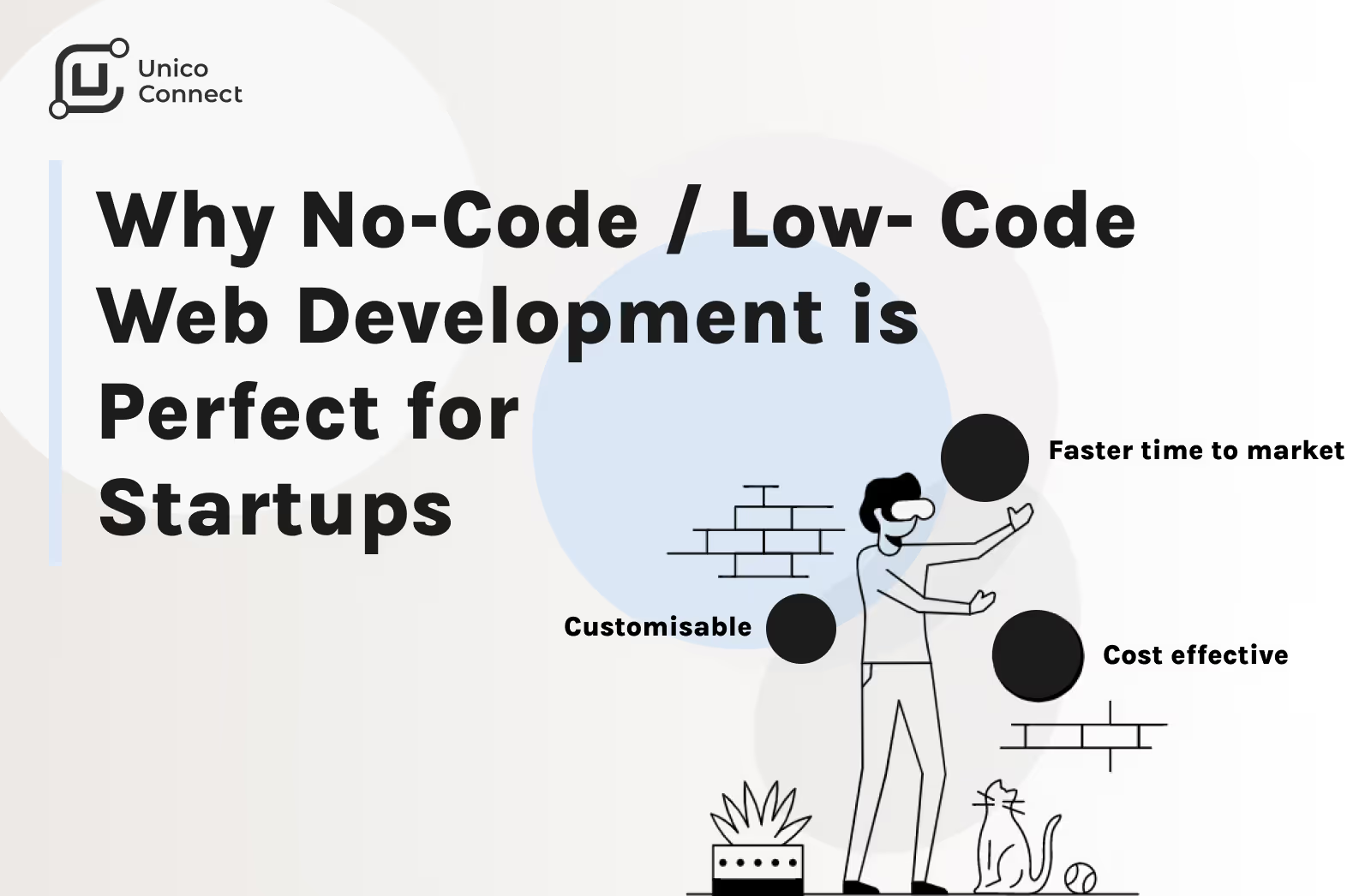
Cost-Effective
Keyhole Software compiled pricing from more than 200 projects across North America, Europe, and Asia, and puts a simple web application MVP at $40,000 to $120,000 and a mid sized platform at $120,000 to $300,000 (Keyhole Software). That benchmark covers coded work at market rates, so part of the gap is team rates rather than the platform. Our no code MVP is a production build with a real backend, not a validation prototype, so it starts from 15,000 dollars and ships in 4 to 8 weeks. For startups without funding, this is often the difference between launching and never launching at all.
Faster Time-to-Market
No-code platforms compress build cycles dramatically. MVPs that take 2 to 3 months in custom code ship in 4 to 8 weeks. For startups, that velocity is the single most important variable in finding product-market fit before runway runs out.
Accessible to Non-Technical Founders
No-code platforms remove the engineering bottleneck. Non-technical founders can build, iterate, and ship without needing to hire engineers or convince a technical co-founder. The pool of people who can start companies grows dramatically.
Customisable and Adaptive
Modern no-code platforms (Bubble, Webflow, Xano, WeWeb, FlutterFlow) offer extensive customisation. Templates, components, custom logic, and integrations let startups build genuinely differentiated products — not just cookie-cutter sites.
The Strongest No-Code Startup Stack in 2026
Most fast-moving startups now run a stack like this:
- Webflow — marketing site, landing pages, content
- Bubble or WeWeb — the main web app
- Xano — backend, database, authentication, APIs
- FlutterFlow — mobile app (when needed)
- Make or Zapier — automation and integrations between platforms
This stack covers nearly every common startup use case — SaaS, marketplace, social, e-commerce, internal tools — at a fraction of the cost and timeline of equivalent custom development.
When Should Startups Move to Custom Development?
The right time to migrate to custom development is usually after three signals are clear:
- Strong product-market fit — the product works and users keep coming back
- Platform ceiling — no-code limits are starting to bind on roadmap or scale
- Capital available — fundraising or revenue can support a custom rebuild
Most successful startups stay on no-code stacks through their seed and Series A stages, then migrate selectively as scale and differentiation demand it. Unico Connect's no-code development services help startups navigate this entire journey — from MVP to first scale to custom migration.
Frequently Asked Questions
Can a startup build a real product on no-code?
Yes — and increasingly, the strongest startups do. Modern no-code platforms produce production-grade apps that handle real users, real transactions, and real growth. The misconception that no-code is "just for prototypes" is outdated.
Will I have to rebuild later when I migrate to custom?
If you grow large enough, eventually yes. Migration is essentially a rebuild — but it's a much smaller bet than building custom from day one. You validate with no-code, prove the product works, then invest in custom only when the economics clearly justify it.
What types of startups benefit most from no-code?
SaaS, marketplaces, internal tools, content platforms, simple consumer apps, and B2B services. Performance-critical startups (gaming, AR/VR, real-time video) or deeply technical startups (foundation models, hardware) may still need custom development from earlier.
How do investors view no-code startups?
Most investors care about traction, not tech stack. Strong metrics on a no-code stack are far more compelling than weak metrics on custom code. As long as the migration story is credible at scale, no-code MVPs raise just fine.
Can I customise no-code platforms enough to differentiate?
Yes. Modern platforms offer custom code, custom widgets, deep integrations, and rich logic. The strongest no-code apps in 2026 don't look like no-code apps — they look like polished custom products.
What's the ideal no-code stack for a startup MVP?
For most SaaS MVPs: Webflow for marketing, Bubble or WeWeb for the app, Xano for the backend, and Make for automation. For mobile-first products: FlutterFlow plus Xano. Total platform cost typically runs $100–$500/month.
Conclusion
No-code and low-code web development is the right default for most startups — dramatically faster, cheaper, and more accessible than custom development. The strongest founders use it strategically: validate with no-code, scale with no-code, migrate to custom only when growth and differentiation demand it. To explore how Unico Connect helps startups ship and scale on the modern no-code stack, see our no-code development services.