








Why No-Code Is the Future of Web Development

Malay Parekh
CEO & Director, Unico Connect
In this article
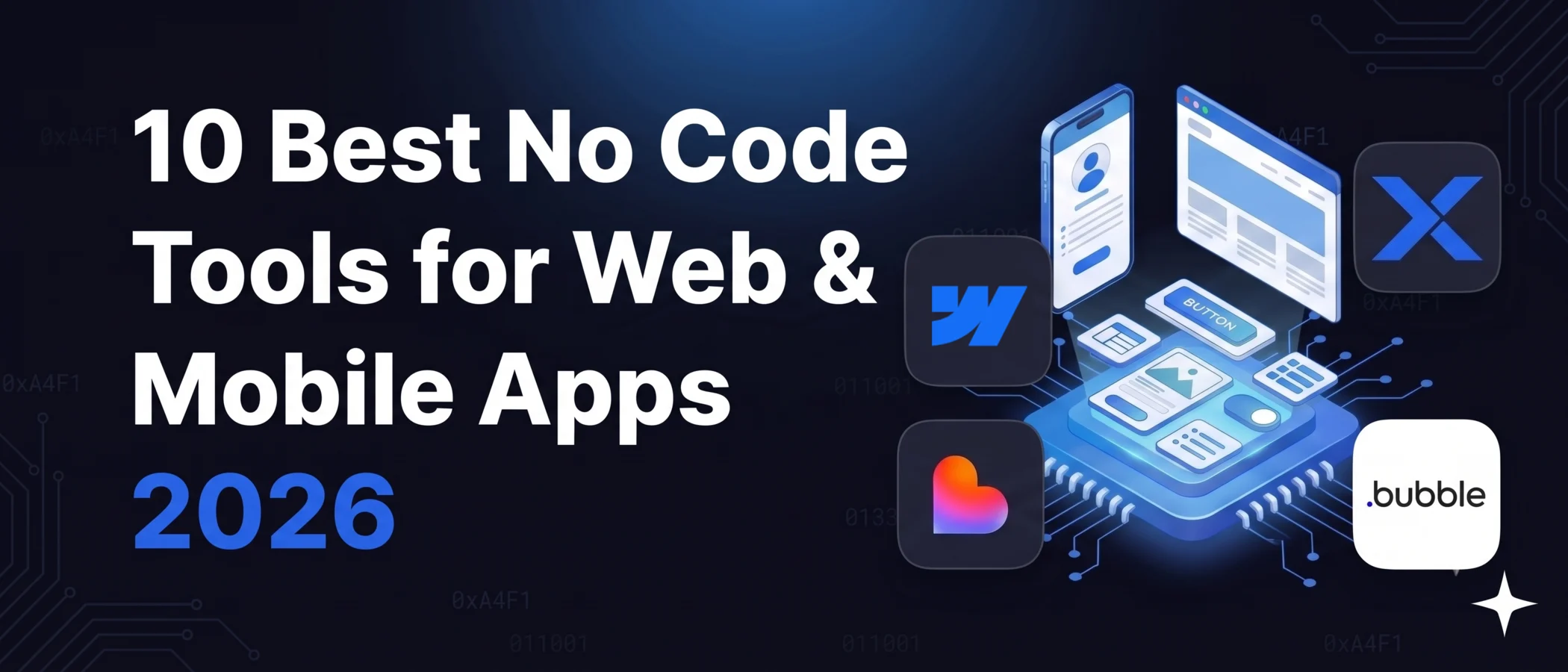
No-code platforms have moved from experimental side-tools to credible production infrastructure for serious web development. The combination of visual builders, mature integrations, scalable hosting, and AI assistance has changed the economics of building web applications — letting teams ship in weeks what used to take quarters. This guide walks through the strongest no-code tools, the business benefits they unlock, and where their limits actually sit.
Quick Answer
No-code is the future of web development for most operational and customer-facing apps because it cuts development time by 60–80%, lowers cost by 40–70%, and lets non-engineers ship production-grade applications. The strongest stack in 2026 — Bubble, Webflow, Xano, WeWeb, Airtable, Zapier — covers nearly every web development use case. Custom development still wins for performance-critical or deeply differentiated products.
Key Takeaways
- No-code is now a credible production stack for serious web development
- Strongest tools: Bubble, Webflow, Xano, WeWeb, Airtable, Zapier
- Major business benefits: speed, cost, accessibility, flexibility
- Production-grade features (auth, scaling, integrations) ship out of the box
- Custom still wins for performance-critical or highly differentiated products
The Strongest No-Code Tools for Web Development in 2026
The no-code ecosystem has matured. A few tools now dominate serious production work:
Bubble
Bubble is a full-stack no-code platform for building production web applications. It combines a visual frontend builder, a built-in database, a logic editor, and hosting — letting teams ship complete apps without code. Strong for marketplaces, SaaS, internal tools, and complex web apps.
Webflow
Webflow is the standard for visual web design and content publishing. It produces clean, production-grade HTML/CSS, hosts globally, integrates with marketing tools, and supports advanced CMS workflows. Strong for marketing sites, content hubs, landing pages, and design-led brands.
Xano
Xano is a no-code backend platform with a visual database builder, REST API generator, authentication, and integrations. It pairs cleanly with frontend builders like WeWeb, Bubble, and FlutterFlow to form full-stack no-code applications.
Airtable
Airtable is a cloud database and spreadsheet hybrid that handles structured data with relational power. Used as a backend for many no-code apps, a project management tool, or a customer database; strong when data structure matters more than user-facing UI.
Zapier
Zapier automates workflows between web apps — moving data, triggering actions, and orchestrating multi-step processes across systems. The integration backbone for most modern no-code stacks.
WeWeb
WeWeb is a low-code frontend builder designed for production web apps. It pairs cleanly with Xano and other backends, supports custom auth and data integration, and produces apps that scale to real production workloads.
Four Crucial Benefits of No-Code Web Development for Businesses
1. Speed of Development
No-code platforms compress build cycles dramatically. Apps that previously took 3–6 months ship in 2–6 weeks. The compression compounds across every project — meaning more software gets built and shipped per dollar of investment.
2. Cost-Effective Solution
No-code platforms significantly reduce development cost. Smaller teams, faster delivery, and lower ongoing maintenance translate to 40–70% lower total cost over the project lifecycle. At scale, platform subscription fees can offset some of the savings, but the net economics still favour no-code for most use cases.
3. User-Friendly Technology
Non-technical users — founders, product managers, operations leads, marketing teams — can now build and maintain working applications. The pool of people who can ship software grows dramatically, removing engineering bottlenecks on internal tools and standard apps.
4. Flexibility
Visual builders let teams iterate fast. Design and logic changes that previously required engineering sprints now ship in hours. The result is dramatically faster experimentation, better product-market fit discovery, and more confident decision-making.
Key No-Code Platform Features
Modern no-code platforms ship with the features production apps actually need:
- Drag-and-drop builders — assemble UI without writing code
- Visual UI components — pre-built buttons, forms, navigation, lists
- Visual modelling — see what you're building as you build it
- Data storage and management — built-in databases or integrations to external ones
- Authentication and user management — out of the box, with SSO and OAuth support
- Payments and subscriptions — Stripe, Paddle, RevenueCat integrations
- Email and notifications — transactional email, in-app notifications, push
- Analytics and observability — built-in or via integrations to GA, Mixpanel, Amplitude
- Hosting and scaling — managed by the platform; no DevOps required
Custom No-Code Development
While no-code platforms are accessible to non-technical users, the highest-quality production apps usually benefit from experienced no-code developers. A no-code specialist understands how to structure data, design clean workflows, optimise performance, integrate cleanly with external systems, and apply security best practices.
For serious production projects, partnering with no-code specialists like Unico Connect typically produces dramatically better results than purely DIY no-code builds — at a fraction of the cost of equivalent custom development.
Frequently Asked Questions
Is no-code really the future of web development?
It's a significant part of the future. Most operational web apps and marketing sites will be built on no-code; differentiated core products will still use custom development. The strongest organisations use both strategically rather than choosing one or the other.
Are no-code web apps production-ready?
Yes, for most use cases. Modern no-code platforms (Bubble, Webflow, Xano, WeWeb) ship with enterprise security, compliance certifications, scaling primitives, and integration capabilities that meet production requirements. Performance-critical or deeply specialised apps may still need custom development.
What types of web apps work best on no-code platforms?
Marketing sites, content publishing, customer portals, dashboards, MVPs, internal tools, marketplaces, simple SaaS products, and operational workflows. Performance-critical apps (real-time video, gaming) and apps with deeply specialised UX or algorithms benefit less from no-code.
How does no-code compare to custom web development on cost?
No-code typically delivers 40–70% lower total cost for standard web apps. The savings come from smaller teams, faster delivery, and lower ongoing maintenance. At very large scale, platform fees can offset some savings, but no-code still wins economically for most projects.
Can no-code platforms handle enterprise workloads?
Yes. Modern platforms ship with SOC 2, ISO 27001, HIPAA compliance, audit logging, SSO, and the integration depth that enterprises require. Many large enterprises now run significant production workloads on no-code platforms.
How do I choose the right no-code platform?
Match the platform to the use case. Webflow for marketing sites and content; Bubble or WeWeb for full web apps; Xano for backends; Airtable for structured data; Zapier or Make for automation. Most production stacks combine 3–5 platforms.
Will I lose IP or face vendor lock-in with no-code?
Depends on the platform. Some (FlutterFlow, Webflow) offer code export or hosting flexibility; others lock you into the platform. Evaluate the migration story before committing — particularly for products you expect to scale dramatically.
Conclusion
No-code is no longer an experimental category — it's the operating layer for modern web development. The combination of speed, cost-efficiency, and accessibility makes it the right default for most operational and customer-facing web apps. The strongest businesses use no-code strategically: for the operational majority of their software, and custom development for the differentiated few. To explore how Unico Connect builds production-grade no-code web applications, see our no-code development services.