









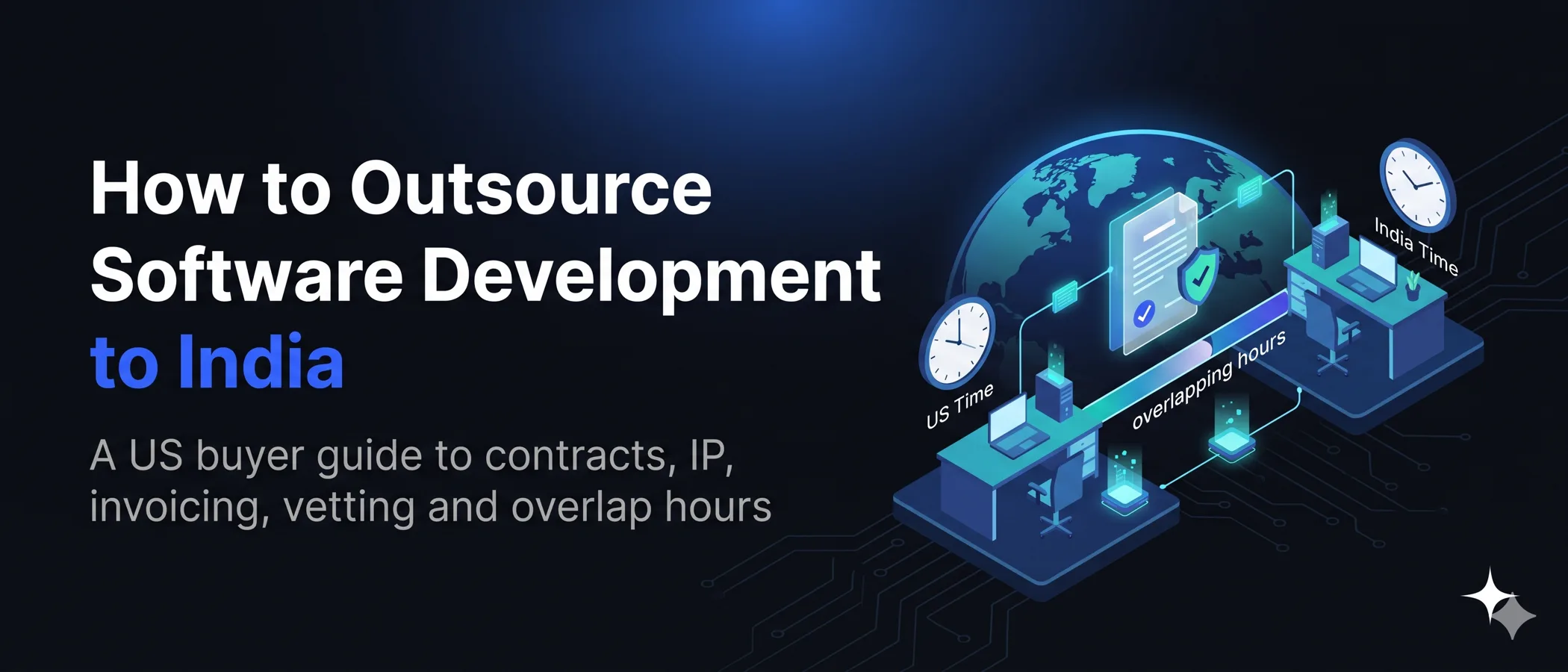
How to Outsource Software Development to India from the US

Malay Parekh
CEO & Director, Unico Connect
In this article
- Quick Answer
- Key Takeaways
- Choose the First Engagement Before the Vendor
- What It Costs to Outsource Software Development to India
- Time Difference and Overlap Hours When US Clocks Change
- How to Vet an Indian Software Development Company
- Contract Clauses and IP Protection Under Indian Law
- Invoices, Payments and Tax Forms for US Buyers
- Outsourcing Software Development to India With Unico Connect
- Frequently Asked Questions
Outsourcing software development to India works or fails on details sales calls skip, such as who owns the code, which tax form you collect before paying, and how many hours a day both teams are online. We checked each rule below at its source on October 23, 2026. None of it is legal or tax advice, so have counsel review your contract.
We run an engineering hub in Mumbai for clients in the US and other countries. Weigh our view with that in mind.
Quick Answer
To outsource software development to India, start with a small fixed scope, check the company on the Ministry of Corporate Affairs and GST registers, and sign a master services agreement (MSA) and statement of work (SOW) that assign the code to you worldwide for the full term of copyright. Ask the Indian company for Form W-8BEN-E before the first payment and expect an export invoice with no Indian GST. Write a shifted working day into the SOW, because a standard Mumbai day shares at most 30 minutes with a US one, as our offshore, nearshore and onshore comparison shows.
US teams bill $100 to $250 per hour against $25 to $50 at strong agencies in India, according to our custom software cost guide.
Key Takeaways
- A fixed scope with written acceptance criteria tests a new vendor at a capped cost. A dedicated team suits a long roadmap with a lead on your side.
- Spell out the term and territory of the IP assignment. If you do not, the Indian Copyright Act defaults to five years and India only.
- You generally file no Form 1099 for an Indian company working in India once it has given you Form W-8BEN-E.
- Indian GST is normally zero on software services exported to a US client, provided the vendor meets the export conditions.
- Plan for the US clock change. A 2pm to 11pm Mumbai shift gives US Eastern time 4.5 shared hours in summer and 3.5 from November 1, 2026 to March 13, 2027.
Choose the First Engagement Before the Vendor
The right model depends on whether a product owner and a tech lead on your side can direct a team every day. Our comparison of staff augmentation vs dedicated teams explains who directs the work under each model. A dedicated team is a whole unit, engineers plus a lead, that works only on your product. You set its priorities and the vendor lead runs daily delivery.
Start with a fixed scope project if
- The first deliverable fits a written scope, such as a proof of concept, an MVP or one module
- You want to judge the vendor on accepted work before committing for months
- The budget has a hard ceiling
Start with a dedicated team if
- You have a product owner and a backlog that runs for quarters
- Your tech lead can review their code every day
- Priorities change too often for a fixed scope
- You want the same engineers to keep the product knowledge
After a bad outsourcing experience, restart with a fixed scope. It caps what a second mistake can cost and makes the vendor prove delivery against criteria you wrote.
We offer fixed scope for proofs of concept and MVPs, then move to a retainer for ongoing work. Our page on how our engagements work sets out the rest of our terms.
What It Costs to Outsource Software Development to India
US and Canadian teams bill $100 to $250 per hour, and strong agencies in India $25 to $50. On October 24, 2026, GoodFirms listings put the India median at the bottom of that band.
8,560
software development companies in India listed on GoodFirms
GoodFirms, October 24, 2026
$25
median hourly rate those firms list
GoodFirms, October 24, 2026
4.9
median client rating across the same firms
GoodFirms, October 24, 2026
Firms set their own listed rates, and the rate rarely decides the total. Rework from a vague scope moves the bill more, and so do the hours your lead spends directing the team.
Here is what we charge. Rates run $25 to $50 an hour depending on seniority, and fixed scope projects have a $10,000 minimum.
Time Difference and Overlap Hours When US Clocks Change
India keeps India Standard Time all year. That is 9.5 hours ahead of US Eastern time in summer, 10.5 in winter, and 12.5 to 13.5 hours ahead of Pacific time. Under the federal daylight saving rule, US clocks fall back each November, and Table 1 shows what a shifted Mumbai day loses in each zone.
As our offshore comparison puts it, four hours is the practical minimum for a daily standup, live code review, and same day unblocking.
Table 1. Hours a Mumbai team shares with a 9 to 5 US workday
| US time zone | Mumbai 10am to 7pm, US summer | Mumbai 2pm to 11pm, US summer | Mumbai 2pm to 11pm, US winter | Mumbai 3pm to midnight, US winter |
|---|---|---|---|---|
| Eastern | 30 minutes | 4.5 hours | 3.5 hours | 4.5 hours |
| Central | None | 3.5 hours | 2.5 hours | 3.5 hours |
| Mountain | None | 2.5 hours | 1.5 hours | 2.5 hours |
| Arizona, no daylight saving outside the Navajo Nation | None | 1.5 hours | 1.5 hours | 2.5 hours |
| Pacific | None | 1.5 hours | 30 minutes | 1.5 hours |
US summer means daylight saving time, March 8 to October 31, 2026 and again from March 14, 2027. US winter runs November 1, 2026 to March 13, 2027, when the 10am to 7pm Mumbai day shares no time with any US zone. Figures are our arithmetic from IANA time zone offsets, October 23, 2026.
To keep four hours with Eastern time through the winter, move the Mumbai shift an hour later, to 3pm to midnight, or start your day an hour earlier.
The West Coast is harder, with 1.5 hours at best, so plan one daily sync in your time zone and leave deep work to IST hours.
Overlap that is not in the SOW
If an offshore partner will not commit to a shifted schedule in writing, you are buying the 30 minute version. Put the shift, the shared window, the plan for the November clock change and the holiday calendars of both countries into the SOW.
How to Vet an Indian Software Development Company
Vet the vendor before you share code or money. In an r/ExperiencedDevs thread with hundreds of comments, engineers keep describing the same failures. Vendors filled seats to bill for more people, paid no penalty for defects they shipped and kept contracts running one more month. Table 2 has a clause for each.
- Confirm the legal entity you will sign with, look it up in the Master Data Services of the Ministry of Corporate Affairs, and check its GST number with the Search Taxpayer tool.
- Ask for the ISO/IEC 27001 certificate and its expiry date. As our guide to choosing a software development partner puts it, ISO/IEC 27001 is a certification and SOC 2 is an audit report, while HIPAA and GDPR are laws you comply with rather than certificates a vendor can hold.
- Read the text of directory reviews. With a median rating of 4.9, stars separate little, and GoodFirms marks sponsored listings as agencies that pay for premium placement.
- Ask how the vendor hires. A credible answer names stages, such as a live coding round and third party background verification.
- Interview the engineers who will do the work, ask whether they are employees or contractors, and name the key people in the SOW.
- Call a current client and ask what went wrong and how the vendor handled it.
We operate an ISO/IEC 27001:2022 certified information security management system.
Contract Clauses and IP Protection Under Indian Law
You can pay every invoice and still not own the code.
Say an engineer on the vendor staff writes your login flow. Indian copyright law treats that code as a literary work, in the same class as a novel. Because it was written on the job, the vendor owns it first, unless an agreement says otherwise. Your invoices do not change that. Only a written assignment, signed by the vendor, moves the code to you.
So check the assignment for two blanks, term and territory. Take a contract that never says how long the assignment runs. Indian law deems it to last five years from the date of assignment. Take one that never says where. The assignment is then presumed to extend within India only (Copyright Act 1957, sections 17 to 19). Few US buyers mean to sign that.
The assignment is the clause most buyers miss. Do not sign one that leaves either blank.
Freelancers behind the agency
Freelancers can break the chain of ownership. The employer rule in section 17 of the Copyright Act reaches employees and apprentices doing their jobs, and nobody else. A freelancer is neither, so the code stays theirs until they assign it. Now picture an agency that passes your tickets to freelancers you never contracted with. It may not hold the rights it promises you, since a vendor can only pass on rights it holds. So if the vendor uses contractors, get its written confirmation that each one has assigned their work to it.
Table 2. Clauses to settle with an Indian software vendor
| Clause | Why it matters | What to ask for | Source |
|---|---|---|---|
| Copyright assignment | Silence means five years, India only | Signed, worldwide, full term, named media, no one year lapse | Indian Copyright Act, sections 18 and 19 |
| Mutual non disclosure agreement (NDA) | Discovery shares your plans before any MSA exists | A mutual NDA signed before discovery | Practice, not statute |
| Governing law and disputes | A US party makes it an international commercial arbitration | Named law, seat and institution | Arbitration and Conciliation Act 1996, section 2(1)(f) |
| Data protection | US state law and the Digital Personal Data Protection (DPDP) Act set duties | Purpose limits, security safeguards, notice if the vendor cannot comply | Cal. Civ. Code 1798.100, DPDP Act 2023 |
| Named engineers and replacements | The people in the pitch can change after signing | Key people named, your approval of any swap, a replacement for poor fit | Practice, not statute |
| Acceptance and warranty | Defects should not be billed twice | Acceptance criteria, rework at vendor cost | Practice, not statute |
| Termination, code and accounts | You cannot leave without your code | Notice period, handover pack, repositories and cloud accounts in your name | Practice, not statute |
| Restraints on engineers | Restraints on a lawful profession are void to that extent | Ask counsel before relying on a non compete | Indian Contract Act 1872, section 27 |
We sign a mutual NDA before discovery starts, and IP assignment and all other contract terms are set out in the MSA and SOW you sign when the engagement begins.
An assignment that is silent on time and place
Under Indian law, a one line clause assigning all IP to you leaves duration and territory to the section 19 defaults. It has a second gap, and it runs on a clock. If you leave an assigned right unused through the first year after the assignment date, the assignment of that right lapses, unless the assignment says otherwise.
What should the clause say instead? Worldwide rights, for the full term of copyright. The deliverables and fees under each SOW, by name. Every medium and mode of use you need, listed out. And a line that switches off the one year lapse. The media list matters because section 18 leaves out any medium or mode of use that was not yet in commercial use when you signed, unless the assignment names it. Have counsel write it to work under Indian and US law.
Governing Law and Where a Dispute Is Heard
Pick the governing law and the forum with counsel. Going to arbitration? Name the seat and the institution as well.
The seat matters if you ever need to enforce an award in India. India joined the New York Convention on foreign arbitral awards in 1960 and the United States in 1970 (UNCITRAL status table). Each applies it only to commercial disputes, and only to awards made in another member state. On the Indian side, sections 44 to 49 of the Arbitration and Conciliation Act provide for enforcing an award made in a Convention territory the Indian government has notified. Confirm your seat is one.
Ask counsel one more thing before you pick a forum. How would a US judgment, or an arbitral award, actually be enforced in India?
Data Terms for Your US Users
Write your own privacy duties into the vendor contract. Say you run a US app and the California Consumer Privacy Act (CCPA) covers your business. If you disclose personal information to your vendor as a service provider or contractor for a business purpose, the law says you must enter into an agreement with it (Cal. Civ. Code 1798.100). That agreement has to limit what the data is used for, bind the vendor to the CCPA and give you the right to stop and remediate unauthorized use.
Do not count on Indian law to fill the gaps. Picture an Indian vendor handling personal data about your customers in the US under its contract with you. Section 17(1)(d) of the DPDP Act has an exemption for that setup. For that work, the consent and notice rules switch off. So do almost all other data handling duties, the rights of data principals and the power to restrict transfers abroad. The security duty stays, so the data must still be protected with reasonable security safeguards. These DPDP sections start in May 2027 under the commencement notification.
Invoices, Payments and Tax Forms for US Buyers
Before you pay the first invoice, ask an Indian company for Form W-8BEN-E. The form documents the company as foreign and claims its exemption from Form 1099 reporting and backup withholding on that income. An Indian freelancer gives Form W-8BEN. A US entity of the vendor gives Form W-9. Where the work happens decides the source of the income. Services performed in India are not US source income (IRS Publication 515), and work done in the United States is. Raise any on site work with your tax adviser before an engineer travels.
Table 3. Paperwork when a US company pays an Indian software vendor
| Item | Who handles it | What it does | Source |
|---|---|---|---|
| Form W-8BEN-E | The Indian company, before the first payment | Documents a foreign entity. You keep it and do not send it to the IRS. A form signed in 2026 generally stays valid through December 31, 2029. | IRS Instructions for Form W-8BEN-E |
| Form 1099-NEC | You, for most noncorporate US payees paid $2,000 or more from 2026 | Not required for a payment you can tie, before paying, to documentation of a foreign payee | 1099-NEC instructions, 26 CFR 1.6041-4 |
| Export invoice | The vendor | No Indian GST, and an endorsement that the supply is for export under a Letter of Undertaking without payment of integrated tax | CGST Rule 46 |
| Letter of Undertaking | The vendor, filed in Form GST RFD-11 before exporting | Lets the vendor export without paying integrated tax | CGST Rule 96A |
| Payment schedule, currency and wire fees | Both sides, agreed in the MSA | Sets milestone or monthly billing, the invoice currency, such as USD by international wire, and who pays the bank charges | Practice, not statute |
Check the first invoice for GST. A correct invoice to a US company normally carries no GST, because exports are zero rated under section 16.
The service must be an export of services. Among other conditions, the supplier is in India, the recipient and the place of supply are outside India, and payment arrives in convertible foreign exchange or in rupees where the Reserve Bank of India permits.
Rupee invoices leave you the currency risk. We invoice in USD, euros or INR.
Outsourcing Software Development to India With Unico Connect
Unico Connect serves US clients through our US presence for contracts and billing, with engineering delivered from our engineering hub in Mumbai. Our US work includes Highlands Brain, an AI powered learning platform for a charter school network in California, which serves more than 15,000 students, and our page on software development for US companies covers more.
Frequently Asked Questions
Do I need to file a Form 1099 for a foreign contractor in India?
Generally no, when the contractor is an Indian company or an Indian freelancer working in India. Work done in India produces foreign source income, and IRS rules require no information return when, before paying, you can tie the payment to documentation that the payee is foreign. That documentation is Form W-8BEN-E for a company or Form W-8BEN for a freelancer. Check any work done inside the United States with your tax adviser.
What is Form W-8BEN-E and who needs one?
Form W-8BEN-E is the IRS form a foreign entity, such as an Indian software company, gives a US payer to document its foreign status. It stays on file with the payer and does not go to the IRS. One signed in 2026 generally remains valid through December 31, 2029. Indian freelancers use Form W-8BEN instead, and a US entity of an Indian vendor uses Form W-9.
Do Indian software companies charge GST to US clients?
Normally not. Software services an Indian vendor supplies to a US client usually meet the export of services conditions when payment arrives in foreign currency, and Indian GST law zero rates exports. A vendor exporting without paying tax files a bond or a Letter of Undertaking and marks the invoice as an export supply. If GST appears on your invoice, ask why.
What should an IP assignment with an Indian company say?
Put it in writing and have the vendor sign it. It should name the deliverables, the rights, every medium of use you need and the fees, and it should cover the whole world for as long as copyright lasts. Without a stated term, the Indian Copyright Act reads it as five years, and without a stated territory, as India only. Have counsel draft it.
Can an arbitration award made outside India be enforced against an Indian software vendor?
Indian law provides for it when the award is made in a New York Convention territory the Indian government has notified, and a court may refuse enforcement only on the grounds the Arbitration and Conciliation Act lists. India and the United States are both parties to the Convention. Write the governing law, seat and institution into the contract, and have counsel confirm the seat is a notified territory.
Does the overlap with India change when US clocks change?
Yes, by one hour. India does not use daylight saving time, so from November 1, 2026, when US clocks fall back, until March 14, 2027, when they spring forward, a 2pm to 11pm Mumbai shift shares 3.5 hours with the US East Coast instead of 4.5. In those months a 3pm to midnight shift shares 4.5 hours.