









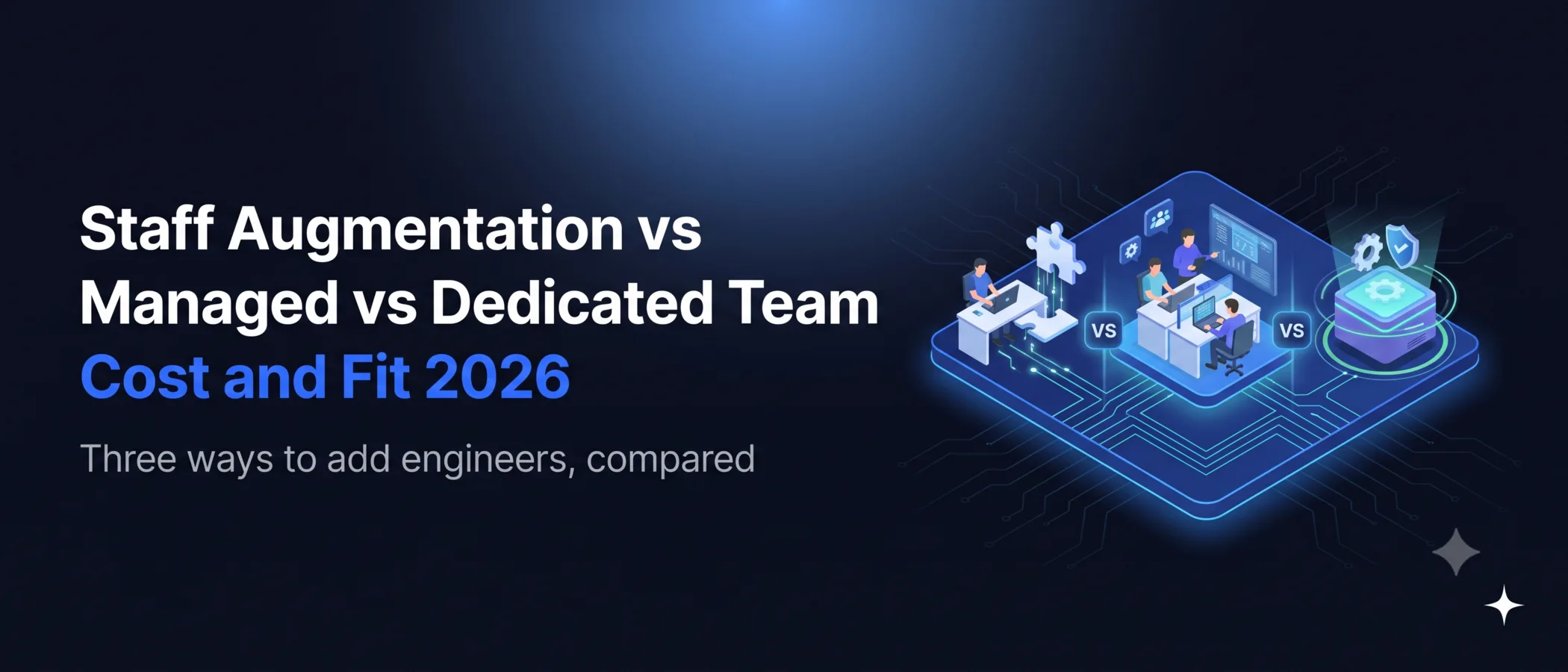
Staff Augmentation vs Managed Services vs Dedicated Team, Cost and Fit in 2026

Malay Parekh
CEO & Director, Unico Connect
In this article
- Quick Answer
- Key Takeaways
- What Each Model Means for a Software Team
- Who Sets Priorities, Who Runs Delivery, Who Carries the Risk
- Staff Augmentation vs Managed Services Cost for Four Engineers
- Costs Beyond the Hourly Rate
- Staff Augmentation vs Managed Services, Which Fits Your Team
- Contract Terms That Change With the Model
- Moving From One Model to Another
- What AI Assisted Coding Changes in Each Model
- Where Unico Connect Fits Among the Three Models
- Frequently Asked Questions
Staff augmentation vs managed services gets argued on the hourly rate, but the bigger difference is who directs the work each day and who answers when a release slips. A dedicated team sits between the two, and vendors use that label for different things. We define all three for a software team, then price four full time engineers for six months with the arithmetic shown. We sell engineers on a monthly retainer, from one developer to a dedicated team, and scope based projects, so weigh our view with that in mind.
Quick Answer
Staff augmentation adds individual engineers to your team, and you direct their work and own the result. Managed services hand an outcome or a running service to a provider that decides how to deliver it against an agreed scope or service level. A dedicated team is a whole unit, engineers plus a lead, that works only on your product. You set its priorities and the vendor lead runs daily delivery.
For four engineers over six months, US hires cost $336,000 to $376,000 in loaded pay before recruiting fees. Staff augmentation costs $230,400 to $288,000 at Latin American senior rates and $119,040 to $157,440 at Asian senior rates. Four full time Unico Connect engineers on staff augmentation start at about $16,000 a month, or $96,000 over six months, rising with seniority. That figure is an estimate, not a quote. A Latin American dedicated team with the lead billed at the senior rate costs $288,000 to $360,000, and managed services are quoted per scope or service level.
Key Takeaways
- Staff augmentation, dedicated teams and managed services differ in who directs the work and who carries the outcome. Where the engineers sit is a separate choice.
- Staff augmentation leans hardest on your own managers. Each weekly hour of their time costs about $2,106 to $2,340 over six months at the loaded rate of a median US engineer.
- A dedicated team adds a lead seat on the vendor side, which moves daily coordination to the vendor and raises the cost to $48,000 to $60,000 a month for four senior engineers and a lead in Latin America, with the lead billed at the senior rate.
- Managed services are priced on outcomes and volume, so compare quotes on scope and service levels, not on hourly rates alone.
- In the Deloitte 2024 Global Outsourcing Survey of more than 500 business and technology leaders, 67 percent reported using managed or operate services, against 29 percent for the legacy staff augmentation model.
- Under every model the engineers work for the vendor. Get ownership of the code assigned to you in a signed contract.
What Each Model Means for a Software Team
For a software team, the three models differ in who runs the work each day, your engineering lead under staff augmentation, the vendor lead in a dedicated team, or the provider under managed services.
Staff Augmentation
Clutch describes IT staff augmentation as adding talent to your team on an on demand basis. The engineers join your standups, your repository and your code review, and your engineering lead assigns their work every day. You pay per engineer, by the hour or the month, on a time and materials basis, and you own delivery and the result.

Dedicated Team
In the dedicated team model, you pay monthly for a complete unit, engineers plus a tech lead and sometimes QA or design, that works only on your product. We follow the split BairesDev publishes for its own dedicated teams, which coordinate with your leads on business objectives and drive delivery with their own tech PM. You own the roadmap. The vendor lead runs the standups and sprints.
Managed Services
With managed services you buy a result instead of people. Deloitte defines them as longer term relationships tied to service levels through a service level agreement, or SLA, and priced on outcomes and volume. For software, that means a build delivered against a written scope or a live product kept to agreed service levels, with the provider choosing the team and the method. In IT operations the same words mean a managed service provider, or MSP, that runs networks, infrastructure or security for you.

67%
of executives reported using managed or operate services, up from 45 percent two years earlier
Deloitte Global Outsourcing Survey 2024
29%
reported using the legacy staff augmentation model
Deloitte Global Outsourcing Survey 2024
$11.3B
managed services annual contract value in Q3 2026 on contracts of $5 million or more, the highest ISG has recorded
ISG Index, October 2026
Deloitte surveyed more than 500 business and technology leaders, and the ISG Index counts only contracts worth $5 million or more a year, so treat them as signals from leaders and big contracts, not startups.
Who Sets Priorities, Who Runs Delivery, Who Carries the Risk
You set the goals in all three models, but only under managed services does the provider carry delivery risk, within the agreed scope or service level. The first three rows of the table settle what a proposal really offers.
| Question | Staff augmentation | Dedicated team | Managed services |
|---|---|---|---|
| Who sets priorities | You | You, through the backlog | You set the outcome, the provider plans the work |
| Who runs daily work | Your engineering lead | The vendor tech lead | The provider |
| Who carries delivery risk | You | Mostly you, the vendor answers for team performance | The provider, within the agreed scope or service level |
| Who hires and replaces people | The vendor supplies, you choose | The vendor | The provider |
| What you pay for | Hours or months per engineer | Monthly seats for the whole team | An outcome, a fixed fee or a service level |
| What you need in house | An engineering lead with time | A product owner who sets priorities | Someone to write the scope and check the results |
| Where knowledge sits | In your team and repository | With the team, unless it is documented | With the provider, unless the contract requires a handover |
Some vendors sell managed capacity, a team the vendor runs and bills by headcount. If the contract names headcount but no delivery targets, it is a dedicated team under another name. Price it like one.
Staff Augmentation vs Managed Services Cost for Four Engineers
Staff augmentation is priced per engineer hour, and four senior engineers for six months cost $230,400 to $288,000 in Latin America and $119,040 to $157,440 in Asia. Managed services are quoted per scope or service level, and the arithmetic below turns a managed quote into an hourly rate you can compare. US or Canadian agency engineers can cost more than hiring, because the agency rate carries its own overhead and margin. Each hourly row assumes 160 billable hours a month per seat.
| Route | Rate basis | Six months | Per month | Not in the number |
|---|---|---|---|---|
| Four US hires | Loaded pay of $168,000 to $188,000 a year each | $336,000 to $376,000 | $56,000 to $62,667 | Recruiting fees, time to hire and your management time |
| US or Canadian agency engineers | $100 to $250 an hour | $384,000 to $960,000 | $64,000 to $160,000 | Your management time |
| Staff augmentation, senior engineers in Latin America | $60 to $75 an hour | $230,400 to $288,000 | $38,400 to $48,000 | Your management time |
| Staff augmentation, senior engineers in Asia | $31 to $41 an hour | $119,040 to $157,440 | $19,840 to $26,240 | Your management time |
| Staff augmentation, Unico Connect engineers in Mumbai | $25 to $50 an hour depending on seniority | From $96,000 | From $16,000, rising with seniority | Your management time |
| Dedicated team, four senior engineers and a lead in Latin America | Five seats at $60 to $75 an hour | $288,000 to $360,000 | $48,000 to $60,000 | Your product owner time |
| Managed services or a fixed scope build | Priced per outcome or service level | Quoted per scope | Quoted per scope | Changes outside the agreed scope |
The Bureau of Labor Statistics puts the May 2025 median for its software developers, quality assurance analysts, and testers occupation at 134,040 dollars per year, which it also states as 64.44 dollars per hour. Load that at 25 to 40 percent for payroll taxes, insurance, retirement and paid time off and one US engineer costs roughly 81 to 90 dollars an hour, or 168,000 to 188,000 dollars a year, before recruiting fees. Our guide to offshore, nearshore and onshore costs explains that load, which is a planning rule of thumb rather than a BLS figure.
Accelerance puts Latin American junior developers at 33 to 45 dollars an hour and seniors at 60 to 75, and Asian juniors at 24 to 31 with seniors at 31 to 41, calling Asia the cost leader. At 160 hours a month, one senior engineer at those rates costs $9,600 to $12,000 a month in Latin America and $4,960 to $6,560 in Asia. The US and Canadian band comes from our custom software cost guide, where US and Canadian teams bill $100 to $250 per hour.
How we calculated it. Four engineers at 160 hours for six months is 3,840 billable hours, or 4,800 with the lead billed as a fifth senior seat, and each vendor row multiplies those hours by the rate. The in house row is the loaded annual figure, times four, for half a year. Recruiting fees, which our AI developer hiring cost guide plans at 15 to 25 percent of first year salary, would add $80,424 to $134,040 for four hires at the BLS median. All figures are in US dollars before tax, using rates as published when we checked them on 9 October 2026.
Our row is an estimate from our published rates, not a quote. To set a managed quote beside these rows, divide the fee by the people on it, their months and 160 hours to get an hourly rate. That rate also pays the provider to carry delivery risk.
Read the in house row with care
The loaded figure covers paid hours, including leave and holidays, while vendors bill hours worked. Per hour actually worked, an employee costs more than the 81 to 90 dollars above.
Costs Beyond the Hourly Rate
Four costs never show in a rate comparison. The first is already on your payroll, the hours your own lead spends directing outside engineers.
Put a price on your management time
Under staff augmentation your engineering lead writes the tickets, reviews the code and unblocks the engineers. At the loaded US employee rate of about $81 to $90 an hour, every hour a week your lead spends on outside engineers costs about $2,106 to $2,340 over six months. Treat that figure as a floor for a senior lead, since the rate is for the median engineer, and multiply it by the hours your lead actually spends.
Hiring in house in the US realistically takes two to four months from opening the role to shipped work once notice periods and ramp are counted, which is why many teams start with a partner and hire in parallel.
People also leave vendors. TCS reported 13.3 percent attrition in its IT services business over the twelve months to September 2026, and Infosys reported 13.0 percent voluntary attrition in its IT services business over the twelve months to June 2026. Ask each vendor what happens, and who pays, when an engineer resigns.
Leaving costs money too. A notice period commits you to invoices after you decide to stop, and knowledge walks out with the people unless documentation is a deliverable.
Staff Augmentation vs Managed Services, Which Fits Your Team
Start with one question. Who on your side has time to direct outside engineers every day? If the honest answer is nobody, staff augmentation will cost you more than its rate suggests, ours included, and a dedicated team or a managed build is the better buy.

Choose staff augmentation if
- you have an engineering lead with time to direct more people
- the backlog is clear and the gap is hands or one missing skill
- you expect to add or remove people as the backlog changes
Choose a dedicated team if
- the roadmap spans quarters and nobody on your side can run daily delivery
- you want one team that stays together and keeps its knowledge
- a product owner on your side can still set priorities
Choose managed services if
- you can define the outcome and let the provider carry delivery risk and choose the method
- the work is stable, such as running and maintaining a live product
If the role is permanent and central to your product, and you can wait for a hire, hire your own engineer instead of renting one. If staff augmentation wins, our IT staff augmentation company shortlist, which includes us, compares vendors, rates and contract clauses. For a managed build, our guide to choosing a software development partner covers proposals and paid pilots.
Contract Terms That Change With the Model
Code ownership works the same way under all three models, while repository access, documentation, service levels and exit terms change with the model. A staff augmentation contract is usually a master services agreement (MSA) with a statement of work (SOW) that sets the rate, the notice period and the assignment of code to you. Under US copyright law, code an employee writes as part of the job is a work made for hire, owned by the employer (US Copyright Office Circular 30). A transfer of copyright ownership is valid only in a writing signed by the owner (17 U.S.C. 204(a)). The engineers work for the vendor, as employees or contractors, so ownership of the code should pass to you through a signed assignment in the MSA or SOW. Where the vendor uses contractors, get its written confirmation that each one has assigned their work to it, because a vendor can only pass on rights it holds. Ask your counsel to check the wording, especially when the engineers work outside the US.
| Term | Staff augmentation | Dedicated team | Managed services |
|---|---|---|---|
| Code and IP | Assigned to you in writing | Assigned to you in writing | Assigned to you in writing, with a license to any code the provider reuses |
| Repository and cloud accounts | Yours from day one | Yours from day one | Often the provider runs them, so write in a transfer at exit |
| Documentation | Your team standards | The vendor lead keeps it current | A handover pack as a named deliverable |
| Service levels | None, you manage performance | Team performance and replacement terms | Response, resolution or uptime targets and what happens on a miss |
| Exit | Notice per engineer | Notice for the team plus a handover | A transition period with knowledge transfer |
Moving From One Model to Another
You do not have to pick once. A common path runs from a fixed scope build to added engineers, then a dedicated team, then a maintenance retainer once the product is stable. Here is how that path works with us.
Build the first version to a fixed scope
We offer fixed scope for proofs of concept and MVPs, then move to a retainer for ongoing work, so the engagement can scale with you. Take the repository, documentation and cloud accounts in your name at handover.
Add engineers when you have a lead and a backlog
Your developer works as an extension of your team, directly in your channels. Our replacement guarantee gives you a replacement vetted developer at no extra fee if the placed developer is not the right fit or underperforms. Give each engineer access, your coding standards and a first ticket in week one.
Form a dedicated team when the roadmap spans quarters
Keep the engineers who already know the code, add a lead, and agree in writing who sets priorities and who runs the sprints.
Keep the stable product on a maintenance retainer
Ongoing maintenance retainers cover performance, security patches, dependency updates, and feature work. Keep documentation a named deliverable here too. People move on, even on a retainer. If you need service levels, get them in writing, because a retainer alone does not set them.
What AI Assisted Coding Changes in Each Model
In the Deloitte 2024 Global Outsourcing Survey, 83 percent of executives expected vendors to bring AI into how they deliver services, yet only 25 percent were seeing AI cut the cost of vendor services. The whole Unico Connect team uses Claude Code daily. Our engineering leads estimate that roughly 80 percent of our production code is AI generated. In our experience, that moves the bottleneck from writing code to reviewing it. Engineers are expected to understand the code AI produces, and a tech lead or senior developer reviews it before it ships.
Under staff augmentation that review lands on your senior engineers, and ours follow your code review workflow. In a dedicated team the vendor lead reviews first, and under managed services the provider owns it. Whichever model you pick, name the reviewer in the SOW.
Where Unico Connect Fits Among the Three Models
Unico Connect offers two models, a retainer where you pay for a fixed team every month, from one developer to a dedicated team, or a scope based project, and how our engagements work sets out our terms. Mapped to this guide, the retainer covers staff augmentation and dedicated teams, where we add a tech lead to the engineers, and a scope based project is a fixed scope build. The managed services we run are Google Cloud and Google Workspace for clients in India. Unico Connect serves US clients through our US presence for contracts and billing, with engineering delivered from our engineering hub in Mumbai. Our ratings stand at 4.8 from 54 reviews on Clutch, 4.9 from 32 on DesignRush, and 4.8 from 43 on GoodFirms.
Frequently Asked Questions
What is the difference between staff augmentation and managed services?
Staff augmentation sells you people, and managed services sell you a result. With staff augmentation, engineers join your team, you direct their work, you own the outcome and you pay by the hour or the month. With managed services, the provider decides how to deliver an agreed scope or service level, carries the delivery risk and prices on outcomes and volume rather than hours.
What are the key differences between a managed capacity model and staff augmentation?
The difference is who manages the engineers. In staff augmentation you direct them yourself. In a managed capacity model the vendor supplies a team, manages it and bills by headcount, and the outcome stays yours unless the vendor commits to delivery targets.
Is staff augmentation considered outsourcing?
Partly, because staff augmentation outsources the employment but not the direction of the work. The vendor hires, pays and replaces the engineers, but your team still directs the work and owns the result. Deloitte, in its 2024 Global Outsourcing Survey, describes traditional outsourcing as transactional and typically built on a staff augmentation model, and ties managed services to service levels priced on outcomes and volume.
What are examples of managed services?
In IT operations, a managed service provider runs networks, infrastructure, applications or security on an ongoing contract, and Deloitte lists hosting and cloud operations and infrastructure support. For a software product, examples are keeping a live application to agreed response times, running its cloud hosting, or delivering a defined build against a written scope.
How much does a dedicated development team cost per month?
A dedicated team of four senior engineers and a lead costs about $48,000 to $60,000 a month in Latin America, at 160 hours a seat, Accelerance 2026 senior rates of $60 to $75 an hour and the lead billed as a senior. A lead who costs more raises the total. Few vendors publish team prices, so ask whether lead, QA and design seats are billed separately.
Which is better, staff augmentation or managed services?
Neither, in general. Managed services vs staff augmentation comes down to who directs the work, your team or the provider. Staff augmentation is better when you have engineering leadership and a clear backlog. Managed services are better when you can define the outcome or service level and want the provider to carry delivery risk. For a short push, staff augmentation is quicker to start, but ask about any minimum term before you sign.