







5 Reasons Why No-Code Is Perfect for Entrepreneurs

Malay Parekh
CEO & Director, Unico Connect
In this article
For most entrepreneurs, the gap between idea and shipped product is measured in months — usually because of how long custom development takes. No-code platforms close that gap dramatically. The right tool turns a complex software build into a few days of focused work. This guide walks through the five reasons no-code is uniquely well-suited to entrepreneurs in 2026 — and how to use it well.
Quick Answer
No-code is perfect for entrepreneurs because it compresses time-to-market, dramatically reduces development cost, enables broad customisation through drag-and-drop tooling, eliminates most ongoing maintenance, and democratises who can build software inside a small team. With platforms like Xano, FlutterFlow, and Webflow, founders can ship production-grade applications without hiring a full engineering team.
Key Takeaways
- No-code compresses months of development into days for the right use cases
- Cost savings are large — typically 50–80% lower than traditional development for MVPs
- Modern no-code platforms support significant customisation and integrations
- Lower maintenance burden frees founders to focus on customers, not codebases
- The realistic frame is no-code first, custom code only when no-code can't handle it
1. Speed and Agility
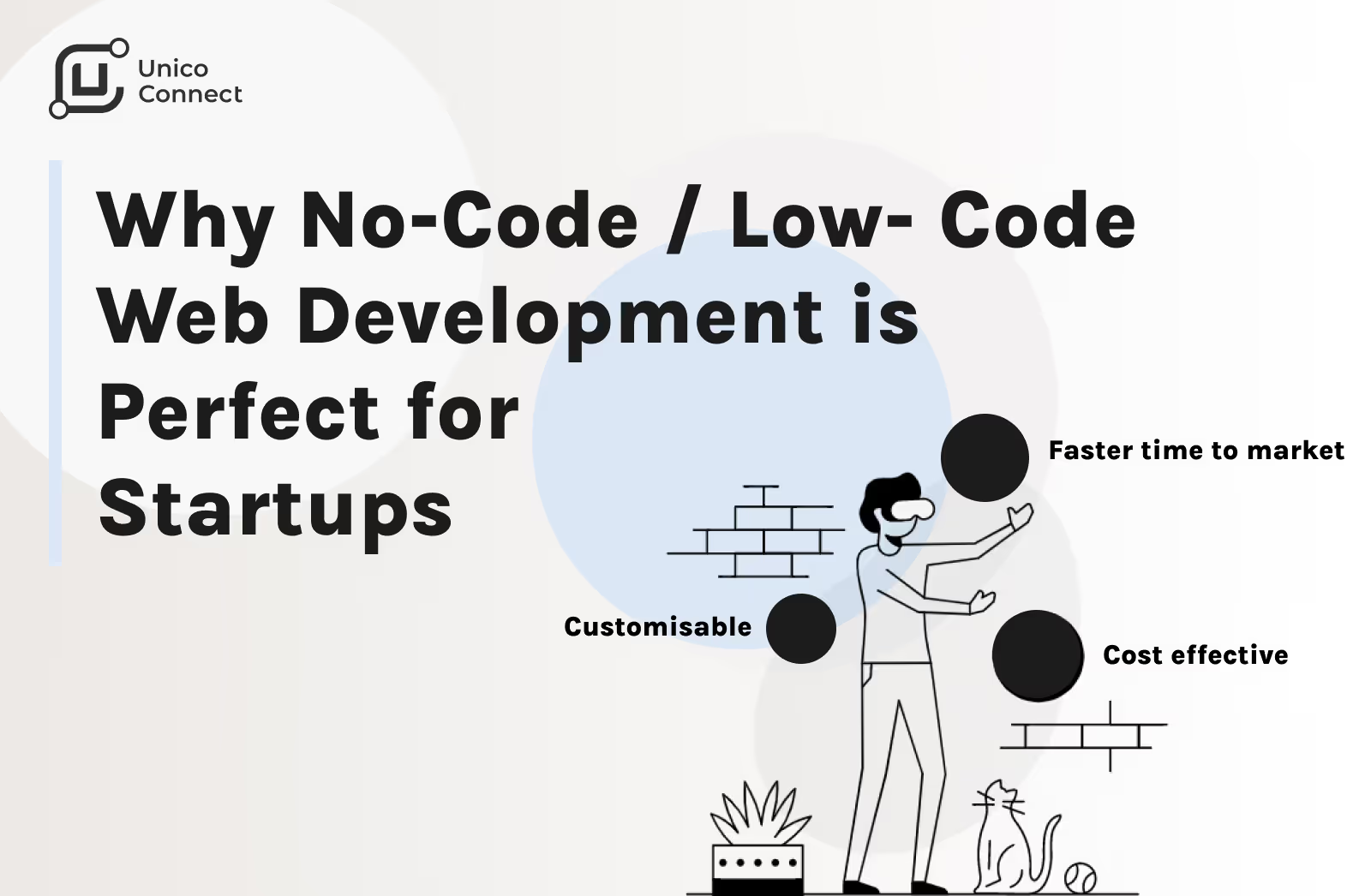
Time is the founder's scarcest resource. No-code platforms enable applications to go from idea to working software in days, not months. With tools like Xano, founders build scalable, reliable backend applications without traditional coding. With FlutterFlow, they ship mobile apps directly to the App Store and Play Store.
The agility this creates compounds: faster prototyping means faster customer learning, faster iteration on the right ideas, and faster realisation of what to abandon. In a market where competitive position is determined by speed of learning, no-code is one of the biggest unlocks available to a founder.
2. Cost-Effectiveness
Traditional development is expensive — senior engineering rates, longer timelines, and the inevitable maintenance backlog. No-code reduces this dramatically. Most MVPs that would cost $60K–$150K in custom code can be built and launched for under $20K in no-code, with similar or better quality.
Unico Connect offers affordable no-code development services that let entrepreneurs build production-grade applications without the burn rate of an engineering team. The savings free capital for product-market fit work — customer acquisition, brand, partnerships — where it matters most early on.
3. Innovation and Customisation
Modern no-code platforms are not "low-power". Tools like FlutterFlow let entrepreneurs build visually polished, performant mobile apps with drag-and-drop interfaces. Behind the visual builder are real Flutter codebases, native performance, and access to extensive customisation through actions, custom code blocks, and third-party integrations.
For entrepreneurs, this means experimenting freely with ideas — design changes, new features, layout iterations — without waiting on engineering. The cost of running an experiment drops dramatically, which is exactly what early-stage product teams need.
4. Simplified Maintenance and Reliability
Platforms like Webflow provide cloud-based hosting, CMS, and infrastructure with built-in CDN, automated SSL, and zero server management. The maintenance burden of a traditional codebase — security patches, dependency updates, infrastructure operations — largely disappears.
For solo founders and small teams, this is enormous. Time spent on maintenance is time not spent on customers. With no-code, that time stays where it should — on the business itself.
5. Democratised Development
No-code platforms expand who can build software. A founder with strong product thinking — but no engineering background — can ship a working application. A product manager can prototype real workflows. A designer can build interactive product experiences without an engineer in the loop.
For small teams, this democratisation is a force multiplier. Roles overlap, hand-offs reduce, and decisions get made faster. Diverse perspectives shape the product directly rather than being filtered through a development queue.
When No-Code Falls Short — And What to Do Then
Honest framing: no-code is the right starting point for most entrepreneurial use cases — MVPs, internal tools, landing pages, customer-facing micro-apps. It is generally not the right fit for differentiated, performance-critical, or large-scale product work.
The mature pattern is to start with no-code, prove product-market fit, then selectively migrate the most critical components to custom code as you scale. Unico Connect helps founders navigate that transition — from no-code MVP to custom-engineered platform — through our development services.
Frequently Asked Questions
Can I build a real startup with no-code?
Yes. Several venture-backed startups have launched and scaled on no-code platforms. The realistic pattern is no-code for the MVP and early growth, with selective rebuilding of performance-critical or differentiated components as you scale. Many companies never need to migrate at all.
What no-code tools are best for entrepreneurs in 2026?
Bubble and Webflow for web apps and marketing sites; FlutterFlow for mobile apps; Xano and Supabase for backend and data; Zapier and Make for workflow automation; Airtable for lightweight data; and Notion for internal operations. The right combination depends on the product.
How much does it cost to build an MVP with no-code?
Most no-code MVPs cost between $5K and $25K, depending on complexity and integrations. Compare this to $60K–$150K for a comparable custom-coded MVP. Subscription costs for the platforms themselves typically run $50–$500/month at MVP scale.
How long does it take to launch a no-code MVP?
A focused no-code MVP launches in 4 to 8 weeks for a single founder working with a strong agency, and takes longer for a founder learning the tools themselves. Compare this to 2 to 3 months for a comparable custom coded MVP.
Will my no-code app scale if I get traction?
For most use cases, yes. Modern no-code platforms handle thousands to hundreds of thousands of users without issue. For extreme scale, latency-sensitive workloads, or differentiated infrastructure needs, plan for a selective migration to custom code on the components that matter.
Should I learn no-code myself, or hire help?
Both are valid paths. Learning the tools yourself takes 30–60 days of focused effort and gives you control over the full product. Hiring a no-code agency like Unico Connect compresses launch to weeks, brings senior product judgment, and frees you for customer work. Most founders combine both — learn the tools, hire help for the heavy lifting.
Conclusion
No-code has become the default starting point for serious entrepreneurs in 2026. The combination of speed, cost-effectiveness, customisation, low maintenance, and democratised collaboration gives founders an unfair advantage in a world where speed of learning determines who wins. To explore how Unico Connect builds no-code MVPs for founders, see our no-code development services.