








The Future of Web Development, Will No-Code Technologies Conquer the Market?

Vasim Gujrati
Solutions Architect, AI & Platforms, Unico Connect
In this article
No-code platforms have moved from curiosity to mainstream in web development. The question is no longer whether no-code is viable — it clearly is — but how much of the web development market it will eventually capture. This guide walks through where no-code is winning, where it isn't, and a realistic view of what the next five years look like.
Quick Answer
No-code is reshaping web development by enabling non-engineers to ship working applications quickly and at lower cost. It already dominates marketing sites, landing pages, and many internal tools. It will capture more of the market over the next 5 years, particularly for content-driven sites, MVPs, and the long tail of business applications. It is unlikely to replace traditional development entirely — complex, highly customised, or extreme-scale projects will still require code.
Key Takeaways
- No-code is no longer experimental; it's mainstream for many web use cases
- The biggest wins are speed (10× faster), cost (50–80% lower), and democratised access for non-engineers
- Real limitations remain: customisation depth, vendor lock-in, and edge-case performance
- No-code will continue expanding but won't fully replace traditional development
- The mature pattern is hybrid — no-code for the long tail, custom code for differentiated work
The Rise of No-Code Technologies
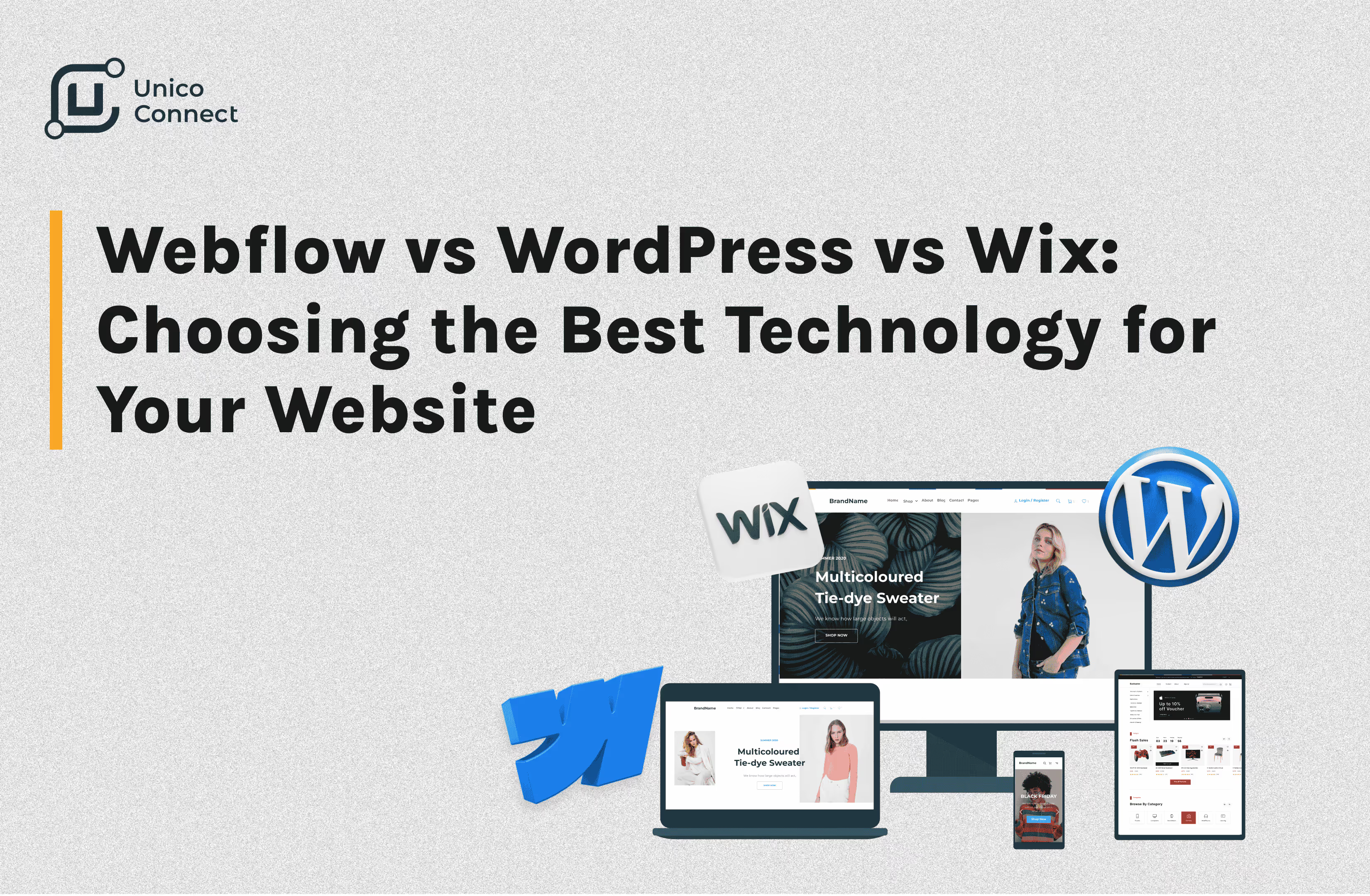
No-code platforms let users create and manage websites and applications through visual programming and drag-and-drop interfaces — no programming knowledge required. The platforms have matured significantly. Webflow, Bubble, Framer, FlutterFlow, Squarespace, and Wix now ship production-grade websites and applications with strong performance, SEO, and integration capabilities.
For most teams, the realistic question in 2025 is not "should we use no-code" but "where in our stack does no-code create the most leverage". The conversation has shifted from skepticism to strategy.
Benefits of No-Code Web Development
Five benefits drive adoption:
- Lower development cost — most no-code projects cost 50–80% less than custom equivalents
- Faster time-to-market — websites ship in days; applications in weeks
- Easier maintenance — visual updates without engineering tickets
- Empowered non-technical teams — marketing, product, and operations contribute directly
- Stronger cross-functional collaboration — designers, engineers, and stakeholders work in the same tools
For most marketing sites and content-driven web experiences, these benefits compound into measurable competitive advantage.
Challenges and Limitations
Honest framing matters. Three limitations remain:
- Reduced customisation depth — no-code platforms have ceilings; deeply custom UX or unique logic eventually hits them
- Performance edge cases — most no-code performs well, but extreme scale or latency-sensitive applications can require custom optimisation
- Vendor dependence — your application runs on someone else's platform; pricing, direction, and outages are outside your control
These limitations are real but manageable for most use cases — and the platforms continue to address them year over year.
The Future of Web Development and No-Code
Four forces will shape the next 5 years:
- Platform capability expansion — no-code platforms keep absorbing more advanced functionality (AI features, complex integrations, deeper customisation)
- Demand for cost-effective and rapid delivery — businesses increasingly favour speed over perfection for non-differentiated work
- AI-native no-code — generative AI is already producing components, content, and entire pages from text prompts; this expands what no-code can do dramatically
- Continued digital transformation — every industry is shipping more software; no-code absorbs the long tail of demand
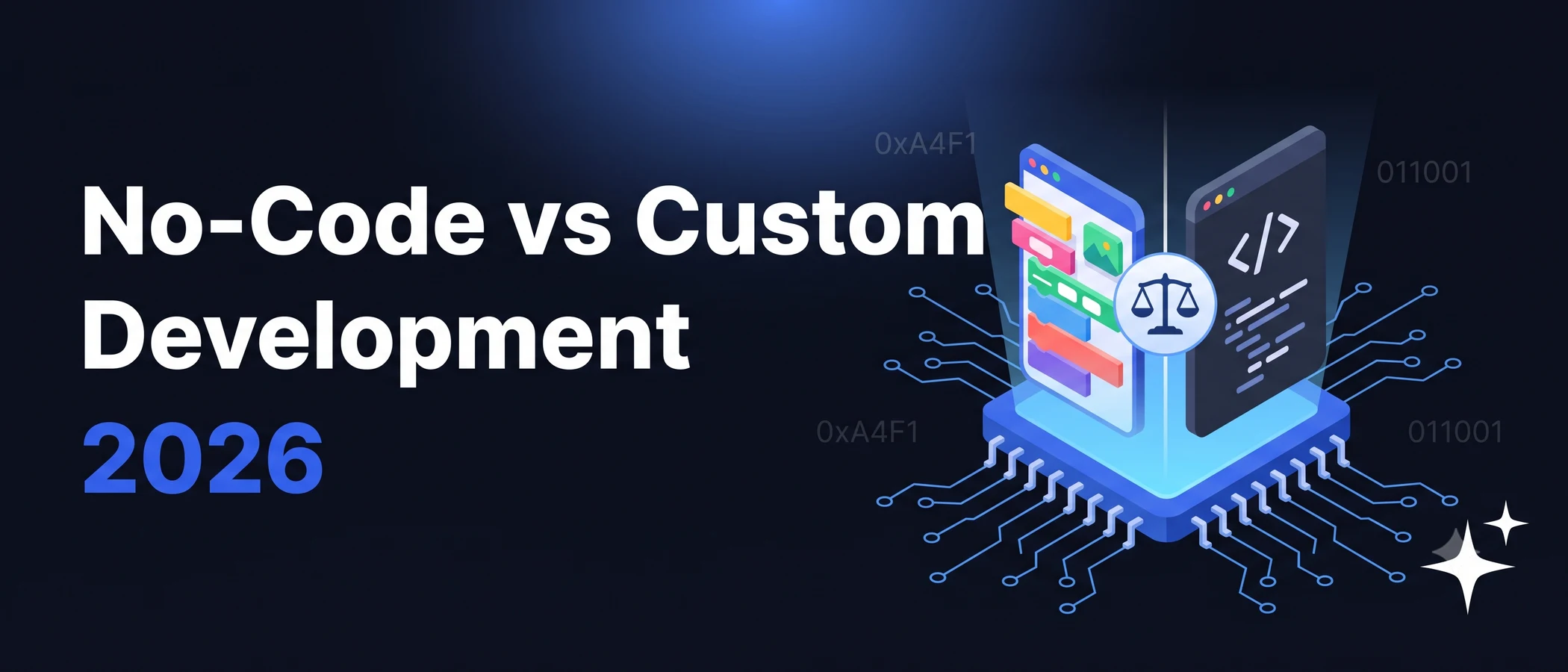
The realistic prediction: no-code will capture a majority of web development market share for marketing sites, content-driven applications, internal tools, and most MVPs. Custom development will remain dominant for highly differentiated product work, extreme scale, and specialised infrastructure.
When Custom Code Still Wins
Honest framing: custom code is still the right choice when you need:
- Maximum performance and latency at scale (sub-50ms requirements, millions of concurrent users)
- Deeply customised UX that exceeds platform capabilities
- Specialised infrastructure with unique architectural requirements
- Differentiated product features where the UX is competitive moat
For most other web work, no-code is the better starting point in 2025 and beyond. Unico Connect's services help enterprises pick the right approach and build accordingly.
Frequently Asked Questions
Will no-code replace traditional web development entirely?
No. No-code will continue capturing market share for marketing sites, content-driven applications, internal tools, and MVPs. Custom development will remain dominant for complex, differentiated, and high-scale product work. The mature pattern is hybrid, not full replacement.
What types of websites are best built with no-code?
Marketing sites, landing pages, blogs, documentation sites, simple ecommerce, MVPs, internal dashboards, and customer-facing micro-apps. For these use cases, no-code is typically faster, cheaper, and produces equivalent quality to custom development.
Are no-code websites good for SEO?
Yes, on modern platforms. Webflow, Framer, and similar platforms produce SEO-friendly markup with full control over meta tags, structured data, and performance. SEO is more about content and structure than build tool.
How secure is no-code web development?
Modern no-code platforms offer strong default security — SSL, encryption, DDoS protection, role-based access. Enterprise tiers add SOC 2 compliance, audit logging, and SSO. For sensitive workloads, verify each platform's specific certifications match your requirements.
Can no-code handle ecommerce well?
Yes for most use cases. Webflow Ecommerce, Shopify, and Squarespace Commerce handle thousands of products and significant transaction volume. For highly customised ecommerce experiences or enterprise-scale catalogues, custom development may still be the right choice.
How will AI change no-code in the next 5 years?
Significantly. Generative AI is already producing components, copy, and entire page layouts from text prompts. Over the next 5 years, expect AI-native no-code tools that combine natural-language interfaces with full design and engineering capabilities — making web development even more accessible to non-engineers.
Conclusion
The future of web development is not "no-code versus traditional" — it's "where does each one fit best". No-code has won the long tail of web development and will continue expanding. Custom development will remain dominant for differentiated, high-scale, and deeply customised work. The strongest teams use both deliberately. To explore how Unico Connect builds both, see our services, or hire Xano developers.